What we lose by aggregating

Jun 25, JDN 2457930

One of the central premises of current neoclassical macroeconomics is the representative agent: Rather than trying to keep track of all the thousands of firms, millions of people, and billions of goods and in a national economy, we aggregate everything up into a single worker/consumer and a single firm producing and consuming a single commodity.

This sometimes goes under the baffling misnomer of microfoundations, which would seem to suggest that it carries detailed information about the microeconomic behavior underlying it; in fact what this means is that the large-scale behavior is determined by some sort of (perfectly) rational optimization process as if there were just one person running the entire economy optimally.

First of all, let me say that some degree of aggregation is obviously necessary. Literally keeping track of every single transaction by every single person in an entire economy would require absurd amounts of data and calculation. We might have enough computing power to theoretically try this nowadays, but then again we might not—and in any case such a model would very rapidly lose sight of the forest for the trees.

But it is also clearly possible to aggregate too much, and most economists don’t seem to appreciate this. They cite a couple of famous theorems (like the Gorman Aggregation Theorem) involving perfectly-competitive firms and perfectly-rational identical consumers that offer a thin veneer of justification for aggregating everything into one, and then go on with their work as if this meant everything were fine.

What’s wrong with such an approach?

Well, first of all, a representative agent model can’t talk about inequality at all. It’s not even that a representative agent model says inequality is good, or not a problem; it lacks the capacity to even formulate the concept. Trying to talk about income or wealth inequality in a representative agent model would be like trying to decide whether your left hand is richer than your right hand.

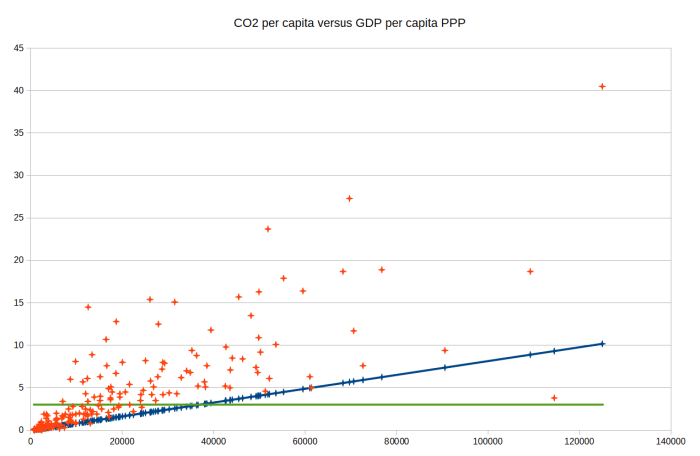
It’s also nearly impossible to talk about poverty in a representative agent model; the best you can do is talk about a country’s overall level of development, and assume (not without reason) that a country with a per-capita GDP of $1,000 probably has a lot more poverty than a country with a per-capita GDP of $50,000. But two countries with the same per-capita GDP can have very different poverty rates—and indeed, the cynic in me wonders if the reason we’re reluctant to use inequality-adjusted measures of development is precisely that many American economists fear where this might put the US in the rankings. The Human Development Index was a step in the right direction because it includes things other than money (and as a result Saudi Arabia looks much worse and Cuba much better), but it still aggregates and averages everything, so as long as your rich people are doing well enough they can compensate for how badly your poor people are doing.

Nor can you talk about oligopoly in a representative agent model, as there is always only one firm, which for some reason chooses to act as if it were facing competition instead of rationally behaving as a monopoly. (This is not quite as nonsensical as it sounds, as the aggregation actually does kind of work if there truly are so many firms that they are all forced down to zero profit by fierce competition—but then again, what market is actually like that?) There is no market share, no market power; all are at the mercy of the One True Price.

You can still talk about externalities, sort of; but in order to do so you have to set up this weird doublethink phenomenon where the representative consumer keeps polluting their backyard and then can’t figure out why their backyard is so darn polluted. (I suppose humans do seem to behave like that sometimes; but wait, I thought you believed people were rational?) I think this probably confuses many an undergrad, in fact; the models we teach them about externalities generally use this baffling assumption that people consider one set of costs when making their decisions and then bear a different set of costs from the outcome. If you can conceptualize the idea that we’re aggregating across people and thinking “as if” there were a representative agent, you can ultimately make sense of this; but I think a lot of students get really confused by it.

Indeed, what can you talk about with a representative agent model? Economic growth and business cycles. That’s… about it. These are not minor issues, of course; indeed, as Robert Lucas famously said:

The consequences for human welfare involved in questions like these [on economic growth] are simply staggering: once one starts to think about them, it is hard to think about anything else.

I certainly do think that studying economic growth and business cycles should be among the top priorities of macroeconomics. But then, I also think that poverty and inequality should be among the top priorities, and they haven’t been—perhaps because the obsession with representative agent models make that basically impossible.

I want to be constructive here; I appreciate that aggregating makes things much easier. So what could we do to include some heterogeneity without too much cost in complexity?

Here’s one: How about we have p firms, making q types of goods, sold to n consumers? If you want you can start by setting all these numbers equal to 2; simply going from 1 to 2 has an enormous effect, as it allows you to at least say something about inequality. Getting them as high as 100 or even 1000 still shouldn’t be a problem for computing the model on an ordinary laptop. (There are “econophysicists” who like to use these sorts of agent-based models, but so far very few economists take them seriously. Partly that is justified by their lack of foundational knowledge in economics—the arrogance of physicists taking on a new field is legendary—but partly it is also interdepartmental turf war, as economists don’t like the idea of physicists treading on their sacred ground.) One thing that really baffles me about this is that economists routinely use computers to solve models that can’t be calculated by hand, but it never seems to occur to them that they could have started at the beginning planning to make the model solvable only by computer, and that would spare them from making the sort of heroic assumptions they are accustomed to making—assumptions that only made sense when they were used to make a model solvable that otherwise wouldn’t be.

You could also assign a probability distribution over incomes; that can get messy quickly, but we actually are fortunate that the constant relative risk aversion utility function and the Pareto distribution over incomes seem to fit the data quite well—as the product of those two things is integrable by hand. As long as you can model how your policy affects this distribution without making that integral impossible (which is surprisingly tricky), you can aggregate over utility instead of over income, which is a lot more reasonable as a measure of welfare.

And really I’m only scratching the surface here. There are a vast array of possible new approaches that would allow us to extend macroeconomic models to cover heterogeneity; the real problem is an apparent lack of will in the community to make such an attempt. Most economists still seem very happy with representative agent models, and reluctant to consider anything else—often arguing, in fact, that anything else would make the model less microfounded when plainly the opposite is the case.


Why “marginal productivity” is no excuse for inequality

May 28, JDN 2457902

In most neoclassical models, workers are paid according to their marginal productivity—the additional (market) value of goods that a firm is able to produce by hiring that worker. This is often used as an excuse for inequality: If someone can produce more, why shouldn’t they be paid more?

The most extreme example of this is people like Maura Pennington writing for Forbes about how poor people just need to get off their butts and “do something”; but there is a whole literature in mainstream economics, particularly “optimal tax theory”, arguing based on marginal productivity that we should tax the very richest people the least and never tax capital income. The Chamley-Judd Theorem famously “shows” (by making heroic assumptions) that taxing capital just makes everyone worse off because it reduces everyone’s productivity.

The biggest reason this is wrong is that there are many, many reasons why someone would have a higher income without being any more productive. They could inherit wealth from their ancestors and get a return on that wealth; they could have a monopoly or some other form of market power; they could use bribery and corruption to tilt government policy in their favor. Indeed, most of the top 0.01% do literally all of these things.

But even if you assume that pay is related to productivity in competitive markets, the argument is not nearly as strong as it may at first appear. Here I have a simple little model to illustrate this.

Suppose there are 10 firms and 10 workers. Suppose that firm 1 has 1 unit of effective capital (capital adjusted for productivity), firm 2 has 2 units, and so on up to firm 10 which has 10 units. And suppose that worker 1 has 1 unit of so-called “human capital”, representing their overall level of skills and education, worker 2 has 2 units, and so on up to worker 10 with 10 units. Suppose each firm only needs one worker, so this is a matching problem.

Furthermore, suppose that productivity is equal to capital times human capital: That is, if firm 2 hired worker 7, they would make 2*7 = $14 of output.

What will happen in this market if it converges to equilibrium?

Well, first of all, the most productive firm is going to hire the most productive worker—so firm 10 will hire worker 10 and produce $100 of output. What wage will they pay? Well, they need a wage that is high enough to keep worker 10 from trying to go elsewhere. They should therefore pay a wage of $90—the next-highest firm productivity times the worker’s productivity. That’s the highest wage any other firm could credibly offer; so if they pay this wage, worker 10 will not have any reason to leave.

Now the problem has been reduced to matching 9 firms to 9 workers. Firm 9 will hire worker 9, making $81 of output, and paying $72 in wages.

And so on, until worker 1 at firm 1 produces $1 and receives… $0. Because there is no way for worker 1 to threaten to leave, in this model they actually get nothing. If I assume there’s some sort of social welfare system providing say $0.50, then at least worker 1 can get that $0.50 by threatening to leave and go on welfare. (This, by the way, is probably the real reason firms hate social welfare spending; it gives their workers more bargaining power and raises wages.) Or maybe they have to pay that $0.50 just to keep the worker from starving to death.

What does inequality look like in this society?
Well, the most-productive firm only has 10 times as much capital as the least-productive firm, and the most-educated worker only has 10 times as much skill as the least-educated worker, so we might think that incomes would vary only by a factor of 10.

But in fact they vary by a factor of over 100.

The richest worker makes $90, while the poorest worker makes $0.50. That’s a ratio of 180. (Still lower than the ratio of the average CEO to their average employee in the US, by the way.) The worker is 10 times as productive, but they receive 180 times as much income.

The firm profits vary along a more reasonable scale in this case; firm 1 makes a profit of $0.50 while firm 10 makes a profit of $10. Indeed, except for firm 1, firm n always makes a profit of $n. So that’s very nearly a linear scaling in productivity.

Where did this result come from? Why is it so different from the usual assumptions? All I did was change one thing: I allowed for increasing returns to scale.

If you make the usual assumption of constant returns to scale, this result can’t happen. Multiplying all the inputs by 10 should just multiply the output by 10, by assumption—since that is the definition of constant returns to scale.

But if you look at the structure of real-world incomes, it’s pretty obvious that we don’t have constant returns to scale.

If we had constant returns to scale, we should expect that wages for the same person should only vary slightly if that person were to work in different places. In particular, to have a 2-fold increase in wage for the same worker you’d need more than a 2-fold increase in capital.

This is a bit counter-intuitive, so let me explain a bit further. If a 2-fold increase in capital results in a 2-fold increase in wage for a given worker, that’s increasing returns to scale—indeed, it’s precisely the production function I assumed above.
If you had constant returns to scale, a 2-fold increase in wage would require something like an 8-fold increase in capital. This is because you should get a 2-fold increase in total production by doubling everything—capital, labor, human capital, whatever else. So doubling capital by itself should produce a much weaker effect. For technical reasons I’d rather not get into at the moment, usually it’s assumed that production is approximately proportional to capital to the one-third power—so to double production you need to multiply capital by 2^3 = 8.

I wasn’t able to quickly find really good data on wages for the same workers across different countries, but this should at least give a rough idea. In Mumbai, the minimum monthly wage for a full-time worker is about $80. In Shanghai, it is about $250. If you multiply out the US federal minimum wage of $7.25 per hour by 40 hours by 4 weeks, that comes to $1160 per month.

Of course, these are not the same workers. Even an “unskilled” worker in the US has a lot more education and training than a minimum-wage worker in India or China. But it’s not that much more. Maybe if we normalize India to 1, China is 3 and the US is 10.

Likewise, these are not the same jobs. Even a minimum wage job in the US is much more capital-intensive and uses much higher technology than most jobs in India or China. But it’s not that much more. Again let’s say India is 1, China is 3 and the US is 10.

If we had constant returns to scale, what should the wages be? Well, for India at productivity 1, the wage is $80. So for China at productivity 3, the wage should be $240—it’s actually $250, close enough for this rough approximation. But the US wage should be $800—and it is in fact $1160, 45% larger than we would expect by constant returns to scale.

Let’s try comparing within a particular industry, where the differences in skill and technology should be far smaller. The median salary for a software engineer in India is about 430,000 INR, which comes to about $6,700. If that sounds rather low for a software engineer, you’re probably more accustomed to the figure for US software engineers, which is $74,000. That is a factor of 11 to 1. For the same job. Maybe US software engineers are better than Indian software engineers—but are they that much better? Yes, you can adjust for purchasing power and shrink the gap: Prices in the US are about 4 times as high as those in India, so the real gap might be 3 to 1. But these huge price differences themselves need to be explained somehow, and even 3 to 1 for the same job in the same industry is still probably too large to explain by differences in either capital or education, unless you allow for increasing returns to scale.

In most industries, we probably don’t have quite as much increasing returns to scale as I assumed in my simple model. Workers in the US don’t make 100 times as much as workers in India, despite plausibly having both 10 times as much physical capital and 10 times as much human capital.

But in some industries, this model might not even be enough! The most successful authors and filmmakers, for example, make literally thousands of times as much money as the average author or filmmaker in their own country. J.K. Rowling has almost $1 billion from writing the Harry Potter series; this is despite having literally the same amount of physical capital and probably not much more human capital than the average author in the UK who makes only about 11,000 GBP—which is about $14,000. Harry Potter and the Philosopher’s Stone is now almost exactly 20 years old, which means that Rowling made an average of $50 million per year, some 3500 times as much as the average British author. Is she better than the average British author? Sure. Is she three thousand times better? I don’t think so. And we can’t even make the argument that she has more capital and technology to work with, because she doesn’t! They’re typing on the same laptops and using the same printing presses. Either the return on human capital for British authors is astronomical, or something other than marginal productivity is at work here—and either way, we don’t have anything close to constant returns to scale.

What can we take away from this? Well, if we don’t have constant returns to scale, then even if wage rates are proportional to marginal productivity, they aren’t proportional to the component of marginal productivity that you yourself bring. The same software developer makes more at Microsoft than at some Indian software company, the same doctor makes more at a US hospital than a hospital in China, the same college professor makes more at Harvard than at a community college, and J.K. Rowling makes three thousand times as much as the average British author—therefore we can’t speak of marginal productivity as inhering in you as an individual. It is an emergent property of a production process that includes you as a part. So even if you’re entirely being paid according to “your” productivity, it’s not really your productivity—it’s the productivity of the production process you’re involved in. A myriad of other factors had to snap into place to make your productivity what it is, most of which you had no control over. So in what sense, then, can we say you earned your higher pay?

Moreover, this problem becomes most acute precisely when incomes diverge the most. The differential in wages between two welders at the same auto plant may well be largely due to their relative skill at welding. But there’s absolutely no way that the top athletes, authors, filmmakers, CEOs, or hedge fund managers could possibly make the incomes they do by being individually that much more productive.

Markets value rich people more

Feb 26, JDN 2457811

Competitive markets are optimal at maximizing utility, as long as you value rich people more.

That is literally a theorem in neoclassical economics. I had previously thought that this was something most economists didn’t realize; I had delusions of grandeur that maybe I could finally convince them that this is the case. But no, it turns out this is actually a well-known finding; it’s just that somehow nobody seems to care. Or if they do care, they never talk about it. For all the thousands of papers and articles about the distortions created by minimum wage and capital gains tax, you’d think someone could spare the time to talk about the vastly larger fundamental distortions created by the structure of the market itself.

It’s not as if this is something completely hopeless we could never deal with. A basic income would go a long way toward correcting this distortion, especially if coupled with highly progressive taxes. By creating a hard floor and a soft ceiling on income, you can reduce the inequality that makes these distortions so large.

The basics of the theorem are quite straightforward, so I think it’s worth explaining them here. It’s extremely general; it applies anywhere that goods are allocated by market prices and different individuals have wildly different amounts of wealth.

Suppose that each person has a certain amount of wealth W to spend. Person 1 has W1, person 2 has W2, and so on. They all have some amount of happiness, defined by a utility function, which I’ll assume is only dependent on wealth; this is a massive oversimplification of course, but it wouldn’t substantially change my conclusions to include other factors—it would just make everything more complicated. (In fact, including altruistic motives would make the whole argument stronger, not weaker.) Thus I can write each person’s utility as a function U(W). The rate of change of this utility as wealth increases, the marginal utility of wealth, is denoted U'(W).

By the law of diminishing marginal utility, the marginal utility of wealth U'(W) is decreasing. That is, the more wealth you have, the less each new dollar is worth to you.

Now suppose people are buying goods. Each good C provides some amount of marginal utility U'(C) to the person who buys it. This can vary across individuals; some people like Pepsi, others Coke. This marginal utility is also decreasing; a house is worth a lot more to you if you are living in the street than if you already have a mansion. Ideally we would want the goods to go to the people who want them the most—but as you’ll see in a moment, markets systematically fail to do this.

If people are making their purchases rationally, each person’s willingness-to-pay P for a given good C will be equal to their marginal utility of that good, divided by their marginal utility of wealth:

P = U'(C)/U'(W)

Now consider this from the perspective of society as a whole. If you wanted to maximize utility, you’d equalize marginal utility across individuals (by the Extreme Value Theorem). The idea is that if marginal utility is higher for one person, you should give that person more, because the benefit of what you give them will be larger that way; and if marginal utility is lower for another person, you should give that person less, because the benefit of what you give them will be smaller. When everyone is equal, you are at the maximum.

But market prices don’t actually do this. Instead they equalize over willingness-to-pay. So if you’ve got two individuals 1 and 2, instead of having this:

U'(C1) = U'(C2)

you have this:

P1 = P2

which translates to:

U'(C1)/U'(W1) = U'(C2)/U'(W2)

If the marginal utilities were the same, U'(W1) = U'(W2), we’d be fine; these would give the same results. But that would only happen if W1 = W2, that is, if the two individuals had the same amount of wealth.

Now suppose we were instead maximizing weighted utility, where each person gets a weighting factor A based on how “important” they are or something. If your A is higher, your utility matters more. If we maximized this new weighted utility, we would end up like this:

A1*U'(C1) = A2*U'(C2)

Because person 1’s utility counts for more, their marginal utility also counts for more. This seems very strange; why are we valuing some people more than others? On what grounds?

Yet this is effectively what we’ve already done by using market prices.
Just set:
A = 1/U'(W)

Since marginal utility of wealth is decreasing, 1/U'(W) is higher precisely when W is higher.

How much higher? Well, that depends on the utility function. The two utility functions I find most plausible are logarithmic and harmonic. (Actually I think both apply, one to other-directed spending and the other to self-directed spending.)

If utility is logarithmic:

U = ln(W)

Then marginal utility is inversely proportional:

U'(W) = 1/W

In that case, your value as a human being, as spoken by the One True Market, is precisely equal to your wealth:

A = 1/U'(W) = W

If utility is harmonic, matters are even more severe.

U(W) = 1-1/W

Marginal utility goes as the inverse square of wealth:

U'(W) = 1/W^2

And thus your value, according to the market, is equal to the square of your wealth:

A = 1/U'(W) = W^2

What are we really saying here? Hopefully no one actually believes that Bill Gates is really morally worth 400 trillion times as much as a starving child in Malawi, as the calculation from harmonic utility would imply. (Bill Gates himself certainly doesn’t!) Even the logarithmic utility estimate saying that he’s worth 20 million times as much is pretty hard to believe.

But implicitly, the market “believes” that, because when it decides how to allocate resources, something that is worth 1 microQALY to Bill Gates (about the value a nickel dropped on the floor to you or I) but worth 20 QALY (twenty years of life!) to the Malawian child, will in either case be priced at $8,000, and since the child doesn’t have $8,000, it will probably go to Mr. Gates. Perhaps a middle-class American could purchase it, provided it was worth some 0.3 QALY to them.

Now consider that this is happening in every transaction, for every good, in every market. Goods are not being sold to the people who get the most value out of them; they are being sold to the people who have the most money.

And suddenly, the entire edifice of “market efficiency” comes crashing down like a house of cards. A global market that quite efficiently maximizes willingness-to-pay is so thoroughly out of whack when it comes to actually maximizing utility that massive redistribution of wealth could enormously increase human welfare, even if it turned out to cut our total output in half—if utility is harmonic, even if it cut our total output to one-tenth its current value.

The only way to escape this is to argue that marginal utility of wealth is not decreasing, or at least decreasing very, very slowly. Suppose for instance that utility goes as the 0.9 power of wealth:

U(W) = W^0.9

Then marginal utility goes as the -0.1 power of wealth:

U'(W) = 0.9 W^(-0.1)

On this scale, Bill Gates is only worth about 5 times as much as the Malawian child, which in his particular case might actually be too small—if a trolley is about to kill either Bill Gates or 5 Malawian children, I think I save Bill Gates, because he’ll go on to save many more than 5 Malawian children. (Of course, substitute Donald Trump or Charles Koch and I’d let the trolley run over him without a second thought if even a single child is at stake, so it’s not actually a function of wealth.) In any case, a 5 to 1 range across the whole range of human wealth is really not that big a deal. It would introduce some distortions, but not enough to justify any redistribution that would meaningfully reduce overall output.

Of course, that commits you to saying that $1 to a Malawian child is only worth about $1.50 to you or I and $5 to Bill Gates. If you can truly believe this, then perhaps you can sleep at night accepting the outcomes of neoclassical economics. But can you, really, believe that? If you had the choice between an intervention that would give $100 to each of 10,000 children in Malawi, and another that would give $50,000 to each of 100 billionaires, would you really choose the billionaires? Do you really think that the world would be better off if you did?

We don’t have precise measurements of marginal utility of wealth, unfortunately. At the moment, I think logarithmic utility is the safest assumption; it’s about the slowest decrease that is consistent with the data we have and it is very intuitive and mathematically tractable. Perhaps I’m wrong and the decrease is even slower than that, say W^(-0.5) (then the market only values billionaires as worth thousands of times as much as starving children). But there’s no way you can go as far as it would take to justify our current distribution of wealth. W^(-0.1) is simply not a plausible value.

And this means that free markets, left to their own devices, will systematically fail to maximize human welfare. We need redistribution—a lot of redistribution. Don’t take my word for it; the math says so.

Bigotry is more powerful than the market

Nov 20, JDN 2457683

If there’s one message we can take from the election of Donald Trump, it is that bigotry remains a powerful force in our society. A lot of autoflagellating liberals have been trying to explain how this election result really reflects our failure to help people displaced by technology and globalization (despite the fact that personal income and local unemployment had negligible correlation with voting for Trump), or Hillary Clinton’s “bad campaign” that nonetheless managed the same proportion of Democrat turnout that re-elected her husband in 1996.

No, overwhelmingly, the strongest predictor of voting for Trump was being White, and living in an area where most people are White. (Well, actually, that’s if you exclude authoritarianism as an explanatory variable—but really I think that’s part of what we’re trying to explain.) Trump voters were actually concentrated in areas less affected by immigration and globalization. Indeed, there is evidence that these people aren’t racist because they have anxiety about the economy—they are anxious about the economy because they are racist. How does that work? Obama. They can’t believe that the economy is doing well when a Black man is in charge. So all the statistics and even personal experiences mean nothing to them. They know in their hearts that unemployment is rising, even as the BLS data clearly shows it’s falling.

The wide prevalence and enormous power of bigotry should be obvious. But economists rarely talk about it, and I think I know why: Their models say it shouldn’t exist. The free market is supposed to automatically eliminate all forms of bigotry, because they are inefficient.

The argument for why this is supposed to happen actually makes a great deal of sense: If a company has the choice of hiring a White man or a Black woman to do the same job, but they know that the market wage for Black women is lower than the market wage for White men (which it most certainly is), and they will do the same quality and quantity of work, why wouldn’t they hire the Black woman? And indeed, if human beings were rational profit-maximizers, this is probably how they would think.

More recently some neoclassical models have been developed to try to “explain” this behavior, but always without daring to give up the precious assumption of perfect rationality. So instead we get the two leading neoclassical theories of discrimination, which are statistical discrimination and taste-based discrimination.

Statistical discrimination is the idea that under asymmetric information (and we surely have that), features such as race and gender can act as signals of quality because they are correlated with actual quality for various reasons (usually left unspecified), so it is not irrational after all to choose based upon them, since they’re the best you have.

Taste-based discrimination is the idea that people are rationally maximizing preferences that simply aren’t oriented toward maximizing profit or well-being. Instead, they have this extra term in their utility function that says they should also treat White men better than women or Black people. It’s just this extra thing they have.

A small number of studies have been done trying to discern which of these is at work.
The correct answer, of course, is neither.

Statistical discrimination, at least, could be part of what’s going on. Knowing that Black people are less likely to be highly educated than Asians (as they definitely are) might actually be useful information in some circumstances… then again, you list your degree on your resume, don’t you? Knowing that women are more likely to drop out of the workforce after having a child could rationally (if coldly) affect your assessment of future productivity. But shouldn’t the fact that women CEOs outperform men CEOs be incentivizing shareholders to elect women CEOs? Yet that doesn’t seem to happen. Also, in general, people seem to be pretty bad at statistics.

The bigger problem with statistical discrimination as a theory is that it’s really only part of a theory. It explains why not all of the discrimination has to be irrational, but some of it still does. You need to explain why there are these huge disparities between groups in the first place, and statistical discrimination is unable to do that. In order for the statistics to differ this much, you need a past history of discrimination that wasn’t purely statistical.

Taste-based discrimination, on the other hand, is not a theory at all. It’s special pleading. Rather than admit that people are failing to rationally maximize their utility, we just redefine their utility so that whatever they happen to be doing now “maximizes” it.

This is really what makes the Axiom of Revealed Preference so insidious; if you really take it seriously, it says that whatever you do, must by definition be what you preferred. You can’t possibly be irrational, you can’t possibly be making mistakes of judgment, because by definition whatever you did must be what you wanted. Maybe you enjoy bashing your head into a wall, who am I to judge?

I mean, on some level taste-based discrimination is what’s happening; people think that the world is a better place if they put women and Black people in their place. So in that sense, they are trying to “maximize” some “utility function”. (By the way, most human beings behave in ways that are provably inconsistent with maximizing any well-defined utility function—the Allais Paradox is a classic example.) But the whole framework of calling it “taste-based” is a way of running away from the real explanation. If it’s just “taste”, well, it’s an unexplainable brute fact of the universe, and we just need to accept it. If people are happier being racist, what can you do, eh?

So I think it’s high time to start calling it what it is. This is not a question of taste. This is a question of tribal instinct. This is the product of millions of years of evolution optimizing the human brain to act in the perceived interest of whatever it defines as its “tribe”. It could be yourself, your family, your village, your town, your religion, your nation, your race, your gender, or even the whole of humanity or beyond into all sentient beings. But whatever it is, the fundamental tribe is the one thing you care most about. It is what you would sacrifice anything else for.

And what we learned on November 9 this year is that an awful lot of Americans define their tribe in very narrow terms. Nationalistic and xenophobic at best, racist and misogynistic at worst.

But I suppose this really isn’t so surprising, if you look at the history of our nation and the world. Segregation was not outlawed in US schools until 1955, and there are women who voted in this election who were born before American women got the right to vote in 1920. The nationalistic backlash against sending jobs to China (which was one of the chief ways that we reduced global poverty to its lowest level ever, by the way) really shouldn’t seem so strange when we remember that over 100,000 Japanese-Americans were literally forcibly relocated into camps as recently as 1942. The fact that so many White Americans seem all right with the biases against Black people in our justice system may not seem so strange when we recall that systemic lynching of Black people in the US didn’t end until the 1960s.

The wonder, in fact, is that we have made as much progress as we have. Tribal instinct is not a strange aberration of human behavior; it is our evolutionary default setting.

Indeed, perhaps it is unreasonable of me to ask humanity to change its ways so fast! We had millions of years to learn how to live the wrong way, and I’m giving you only a few centuries to learn the right way?

The problem, of course, is that the pace of technological change leaves us with no choice. It might be better if we could wait a thousand years for people to gradually adjust to globalization and become cosmopolitan; but climate change won’t wait a hundred, and nuclear weapons won’t wait at all. We are thrust into a world that is changing very fast indeed, and I understand that it is hard to keep up; but there is no way to turn back that tide of change.

Yet “turn back the tide” does seem to be part of the core message of the Trump voter, once you get past the racial slurs and sexist slogans. People are afraid of what the world is becoming. They feel that it is leaving them behind. Coal miners fret that we are leaving them behind by cutting coal consumption. Factory workers fear that we are leaving them behind by moving the factory to China or inventing robots to do the work in half the time for half the price.

And truth be told, they are not wrong about this. We are leaving them behind. Because we have to. Because coal is polluting our air and destroying our climate, we must stop using it. Moving the factories to China has raised them out of the most dire poverty, and given us a fighting chance toward ending world hunger. Inventing the robots is only the next logical step in the process that has carried humanity forward from the squalor and suffering of primitive life to the security and prosperity of modern society—and it is a step we must take, for the progress of civilization is not yet complete.

They wouldn’t have to let themselves be left behind, if they were willing to accept our help and learn to adapt. That carbon tax that closes your coal mine could also pay for your basic income and your job-matching program. The increased efficiency from the automated factories could provide an abundance of wealth that we could redistribute and share with you.

But this would require them to rethink their view of the world. They would have to accept that climate change is a real threat, and not a hoax created by… uh… never was clear on that point actually… the Chinese maybe? But 45% of Trump supporters don’t believe in climate change (and that’s actually not as bad as I’d have thought). They would have to accept that what they call “socialism” (which really is more precisely described as social democracy, or tax-and-transfer redistribution of wealth) is actually something they themselves need, and will need even more in the future. But despite rising inequality, redistribution of wealth remains fairly unpopular in the US, especially among Republicans.

Above all, it would require them to redefine their tribe, and start listening to—and valuing the lives of—people that they currently do not.

Perhaps we need to redefine our tribe as well; many liberals have argued that we mistakenly—and dangerously—did not include people like Trump voters in our tribe. But to be honest, that rings a little hollow to me: We aren’t the ones threatening to deport people or ban them from entering our borders. We aren’t the ones who want to build a wall (though some have in fact joked about building a wall to separate the West Coast from the rest of the country, I don’t think many people really want to do that). Perhaps we live in a bubble of liberal media? But I make a point of reading outlets like The American Conservative and The National Review for other perspectives (I usually disagree, but I do at least read them); how many Trump voters do you think have ever read the New York Times, let alone Huffington Post? Cosmopolitans almost by definition have the more inclusive tribe, the more open perspective on the world (in fact, do I even need the “almost”?).

Nor do I think we are actually ignoring their interests. We want to help them. We offer to help them. In fact, I want to give these people free money—that’s what a basic income would do, it would take money from people like me and give it to people like them—and they won’t let us, because that’s “socialism”! Rather, we are simply refusing to accept their offered solutions, because those so-called “solutions” are beyond unworkable; they are absurd, immoral and insane. We can’t bring back the coal mining jobs, unless we want Florida underwater in 50 years. We can’t reinstate the trade tariffs, unless we want millions of people in China to starve. We can’t tear down all the robots and force factories to use manual labor, unless we want to trigger a national—and then global—economic collapse. We can’t do it their way. So we’re trying to offer them another way, a better way, and they’re refusing to take it. So who here is ignoring the concerns of whom?

Of course, the fact that it’s really their fault doesn’t solve the problem. We do need to take it upon ourselves to do whatever we can, because, regardless of whose fault it is, the world will still suffer if we fail. And that presents us with our most difficult task of all, a task that I fully expect to spend a career trying to do and yet still probably failing: We must understand the human tribal instinct well enough that we can finally begin to change it. We must know enough about how human beings form their mental tribes that we can actually begin to shift those parameters. We must, in other words, cure bigotry—and we must do it now, for we are running out of time.

Sometimes people have to lose their jobs. This isn’t a bad thing.

Oct 8, JDN 2457670

Eleizer Yudkowsky (founder of the excellent blog forum Less Wrong) has a term he likes to use to distinguish his economic policy views from either liberal, conservative, or even libertarian: “econoliterate”, meaning the sort of economic policy ideas one comes up with when one actually knows a good deal about economics.

In general I think Yudkowsky overestimates this effect; I’ve known some very knowledgeable economists who disagree quite strongly over economic policy, and often following the conventional political lines of liberal versus conservative: Liberal economists want more progressive taxation and more Keynesian monetary and fiscal policy, while conservative economists want to reduce taxes on capital and remove regulations. Theoretically you can want all these things—as Miles Kimball does—but it’s rare. Conservative economists hate minimum wage, and lean on the theory that says it should be harmful to employment; liberal economists are ambivalent about minimum wage, and lean on the empirical data that shows it has almost no effect on employment. Which is more reliable? The empirical data, obviously—and until more economists start thinking that way, economics is never truly going to be a science as it should be.

But there are a few issues where Yudkowsky’s “econoliterate” concept really does seem to make sense, where there is one view held by most people, and another held by economists, regardless of who is liberal or conservative. One such example is free trade, which almost all economists believe in. A recent poll of prominent economists by the University of Chicago found literally zero who agreed with protectionist tariffs.

Another example is my topic for today: People losing their jobs.

Not unemployment, which both economists and almost everyone else agree is bad; but people losing their jobs. The general consensus among the public seems to be that people losing jobs is always bad, while economists generally consider it a sign of an economy that is run smoothly and efficiently.

To be clear, of course losing your job is bad for you; I don’t mean to imply that if you lose your job you shouldn’t be sad or frustrated or anxious about that, particularly not in our current system. Rather, I mean to say that policy which tries to keep people in their jobs is almost always a bad idea.

I think the problem is that most people don’t quite grasp that losing your job and not having a job are not the same thing. People not having jobs who want to have jobs—unemployment—is a bad thing. But losing your job doesn’t mean you have to stay unemployed; it could simply mean you get a new job. And indeed, that is what it should mean, if the economy is running properly.

Check out this graph, from FRED:

hires_separations

The red line shows hires—people getting jobs. The blue line shows separations—people losing jobs or leaving jobs. During a recession (the most recent two are shown on this graph), people don’t actually leave their jobs faster than usual; if anything, slightly less. Instead what happens is that hiring rates drop dramatically. When the economy is doing well (as it is right now, more or less), both hires and separations are at very high rates.

Why is this? Well, think about what a job is, really: It’s something that needs done, that no one wants to do for free, so someone pays someone else to do it. Once that thing gets done, what should happen? The job should end. It’s done. The purpose of the job was not to provide for your standard of living; it was to achieve the task at hand. Once it doesn’t need done, why keep doing it?

We tend to lose sight of this, for a couple of reasons. First, we don’t have a basic income, and our social welfare system is very minimal; so a job usually is the only way people have to provide for their standard of living, and they come to think of this as the purpose of the job. Second, many jobs don’t really “get done” in any clear sense; individual tasks are completed, but new ones always arise. After every email sent is another received; after every patient treated is another who falls ill.

But even that is really only true in the short run. In the long run, almost all jobs do actually get done, in the sense that no one has to do them anymore. The job of cleaning up after horses is done (with rare exceptions). The job of manufacturing vacuum tubes for computers is done. Indeed, the job of being a computer—that used to be a profession, young women toiling away with slide rules—is very much done. There are no court jesters anymore, no town criers, and very few artisans (and even then, they’re really more like hobbyists). There are more writers now than ever, and occasional stenographers, but there are no scribes—no one powerful but illiterate pays others just to write things down, because no one powerful is illiterate (and even few who are not powerful, and fewer all the time).

When a job “gets done” in this long-run sense, we usually say that it is obsolete, and again think of this as somehow a bad thing, like we are somehow losing the ability to do something. No, we are gaining the ability to do something better. Jobs don’t become obsolete because we can’t do them anymore; they become obsolete because we don’t need to do them anymore. Instead of computers being a profession that toils with slide rules, they are thinking machines that fit in our pockets; and there are plenty of jobs now for software engineers, web developers, network administrators, hardware designers, and so on as a result.

Soon, there will be no coal miners, and very few oil drillers—or at least I hope so, for the sake of our planet’s climate. There will be far fewer auto workers (robots have already done most of that already), but far more construction workers who install rail lines. There will be more nuclear engineers, more photovoltaic researchers, even more miners and roofers, because we need to mine uranium and install solar panels on rooftops.

Yet even by saying that I am falling into the trap: I am making it sound like the benefit of new technology is that it opens up more new jobs. Typically it does do that, but that isn’t what it’s for. The purpose of technology is to get things done.

Remember my parable of the dishwasher. The goal of our economy is not to make people work; it is to provide people with goods and services. If we could invent a machine today that would do the job of everyone in the world and thereby put us all out of work, most people think that would be terrible—but in fact it would be wonderful.

Or at least it could be, if we did it right. See, the problem right now is that while poor people think that the purpose of a job is to provide for their needs, rich people think that the purpose of poor people is to do jobs. If there are no jobs to be done, why bother with them? At that point, they’re just in the way! (Think I’m exaggerating? Why else would anyone put a work requirement on TANF and SNAP? To do that, you must literally think that poor people do not deserve to eat or have homes if they aren’t, right now, working for an employer. You can couch that in cold economic jargon as “maximizing work incentives”, but that’s what you’re doing—you’re threatening people with starvation if they can’t or won’t find jobs.)

What would happen if we tried to stop people from losing their jobs? Typically, inefficiency. When you aren’t allowed to lay people off when they are no longer doing useful work, we end up in a situation where a large segment of the population is being paid but isn’t doing useful work—and unlike the situation with a basic income, those people would lose their income, at least temporarily, if they quit and tried to do something more useful. There is still considerable uncertainty within the empirical literature on just how much “employment protection” (laws that make it hard to lay people off) actually creates inefficiency and reduces productivity and employment, so it could be that this effect is small—but even so, likewise it does not seem to have the desired effect of reducing unemployment either. It may be like minimum wage, where the effect just isn’t all that large. But it’s probably not saving people from being unemployed; it may simply be shifting the distribution of unemployment so that people with protected jobs are almost never unemployed and people without it are unemployed much more frequently. (This doesn’t have to be based in law, either; while it is made by custom rather than law, it’s quite clear that tenure for university professors makes tenured professors vastly more secure, but at the cost of making employment tenuous and underpaid for adjuncts.)

There are other policies we could make that are better than employment protection, active labor market policies like those in Denmark that would make it easier to find a good job. Yet even then, we’re assuming that everyone needs jobs–and increasingly, that just isn’t true.

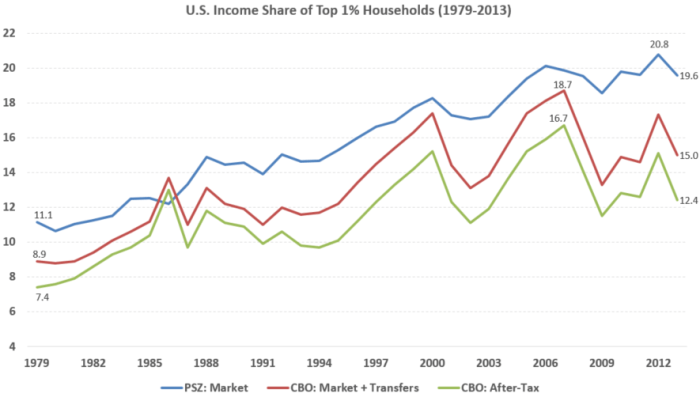
So, when we invent a new technology that replaces workers, workers are laid off from their jobs—and that is as it should be. What happens next is what we do wrong, and it’s not even anybody in particular; this is something our whole society does wrong: All those displaced workers get nothing. The extra profit from the more efficient production goes entirely to the shareholders of the corporation—and those shareholders are almost entirely members of the top 0.01%. So the poor get poorer and the rich get richer.

The real problem here is not that people lose their jobs; it’s that capital ownership is distributed so unequally. And boy, is it ever! Here are some graphs I made of the distribution of net wealth in the US, using from the US Census.

Here are the quintiles of the population as a whole:

net_wealth_us

And here are the medians by race:

net_wealth_race

Medians by age:

net_wealth_age

Medians by education:

net_wealth_education

And, perhaps most instructively, here are the quintiles of people who own their homes versus renting (The rent is too damn high!)

net_wealth_rent

All that is just within the US, and already they are ranging from the mean net wealth of the lowest quintile of people under 35 (-$45,000, yes negative—student loans) to the mean net wealth of the highest quintile of people with graduate degrees ($3.8 million). All but the top quintile of renters are poorer than all but the bottom quintile of homeowners. And the median Black or Hispanic person has less than one-tenth the wealth of the median White or Asian person.

If we look worldwide, wealth inequality is even starker. Based on UN University figures, 40% of world wealth is owned by the top 1%; 70% by the top 5%; and 80% by the top 10%. There is less total wealth in the bottom 80% than in the 80-90% decile alone. According to Oxfam, the richest 85 individuals own as much net wealth as the poorest 3.7 billion. They are the 0.000,001%.

If we had an equal distribution of capital ownership, people would be happy when their jobs became obsolete, because it would free them up to do other things (either new jobs, or simply leisure time), while not decreasing their income—because they would be the shareholders receiving those extra profits from higher efficiency. People would be excited to hear about new technologies that might displace their work, especially if those technologies would displace the tedious and difficult parts and leave the creative and fun parts. Losing your job could be the best thing that ever happened to you.

The business cycle would still be a problem; we have good reason not to let recessions happen. But stopping the churn of hiring and firing wouldn’t actually make our society better off; it would keep people in jobs where they don’t belong and prevent us from using our time and labor for its best use.

Perhaps the reason most people don’t even think of this solution is precisely because of the extreme inequality of capital distribution—and the fact that it has more or less always been this way since the dawn of civilization. It doesn’t seem to even occur to most people that capital income is a thing that exists, because they are so far removed from actually having any amount of capital sufficient to generate meaningful income. Perhaps when a robot takes their job, on some level they imagine that the robot is getting paid, when of course it’s the shareholders of the corporations that made the robot and the corporations that are using the robot in place of workers. Or perhaps they imagine that those shareholders actually did so much hard work they deserve to get paid that money for all the hours they spent.

Because pay is for work, isn’t it? The reason you get money is because you’ve earned it by your hard work?

No. This is a lie, told to you by the rich and powerful in order to control you. They know full well that income doesn’t just come from wages—most of their income doesn’t come from wages! Yet this is even built into our language; we say “net worth” and “earnings” rather than “net wealth” and “income”. (Parade magazine has a regular segment called “What People Earn”; it should be called “What People Receive”.) Money is not your just reward for your hard work—at least, not always.

The reason you get money is that this is a useful means of allocating resources in our society. (Remember, money was created by governments for the purpose of facilitating economic transactions. It is not something that occurs in nature.) Wages are one way to do that, but they are far from the only way; they are not even the only way currently in use. As technology advances, we should expect a larger proportion of our income to go to capital—but what we’ve been doing wrong is setting it up so that only a handful of people actually own any capital.

Fix that, and maybe people will finally be able to see that losing your job isn’t such a bad thing; it could even be satisfying, the fulfillment of finally getting something done.

“The cake is a lie”: The fundamental distortions of inequality

July 13, JDN 2457583

Inequality of wealth and income, especially when it is very large, fundamentally and radically distorts outcomes in a capitalist market. I’ve already alluded to this matter in previous posts on externalities and marginal utility of wealth, but it is so important I think it deserves to have its own post. In many ways this marks a paradigm shift: You can’t think about economics the same way once you realize it is true.

To motivate what I’m getting at, I’ll expand upon an example from a previous post.

Suppose there are only two goods in the world; let’s call them “cake” (K) and “money” (M). Then suppose there are three people, Baker, who makes cakes, Richie, who is very rich, and Hungry, who is very poor. Furthermore, suppose that Baker, Richie and Hungry all have exactly the same utility function, which exhibits diminishing marginal utility in cake and money. To make it more concrete, let’s suppose that this utility function is logarithmic, specifically: U = 10*ln(K+1) + ln(M+1)

The only difference between them is in their initial endowments: Baker starts with 10 cakes, Richie starts with $100,000, and Hungry starts with $10.

Therefore their starting utilities are:

U(B) = 10*ln(10+1)= 23.98

U(R) = ln(100,000+1) = 11.51

U(H) = ln(10+1) = 2.40

Thus, the total happiness is the sum of these: U = 37.89

Now let’s ask two very simple questions:

1. What redistribution would maximize overall happiness?
2. What redistribution will actually occur if the three agents trade rationally?

If multiple agents have the same diminishing marginal utility function, it’s actually a simple and deep theorem that the total will be maximized if they split the wealth exactly evenly. In the following blockquote I’ll prove the simplest case, which is two agents and one good; it’s an incredibly elegant proof:

Given: for all x, f(x) > 0, f'(x) > 0, f”(x) < 0.

Maximize: f(x) + f(A-x) for fixed A

f'(x) – f'(A – x) = 0

f'(x) = f'(A – x)

Since f”(x) < 0, this is a maximum.

Since f'(x) > 0, f is monotonic; therefore f is injective.

x = A – x

QED

This can be generalized to any number of agents, and for multiple goods. Thus, in this case overall happiness is maximized if the cakes and money are both evenly distributed, so that each person gets 3 1/3 cakes and $33,336.66.

The total utility in that case is:

3 * (10 ln(10/3+1) + ln(33,336.66+1)) = 3 * (14.66 + 10.414) = 3 (25.074) =75.22

That’s considerably better than our initial distribution (almost twice as good). Now, how close do we get by rational trade?

Each person is willing to trade up until the point where their marginal utility of cake is equal to their marginal utility of money. The price of cake will be set by the respective marginal utilities.

In particular, let’s look at the trade that will occur between Baker and Richie. They will trade until their marginal rate of substitution is the same.

The actual algebra involved is obnoxious (if you’re really curious, here are some solved exercises of similar trade problems), so let’s just skip to the end. (I rushed through, so I’m not actually totally sure I got it right, but to make my point the precise numbers aren’t important.)
Basically what happens is that Richie pays an exorbitant price of $10,000 per cake, buying half the cakes with half of his money.

Baker’s new utility and Richie’s new utility are thus the same:
U(R) = U(B) = 10*ln(5+1) + ln(50,000+1) = 17.92 + 10.82 = 28.74
What about Hungry? Yeah, well, he doesn’t have $10,000. If cakes are infinitely divisible, he can buy up to 1/1000 of a cake. But it turns out that even that isn’t worth doing (it would cost too much for what he gains from it), so he may as well buy nothing, and his utility remains 2.40.

Hungry wanted cake just as much as Richie, and because Richie has so much more Hungry would have gotten more happiness from each new bite. Neoclassical economists promised him that markets were efficient and optimal, and so he thought he’d get the cake he needs—but the cake is a lie.

The total utility is therefore:

U = U(B) + U(R) + U(H)

U = 28.74 + 28.74 + 2.40

U = 59.88

Note three things about this result: First, it is more than where we started at 37.89—trade increases utility. Second, both Richie and Baker are better off than they were—trade is Pareto-improving. Third, the total is less than the optimal value of 75.22—trade is not utility-maximizing in the presence of inequality. This is a general theorem that I could prove formally, if I wanted to bore and confuse all my readers. (Perhaps someday I will try to publish a paper doing that.)

This result is incredibly radical—it basically goes against the core of neoclassical welfare theory, or at least of all its applications to real-world policy—so let me be absolutely clear about what I’m saying, and what assumptions I had to make to get there.

I am saying that if people start with different amounts of wealth, the trades they would willfully engage in, acting purely under their own self interest, would not maximize the total happiness of the population. Redistribution of wealth toward equality would increase total happiness.

First, I had to assume that we could simply redistribute goods however we like without affecting the total amount of goods. This is wildly unrealistic, which is why I’m not actually saying we should reduce inequality to zero (as would follow if you took this result completely literally). Ironically, this is an assumption that most neoclassical welfare theory agrees with—the Second Welfare Theorem only makes any sense in a world where wealth can be magically redistributed between people without any harmful economic effects. If you weaken this assumption, what you find is basically that we should redistribute wealth toward equality, but beware of the tradeoff between too much redistribution and too little.

Second, I had to assume that there’s such a thing as “utility”—specifically, interpersonally comparable cardinal utility. In other words, I had to assume that there’s some way of measuring how much happiness each person has, and meaningfully comparing them so that I can say whether taking something from one person and giving it to someone else is good or bad in any given circumstance.

This is the assumption neoclassical welfare theory generally does not accept; instead they use ordinal utility, on which we can only say whether things are better or worse, but never by how much. Thus, their only way of determining whether a situation is better or worse is Pareto efficiency, which I discussed in a post a couple years ago. The change from the situation where Baker and Richie trade and Hungry is left in the lurch to the situation where all share cake and money equally in socialist utopia is not a Pareto-improvement. Richie and Baker are slightly worse off with 25.07 utilons in the latter scenario, while they had 28.74 utilons in the former.

Third, I had to assume selfishness—which is again fairly unrealistic, but again not something neoclassical theory disagrees with. If you weaken this assumption and say that people are at least partially altruistic, you can get the result where instead of buying things for themselves, people donate money to help others out, and eventually the whole system achieves optimal utility by willful actions. (It depends just how altruistic people are, as well as how unequal the initial endowments are.) This actually is basically what I’m trying to make happen in the real world—I want to show people that markets won’t do it on their own, but we have the chance to do it ourselves. But even then, it would go a lot faster if we used the power of government instead of waiting on private donations.

Also, I’m ignoring externalities, which are a different type of market failure which in no way conflicts with this type of failure. Indeed, there are three basic functions of government in my view: One is to maintain security. The second is to cancel externalities. The third is to redistribute wealth. The DOD, the EPA, and the SSA, basically. One could also add macroeconomic stability as a fourth core function—the Fed.

One way to escape my theorem would be to deny interpersonally comparable utility, but this makes measuring welfare in any way (including the usual methods of consumer surplus and GDP) meaningless, and furthermore results in the ridiculous claim that we have no way of being sure whether Bill Gates is happier than a child starving and dying of malaria in Burkina Faso, because they are two different people and we can’t compare different people. Far more reasonable is not to believe in cardinal utility, meaning that we can say an extra dollar makes you better off, but we can’t put a number on how much.

And indeed, the difficulty of even finding a unit of measure for utility would seem to support this view: Should I use QALY? DALY? A Likert scale from 0 to 10? There is no known measure of utility that is without serious flaws and limitations.

But it’s important to understand just how strong your denial of cardinal utility needs to be in order for this theorem to fail. It’s not enough that we can’t measure precisely; it’s not even enough that we can’t measure with current knowledge and technology. It must be fundamentally impossible to measure. It must be literally meaningless to say that taking a dollar from Bill Gates and giving it to the starving Burkinabe would do more good than harm, as if you were asserting that triangles are greener than schadenfreude.

Indeed, the whole project of welfare theory doesn’t make a whole lot of sense if all you have to work with is ordinal utility. Yes, in principle there are policy changes that could make absolutely everyone better off, or make some better off while harming absolutely no one; and the Pareto criterion can indeed tell you that those would be good things to do.

But in reality, such policies almost never exist. In the real world, almost anything you do is going to harm someone. The Nuremburg trials harmed Nazi war criminals. The invention of the automobile harmed horse trainers. The discovery of scientific medicine took jobs away from witch doctors. Inversely, almost any policy is going to benefit someone. The Great Leap Forward was a pretty good deal for Mao. The purges advanced the self-interest of Stalin. Slavery was profitable for plantation owners. So if you can only evaluate policy outcomes based on the Pareto criterion, you are literally committed to saying that there is no difference in welfare between the Great Leap Forward and the invention of the polio vaccine.

One way around it (that might actually be a good kludge for now, until we get better at measuring utility) is to broaden the Pareto criterion: We could use a majoritarian criterion, where you care about the number of people benefited versus harmed, without worrying about magnitudes—but this can lead to Tyranny of the Majority. Or you could use the Difference Principle developed by Rawls: find an ordering where we can say that some people are better or worse off than others, and then make the system so that the worst-off people are benefited as much as possible. I can think of a few cases where I wouldn’t want to apply this criterion (essentially they are circumstances where autonomy and consent are vital), but in general it’s a very good approach.

Neither of these depends upon cardinal utility, so have you escaped my theorem? Well, no, actually. You’ve weakened it, to be sure—it is no longer a statement about the fundamental impossibility of welfare-maximizing markets. But applied to the real world, people in Third World poverty are obviously the worst off, and therefore worthy of our help by the Difference Principle; and there are an awful lot of them and very few billionaires, so majority rule says take from the billionaires. The basic conclusion that it is a moral imperative to dramatically reduce global inequality remains—as does the realization that the “efficiency” and “optimality” of unregulated capitalism is a chimera.

Whose tax plan makes the most sense?

JDN 2457496

The election for the President of the United States has now come down to four candidates; the most likely winner is Hillary Clinton, but despite claims to the contrary Bernie Sanders could still win the Democratic nomination. On the Republican side Donald Trump holds a small lead over Ted Cruz, and then there’s a small chance that Kasich could win or a new candidate could emerge if neither can win a majority and they go to a brokered convention (I’ve heard Romney and Ryan suggested, and either of them would be far better).

There are a lot of differences between the various candidates, and while it feels partisan to say so I really think it’s pretty obvious that Clinton and Sanders are superior candidates to Trump and Cruz. Trump is a plutocratic crypto-fascist blowhard with no actual qualifications, and Cruz seems to extrude sleaze from his every pore—such that basically nobody who knows him well actually likes him.

In general I’ve preferred Sanders, though when he started talking about trade policy the other day it actually got me pretty worried that he doesn’t appreciate the benefits of free trade. So while I think a lot of Clinton’s plans are kind of lukewarm, I wouldn’t mind if she won, if only because her trade policy is clearly better.

But today I’m going to compare all four candidates in a somewhat wonkier way: Let’s talk about taxes.

Specifically, federal income tax. There are a lot of other types of taxes of course, but federal income tax is the chief source of revenue for the US federal government, as well as the chief mechanism by which the United States engages in redistribution of wealth. I’ll also briefly discuss payroll taxes, which are the second-largest source of federal revenue.
So, I’ve looked up the income tax plans of Hillary Clinton, Bernie Sanders, Donald Trump, and Ted Cruz respectively, and they are summarized below. The first column gives the minimum income threshold for that marginal tax rate (since they vary slightly I’ll be rounding to the nearest thousand). For comparison I’ve included the current income tax system as well. I’m using the rates for an individual filing singly with no deductions for simplicity.

Current system Hillary Clinton Bernie Sanders Donald Trump Ted Cruz
0 10% 10% 10% 0% 0%
9,000 15% 15% 15% 0% 0%
25,000 15% 15% 15% 10% 0%
36,000 25% 25% 25% 10% 10%
37,000 25% 25% 25% 10% 10%
50,000 25% 25% 25% 20% 10%
91,000 28% 28% 28% 20% 10%
150,000 28% 28% 28% 25% 10%
190,000 33% 33% 33% 25% 10%
250,000 33% 33% 37% 25% 10%
412,000 35% 35% 37% 25% 10%
413,000 39.6% 35% 37% 25% 10%
415,000 39.6% 39.6% 37% 25% 10%
500,000 39.6% 39.6% 43% 25% 10%
2,000,000 39.6% 39.6% 48% 25% 10%
5,000,000 39.6% 43.6% 48% 25% 10%
10,000,000 39.6% 43.6% 52% 25% 10%

As you can see, Hillary Clinton’s plan is basically our current system, with some minor adjustments and a slight increase in progressivity.In addition to these slight changes in the income tax code, she also proposes to close some loopholes in corporate taxes, but she basically doesn’t change the payroll tax system at all. Her plan would not change a whole lot, but we know it would work, because our current tax system does work.

Despite calling himself a social democrat and being accused of being a far more extreme sort of socialist, Bernie Sanders offers a tax plan that isn’t very radical either; he makes our income tax system a bit more progressive, especially at very high incomes; but it’s nothing out of the ordinary by historical standards. Sanders’ top rate of 52% is about what Reagan set in his first tax cut plan in 1982, and substantially lower than the about 90% top rates we had from 1942 to 1964 and the about 70% top rates we had from 1965 to 1981. Sanders would also lift the income cap on payroll taxes (which it makes no sense not to do—why would we want payroll taxes to be regressive?) and eliminate the payroll tax deduction for fringe benefits (which is something a lot of economists have been clamoring for).

No, it’s the Republicans who have really radical tax plans. Donald Trump’s plan involves a substantial cut across the board, to rates close to the lowest they’ve ever been in US history, which was during the Roaring Twenties—the top tax rate was 25% from 1925 to 1931. Trump also proposes to cut the corporate tax in half (which I actually like), and eliminate the payroll tax completely—which would only make sense if you absorbed it into income taxes, which he does not.

Ted Cruz’s plan is even more extreme, removing essentially all progressivity from the US tax code and going to a completely flat tax at the nonsensically low rate of 10%. We haven’t had a rate that low since 1915—so these would be literally the lowest income tax rates we’ve had in a century. Ted Cruz also wants to cut the corporate tax rate in half and eliminate payroll taxes, which is even crazier in his case because of how much he would be cutting income tax rates.

To see why this is so bonkers, take a look at federal spending as a portion of GDP over the last century. We spent only about 10% of GDP in 1915; We currently take in $3.25 trillion per year, 17.4% of GDP, and spend $3.70 trillion per year, 19.8% of GDP. So Ted Cruz’s plan was designed for an era in which the federal government spent about half what it does right now. I don’t even see how we could cut spending that far that fast; it would require essentially eliminating Social Security and Medicare, or else huge cuts in just about everything else. Either that, or we’d have to run the largest budget deficit we have since WW2, and not just for the war spending but indefinitely.

Donald Trump’s plan is not quite as ridiculous, but fact-checkers have skewered him for claiming it will be revenue-neutral. No, it would cut revenue by about $1 trillion per year, which would mean either large deficits (and concomitant risk of inflation and interest rate spikes—this kind of deficit would have been good in 2009, but it’s not so great indefinitely) or very large reductions in spending.

To be fair, both Republicans do claim they intend to cut a lot of spending. But they never quite get around to explaining what spending they’ll be cutting. Are you gutting Social Security? Ending Medicare? Cutting the military in half? These are the kinds of things you’d need to do in order to save this much money.

It’s kind of a shame that Cruz set the rate so low, because if he’d proposed a flat tax of say 25% or 30% that might actually make sense. Applied to consumption instead of income, this would be the Fair Tax, which is 23% if calculated like an income tax or 30% if calculated like a sales tax—either way it’s 26 log points. The Fair Tax could actually provide sufficient revenue to support most existing federal spending,

I still oppose it because I want taxes to be progressive (for reasons I’ve explained previously), and the Fair Tax, by applying only to consumption it would be very regressive (poor people often spend more than 100% of their incomes on consumption—financing it on debt—while rich people generally spend about 50%, and the very rich spend even less). It would exacerbate inequality quite dramatically, especially in capital income, which would be completely untaxed. Even a flat income tax like Cruz’s would still hit the poor harder than the rich in real terms.

But I really do like the idea of a very simple, straightforward tax code that has very few deductions so that everyone knows how much they are going to pay and doesn’t have to deal with hours of paperwork to do it. If this lack of deductions is enshrined in law, it would also remove most of the incentives to lobby for loopholes and tax expenditures, making our tax system much fairer and more efficient.

No doubt about it, flat taxes absolutely are hands-down the easiest to compute. Most people would probably have trouble figuring out a formula like r = I^{-p}, though computers have no such problem (my logarithmic tax plan is easier on computers than the present system); but even fifth-graders can multiply something by 25%. There is something very appealing about everyone knowing at all times that they pay in taxes one-fourth of what they get in income. Adding a simple standard deduction for low incomes makes it slightly more complicated, but also makes it a little bit progressive and is totally worth the tradeoff.

His notion of “eliminating the IRS” is ridiculous (we still need the IRS to audit people to make sure they are honest about their incomes!), and I think the downsides of having no power to redistribute wealth via taxes outweigh the benefits of a flat tax, but the benefits are very real. The biggest problem is that Cruz chose a rate that simply makes no sense; there’s no way to make the numbers work out if the rate is only 10%, especially since you’re excluding half the population from being taxed at all.

Hopefully you see how this supports my contention that Clinton and Sanders are the serious candidates while Trump and Cruz are awful; Clinton wants to keep our current tax system, and Sanders wants to make it a bit more progressive, while Trump and Cruz prize cutting taxes and making taxes simple so highly that they forgot to make sure the numbers actually make any sense—or worse, didn’t care.

Is Equal Unfair?

JDN 2457492

Much as you are officially a professional when people start paying you for what you do, I think you are officially a book reviewer when people start sending you books for free asking you to review them for publicity. This has now happened to me, with the book Equal Is Unfair by Don Watkins and Yaron Brook. This post is longer than usual, but in order to be fair to the book’s virtues as well as its flaws, I felt a need to explain quite thoroughly.

It’s a very frustrating book, because at times I find myself agreeing quite strongly with the first part of a paragraph, and then reaching the end of that same paragraph and wanting to press my forehead firmly into the desk in front of me. It makes some really good points, and for the most part uses economic statistics reasonably accurately—but then it rides gleefully down a slippery slope fallacy like a waterslide. But I guess that’s what I should have expected; it’s by leaders of the Ayn Rand Institute, and my experience with reading Ayn Rand is similar to that of Randall Monroe (I’m mainly referring to the alt-text, which uses slightly foul language).

As I kept being jostled between “That’s a very good point.”, “Hmm, that’s an interesting perspective.”, and “How can anyone as educated as you believe anything that stupid!?” I realized that there are actually three books here, interleaved:

1. A decent economics text on the downsides of taxation and regulation and the great success of technology and capitalism at raising the standard of living in the United States, which could have been written by just about any mainstream centrist neoclassical economist—I’d say it reads most like John Taylor or Ken Galbraith. My reactions to this book were things like “That’s a very good point.”, and “Sure, but any economist would agree with that.”

2. An interesting philosophical treatise on the meanings of “equality” and “opportunity” and their application to normative economic policy, as well as about the limitations of statistical data in making political and ethical judgments. It could have been written by Robert Nozick (actually I think much of it was based on Robert Nozick). Some of the arguments are convincing, others are not, and many of the conclusions are taken too far; but it’s well within the space of reasonable philosophical arguments. My reactions to this book were things like “Hmm, that’s an interesting perspective.” and “Your argument is valid, but I think I reject the second premise.”

3. A delusional rant of the sort that could only be penned by a True Believer in the One True Gospel of Ayn Rand, about how poor people are lazy moochers, billionaires are world-changing geniuses whose superior talent and great generosity we should all bow down before, and anyone who would dare suggest that perhaps Steve Jobs got lucky or owes something to the rest of society is an authoritarian Communist who hates all achievement and wants to destroy the American Dream. It was this book that gave me reactions like “How can anyone as educated as you believe anything that stupid!?” and “You clearly have no idea what poverty is like, do you?” and “[expletive] you, you narcissistic ingrate!”

Given that the two co-authors are Executive Director and a fellow of the Ayn Rand Institute, I suppose I should really be pleasantly surprised that books 1 and 2 exist, rather than disappointed by book 3.

As evidence of each of the three books interleaved, I offer the following quotations:

Book 1:

“All else being equal, taxes discourage production and prosperity.” (p. 30)

No reasonable economist would disagree. The key is all else being equal—it rarely is.

“For most of human history, our most pressing problem was getting enough food. Now food is abundant and affordable.” (p.84)

Correct! And worth pointing out, especially to anyone who thinks that economic progress is an illusion or we should go back to pre-industrial farming practices—and such people do exist.

“Wealth creation is first and foremost knowledge creation. And this is why you can add to the list of people who have created the modern world, great thinkers: people such as Euclid, Aristotle, Galileo, Newton, Darwin, Einstein, and a relative handful of others.” (p.90, emph. in orig.)

Absolutely right, though as I’ll get to below there’s something rather notable about that list.

“To be sure, there is competition in an economy, but it’s not a zero-sum game in which some have to lose so that others can win—not in the big picture.” (p. 97)

Yes! Precisely! I wish I could explain to more people—on both the Left and the Right, by the way—that economics is nonzero-sum, and that in the long run competitive markets improve the standard of living of society as a whole, not just the people who win that competition.

Book 2:

“Even opportunities that may come to us without effort on our part—affluent parents, valuable personal connections, a good education—require enormous effort to capitalize on.” (p. 66)

This is sometimes true, but clearly doesn’t apply to things like the Waltons’ inherited billions, for which all they had to do was be born in the right family and not waste their money too extravagantly.

“But life is not a game, and achieving equality of initial chances means forcing people to play by different rules.” (p. 79)

This is an interesting point, and one that I think we should acknowledge; we must treat those born rich differently from those born poor, because their unequal starting positions mean that treating them equally from this point forward would lead to a wildly unfair outcome. If my grandfather stole your grandfather’s wealth and passed it on to me, the fair thing to do is not to treat you and I equally from this point forward—it’s to force me to return what was stolen, insofar as that is possible. And even if we suppose that my grandfather earned far vaster wealth than yours, I think a more limited redistribution remains justified simply to put you and I on a level playing field and ensure fair competition and economic efficiency.

“The key error in this argument is that it totally mischaracterizes what it means to earn something. For the egalitarians, the results of our actions don’t merely have to be under our control, but entirely of our own making. […] But there is nothing like that in reality, and so what the egalitarians are ultimately doing is wiping out the very possibility of earning something.” (p. 193)

The way they use “egalitarian” as an insult is a bit grating, but there clearly are some actual egalitarian philosophers whose views are this extreme, such as G.A. Cohen, James Kwak and Peter Singer. I strongly agree that we need to make a principled distinction between gains that are earned and gains that are unearned, such that both sets are nonempty. Yet while Cohen would seem to make “earned” an empty set, Watkins and Brook very nearly make “unearned” empty—you get what you get, and you deserve it. The only exceptions they seem willing to make are outright theft and, what they consider equivalent, taxation. They have no concept of exploitation, excessive market power, or arbitrage—and while they claim they oppose fraud, they seem to think that only government is capable of it.

Book 3:

“What about government handouts (usually referred to as ‘transfer payments’)?” (p. 23)

Because Social Security is totally just a handout—it’s not like you pay into it your whole life or anything.

“No one cares whether the person who fixes his car or performs his brain surgery or applies for a job at his company is male or female, Indian or Pakistani—he wants to know whether they are competent.” (p.61)

Yes they do. We have direct experimental evidence of this.

“The notion that ‘spending drives the economy’ and that rich people spend less than others isn’t a view seriously entertained by economists,[…]” (p. 110)

The New Synthesis is Keynesian! This is what Milton Friedman was talking about when he said, “We’re all Keynesians now.”

“Because mobility statistics don’t distinguish between those who don’t rise and those who can’t, they are useless when it comes to assessing how healthy mobility is.” (p. 119)

So, if Black people have much lower odds of achieving high incomes even controlling for education, we can’t assume that they are disadvantaged or discriminated against; maybe Black people are just lazy or stupid? Is that what you’re saying here? (I think it might be.)

“Payroll taxes alone amount to 15.3 percent of your income; money that is taken from you and handed out to the elderly. This means that you have to spend more than a month and a half each year working without pay in order to fund other people’s retirement and medical care.” (p. 127)

That is not even close to how taxes work. Taxes are not “taken” from money you’d otherwise get—taxation changes prices and the monetary system depends upon taxation.

“People are poor, in the end, because they have not created enough wealth to make themselves prosperous.” (p. 144)

This sentence was so awful that when I showed it to my boyfriend, he assumed it must be out of context. When I showed him the context, he started swearing the most I’ve heard him swear in a long time, because the context was even worse than it sounds. Yes, this book is literally arguing that the reason people are poor is that they’re just too lazy and stupid to work their way out of poverty.

“No society has fully implemented the egalitarian doctrine, but one came as close as any society can come: Cambodia’s Khmer Rouge.” (p. 207)

Because obviously the problem with the Khmer Rouge was their capital gains taxes. They were just too darn fair, and if they’d been more selfish they would never have committed genocide. (The authors literally appear to believe this.)


So there are my extensive quotations, to show that this really is what the book is saying. Now, a little more summary of the good, the bad, and the ugly.

One good thing is that the authors really do seem to understand fairly well the arguments of their opponents. They quote their opponents extensively, and only a few times did it feel meaningfully out of context. Their use of economic statistics is also fairly good, though occasionally they present misleading numbers or compare two obviously incomparable measures.

One of the core points in Equal is Unfair is quite weak: They argue against the “shared-pie assumption”, which is that we create wealth as a society, and thus the rest of society is owed some portion of the fruits of our efforts. They maintain that this is fundamentally authoritarian and immoral; essentially they believe a totalizing false dichotomy between either absolute laissez-faire or Stalinist Communism.

But the “shared-pie assumption” is not false; we do create wealth as a society. Human cognition is fundamentally social cognition; they said themselves that we depend upon the discoveries of people like Newton and Einstein for our way of life. But it should be obvious we can never pay Einstein back; so instead we must pay forward, to help some child born in the ghetto to rise to become the next Einstein. I agree that we must build a society where opportunity is maximized—and that means, necessarily, redistributing wealth from its current state of absurd and immoral inequality.

I do however agree with another core point, which is that most discussions of inequality rely upon a tacit assumption which is false: They call it the “fixed-pie assumption”.

When you talk about the share of income going to different groups in a population, you have to be careful about the fact that there is not a fixed amount of wealth in a society to be distributed—not a “fixed pie” that we are cutting up and giving around. If it were really true that the rising income share of the top 1% were necessary to maximize the absolute benefits of the bottom 99%, we probably should tolerate that, because the alternative means harming everyone. (In arguing this they quote John Rawls several times with disapprobation, which is baffling because that is exactly what Rawls says.)

Even if that’s true, there is still a case to be made against inequality, because too much wealth in the hands of a few people will give them more power—and unequal power can be dangerous even if wealth is earned, exchanges are uncoerced, and the distribution is optimally efficient. (Watkins and Brook dismiss this contention out of hand, essentially defining beneficent exploitation out of existence.)

Of course, in the real world, there’s no reason to think that the ballooning income share of the top 0.01% in the US is actually associated with improved standard of living for everyone else.

I’ve shown these graphs before, but they bear repeating:

Income shares for the top 1% and especially the top 0.1% and 0.01% have risen dramatically in the last 30 years.

top_income_shares_adjusted

But real median income has only slightly increased during the same period.

US_median_household_income

Thus, mean income has risen much faster than median income.

median_mean

While theoretically it could be that the nature of our productivity technology has shifted in such a way that it suddenly became necessary to heap more and more wealth on the top 1% in order to continue increasing national output, there is actually very little evidence of this. On the contrary, as Joseph Stiglitz (Nobel Laureate, you may recall) has documented, the leading cause of our rising inequality appears to be a dramatic increase in rent-seeking, which is to say corruption, exploitation, and monopoly power. (This probably has something to do with why I found in my master’s thesis that rising top income shares correlate quite strongly with rising levels of corruption.)

Now to be fair, the authors of Equal is Unfair do say that they are opposed to rent-seeking, and would like to see it removed. But they have a very odd concept of what rent-seeking entails, and it basically seems to amount to saying that whatever the government does is rent-seeking, whatever corporations do is fair free-market competition. On page 38 they warn us not to assume that government is good and corporations are bad—but actually it’s much more that they assume that government is bad and corporations are good. (The mainstream opinion appears to be actually that both are bad, and we should replace them both with… er… something.)

They do make some other good points I wish more leftists would appreciate, such as the point that while colonialism and imperialism can damage countries that suffer them and make them poorer, they generally do not benefit the countries that commit them and make them richer. The notion that Europe is rich because of imperialism is simply wrong; Europe is rich because of education, technology, and good governance. Indeed, the greatest surge in Europe’s economic growth occurred as the period of imperialism was winding down—when Europeans realized that they would be better off trying to actually invent and produce things rather than stealing them from others.

Likewise, they rightfully demolish notions of primitivism and anti-globalization that I often see bouncing around from folks like Naomi Klein. But these are book 1 messages; any economist would agree that primitivism is a terrible idea, and very few are opposed to globalization per se.

The end of Equal is Unfair gives a five-part plan for unleashing opportunity in America:

1. Abolish all forms of corporate welfare so that no business can gain unfair advantage.

2. Abolish government barriers to work so that every individual can enjoy the dignity of earned success.

3. Phase out the welfare state so that America can once again become the land of self-reliance.

4. Unleash the power of innovation in education by ending the government monopoly on schooling.

5. Liberate innovators from the regulatory shackles that are strangling them.

Number 1 is hard to disagree with, except that they include literally everything the government does that benefits a corporation as corporate welfare, including things like subsidies for solar power that the world desperately needs (or millions of people will die).

Number 2 sounds really great until you realize that they are including all labor standards, environmental standards and safety regulations as “barriers to work”; because it’s such a barrier for children to not be able to work in a factory where your arm can get cut off, and such a barrier that we’ve eliminated lead from gasoline emissions and thereby cut crime in half.

Number 3 could mean a lot of things; if it means replacing the existing system with a basic income I’m all for it. But in fact it seems to mean removing all social insurance whatsoever. Indeed, Watkins and Brook do not appear to believe in social insurance at all. The whole concept of “less fortunate”, “there but for the grace of God go I” seems to elude them. They have no sense that being fortunate in their own lives gives them some duty to help others who were not; they feel no pang of moral obligation whatsoever to help anyone else who needs help. Indeed, they literally mock the idea that human beings are “all in this together”.

They also don’t even seem to believe in public goods, or somehow imagine that rational self-interest could lead people to pay for public goods without any enforcement whatsoever despite the overwhelming incentives to free-ride. (What if you allow people to freely enter a contract that provides such enforcement mechanisms? Oh, you mean like social democracy?)

Regarding number 4, I’d first like to point out that private schools exist. Moreover, so do charter schools in most states, and in states without charter schools there are usually vouchers parents can use to offset the cost of private schools. So while the government has a monopoly in the market share sense—the vast majority of education in the US is public—it does not actually appear to be enforcing a monopoly in the anti-competitive sense—you can go to private school, it’s just too expensive or not as good. Why, it’s almost as if education is a public good or a natural monopoly.

Number 5 also sounds all right, until you see that they actually seem most opposed to antitrust laws of all things. Why would antitrust laws be the ones that bother you? They are designed to increase competition and lower barriers, and largely succeed in doing so (when they are actually enforced, which is rare of late). If you really want to end barriers to innovation and government-granted monopolies, why is it not patents that draw your ire?

They also seem to have trouble with the difference between handicapping and redistribution—they seem to think that the only way to make outcomes more equal is to bring the top down and leave the bottom where it is, and they often use ridiculous examples like “Should we ban reading to your children, because some people don’t?” But of course no serious egalitarian would suggest such a thing. Education isn’t fungible, so it can’t be redistributed. You can take it away (and sometimes you can add it, e.g. public education, which Watkins and Brooks adamantly oppose); but you can’t simply transfer it from one person to another. Money on the other hand, is by definition fungible—that’s kind of what makes it money, really. So when we take a dollar from a rich person and give it to a poor person, the poor person now has an extra dollar. We’ve not simply lowered; we’ve also raised. (In practice it’s a bit more complicated than that, as redistribution can introduce inefficiencies. So realistically maybe we take $1.00 and give $0.90; that’s still worth doing in a lot of cases.)

If attributes like intelligence were fungible, I think we’d have a very serious moral question on our hands! It is not obvious to me that the world is better off with its current range of intelligence, compared to a world where geniuses had their excess IQ somehow sucked out and transferred to mentally disabled people. Or if you think that the marginal utility of intelligence is increasing, then maybe we should redistribute IQ upward—take it from some mentally disabled children who aren’t really using it for much and add it onto some geniuses to make them super-geniuses. Of course, the whole notion is ridiculous; you can’t do that. But whereas Watkins and Brook seem to think it’s obvious that we shouldn’t even if we could, I don’t find that obvious at all. You didn’t earn your IQ (for the most part); you don’t seem to deserve it in any deep sense; so why should you get to keep it, if the world would be much better off if you didn’t? Why should other people barely be able to feed themselves so I can be good at calculus? At best, maybe I’m free to keep it—but given the stakes, I’m not even sure that would be justifiable. Peter Singer is right about one thing: You’re not free to let a child drown in a lake just to keep your suit from getting wet.

Ultimately, if you really want to understand what’s going on with Equal is Unfair, consider the following sentence, which I find deeply revealing as to the true objectives of these Objectivists:

“Today, meanwhile, although we have far more liberty than our feudal ancestors, there are countless ways in which the government restricts our freedom to produce and trade including minimum wage laws, rent control, occupational licensing laws, tariffs, union shop laws, antitrust laws, government monopolies such as those granted to the post office and education system, subsidies for industries such as agriculture or wind and solar power, eminent domain laws, wealth redistribution via the welfare state, and the progressive income tax.” (p. 114)

Some of these are things no serious economist would disagree with: We should stop subsidizing agriculture and tariffs should be reduced or removed. Many occupational licenses are clearly unnecessary (though this has a very small impact on inequality in real terms—licensing may stop you from becoming a barber, but it’s not what stops you from becoming a CEO). Others are legitimately controversial: Economists are currently quite divided over whether minimum wage is beneficial or harmful (I lean toward beneficial, but I’d prefer a better solution), as well as how to properly regulate unions so that they give workers much-needed bargaining power without giving unions too much power. But a couple of these are totally backward, exactly contrary to what any mainstream economist would say: Antitrust laws need to be enforced more, not eliminated (don’t take it from me; take it from that well-known Marxist rag The Economist). Subsidies for wind and solar power make the economy more efficient, not less—and suspiciously Watkins and Brook omitted the competing subsidies that actually are harmful, namely those to coal and oil.

Moreover, I think it’s very revealing that they included the word progressive when talking about taxation. In what sense does making a tax progressive undermine our freedom? None, so far as I can tell. The presence of a tax undermines freedom—your freedom to spend that money some other way. Making the tax higher undermines freedom—it’s more money you lose control over. But making the tax progressive increases freedom for some and decreases it for others—and since rich people have lower marginal utility of wealth and are generally more free in substantive terms in general, it really makes the most sense that, holding revenue constant, making a tax progressive generally makes your people more free.

But there’s one thing that making taxes progressive does do: It benefits poor people and hurts rich people. And thus the true agenda of Equal is Unfair becomes clear: They aren’t actually interested in maximizing freedom—if they were, they wouldn’t be complaining about occupational licensing and progressive taxation, they’d be outraged by forced labor, mass incarceration, indefinite detention, and the very real loss of substantive freedom that comes from being born into poverty. They wouldn’t want less redistribution, they’d want more efficient and transparent redistribution—a shift from the current hodgepodge welfare state to a basic income system. They would be less concerned about the “freedom” to pollute the air and water with impunity, and more concerned about the freedom to breathe clean air and drink clean water.

No, what they really believe is rich people are better. They believe that billionaires attained their status not by luck or circumstance, not by corruption or ruthlessness, but by the sheer force of their genius. (This is essentially the entire subject of chapter 6, “The Money-Makers and the Money-Appropriators”, and it’s nauseating.) They describe our financial industry as “fundamentally moral and productive” (p.156)—the industry that you may recall stole millions of homes and laundered money for terrorists. They assert that no sane person could believe that Steve Wozniack got lucky—I maintain no sane person could think otherwise. Yes, he was brilliant; yes, he invented good things. But he had to be at the right place at the right time, in a society that supported and educated him and provided him with customers and employees. You didn’t build that.

Indeed, perhaps most baffling is that they themselves seem to admit that the really great innovators, such as Newton, Einstein, and Darwin, were scientists—but scientists are almost never billionaires. Even the common counterexample, Thomas Edison, is largely false; he mainly plagiarized from Nikola Tesla and appropriated the ideas of his employees. Newton, Einstein and Darwin were all at least upper-middle class (as was Tesla, by the way—he did not die poor as is sometimes portrayed), but they weren’t spectacularly mind-bogglingly rich the way that Steve Jobs and Andrew Carnegie were and Bill Gates and Jeff Bezos are.

Some people clearly have more talent than others, and some people clearly work harder than others, and some people clearly produce more than others. But I just can’t wrap my head around the idea that a single man can work so hard, be so talented, produce so much that he can deserve to have as much wealth as a nation of millions of people produces in a year. Yet, Mark Zuckerberg has that much wealth. Remind me again what he did? Did he cure a disease that was killing millions? Did he colonize another planet? Did he discover a fundamental law of nature? Oh yes, he made a piece of software that’s particularly convenient for talking to your friends. Clearly that is worth the GDP of Latvia. Not that silly Darwin fellow, who only uncovered the fundamental laws of life itself.

In the grand tradition of reducing complex systems to simple numerical values, I give book 1 a 7/10, book 2 a 5/10, and book 3 a 2/10. Equal is Unfair is about 25% book 1, 25% book 2, and 50% book 3, so altogether their final score is, drumroll please: 4/10. Maybe read the first half, I guess? That’s where most of the good stuff is.

Free trade is not the problem. Billionaires are the problem.

JDN 2457468

One thing that really stuck out to me about the analysis of the outcome of the Michigan primary elections was that people kept talking about trade; when Bernie Sanders, a center-left social democrat, and Donald Trump, a far-right populist nationalist (and maybe even crypto-fascist) are the winners, something strange is at work. The one common element that the two victors seemed to have was their opposition to free trade agreements. And while people give many reasons to support Trump, many quite baffling, his staunch protectionism is one of the stronger voices. While Sanders is not as staunchly protectionist, he definitely has opposed many free-trade agreements.

Most of the American middle class feels as though they are running in place, working as hard as they can to stay where they are and never moving forward. The income statistics back them up on this; as you can see in this graph from FRED, real median household income in the US is actually lower than it was a decade ago; it never really did recover from the Second Depression:

US_median_household_income

As I talk to people about why they think this is, one of the biggest reasons they always give is some variant of “We keep sending our jobs to China.” There is this deep-seated intuition most Americans seem to have that the degradation of the middle class is the result of trade globalization. Bernie Sanders speaks about ending this by changes in tax policy and stronger labor regulations (which actually makes some sense); Donald Trump speaks of ending this by keeping out all those dirty foreigners (which appeals to the worst in us); but ultimately, they both are working from the narrative that free trade is the problem.

But free trade is not the problem. Like almost all economists, I support free trade. Free trade agreements might be part of the problem—but that’s because a lot of free trade agreements aren’t really about free trade. Many trade agreements, especially the infamous TRIPS accord, were primarily about restricting trade—specifically on “intellectual property” goods like patented drugs and copyrighted books. They were about expanding the monopoly power of corporations over their products so that the monopoly applied not just to the United States, but indeed to the whole world. This is the opposite of free trade and everything that it stands for. The TPP was a mixed bag, with some genuinely free-trade provisions (removing tariffs on imported cars) and some awful anti-trade provisions (making patents on drugs even stronger).

Every product we buy as an import is another product we sell as an export. This is not quite true, as the US does run a trade deficit; but our trade deficit is small compared to our overall volume of trade (which is ludicrously huge). Total US exports for 2014, the last full year we’ve fully tabulated, were $3.306 trillion—roughly the entire budget of the federal government. Total US imports for 2014 were $3.578 trillion. This makes our trade deficit $272 billion, which is 7.6% of our imports, or about 1.5% of our GDP of $18.148 trillion. So to be more precise, every 100 products we buy as imports are 92 products we sell as exports.

If we stopped making all these imports, what would happen? Well, for one thing, millions of people in China would lose their jobs and fall back into poverty. But even if you’re just looking at the US specifically, there’s no reason to think that domestic production would increase nearly as much as the volume of trade was reduced, because the whole point of trade is that it’s more efficient than domestic production alone. It is actually generous to think that by switching to autarky we’d have even half the domestic production that we’re currently buying in imports. And then of course countries we export to would retaliate, and we’d lose all those exports. The net effect of cutting ourselves off from world trade would be a loss of about $1.5 trillion in GDP—average income would drop by 8%.

Now, to be fair, there are winners and losers. Offshoring of manufacturing does destroy the manufacturing jobs that are offshored; but at least when done properly, it also creates new jobs by improved efficiency. These two effects are about the same size, so the overall effect is a small decline in the overall number of US manufacturing jobs. It’s not nearly large enough to account for the collapsing middle class.

Globalization may be one contributor to rising inequality, as may changes in technology that make some workers (software programmers) wildly more productive as they make other workers (cashiers, machinists, and soon truck drivers) obsolete. But those of us who have looked carefully at the causes of rising income inequality know that this is at best a small part of what’s really going on.

The real cause is what Bernie Sanders is always on about: The 1%. Gains in income in the US for the last few decades (roughly as long as I’ve been alive) have been concentrated in a very small minority of the population—in fact, even 1% may be too coarse. Most of the income gains have actually gone to more like the top 0.5% or top 0.25%, and the most spectacular increases in income have all been concentrated in the top 0.01%.

The story that we’ve been told—I dare say sold—by the mainstream media (which is, lets face it, owned by a handful of corporations) is that new technology has made it so that anyone who works hard (or at least anyone who is talented and works hard and gets a bit lucky) can succeed or even excel in this new tech-driven economy.

I just gave up on a piece of drivel called Bold that was seriously trying to argue that anyone with a brilliant idea can become a billionaire if they just try hard enough. (It also seemed positively gleeful about the possibility of a cyberpunk dystopia in which corporations use mass surveillance on their customers and competitors—yes, seriously, this was portrayed as a good thing.) If you must read it, please, don’t give these people any more money. Find it in a library, or find a free ebook version, or something. Instead you should give money to the people who wrote the book I switched to, Raw Deal, whose authors actually understand what’s going on here (though I maintain that the book should in fact be called Uber Capitalism).

When you look at where all the money from the tech-driven “new economy” is going, it’s not to the people who actually make things run. A typical wage for a web developer is about $35 per hour, and that’s relatively good as far as entry-level tech jobs. A typical wage for a social media intern is about $11 per hour, which is probably less than what the minimum wage ought to be. The “sharing economy” doesn’t produce outstandingly high incomes for workers, just outstandingly high income risk because you aren’t given a full-time salary. Uber has claimed that its drivers earn $90,000 per year, but in fact their real take-home pay is about $25 per hour. A typical employee at Airbnb makes $28 per hour. If you do manage to find full-time hours at those rates, you can make a middle-class salary; but that’s a big “if”. “Sharing economy”? Robert Reich has aptly renamed it the “share the crumbs economy”.

So where’s all this money going? CEOs. The CEO of Uber has net wealth of $8 billion. The CEO of Airbnb has net wealth of $3.3 billion. But they are paupers compared to the true giants of the tech industry: Larry Page of Google has $36 billion. Jeff Bezos of Amazon has $49 billion. And of course who can forget Bill Gates, founder of Microsoft, and his mind-boggling $77 billion.

Can we seriously believe that this is because their ideas were so brilliant, or because they are so talented and skilled? Uber’s “brilliant” idea is just to monetize carpooling and automate linking people up. Airbnb’s “revolutionary” concept is an app to advertise your bed-and-breakfast. At least Google invented some very impressive search algorithms, Amazon created one of the most competitive product markets in the world, and Microsoft democratized business computing. Of course, none of these would be possible without the invention of the Internet by government and university projects.

As for what these CEOs do that is so skilled? At this point they basically don’t do… anything. Any real work they did was in the past, and now it’s all delegated to other people; they just rake in money because they own things. They can manage if they want, but most of them have figured out that the best CEOs do very little while CEOS who micromanage typically fail. While I can see some argument for the idea that working hard in the past could merit you owning capital in the future, I have a very hard time seeing how being very good at programming and marketing makes you deserve to have so much money you could buy a new Ferrari every day for the rest of your life.

That’s the heuristic I like to tell people, to help them see the absolutely enormous difference between a millionaire and a billionaire: A millionaire is someone who can buy a Ferrari. A billionaire is someone who can buy a new Ferrari every day for the rest of their life. A high double-digit billionaire like Bezos or Gates could buy a new Ferrari every hour for the rest of their life. (Do the math; a Ferrari is about $250,000. Remember that they get a return on capital typically between 5% and 15% per year. With $1 billion, you get $50 to $150 million just in interest and dividends every year, and $100 million is enough to buy 365 Ferraris. As long as you don’t have several very bad years in a row on your stocks, you can keep doing this more or less forever—and that’s with only $1 billion.)

Immigration and globalization are not what is killing the American middle class. Corporatization is what’s killing the American middle class. Specifically, the use of regulatory capture to enforce monopoly power and thereby appropriate almost all the gains of new technologies into into the hands of a few dozen billionaires. Typically this is achieved through intellectual property, since corporate-owned patents basically just are monopolistic regulatory capture.

Since 1984, US real GDP per capita rose from $28,416 to $46,405 (in 2005 dollars). In that same time period, real median household income only rose from $48,664 to $53,657 (in 2014 dollars). That means that the total amount of income per person in the US rose by 49 log points (63%), while the amount of income that a typical family received only rose 10 log points (10%). If median income had risen at the same rate as per-capita GDP (and if inequality remained constant, it would), it would now be over $79,000, instead of $53,657. That is, a typical family would have $25,000 more than they actually do. The poverty line for a family of 4 is $24,300; so if you’re a family of 4 or less, the billionaires owe you a poverty line. You should have three times the poverty line, and in fact you have only two—because they took the rest.

And let me be very clear: I mean took. I mean stole, in a very real sense. This is not wealth that they created by their brilliance and hard work. This is wealth that they expropriated by exploiting people and manipulating the system in their favor. There is no way that the top 1% deserves to have as much wealth as the bottom 95% combined. They may be talented; they may work hard; but they are not that talented, and they do not work that hard. You speak of “confiscation of wealth” and you mean income taxes? No, this is the confiscation of our nation’s wealth.

Those of us who voted for Bernie Sanders voted for someone who is trying to stop it.

Those of you who voted for Donald Trump? Congratulations on supporting someone who epitomizes it.

How Reagan ruined America

JDN 2457408

Or maybe it’s Ford?

The title is intentionally hyperbolic; despite the best efforts of Reagan and his ilk, America does yet survive. Indeed, as Obama aptly pointed out in his recent State of the Union, we appear to be on an upward trajectory once more. And as you’ll see in a moment, many of the turning points actually seem to be Gerald Ford, though it was under Reagan that the trends really gained steam.

But I think it’s quite remarkable just how much damage Reaganomics did to the economy and society of the United States. It’s actually a turning point in all sorts of different economic policy measures; things were going well from the 1940s to the 1970s, and then suddenly in the 1980s they take a turn for the worse.

The clearest example is inequality. From the World Top Incomes Database, here’s the graph I featured on my Patreon page of income shares in the United States:

top_income_shares_pretty.png

Inequality was really bad during the Roaring Twenties (no surprise to anyone who has read The Great Gatsby), then after the turmoil of the Great Depression, the New Deal, and World War 2, inequality was reduced to a much lower level.

During this period, what I like to call the Golden Age of American Capitalism:

Instead of almost 50% in the 1920s, the top 10% now received about 33%.

Instead of over 20% in the 1920s, the top 1% now received about 10%.

Instead of almost 5% in the 1920s, the top 0.01% now received about 1%.

This pattern continued to hold, remarkably stable, until 1980. Then, it completely unraveled. Income shares of the top brackets rose, and continued to rise, ever since (fluctuating with the stock market of course). Now, we’re basically back right where we were in the 1920s; the top 10% gets 50%, the top 1% gets 20%, and the top 0.01% gets 4%.

Not coincidentally, we see the same pattern if we look at the ratio of CEO pay to average worker pay, as shown here in a graph from the Economic Policy Institute:

Snapshot_CEO_pay_main

Up until 1980, the ratio in pay between CEOs and their average workers was steady around 20 to 1. From that point forward, it began to rise—and rise, and rise. It continued to rise under every Presidential administration, and actually hit its peak in 2000, under Bill Clinton, at an astonishing 411 to 1 ratio. In the 2000s it fell to about 250 to 1 (hurray?), and has slightly declined since then to about 230 to 1.

By either measure, we can see a clear turning point in US inequality—it was low and stable, until Reagan came along, when it began to explode.

Part of this no doubt is the sudden shift in tax rates. The top marginal tax rates on income were over 90% from WW2 to the 1960s; then JFK reduced them to 70%, which is probably close to the revenue-maximizing rate. There they stayed, until—you know the refrain—along came Reagan, and by the end of his administration he had dropped the top marginal rate to 28%. It then was brought back up to about 35%, where it has basically remained, sometimes getting as high as 40%.

US_income_tax_rates

Another striking example is the ratio between worker productivity and wages. The Economic Policy Institute has a very detailed analysis of this, but I think their graph by itself is quite striking:

productivity_wages

Starting around the 1970s, and then rapidly accelerating from the 1980s onward, we see a decoupling of productivity from wages. Productivity has continued to rise at more or less the same rate, but wages flatten out completely, even falling for part of the period.

For those who still somehow think Republicans are fiscally conservative, take a look at this graph of the US national debt:

US_federal_debt

We were at a comfortable 30-40% of GDP range, actually slowly decreasing—until Reagan. We got back on track to reduce the debt during the mid-1990s—under Bill Clinton—and then went back to raising it again once George W. Bush got in office. It ballooned as a result of the Great Recession, and for the past few years Obama has been trying to bring it back under control.

Of course, national debt is not nearly as bad as most people imagine it to be. If Reagan had only raised the national debt in order to stop unemployment, that would have been fine—but he did not.

Unemployment had never been above 10% since World War 2 (and in fact reached below 4% in the 1960s!) and yet all the sudden hit almost 11%, shortly after Reagan:
US_unemployment
Let’s look at that graph a little closer. Right now the Federal Reserve uses 5% as their target unemployment rate, the supposed “natural rate of unemployment” (a lot of economists use this notion, despite there being almost no empirical support for it whatsoever). If I draw red lines at 5% unemployment and at 1981, the year Reagan took office, look at what happens.

US_unemployment_annotated

For most of the period before 1981, we spent most of our time below the 5% line, jumping above it during recessions and then coming back down; for most of the period after 1981, we spent most of our time above the 5% line, even during economic booms.

I’ve drawn another line (green) where the most natural break appears, and it actually seems to be the Ford administration; so maybe I can’t just blame Reagan. But something happened in the last quarter of the 20th century that dramatically changed the shape of unemployment in America.

Inflation is at least ambiguous; it was pretty bad in the 1940s and 1950s, and then settled down in the 1960s for awhile before picking up in the 1970s, and actually hit its worst just before Reagan took office:

US_inflation

Then there’s GDP growth.

US_GDP_growth

After World War 2, our growth rate was quite volatile, rising as high as 8% (!) in some years, but sometimes falling to zero or slightly negative. Rates over 6% were common during booms. On average GDP growth was quite good, around 4% per year.

In 1981—the year Reagan took office—we had the worst growth rate in postwar history, an awful -1.9%. Coming out of that recession we had very high growth of about 7%, but then settled into the new normal: More stable growth rates, yes, but also much lower. Never again did our growth rate exceed 4%, and on average it was more like 2%. In 2009, Reagan’s record recession was broken with the Great Recession, a drop of almost 3% in a single year.

GDP per capita tells a similar story, of volatile but fast growth before Reagan followed by stable but slow growth thereafter:

US_GDP_per_capita

Of course, it wouldn’t be fair to blame Reagan for all of this. A lot of things have happened in the late 20th century, after all. In particular, the OPEC oil crisis is probably responsible for many of these 1970s shocks, and when Nixon moved us at last off the Bretton Woods gold standard, it was probably the right decision, but done at a moment of crisis instead of as the result of careful planning.

Also, while the classical gold standard was terrible, the Bretton Woods system actually had some things to recommend it. It required strict capital controls and currency exchange regulations, but the period of highest economic growth and lowest inequality in the United States—the period I’m calling the Golden Age of American Capitalism—was in fact the same period as the Bretton Woods system.

Some of these trends started before Reagan, and all of them continued in his absence—many of them worsening as much or more under Clinton. Reagan took office during a terrible recession, and either contributed to the recovery or at least did not prevent it.

The President only has very limited control over the economy in any case; he can set a policy agenda, but Congress must actually implement it, and policy can take years to show its true effects. Yet given Reagan’s agenda of cutting top tax rates, crushing unions, and generally giving large corporations whatever they want, I think he bears at least some responsibility for turning our economy in this very bad direction.