Tax incidence revisited, part 3: Taxation and the value of money

JDN 2457352

Our journey through the world of taxes continues. I’ve already talked about how taxes have upsides and downsides, as well as how taxes directly affect prices and “before-tax” prices are almost meaningless.

Now it’s time to get into something that even a lot of economists don’t quite seem to grasp, yet which turns out to be fundamental to what taxes truly are.

In the usual way of thinking, it works something like this: We have an economy, through which a bunch of money flows, and then the government comes in and takes some of that money in the form of taxes. They do this because they want to spend money on a variety of services, from military defense to public schools, and in order to afford doing that they need money, so they take in taxes.

This view is not simply wrong—it’s almost literally backwards. Money is not something the economy had that the government comes in and takes. Money is something that the government creates and then adds to the economy to make it function more efficiently. Taxes are not the government taking out money that they need to use; taxes are the government regulating the quantity of money in the system in order to stabilize its value. The government could spend as much money as they wanted without collecting a cent in taxes (not should, but could—it would be a bad idea, but definitely possible); taxes do not exist to fund the government, but to regulate the money supply.

Indeed—and this is the really vital and counter-intuitive point—without taxes, money would have no value.

There is an old myth of how money came into existence that involves bartering: People used to trade goods for other goods, and then people found that gold was particularly good for trading, and started using it for everything, and then eventually people started making paper notes to trade for gold, and voila, money was born.

In fact, such a “barter economy” has never been documented to exist. It probably did once or twice, just given the enormous variety of human cultures; but it was never widespread. Ancient economies were based on family sharing, gifts, and debts of honor.

It is true that gold and silver emerged as the first forms of money, “commodity money”, but they did not emerge endogenously out of trading that was already happening—they were created by the actions of governments. The real value of the gold or silver may have helped things along, but it was not the primary reason why people wanted to hold the money. Money has been based upon government for over 3000 years—the history of money and civilization as we know it. “Fiat money” is basically a redundancy; almost all money, even in a gold standard system, is ultimately fiat money.

The primary reason why people wanted the money was so that they could use it to pay taxes.

It’s really quite simple, actually.

When there is a rule imposed by the government that you will be punished if you don’t turn up on April 15 with at least $4,287 pieces of green paper marked “US Dollar”, you will try to acquire $4,287 pieces of green paper marked “US Dollar”. You will not care whether those notes are exchangeable for gold or silver; you will not care that they were printed by the government originally. Because you will be punished if you don’t come up with those pieces of paper, you will try to get some.

If someone else has some pieces of green paper marked “US Dollar”, and knows that you need them to avoid being punished on April 15, they will offer them to you—provided that you give them something they want in return. Perhaps it’s a favor you could do for them, or something you own that they’d like to have. You will be willing to make this exchange, in order to avoid being punished on April 15.
Thus, taxation gives money value, and allows purchases to occur.

Once you establish a monetary system, it becomes self-sustaining. If you know other people will accept money as payment, you are more willing to accept money as payment because you know that you can go spend it with those people. “Legal tender” also helps this process along—the government threatens to punish people who refuse to accept money as payment. In practice, however, this sort of law is rarely enforced, and doesn’t need to be, because taxation by itself is sufficient to form the basis of the monetary system.

It’s deeply ironic that people who complain about printing money often say we are “debasing” the currency; when you think carefully about what debasement was, it clearly shows that the value of money never really resided in the gold or silver itself. If a government can successfully extract revenue from its monetary system by changing the amount of gold or silver in each coin, then the value of those coins can’t be in the gold and silver—it has to be in the power of the government. You can’t make a profit by dividing a commodity into smaller pieces and then selling the pieces. (Okay, you sort of can, by buying in bulk and selling at retail. But that’s not what we’re talking about. You can’t make money by buying 100 50-gallon barrels of oil and then selling them as 125 40-gallon barrels of oil; it’s the same amount of oil.)

Similarly, the fact that there is such a thing as seignioragethe value of currency in excess of its cost to create—shows that governments impart value to their money. Indeed, one of the reasons for debasement was to realign the value of coins with the value of the metals in the coins, which wouldn’t be necessary if those were simply by definition the same thing.

Taxation serves another important function in the monetary system, which is to regulate the supply of money. The government adds money to the economy by spending, and removes it by taxing; if they add more than they remove—a deficit—the money supply increases, while if they remove more than they add—a surplus—the money supply decreases. In order to maintain stable prices, you want the money supply to increase at approximately the rate of growth; for moderate inflation (which is probably better than actual price stability), you want the money supply to increase slightly faster than the rate of growth. Thus, in general we want the government deficit as a portion of GDP to be slightly larger than the growth rate of the economy. Thus, our current deficit of 2.8% of GDP is actually about where it should be, and we have no particular reason to want to decrease it. (This is somewhat oversimplified, because it ignores the contribution of the Federal Reserve, interest rates, and bank-created money. Most of the money in the world is actually not created by the government, but by banks which are restrained to greater or lesser extent by the government.)

Even a lot of people who try to explain modern monetary theory mistakenly speak as though there was a fundamental shift when we fully abandoned the gold standard in the 1970s. (This is a good explanation overall, but it makes this very error.) But in fact a gold standard really isn’t money “backed” by anything—gold is not what gives the money value, gold is almost worthless by itself. It’s pretty and it doesn’t corrode, but otherwise, what exactly can you do with it? Being tied to money is what made gold valuable, not the other way around. To see this, imagine a world where you have 20,000 tons of gold, but you know that you can never sell it. No one will ever purchase a single ounce. Would you feel particularly rich in that scenario? I think not. Now suppose you have a virtually limitless quantity of pieces of paper that you know people will accept for anything you would ever wish to buy. They are backed by nothing, they are just pieces of paper—but you are now rich, by the standard definition of the word. I can even make the analogy remove the exchange value of money and just use taxation: if you know that in two days you will be imprisoned if you don’t have this particular piece of paper, for the next two days you will guard that piece of paper with your life. It won’t bother you that you can’t exchange that piece of paper for anything else—you wouldn’t even want to. If instead someone else has it, you’ll be willing to do some rather large favors for them in order to get it.

Whenever people try to tell me that our money is “worthless” because it’s based on fiat instead of backed by gold (this happens surprisingly often), I always make them an offer: If you truly believe that our money is worthless, I’ll gladly take any you have off of your hands. I will even provide you with something of real value in return, such as an empty aluminum can or a pair of socks. If they truly believe that fiat money is worthless, they should eagerly accept my offer—yet oddly, nobody ever does.

This does actually create a rather interesting argument against progressive taxation: If the goal of taxation is simply to control inflation, shouldn’t we tax people based only on their spending? Well, if that were the only goal, maybe. But we also have other goals, such as maintaining employment and controlling inequality. Progressive taxation may actually take a larger amount of money out of the system than would be necessary simply to control inflation; but it does so in order to ensure that the super-rich do not become even more rich and powerful.

Governments are limited by real constraints of power and resources, but they they have no monetary constraints other than those they impose themselves. There is definitely something strongly coercive about taxation, and therefore about a monetary system which is built upon taxation. Unfortunately, I don’t know of any good alternatives. We might be able to come up with one: Perhaps people could donate to public goods in a mutually-enforced way similar to Kickstarter, but nobody has yet made that practical; or maybe the government could restructure itself to make a profit by selling private goods at the same time as it provides public goods, but then we have all the downsides of nationalized businesses. For the time being, the only system which has been shown to work to provide public goods and maintain long-term monetary stability is a system in which the government taxes and spends.

A gold standard is just a fiat monetary system in which the central bank arbitrarily decides that their money supply will be directly linked to the supply of an arbitrarily chosen commodity. At best, this could be some sort of commitment strategy to ensure that they don’t create vastly too much or too little money; but at worst, it prevents them from actually creating the right amount of money—and the gold standard was basically what caused the Great Depression. A gold standard is no more sensible a means of backing your currency than would be a standard requiring only prime-numbered interest rates, or one which requires you to print exactly as much money per minute as the price of a Ferrari.

No, the real thing that backs our money is the existence of the tax system. Far from taxation being “taking your hard-earned money”, without taxes money itself could not exist.
Tax incidence revisited, part 2: How taxes affect prices

JDN 2457341

One of the most important aspects of taxation is also one of the most counter-intuitive and (relatedly) least-understood: Taxes are not externally applied to pre-existing exchanges of money. Taxes endogenously interact with the system of prices, changing what the prices will be and then taking a portion of the money exchanged.

The price of something “before taxes” is not actually the price you would pay for it if there had been no taxes on it. Your “pre-tax income” is not actually the income you would have had if there were no income or payroll taxes.

The most obvious case to consider is that of government employees: If there were no taxes, public school teachers could not exist, so the “pre-tax income” of a public school teacher is a meaningless quantity. You don’t “take taxes out” of a government salary; you decide how much money the government employee will actually receive, and then at the same time allocate a certain amount into other budgets based on the tax code—a certain amount into the state general fund, a certain amount into the Social Security Trust Fund, and so on. These two actions could in principle be done completely separately; instead of saying that a teacher has a “pre-tax salary” of $50,000 and is taxed 20%, you could simply say that the teacher receives $40,000 and pay $10,000 into the appropriate other budgets.

In fact, when there is a conflict of international jurisdiction this is sometimes literally what we do. Employees of the World Bank are given immunity from all income and payroll taxes (effectively, diplomatic immunity, though this is not usually how we use the term) based on international law, except for US citizens, who have their taxes paid for them by the World Bank. As a result, all World Bank salaries are quoted “after-tax”, that is, the actual amount of money employees will receive in their paychecks. As a result, a $120,000 salary at the World Bank is considerably higher than a $120,000 salary at Goldman Sachs; the latter would only (“only”) pay about $96,000 in real terms.

For private-sector salaries, it’s not as obvious, but it’s still true. There is actually someone who pays that “before-tax” salary—namely, the employer. “Pre-tax” salaries are actually a measure of labor expenditure (sometimes erroneously called “labor costs”, even by economists—but a true labor cost is the amount of effort, discomfort, stress, and opportunity cost involved in doing labor; it’s an amount of utility, not an amount of money). The salary “before tax” is the amount of money that the employer has to come up with in order to pay their payroll. It is a real amount of money being exchanged, divided between the employee and the government.

The key thing to realize is that salaries are not set in a vacuum. There are various economic (and political) pressures which drive employers to set different salaries. In the real world, there are all sorts of pressures that affect salaries: labor unions, regulations, racist and sexist biases, nepotism, psychological heuristics, employees with different levels of bargaining skill, employers with different concepts of fairness or levels of generosity, corporate boards concerned about public relations, shareholder activism, and so on.

But even if we abstract away from all that for a moment and just look at the fundamental economics, assuming that salaries are set at the price the market will bear, that price depends upon the tax system.

This is because taxes effectively drive a wedge between supply and demand.

Indeed, on a graph, it actually looks like a wedge, as you’ll see in a moment.

Let’s pretend that we’re in a perfectly competitive market. Everyone is completely rational, we all have perfect information, and nobody has any power to manipulate the market. We’ll even assume that we are dealing with hourly wages and we can freely choose the number of hours worked. (This is silly, of course; but removing this complexity helps to clarify the concept and doesn’t change the basic result that prices depend upon taxes.)

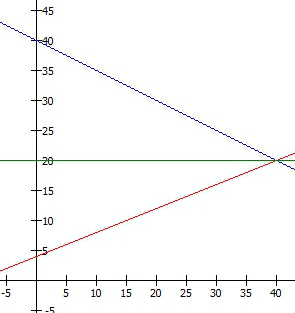
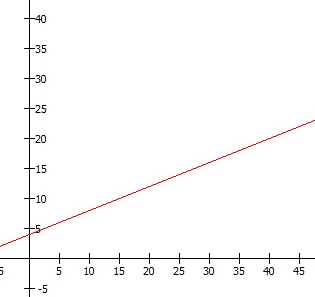
We’ll have a supply curve, which is a graph of the minimum price the worker is willing to accept for each hour in order to work a given number of hours. We generally assume that the supply curve slopes upward, meaning that people are willing to work more hours if you offer them a higher wage for each hour. The idea is that it gets progressively harder to find the time—it eats into more and more important alternative activities. (This is in fact a gross oversimplification, but it’ll do for now. In the real world, labor is the one thing for which the supply curve frequently bends backward.)

supply_curve

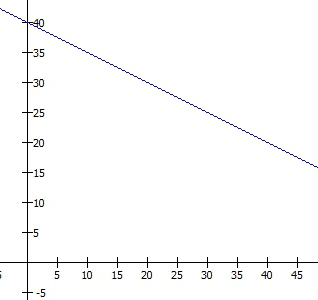
We’ll also have a demand curve, which is a graph of the maximum price the employer is willing to pay for each hour, if the employee works that many hours. We generally assume that the demand curve slopes downward, meaning that the employer is willing to pay less for each hour if the employee works more hours. The reason is that most activities have diminishing marginal returns, so each extra hour of work generally produces less output than the previous hour, and is therefore not worth paying as much for. (This too is an oversimplification, as I discussed previously in my post on the Law of Demand.)

demand_curve

Put these two together, and in a competitive market the price will be set at the point at which supply is equal to demand, so that the very last hour of work was worth exactly what the employer paid for it. That last hour is just barely worth it to the employer, and just barely worth it to the worker; any additional time would either be too expensive for the employer or not lucrative enough for the worker. But for all the previous hours, the value to the employer is higher than the wage, and the cost to the worker is lower than the wage. As a result, both the employer and the worker benefit.

equilibrium_notax

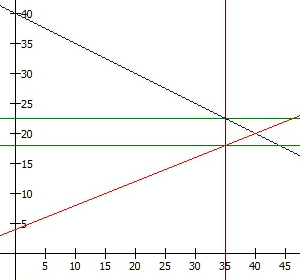
But now, suppose we implement a tax. For concreteness, suppose the previous market-clearing wage was $20 per hour, the worker was working 40 hours, and the tax is 20%. If the employer still offers a wage of $20 for 40 hours of work, the worker is no longer going to accept it, because they will only receive $16 per hour after taxes, and $16 isn’t enough for them to be willing to work 40 hours. The worker could ask for a pre-tax wage of $25 so that the after-tax wage would be $20, but then the employer will balk, because $25 per hour is too expensive for 40 hours of work.

In order to restore the balance (and when we say “equilibrium”, that’s really all we mean—balance), the employer will need to offer a higher pre-tax wage, which means they will demand fewer hours of work. The worker will then be willing to accept a lower after-tax wage for those reduced hours.

In effect, there are now two prices at work: A supply price, the after-tax wage that the worker receives, which must be at or above the supply curve; and a demand price, the pre-tax wage that the employer pays, which must be at or below the demand curve. The difference between those two prices is the tax.

equilibrium_tax

In this case, I’ve set it up so that the pre-tax wage is $22.50, the after-tax wage is $18, and the amount of the tax is $4.50 or 20% of $22.50. In order for both the employer and the worker to accept those prices, the amount of hours worked has been reduced to 35.

As a result of the tax, the wage that we’ve been calling “pre-tax” is actually higher than the wage that the worker would have received if the tax had not existed. This is a general phenomenon; it’s almost always true that your “pre-tax” wage or salary overestimates what you would have actually gotten if the tax had not existed. In one extreme case, it might actually be the same; in another extreme case, your after-tax wage is what you would have received and the “pre-tax” wage rises high enough to account for the entirety of the tax revenue. It’s not really “pre-tax” at all; it’s the after-tax demand price.

Because of this, it’s fundamentally wrongheaded for people to complain that taxes are “taking your hard-earned money”. In all but the most exceptional cases, that “pre-tax” salary that’s being deducted from would never have existed. It’s more of an accounting construct than anything else, or like I said before a measure of labor expenditure. It is generally true that your after-tax salary is lower than the salary you would have gotten without the tax, but the difference is generally much smaller than the amount of the tax that you see deducted. In this case, the worker would see $4.50 per hour deducted from their wage, but in fact they are only down $2 per hour from where they would have been without the tax. And of course, none of this includes the benefits of the tax, which in many cases actually far exceed the costs; if we extended the example, it wouldn’t be hard to devise a scenario in which the worker who had their wage income reduced received an even larger benefit in the form of some public good such as national defense or infrastructure.

Tax Incidence Revisited, Part 1: The downside of taxes

JDN 2457345 EST 22:02

As I was writing this, it was very early (I had to wake up at 04:30) and I was groggy, because we were on an urgent road trip to Pennsylvania for the funeral of my aunt who died quite suddenly a few days ago. I have since edited this post more thoroughly to minimize the impact of my sleep deprivation upon its content. Actually maybe this is a good thing; the saying goes, “write drunk, edit sober” and sleep deprivation and alcohol have remarkably similar symptoms, probably because alcohol is GABA-ergic and GABA is involved in sleep regulation.

Awhile ago I wrote a long post on tax incidence, but the primary response I got was basically the online equivalent of a perplexed blank stare. Struck once again by the Curse of Knowledge, I underestimated the amount of background knowledge necessary to understand my explanation. But tax incidence is very important for public policy, so I really would like to explain it.

Therefore I am now starting again, slower, in smaller pieces. Today’s piece is about the downsides of taxation in general, why we don’t just raise taxes as high as we feel like and make the government roll in dough.

To some extent this is obvious; if income tax were 100%, why would anyone bother working for a salary? You might still work for fulfillment, or out of a sense of duty, or simply because you enjoy what you do—after all, most artists and musicians are hardly in it for the money. But many jobs are miserable and not particularly fulfilling, yet still need to get done. How many janitors or bus drivers work purely for the sense of fulfillment it gives them? Mostly they do it to pay the bills—and if income tax were 100%, it wouldn’t anymore. The formal economy would basically collapse, and then nobody would end up actually paying that 100% tax—so the government would actually get very little revenue, if any.

At the other end of the scale, it’s kind of obvious that if your taxes are all 0% you don’t get any revenue. This is actually more feasible than it may sound; provided you spend only a very small amount (say, 4% of GDP, though that’s less than any country actually spends—maybe you could do 6% like Bangladesh) and you can still get people to accept your currency, you could, in principle, have a government that funds its spending entirely by means of printing money, and could do this indefinitely. In practice, that has never been done, and the really challenging part is getting people to accept your money if you don’t collect taxes in it. One of the more counter-intuitive aspects of modern monetary theory (or perhaps I should capitalize it, Modern Monetary Theory, though the part I agree with is not that different from standard Keynesian theory) is that taxation is the primary mechanism by which money acquires its value.

And then of course with intermediate tax rates such as 20%, 30%, and 50% that actual countries actually use, we do get some positive amount of revenue.

Everything I’ve said so far may seem pretty obvious. Yeah, usually taxes raise revenue, but if you taxed at 0% or 100% they wouldn’t; so what?

Well, this leads to quite an important result. Assuming that tax revenue is continuous (which isn’t quite true, but since we can collect taxes in fractions of a percent and pay in pennies, it’s pretty close), it follows directly from the Extreme Value Theorem that there is in fact a revenue-maximizing tax rate. Both below and above that tax rate, the government takes in less total money. These theorems don’t tell us what the revenue-maximizing rate is; but they tell us that it must exist, somewhere between 0% and 100%.

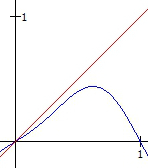
Indeed, it follows that there is what we call the Laffer Curve, a graph of tax revenue as a function of tax rate, and it is in fact a curve, as opposed to the straight line it would be if taxes had no effect on the rest of the economy.

Very roughly, it looks something like this (the blue curve is my sketch of the real-world Laffer curve, while the red line is what it would be if taxes had no distortionary effects):

Laffer_curve

Now, the Laffer curve has been abused many times; in particular, it’s been used to feed into the “trickle-down” “supply-sideReaganomics that has been rightly derided as “voodoo economics” by serious economists. Jeb Bush (or should I say, Jeb!) and Marco Rubio would have you believe that we are on the right edge of the Laffer curve, and we could actually increase tax revenue by cutting taxes, particularly on capital gains and incomes at the top 1%; that’s obviously false. We tried that, it didn’t work. Even theoretically we probably should have known that it wouldn’t; but now that we’ve actually done the experiment and it failed, there should be no serious doubt anymore.

No, we are on the left side of the Laffer curve, where increasing taxes increases revenue, much as you’d intuitively expect. It doesn’t quite increase one-to-one, because adding more taxes does make the economy less efficient; but from where we currently stand, a 1% increase in taxes leads to about a 0.9% increase in revenue (actually estimated as between 0.78% and 0.99%).

Denmark may be on the right side of the Laffer curve, where they could raise more revenue by decreasing tax rates (even then I’m not so sure). But Denmark’s tax rates are considerably higher than ours; while in the US we pay about 27% of GDP in taxes, folks in Denmark pay 49% of GDP in taxes.

The fact remains, however, that there is a Laffer curve, and no serious economist would dispute this. Increasing taxes does in fact create distortions in the economy, and as a result raising tax rates does not increase revenue in a one-to-one fashion. When calculating the revenue from a new tax, you must include not only the fact that the government will get an increased portion, but also that the total amount of income will probably decrease.

Now, I must say probably, because it does depend on what exactly you are taxing. If you tax something that is perfectly inelastic—the same amount of it is going to be made and sold no matter what—then total income will remain exactly the same after the tax. It may be distributed differently, but the total won’t change. This is one of the central justifications for a land tax; land is almost perfectly inelastic, so taxing it allows us to raise revenue without reducing total income.

In fact, there are certain kinds of taxes which increase total income, which makes them basically no-brainer taxes that should always be implemented if at all feasible. These are Pigovian taxes, which are taxes on products with negative externalities; when a product causes harm to other people (the usual example is pollution of air and water), taxing that product equal to the harm caused provides a source of government revenue that also increases the efficiency of the economy as a whole. If we had a tax on carbon emissions that was used to fund research into sustainable energy, this would raise our total GDP in the long run. Taxes on oil and natural gas are not “job killing”; they are job creating. This is why we need a carbon tax, a higher gasoline tax, and a financial transaction tax (to reduce harmful speculation); it’s also why we already have high taxes on alcohol and tobacco.

The alcohol tax is one of the great success stories of Pigouvian taxation.The alcohol tax is actually one of the central factors holding our crime rate so low right now. Another big factor is overall economic growth and anti-poverty programs. The most important factor, however, is lead, or rather the lack thereof; environmental regulations reducing pollutants like lead and mercury from the environment are the leading factor in reducing crime rates over the last generation. Yes, that’s right—our fall in crime had little to do with state police, the FBI, the DEA, or the ATF; our most effective crime-fighting agency is the EPA. This is really not that surprising, as a cognitive economist. Most crime is impulsive and irrational, or else born of economic desperation. Rational crime that it would make sense to punish harshly as a deterrent is quite rare (well, except for white-collar crime, which of course we don’t punish harshly enough—I know I harp on this a lot, but HSBC laundered money for terrorists). Maybe crime would be more common if we had no justice system in place at all, but making our current system even harsher accomplishes basically nothing. Far better to tax the alcohol that leads good people to bad decisions.

It also matters whom you tax, though one of my goals in this tax incidence series is to explain why that doesn’t mean quite what most people think it does. The person who writes the check to the government is not necessarily the person who really pays the tax. The person who really pays is the one whose net income ends up lower after the tax is implemented. Often these are the same person; but often they aren’t, for fundamental reasons I’m hoping to explain.

For now, it’s worth pointing out that a tax which primarily hits the top 1% is going to have a very different impact on the economy than one which hits the entire population. Because of the income and substitution effects, poor people tend to work less as their taxes go up, but rich people tend to work more. Even within income brackets, a tax that hits doctors and engineers is going to have a different effect than a tax that hits bankers and stock traders, and a tax that hits teachers is going to have a different effect than a tax that hits truck drivers. A tax on particular products or services will reduce demand for those products or services, which is good if that’s what you’re trying to do (such as alcohol) but not so good if it isn’t.

So, yes, there are cases where raising taxes can actually increase, or at least not reduce, total income. These are the exception, however; as a general rule, in a Pirate Code sort of way, taxes reduce total income. It’s not simply that income goes down for everyone but the government (which would again be sort of obvious); income goes down for everyone including the government. The difference is simply lost, wasted away by a loss in economic efficiency. We call that difference deadweight loss, and for a poorly-designed tax it can actually far exceed the revenue received.

I think an extreme example may help to grasp the intuition: Suppose we started taxing cars at 200,000%, so that a typical new car costs something like $40 million with taxes. (That’s not a Lamborghini, mind you; that’s a Honda Accord.) What would happen? Nobody is going to buy cars anymore. Overnight, you’ve collapsed the entire auto industry. Dozens of companies go bankrupt, thousands of employees get laid off, the economy immediately falls into recession. And after all that, your car tax will raise no revenue at all, because not a single car will sell. It’s just pure deadweight loss.

That’s an intentionally extreme example; most real-world taxes in fact create less deadweight loss than they raise in revenue. But most real-world taxes do in fact create deadweight loss, and that’s a good reason to be concerned about any new tax.

In general, higher taxes create lower total income, or equivalently higher deadweight loss. All other things equal, lower taxes are therefore better.

What most Americans don’t seem to quite grasp is that all other things are not equal. That tax revenue is central to the proper functioning of our government and our monetary system. We need a certain amount of taxes in order to ensure that we can maintain a stable currency and still pay for things like Medicare, Social Security, and the Department of Defense (to name our top three budget items).

Alternatively, we could not spend so much on those things, and that is a legitimate question of public policy. I personally think that Medicare and Social Security are very good things (and I do have data to back that up—Medicare saves thousands of lives), but they aren’t strictly necessary for basic government functioning; we could get rid of them, it’s just that it would be a bad idea. As for the defense budget, some kind of defense budget is necessary for national security, but I don’t think I’m going out on a very big limb here when I say that one country making 40% of all world military spending probably isn’t.

We can’t have it both ways; if you want Medicare, Social Security, and the Department of Defense, you need to have taxes. “Cutting spending” always means cutting spending on something—so what is it you want to cut? A lot of people seem to think that we waste a huge amount of money on pointless bureaucracy, pork-barrel spending, or foreign aid; but that’s simply not true. All government administration is less than 1% of the budget, and most of it is necessary; earmarks are also less than 1%; foreign aid is also less than 1%. Since our deficit is about 15% of spending, we could eliminate all of those things and we’d barely put a dent in it.

Americans don’t like taxes; I understand that. It’s basically one of our founding principles, in fact, though “No taxation without representation” seems to have mutated of late into simply “No taxation”, or maybe “Read my lips, no new taxes!” It’s never pleasant to see that chunk taken out of your paycheck before you even get it. (Though one thing I hope to explain in this series is that these figures are really not very meaningful; there’s no particular reason to think you’d have made the same gross salary if those taxes hadn’t been present.)

There are in fact sound economic reasons to keep taxes low. The Laffer Curve is absolutely a real thing, even though most of its applications are wrong. But sometimes we need taxes to be higher, and that’s a tradeoff we have to make.We need to have a serious public policy discussion about where our priorities lie, not keep trading sound-bytes about “cutting wasteful spending” and “job-killing tax hikes”.

Just give people money!

JDN 2457332 EDT 17:02.

Today is the Fifth of November, on which a bunch of people who liked a Hollywood movie start posting images in support of a fanatical religious terrorist in his plot to destroy democracy in the United Kingdom a few centuries ago. It’s really weird, but I’m not particularly interested in that.

Instead I’d like to talk about the solution to poverty, which we’ve known for a long time—in fact, it’s completely obvious—and yet have somehow failed to carry out. Many people doubt that it even works, not based on the empirical evidence, but because it just feels like it can’t be right, like it’s so obvious that surely it was tried and didn’t work and that’s why we moved on to other things. When you first tell a kindergartner that there are poor people in the world, that child will very likely ask: “Why don’t we just give them some money?”

Why not indeed?

Formally this is called a “direct cash transfer”, and it comes in many different variants, but basically they run along a continuum from unconditional—we just give it to everybody, no questions asked—to more and more conditional—you have to be below a certain income, or above a certain age, or have kids, or show up at our work program, or take a drug test, etc. The EU has a nice little fact sheet about the different types of cash transfer programs in use.

Actually, I’d argue that at the very far extreme is government salaries—the government will pay you $40,000 per year, provided that you teach high school every weekday. We don’t really think of that as a “conditional cash transfer” because it involves you providing a useful service (and is therefore more like an ordinary, private-sector salary), but many of the conditions imposed on cash transfers actually have this sort of character—we want people to do things that we think are useful to society, in order to justify us giving them the money. It really seems to be a continuum, from just giving money to everyone, to giving money to some people based on them doing certain things, to specifically hiring people to do something.

Social programs in different countries can be found at different places on this continuum. In the United States, our programs are extremely conditional, and also the total amount we give out is relatively small. In Europe, programs are not as conditional—though still conditional—and they give out more. And sure enough, after-tax poverty in Europe is considerably lower, even though before-tax poverty is about the same.

In fact, the most common way to make transfers conditional is to make them “in-kind”; instead of giving you money, we give you something—healthcare, housing, food. Sometimes this makes sense; actually I think for healthcare it makes the most sense, because price signals don’t work in a market as urgent and inelastic as healthcare (that is, you don’t shop around for an emergency room—in fact, people don’t even really shop around for a family doctor). But often it’s simply a condition we impose for political reasons; we don’t want those “lazy freeloaders” to do anything else with the money that we wouldn’t like, such as buying alcohol or gambling. Even poor people in India buy into this sort of reasoning. Nevermind that they generally don’t do that, or that they could just shift away spending they would otherwise be making (warning: technical economics paper within) to do those things anyway—it’s the principle of the thing.

Direct cash transfers not only work—they work about as well as the best things we’ve tried. Spending on cash transfers is about as cost-effective as spending on medical aid and malaria nets.

Other than in experiments (the largest of which I’m aware of was a town in Canada, unless you count Alaska’s Permanent Fund Dividend, which is unconditional but quite small), we have never really tried implementing a fully unconditional cash transfer system. “Too expensive” is usually the complaint, and it would indeed be relatively expensive (probably greater than all of what we currently spend on Social Security and Medicare, which are two of our biggest government budget items). Implementing a program with a cost on the order of $2 trillion per year is surely not something to be done lightly. But it would have one quite substantial benefit: It would eliminate poverty in the United States immediately and forever.

This is why I really like the “abolish poverty” movement; we must recognize that at our current level of economic development, poverty is no longer a natural state, a complex problem to solve. It is a policy decision that we are making. We are saying, as a society, that we would rather continue to have poverty than spend that $2 trillion per year, about 12% of our $17.4 trillion GDP. We are saying that we’d rather have people who are homeless and starving than lose 12 cents of every dollar we make. (To be fair, if we include the dynamic economic impact of this tax-and-transfer system it might actually turn out to be more than that; but it could in fact be less—the increased spending would boost the economy, just as the increased taxes would restrain it—and seems very unlikely to be more than 20% of GDP.)

For most of human history—and in most countries today—that is not the case. India could not abolish poverty immediately by a single tax policy; nor could China. Probably not Brazil either. Maybe Greece could do it, but then again maybe not. But Germany could; the United Kingdom could; France could; and we could in the United States. We have enough wealth now that with a moderate increase in government spending we could create an economic floor below which no person could fall. It is incumbent upon us at the very least to justify why we don’t.

I have heard it said that poverty is not a natural condition, but the result of human action. Even Nelson Mandela endorsed this view. This is false, actually. In general, poverty is the natural condition of all life forms on Earth (and probably all life forms in the universe). Natural selection evolves us toward fitting as many gene-packages into the environment as possible, not toward maximizing the happiness of the sentient beings those gene-packages may happen to be. To a first approximation, all life forms suffer in poverty.

We live at a unique time in human history; for no more than the last century—and perhaps not even that—we have actually had so much wealth that we could eliminate poverty by choice. For hundreds of thousands of years human beings toiled in poverty because there was no such choice. Perhaps good policy in Greece could end poverty today, but it couldn’t have during the reign of Pericles. Good policy in Italy could end poverty now, but not when Caesar was emperor. Good policy in the United Kingdom could easily end poverty immediately, but even under Queen Victoria that wasn’t feasible.

Maybe that’s why we aren’t doing it? Our cultural memory was forged in a time decades or centuries ago, before we had this much wealth to work with. We speak of “end world hunger” in the same breath as “cure cancer” or “conquer death”, a great dream that has always been impossible and perhaps still is—but in fact we should speak of it in the same breath as “split the atom” and “land on the Moon”, seminal achievements that our civilization is now capable of thanks to economic and technological revolution.

Capitalism also seems to have a certain momentum to it; once you implement a market economy that maximizes wealth by harnessing self-interest, people seem to forget that we are fundamentally altruistic beings. I may never forget that economist who sent me an email with “altruism” in scare quotes, as though it was foolish (or at best imprecise) to say that human beings care about one another. But in fact we are the most altruistic species on Earth, without question, in a sense so formal and scientific it can literally be measured quantitatively.

There are real advantages to harnessing self-interest—not least, I know my own interests considerably better than I know yours, no matter who you are—and that is part of how we have achieved this great level of wealth (though personally I think science, democracy, and the empowerment of women are the far greater causes of our prosperity). But we must not let it forget us why we wanted to have wealth in the first place: Not to concentrate power in a handful of individuals who will pass it on to their heirs; not to “maximize work incentives”; not to give us the fanciest technological gadgets. The reason we wanted to have wealth was so that we could finally free ourselves from the endless toil that was our lot by birth and that of all other beings—to let us finally live, instead of merely survive. There is a peak to Maslow’s pyramid, and we could stand there now, together; but we must find the will to give up that 12 cents of every dollar.

What really scares me

JDN 2457327

Today is Halloween, so in the spirit of the holiday I thought I’d talk about things that are scary. Not things like zombies and witches and vampires; those things aren’t real (though people do still believe in them in many parts of the world). And maybe that’s part of the point; maybe Halloween is meant to “scare” us like a roller coaster, where we feel some of the epinephrine rush of fear but deep down we know we are safe.

But today I’m going to talk about things that are actually scary, things that are not safe deep down. I could talk about the Republican debate earlier this week, but maybe I shouldn’t get too scary.

In fiction there is whatever sort of ending the author wants to make, usually a happy one. Even tragic endings are written to be meaningful and satisfying. But in real life any sort of ending is possible. I could be driving down the street tomorrow and a semi truck could blindside me and kill me on impact. There’s no satisfying tragedy there, no comeuppance for my hubris or tragic flaw in my character leading to my doom—but this sort of thing kills over 30,000 Americans each year.

But are car accidents really scary? The way they kill just about anyone at random is scary. But there is a clear limit to how much damage they can do. No society has ever been wiped off the face of the Earth because of traffic accidents. There is no way for traffic accidents to risk the survival of the human race itself.

This brings me to the first thing that is really scary: Climate change. Human societies have been wiped off the face of the Earth due to local ecological collapses. The classic example is Easter Island, which did have an ecological collapse, but also suffered greatly from European invaders. Recent evidence suggests that the Vikings fell apart because glaciation broke their trade networks. Jared Diamond argues that a large number of ancient societies have fallen due to ecological collapse.

Yet for the first time we are now facing rapid global climate change, and it is our own doing. (As the vast majority of climate scientists agree.) We are already seeing its effects in flooding, wildfires, droughts, and hurricanes. Positive feedbacks are created, such as heat waves leading to more air conditioning, which draws more electricity that releases more carbon. Even as management of fishing improves, fisheries are still being depleted—because their waters are becoming too warm for the native fish.

Just yesterday the United Nations released a report showing that current promises of reduced carbon emissions will not be sufficient—even if they are followed through, which such promises often aren’t. The goal was to keep warming under 2 C; but it looks like we are looking at more like 2.7 C. That 0.7-degree difference may not seem like much, but in fact it means thousands or even millions of additional deaths. Most of the economic damage will be done to countries near the equator—which is also where the most impoverished people tend to live. The Global Humanitarian Forum estimates that global warming is already killing 300,000 people each year and causing over $100 billion in economic damage.

Meanwhile, there is a campaign of disinformation about climate change, funneled through secretive “dark money” processes (Why are these even allowed!?), including Exxon corporation, which has known for 30 years that they were contributing to climate change but actively suppressed that knowledge in order to avoid regulation. Koch Industries has also funded a great deal of climate change denialism. West Virginia recently tried to alter their science textbooks to remove references to climate change because they considered the scientific facts to be “too political”. Supposedly serious “think tanks” with conservative ideologies twist data in order to support their claims. Rather than be caught lying or denying science, most of the Republican presidential candidates are avoiding talking about the subject altogether.
There is good news, however: More Americans than ever recognize that climate change is real. 7% changed their minds in just the last few months. Even a lot of Republican politicians are finally coming around.

What else is scary? Nuclear war, a Black Swan. This is the most probable way humanity could destroy ourselves; the probability of nuclear war in the next 50 years has been estimated as high as 10%. Every day that goes by with nuclear weapons at the ready is like pulling the trigger in a game of Russian Roulette. We don’t really know how to estimate the probability with any precision; but even 0.1% per year would be a 10% chance over the next century.

There’s good news on this front as well: Slowly but surely, the world is disarming its nuclear weapons. From a peak of 60,000 nuclear weapons in 1986, we are now down to about 10,000. But we shouldn’t get too comfortable, as the estimated number necessary to trigger a global nuclear winter with catastrophic consequences is only about 100. India or Pakistan alone probably has enough to do that. The US or Russia has enough to do it 40 times over. We will need to continue our current disarmament trend for another 30 years before no single nation has enough weapons to trigger a nuclear winter.

Then there’s one more class of scary Black Swans: Mass extinction events. In particular, I’m talking about the Yellowstone Supervolcano, which could erupt at any moment, and the possibility of a large asteroid impact which could destroy cities or even wipe out all life on the surface of the Earth. We are 99.989% sure that TV135 will not do this; but in that 0.02% chance, it would hit with the force of 2500 megatons—50 times larger than any nuclear weapon ever built. Smaller (“smaller”) sub-megaton impacts are actually remarkably common; we average about two per year. If one ever hit a major city, it would be comparable to the Hiroshima nuclear bombing. The Yellowstone supervolcano would not be as catastrophic as a planet-scouring impact, but it would be comparable to a nuclear war and nuclear winter.

With asteroids, there are actually clear things we could do to improve our chances. Above all, we could invest in space exploration and astronomy. With better telescopes and more tracking stations we could see them coming; with better long-range rockets we might be able to deflect them before they get here. A number of different deflection proposals are being studied right now. This is actually the best reason I can think of to keep at least some nuclear weapons on standby; a large nuclear blast positioned at the right place could be effective at destroying an asteroid or deflecting it enough to miss us.

With Yellowstone, there really isn’t much we can do; all we can do at this point is continue to research the supervolcano and try to find ways to reduce the probability of its eruption. It is currently estimated at a just over 1 in 1 million chance of erupting any given year, but that’s a very rough estimate. Fracking near Yellowstone is currently banned, and I think it should stay that way until we have a very clear idea of what would happen. (It’s actually possible it could reduce the probability of eruption, in which case we should start fracking like crazy.)

Forget the zombie apocalypse. I’m scared of the supervolcano apocalypse.

Means, medians, and inequality denial

JDN 2457324 EDT 21:45

You may have noticed a couple of big changes in the blog today. The first is that I’ve retitled it “Human Economics” to emphasize the positive, and the second is that I’ve moved it to my domain http://patrickjuli.us which is a lot shorter and easier to type. I’ll be making two bite-sized posts a week, just as I have been piloting for the last few weeks.

Earlier today I was dismayed to see a friend link to this graph by the American Enterprise Institute (a well-known Libertarian think-tank):

middleclass1

Look! The “above $100,000” is the only increasing category! That means standard of living in the US is increasing! There’s no inequality problem!

The AEI has an agenda to sell you, which is that the free market is amazing and requires absolutely no intervention, and government is just a bunch of big bad meanies who want to take your hard-earned money and give it away to lazy people. They chose very carefully what data to use for this plot in order to make it look like inequality isn’t increasing.

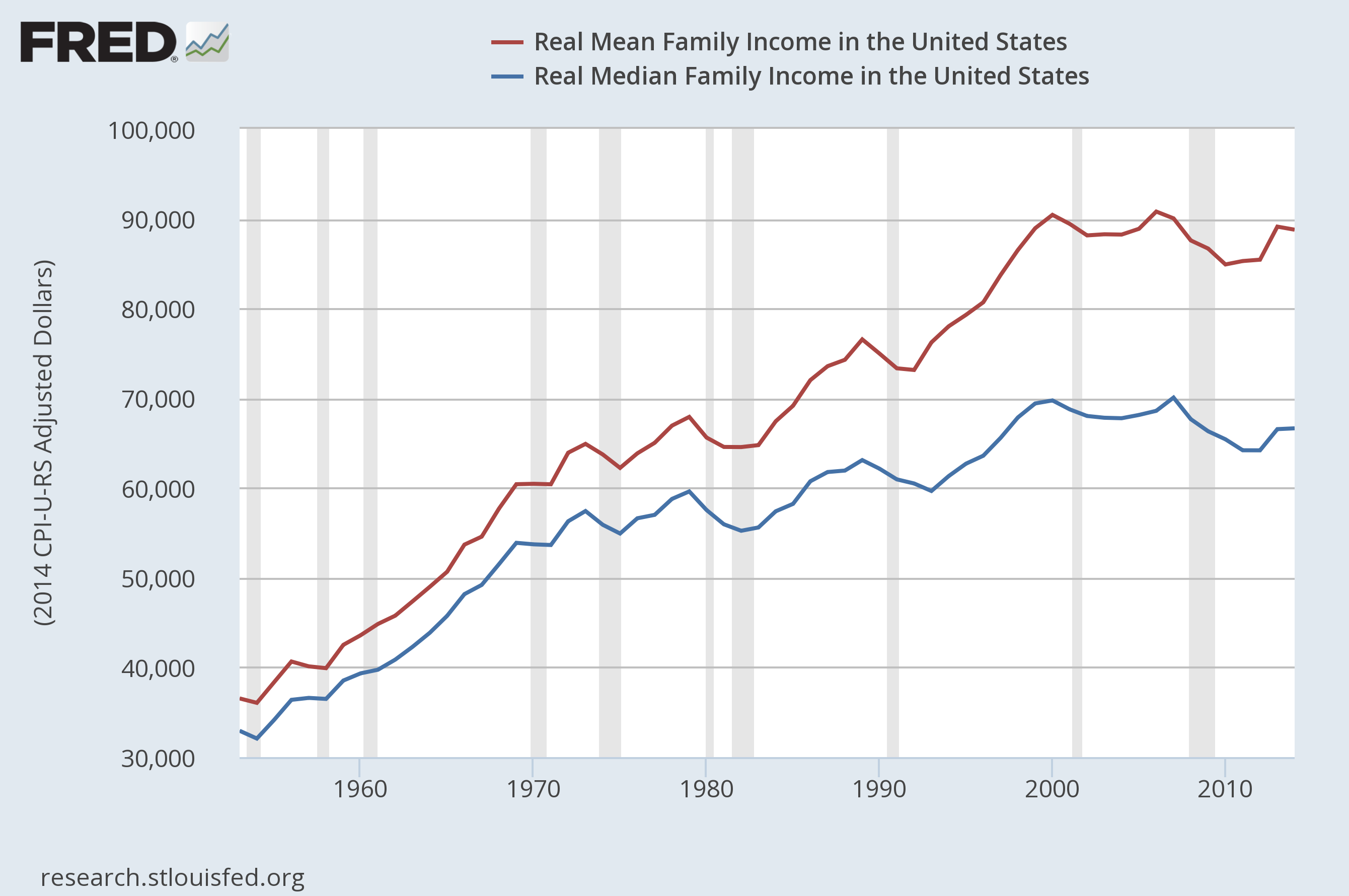
Here’s a more impartial way of looking at the situation, the most obvious, pre-theoretical way of looking at inequality: What has happened to mean income versus median income?

As a refresher from intro statistics, the mean is what you get by adding up the total money and dividing by the number of people; the median is what a person in the exact middle has. So for example if there are three people in a room, one makes $20,000, the second makes $50,000, and the third is Bill Gates making $10,000,000,000, then the mean income is $3,333,333,356 but the median income is $50,000. In a distribution similar to the power-law distribution that incomes generally fall into, the mean is usually higher than the median, and how much higher is a measure of how much inequality there is. (In my example, the mean is much higher, because there’s huge inequality with Bill Gates in the room.) This confuses people, because when people say “the average”, they usually intend the mean; but when they say “the average person”, they usually intend the median. The average person in my three-person example makes $50,000, but the average income is $3.3 billion.

So if we look at mean income versus median income in the US over time, this is what we see:

median_mean

In 1953, mean household income was $36,535 and median household income was $32,932. Mean income was therefore 10.9% higher than median income.

In 2013, mean household income was $88,765 and median income was $66,632. Mean household income was therefore 33.2% higher than median income.

That, my dear readers, is a substantial increase in inequality. To be fair, it’s also a substantial increase in standard of living; these figures are already adjusted for inflation, so the average family really did see their standard of living roughly double during that period.

But this also isn’t the whole story.

First, notice that real median household income is actually about 5% lower now than it was in 2007. Real mean household income is also lower than its peak in 2006, but only by about 2%. This is why in a real sense we are still in the Second Depression; income for most people has not retained its pre-recession peak.

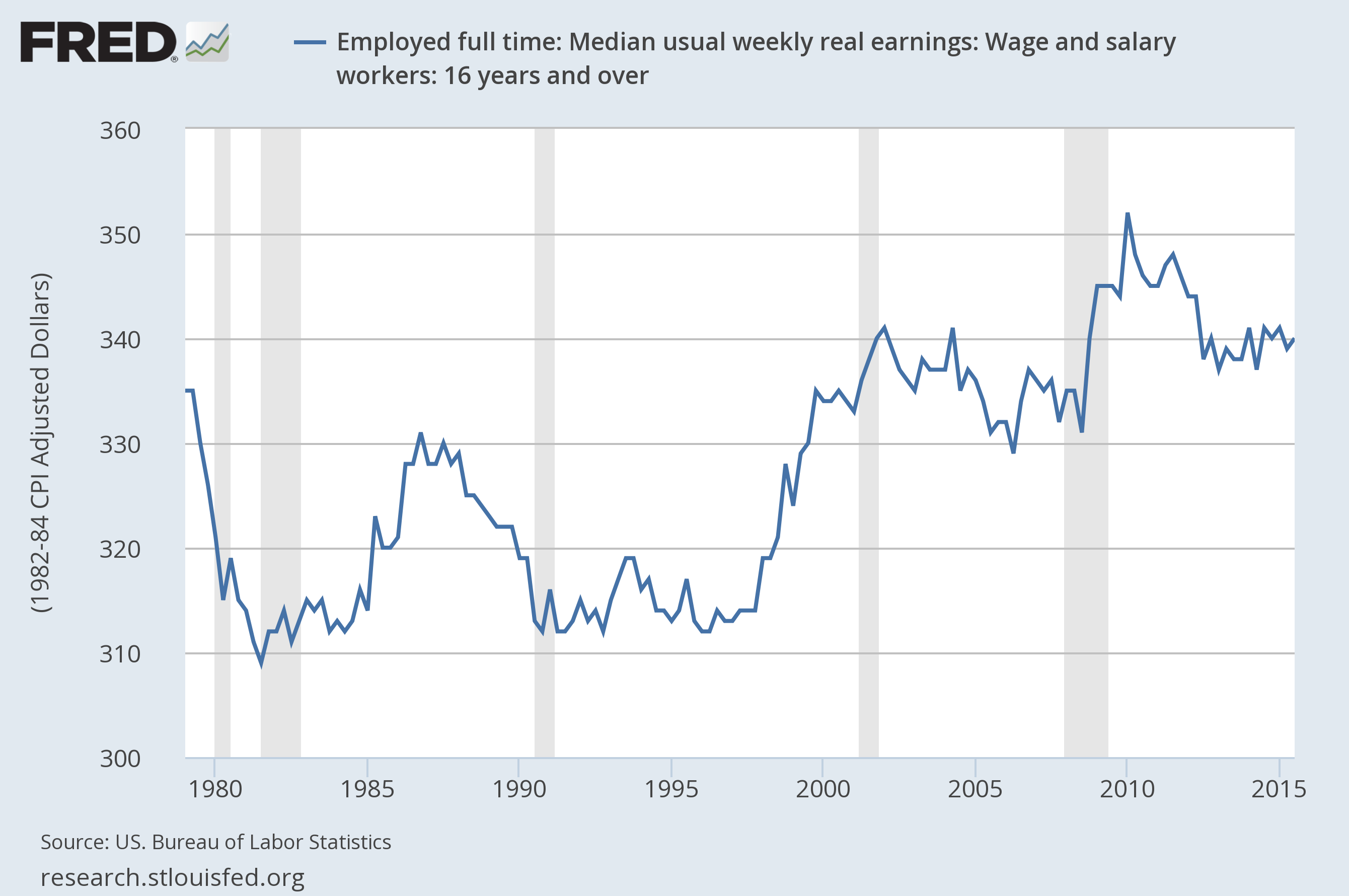
Furthermore, real median earnings for full-time employees have not meaningfully increased over the last 35 years; in 1982 dollars, they were $335 in 1979 and they are $340 now:

median_earnings

At first I thought this was because people were working more hours, but that doesn’t seem to be true; average weekly hours of work have fallen from 38.2 to 33.6:

weekly_hours

The main reason seems to be actually that women are entering the workforce, so more households have multiple full-time incomes; while only 43% of women were in the labor force in 1970, almost 57% are now.

women_labor_force

I must confess to a certain confusion on this point, however, as the difference doesn’t seem to be reflected in any of the measures of personal income. Median personal income was about 41% of median family income in 1974, and now it’s about 43%. I’m not sure exactly what’s going on here.

personal_household

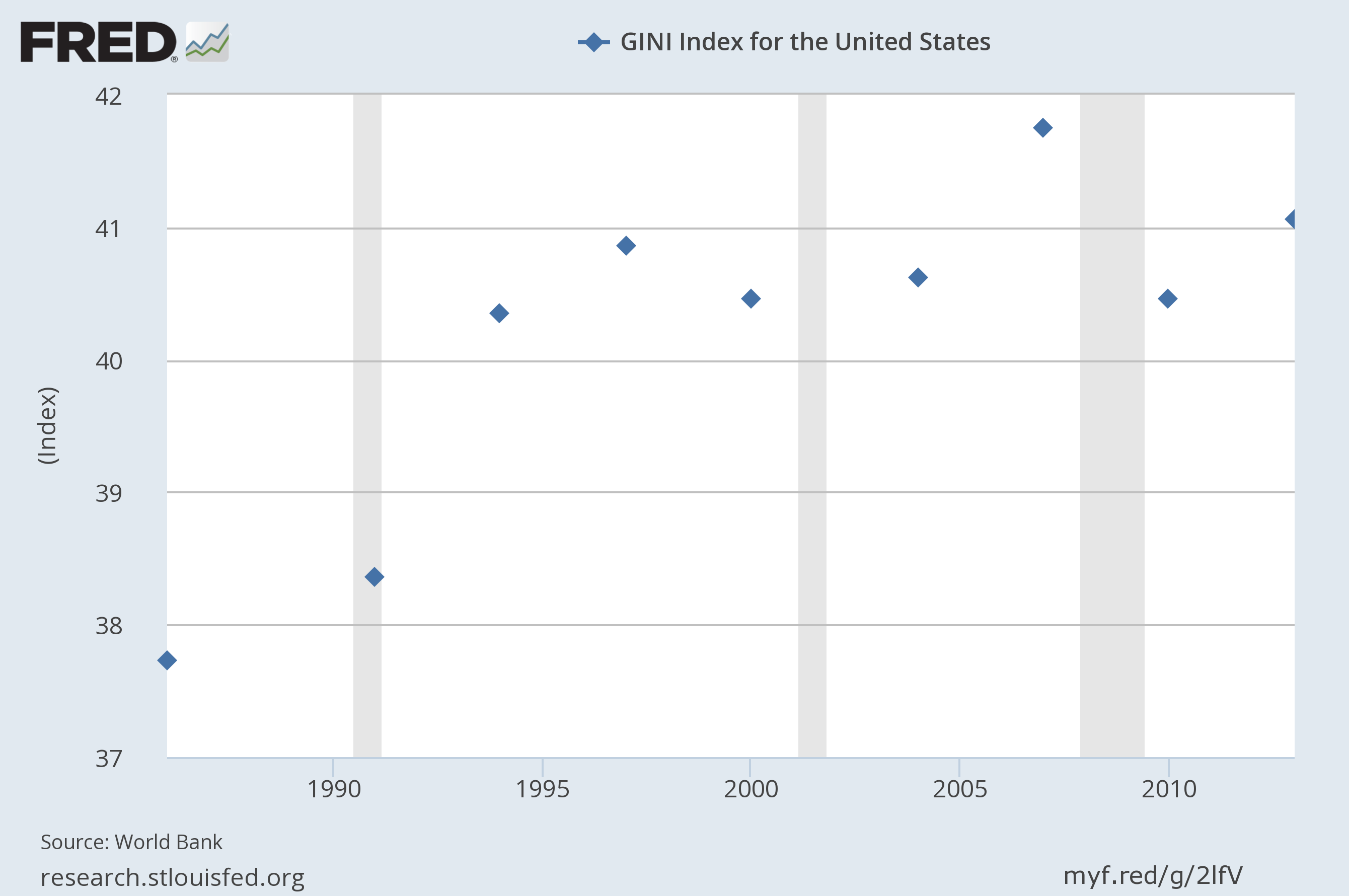
The Gini index, a standard measure of income inequality, is only collected every few years, yet shows a clear rising trend from 37% in 1986 to 41% in 2013:

GINI

But perhaps the best way to really grasp our rising inequality is to look at the actual proportions of income received by each portion of the population.

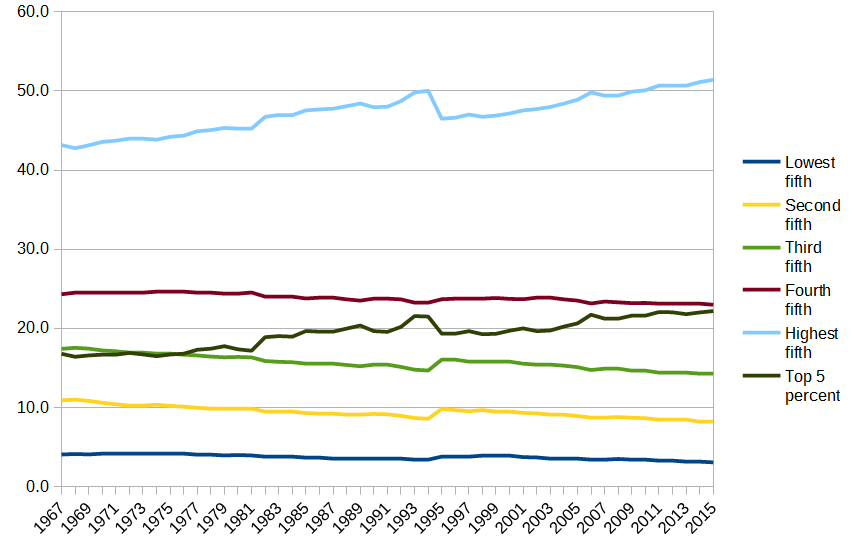
This is what it looks like if you use US Census data, broken down by groups of 20% and the top 5%; notice how since 1977 the top 5% have taken in more than the 40%-60% bracket, and they are poised to soon take in more than the 60%-80% bracket as well:

income_quintiles

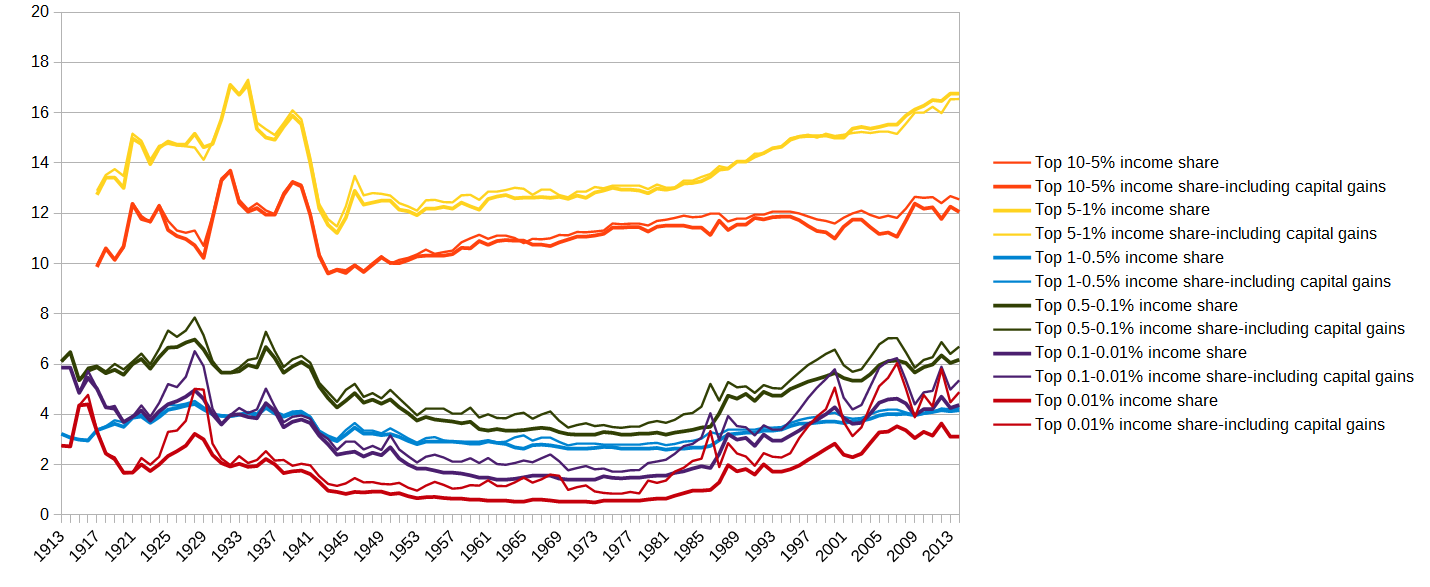
The result is even more striking if you use the World Top Incomes Database. You can watch the share of income rise for the top 10%, 5%, 1%, 0.1%, and 0.01%:

top_income_shares

But in fact it’s even worse than it sounds. What I’ve just drawn double-counts a lot of things; it includes the top 0.01% in the top 0.1%, which is in turn included in the top 1%, and so on. If you exclude these, so that we’re only looking at the people in the top 10% but not the top 5%, the people in the top 5% but not the top 1%, and so on, something even more disturbing happens:

top_income_shares_adjusted

While the top 10% does see some gains, the top 5% gains faster, and the gains accrue even faster as you go up the chain.

Since 1970, the top 10%-5% share grew 10%. The top 0.01% share grew 389%.

Year

Top 10-5% share

Top 10-5% share incl. cap. gains

Top 5-1% share

Top 5-1% share incl cap. gains

Top 1-0.5% share

Top 1-0.5% share incl. cap. gains

Top 0.5-0.1% share

Top 0.5-0.1% share incl. cap. gains

Top 0.1-0.01% share

Top 0.1-0.01% share incl. cap. gains

Top 0.01% share

Top 0.01% share incl. cap. gains

1970

11.13

10.96

12.58

12.64

2.65

2.77

3.22

3.48

1.41

1.78

0.53

1

2014

12.56

12.06

16.78

16.55

4.17

4.28

6.18

6.7

4.38

5.36

3.12

4.89

Relative gain

12.8%

10.0%

33.4%

30.9%

57.4%

54.5%

91.9%

92.5%

210.6%

201.1%

488.7%

389.0%

To be clear, these are relative gains in shares. Including capital gains, the share of income received by the top 10%-5% grew from 10.96% to 12.06%, a moderate increase. The share of income received by the top 0.01% grew from 1.00% to 4.89%, a huge increase. (Yes, the top 0.01% now receive almost 5% of the income, making them on average almost 500 times richer than the rest of us.)

The pie has been getting bigger, which is a good thing. But the rich are getting an ever-larger piece of that pie, and the piece the very rich get is expanding at an alarming rate.

It’s certainly a reasonable question what is causing this rise in inequality, and what can or should be done about it. By people like the AEI try to pretend it doesn’t even exist, and that’s not economic policy analysis; that’s just plain denial.

How about we listen to the Nobel Laureate when we set our taxes?

JDN 2457321 EDT 11:20

I know I’m going out on a limb here, but I think it would generally be a good thing if we based our tax system on the advice of Nobel Laureate economists. Joseph Stiglitz wrote a tax policy paper for the Roosevelt Institution last year that describes in detail how our tax system could be reformed to simultaneously restore economic growth, reduce income inequality, promote environmental sustainability, and in the long run even balance the budget. What’s more, he did the math (I suppose Nobel Laureate economists are known for that), and it looks like his plan would actually work.

The plan is good enough that I think it’s worth going through in some detail.

He opens by reminding us that our “debt crisis” is of our own making, the result of politicians (and voters) who don’t understand economics:

“But we should be clear that these crises – which have resulted in a government shutdown and a near default on the national debt – are not economic but political. The U.S. is not like Greece, unable to borrow to fund its debt and deficit. Indeed, the U.S. has been borrowing at negative real interest rates.”

Stiglitz pulls no punches against bad policies, and isn’t afraid to single out conservatives:

“We also show that some of the so-called reforms that conservatives propose would be counterproductive – they could simultaneously reduce growth and economic welfare and increase unemployment and inequality. It would be better to have no reform than these reforms.”

A lot of the news media keep trying to paint Bernie Sanders as a far-left radical candidate (like this article in Politico calling his hometown the “People’s Republic of Burlington”), because he says things like this: “in recent years, over 99 percent of all new income generated in the economy has gone to the top 1 percent.”

But the following statement was not said by Bernie Sanders, it was said by Joseph Stiglitz, who I will remind you one last time is a world-renowned Nobel Laureate economist:

“The weaknesses in the labor market are reflected in low wages and stagnating incomes. That helps explain why 95 percent of the increase in incomes in the three years after the recovery officially began went to the upper 1 percent. For most Americans, there has been no recovery.”

It was also Stiglitz who said this:

“The American Dream is, in reality, a myth. The U.S. has some of the worst inequality across generations (social mobility) among wealthy nations. The life prospects of a young American are more dependent on the income and education of his parents than in other advanced countries.”

In this country, we have reached the point where policies supported by the analysis of world-renowned economists is considered far-left radicalism, while the “mainstream conservative” view is a system of tax policy that is based on pure fantasy, which has been called “puppies and rainbows” by serious policy analysts and “voodoo economics” by yet another Nobel Laureate economist. A lot of very smart people don’t understand what’s happening in our political system, and want “both sides” to be “equally wrong”, but that is simply not the case: Basic facts of not just social science (e.g. Keynesian monetary policy), but indeed natural science (evolutionary biology, anthropogenic climate change) are now considered “political controversies” because the right wing doesn’t want to believe them.

But let’s get back to the actual tax plan Stiglitz is proposing. He is in favor of raising some taxes and lowering others, spending more on some things and less on other things. His basic strategy is actually quite simple: Raise taxes with low multipliers and cut taxes with high multipliers. Raise spending with high multipliers and cut spending with low multipliers.

“While in general taxes take money out of the system, and therefore have a deflationary bias, some taxes have a larger multiplier than others, i.e. lead to a greater reduction in aggregate demand per dollar of revenue raised. Taxes on the rich and superrich, who save a large fraction of their income, have the least adverse effect on aggregate demand. Taxes on lower income individuals have the most adverse effect on aggregate demand.”

In other words, by making the tax system more progressive, we can directly stimulate economic growth while still increasing the amount of tax revenue we raise. And of course we have plenty of other moral and economic reasons to prefer progressive taxation.

Stiglitz tears apart the “job creator” myth:

“It is important to dispel a misunderstanding that one often hears from advocates of lower taxes for the rich and corporations, which contends that the rich are the job producers, and anything that reduces their income will reduce their ability and incentive to create jobs. First, at the current time, it is not lack of funds that is holding back investment. It is not even a weak and dysfunctional financial sector. America’s large corporations are sitting on more than $2 trillion in cash. What is holding back investment, especially by large corporations, is the lack of demand for their products.”

Stiglitz talks about two principles of taxation to follow:

First is the Generalized Henry George Principle, that we should focus taxes on things that are inelastic, meaning their supply isn’t likely to change much with the introduction of a tax. Henry George favored taxing land, which is quite inelastic indeed. The reason we do this is to reduce the economic distortions created by a tax; the goal is to collect revenue without changing the number of real products that are bought and sold. We need to raise revenue and we want to redistribute income, but we want to do it without creating unnecessary inefficiencies in the rest of the economy.

Second is the Generalized Polluter Pays Principle, that we should tax things that have negative externalities—effects on other people that are harmful. When a transaction causes harm to others who were not party to the transaction, we should tax that transaction in an amount equal to the harm that it would cause, and then use that revenue to offset the damage. In effect, if you hurt someone else, you should have to pay to clean up your own mess. This makes obvious moral sense, but it also makes good economic sense; taxing externalities can improve economic efficiency and actually make everyone better off. The obvious example is again pollution (the original Polluter Pays Principle), but there are plenty of other examples as well.

Stiglitz of course supports taxes on pollution and carbon emissions, which really should be a no-brainer. They aren’t just good for the environment, they would directly increase economic efficiency. The only reason we don’t have comprehensive pollution taxes (or something similar like cap-and-trade) is again the political pressure of right-wing interests.

Stiglitz focuses in particular on the externalities of the financial system, the boom-and-bust cycle of bubble, crisis, crash that has characterized so much of our banking system for generations. With a few exceptions, almost every major economic crisis has been preceded by some sort of breakdown of the financial system (and typically widespread fraud by the way). It is not much exaggeration to say that without Wall Street there would be no depressions. Externalities don’t get a whole lot bigger than that.

Stiglitz proposes a system of financial transaction taxes that are designed to create incentives against the most predatory practices in finance, especially the high-frequency trading in which computer algorithms steal money from the rest of the economy thousands of times per second. Even a 0.01% tax on each financial transaction would probably be enough to eliminate this particular activity.

He also suggests the implementation of “bonus taxes” which disincentivize paying bonuses, which could basically be as simple as removing the deductions placed during the Clinton administration (in a few years are we going to have to say “the first Clinton administration”?) that exempt “performance-based pay” from most forms of income tax. All pay is performance-based, or supposed to be. There should be no special exemption for bonuses and stock options.

Stiglitz also proposes a “bank rescue fund” which would be something like an expansion of the FDIC insurance that banks are already required to have, but designed as catastrophe insurance for the whole macroeconomy. Instead of needing bailed out from general government funds, banks would only be bailed out from a pool of insurance funds they paid in themselves. This could work, but honestly I think I’d rather reduce the moral hazard even more by saying that we will never again bail out banks directly, but instead bail out consumers and real businesses. This would probably save banks anyway (most people don’t default on debts if they can afford to pay them), and if it doesn’t, I don’t see why we should care. The only reason banks exist is to support the real economy; if we can support the real economy without them, they deserve to die. That basic fact seems to have been lost somewhere along the way, and we keep talking about how to save or stabilize the financial system as if it were valuable unto itself.

Stiglitz also proposes much stricter regulations on credit cards, which would require them to charge much lower transaction fees and also pay a portion of their transaction revenue in taxes. I think it’s fair to ask whether we need credit cards at all, or if there’s some alternative banking system that would allow people to make consumer purchases without paying 20% annual interest. (It seems like there ought to be, doesn’t it?)

Next Stiglitz gets to his proposal to reform the corporate income tax. Like many of us, he is sick of corporations like Apple and GE with ten and eleven-figure profits paying little or no taxes by exploiting a variety of loopholes. He points out some of the more egregious ones, like the “step up of basis at death” which allows inherited capital to avoid taxation (personally, I think both morally and economically the optimal inheritance tax rate is 100%!), as well as the various loopholes on offshore accounting which allow corporations to design and sell their products in the US, even manufacture them here, and pay taxes as if all their work were done in the Cayman Islands. He also points out that the argument that corporate taxes disincentivize investment is ridiculous, because most investment is financed by corporate bonds which are tax-deductible.

Stiglitz departs from most other economists in that he actually proposes raising the corporate tax rate itself. Most economists favor cutting the rate on paper, then closing the loopholes to ensure that the new rate is actually paid. Stiglitz says this is not enough, and we must both close the loopholes and increase the rate.

I’m actually not sure I agree with him on this; the incidence of corporate taxes is not very well-understood, and I think there’s a legitimate worry that taxing Apple will make iPhones more expensive without actually taking any money from Tim Cook. I think it would be better to get rid of the corporate tax entirely and then dramatically raise the marginal rates on personal income, including not only labor income but also all forms of capital income. Instead of taxing Apple hoping it will pass through to Tim Cook, I say we just tax Tim Cook. Directly tax his $4 million salary and $70 million in stock options.

Stiglitz does have an interesting proposal to introduce “rent-seeking” taxes that specifically apply to corporations which exercise monopoly or oligopoly power. If you can actually get this to work, it’s very clever; you could actually create a market incentive for corporations to support their own competition—and not in the sense of collusion but in the sense of actually trying to seek out more competitive markets in order to avoid the monopoly tax. Unfortunately, Stiglitz is a little vague on how we’d actually pull that off.

One thing I do agree with Stiglitz on is the use of refundable tax credits to support real investment. Instead of this weird business about not taxing dividends and capital gains in the hope that maybe somehow this will support real investment, we actually give tax credits specifically to companies that build factories or hire more workers.

Stiglitz also does a good job of elucidating the concept of “corporate welfare”, officially called “tax expenditures”, in which subsidies for corporations are basically hidden in the tax code as rebates or deductions. This is actually what Obama was talking about when he said “spending in the tax code”, (he did not invent the concept of tax expenditures), but since he didn’t explain himself well even Jon Stewart accused him of Orwellian Newspeak. Economically a refundable tax rebate of $10,000 is exactly the same thing as a subsidy of $10,000. There are some practical and psychological differences, but there are no real economic differences. If you’re still confused about tax expenditures, the Center for American Progress has a good policy memo on the subject.

Stiglitz also has some changes to make to the personal income tax, all of which I think are spot-on. First we increase the marginal rates, particularly at the very top. Next we equalize rates on all forms of income, including capital income. Next, we remove most, if not all, of the deductions that allow people to avoid paying the rate it says on paper. Finally, we dramatically simplify the tax code so that the majority of people can file a simplified return which basically just says, “This is my income. This is the tax rate for that income. This is what I owe.” You wouldn’t have to worry about itemizing your student loans or mortgage payments or whatever else; just tally up your income and look up your rate. As he points out, this would save a lot of people a lot of stress and also remove a lot of economic distortions.

He talks about how we can phase out the mortgage-interest deduction in particular, because it’s clearly inefficient and regressive but it’s politically popular and dropping it suddenly could lead to another crisis in housing prices.

Stiglitz has a deorbit for anyone who thinks capital income should not be taxed:

“There is, moreover, no justification for taxing those who work hard to earn a living at a higher rate than those who derive their income from speculation.”

By equalizing rates on labor and capital income, he estimates we could raise an additional $130 billion per year—just shy of what it would take to end world hunger. (Actually some estimates say it would be more than enough, others that it would be about half what we need. It’s definitely in the ballpark, however.)

Stiglitz actually proposes making a full deduction of gross household income at $100,000, meaning that the vast majority of Americans would pay no income tax at all. This is where he begins to lose me, because it necessarily means we aren’t going to raise enough revenue by income taxes alone.

He proposes to make up the shortfall by introducing a value-added tax, a VAT. I have to admit a lot of countries have these (including most of Europe) and seem to do all right with them; but I never understood why they are so popular among economists. They are basically sales taxes, and it’s very hard to make any kind of sales tax meaningfully progressive. In fact, they are typically regressive, because rich people spend a smaller proportion of their income than poor people do. Unless we specifically want to disincentivize buying things (and a depression is not the time to do that!), I don’t see why we would want to switch to a sales tax.

At the end of the paper Stiglitz talks about the vital difference between short-term spending cuts and long-term fiscal sustainability:

“Thus, policies that promote output and employment today also contribute to future growth – particularly if they lead to more investment. Thus, austerity measures that take the form of cutbacks in spending on infrastructure, technology, or education not only weaken the economy today, but weaken it in the future, both directly (through the obvious impacts, for example, on the capital stock) but also indirectly, through the diminution in human capital that arises out of employment or educational experience. […] Mindless “deficit fetishism” is likely to be counterproductive. It will weaken the economy and prove counterproductive to raising revenues because the main reason that we are in our current fiscal position is the weak economy.”

It amazes me how many people fail to grasp this. No one would say that paying for college is fiscally irresponsible, because we know that all that student debt will be repaid by your increased productivity and income later on; yet somehow people still think that government subsidies for education are fiscally irresponsible. No one would say that it is a waste of money for a research lab to buy new equipment in order to have a better chance at making new discoveries, yet somehow people still think it is a waste of money for the government to fund research. The most legitimate form of this argument is “crowding-out”, the notion that the increased government spending will be matched by an equal or greater decrease in private spending; but the evidence shows that many public goods—like education, research, and infrastructure—are currently underfunded, and if there is any crowding-out, it is much smaller than the gain produced by the government investment. Crowding-out is theoretically possible but empirically rare.

Above all, now is not the time to fret about deficits. Now is the time to fret about unemployment. We need to get more people working; we need to create jobs for those who are already seeking them, better jobs for those who have them but want more, and opportunities for people who have given up searching for work to keep trying. To do that, we need spending, and we will probably need deficits. That’s all right; once the economy is restored to full capacity then we can adjust our spending to balance the budget (or we may not even need to, if we devise taxes correctly).

Of course, I fear that most of these policies will fall upon deaf ears; but Stiglitz calls us to action:

“We can reform our tax system in ways that will strengthen the economy today, address current economic and social problems, and strengthen our economy for the future. The economic agenda is clear. The question is, will the vested interests which have played such a large role in creating the current distorted system continue to prevail? Do we have the political will to create a tax system that is fair and serves the interests of all Americans?”

What if employees were considered assets?

JDN 2457308 EDT 15:31

Robert Reich has an interesting proposal to change the way we think about labor and capital:
First, are workers assets to be developed or are they costs to be cut?” “Employers treat replaceable workers as costs to be cut, not as assets to be developed.”

This ultimately comes down to a fundamental question of how our accounting rules work: Workers are not considered assets, but wages are considered liabilities.

I don’t want to bore you with the details of accounting (accounting is often thought of as similar to economics, but really it’s the opposite of economics: Whereas economics is empirical, interesting, and fundamentally nonzero-sum, accounting is arbitrary, tedious, and zero-sum by construction), but I think it’s worth discussing the difference between how capital and labor are accounted.

By construction, every credit must come with a debit, no matter how arbitrary this may seem.

We start with an equation:

Assets + Expenses = Equity + Liabilities + Income

When purchasing a piece of capital, you credit the equity account with the capital you just bought, increasing it, then debit the expense account, increasing it as well. Because the capital is valued at the price at which you bought it, the increase in equity exactly balances the increase in expenses, and your assets, liabilities, and income do not change.

But when hiring a worker, you still debit the expense account, but now you credit the liabilities account, increasing it as well. So instead of increasing your equity, which is a good thing, you increase your liabilities, which is a bad thing.

This is why corporate executives are always on the lookout for ways to “cut labor costs”; they conceive of wages as simply outgoing money that doesn’t do anything useful, and therefore something to cut in order to increase profits.

Reich is basically suggesting that we start treating workers as equity, the same as we do with capital; and then corporate executives would be thinking in terms of making a “capital gain” by investing in their workers to increase their “value”.

The problem with this scheme is that it would really only make sense if corporations owned their workers—and I think we all know why that is not a good idea. The reason capital can be counted in the equity account is that capital can be sold off as a source of income; you don’t need to think of yourself as making a sort of “capital gain”; you can make, you know, actual capital gains.

I think actually the deeper problem here is that there is something wrong with accounting in general.

By its very nature, accounting is zero-sum. At best, this allows an error-checking mechanism wherein we can see if the two sides of the equation balance. But at worst, it makes us forget the point of economics.

While an individual may buy a capital asset on speculation, hoping to sell it for a higher price later, that isn’t what capital is for. At an aggregate level, speculation and arbitrage cannot increase real wealth; all they can do is move it around.

The reason we want to have capital is that it makes things—that the value of goods produced by a machine can far exceed the cost to produce that machine. It is in this way that capital—and indeed capitalism—creates real wealth.

Likewise, that is why we use labor—to make things. Labor is worthwhile because—and insofar as—the cost of the effort is less than the benefit of the outcome. Whether you are a baker, an author, a neurosurgeon, or an auto worker, the reason your job is worth doing is that the harm to you from doing it is smaller than the benefit to others from having it done. Indeed, the market mechanism is supposed to be structured so that by transferring wealth to you (i.e., paying you money), we make it so that both you and the people who buy your services are better off.

But accounting methods as we know them make no allowance for this; no matter what you do, the figures always balance. If you end up with more, someone else ends up with less. Since a worker is better off with a wage than they were before, we infer that a corporation must be worse off because it paid that wage. Since a corporation makes a profit selling a good, we infer that a consumer must be worse off because they paid for that purchase. We track the price of everything and understand the value of nothing.

There are two ways of pricing a capital asset: The cost to make it, or the value you get from it. Those two prices are only equal if markets are perfectly efficient, and even then they are only equal at the margin—the last factory built is worth what it can make, but every other factory built before that is worth more. It is that difference which creates real wealth—so assuming that they are the same basically defeats the purpose.

I don’t think we can do away with accounting; we need some way to keep track of where money goes, and we want that system to have built-in mechanisms to reduce rates of error and fraud. Double-entry bookkeeping certainly doesn’t make error and fraud disappear, but it at least does provide some protection against them, which we would lose if we removed the requirement that accounts must balance.

But somehow we need to restructure our metrics so that they give some sense of what economics is really about—not moving around a fixed amount of wealth, but making more wealth. Accounting for employees as assets wouldn’t solve that problem—but it might be a start, I guess?

The TPP sounds… okay, I guess?

JDN 2457308 EDT 12:56

So, the Trans-Pacific Partnership (TPP) agreement has been signed. This upsets a lot of people, from the far-left who say it gives corporations power over democracy to the far-right who say it makes Obama into a dictator. But more mainstream organizations have also come out against it, particularly from the center-left or “radical center”, such as the Electronic Frontier Foundation and Medecins Sans Frontieres.

Bernie Sanders was opposed to it from the beginning, and now Hillary Clinton is opposed as well—though given her long track record of support for trade agreements it’s unclear whether this opposition is sincere, or simply reflects the way that Sanders has shifted our Overton Window to the left. Many Republicans also opposed the deal, and they’re already calling it “Obamatrade”. (Apparently they didn’t learn their lesson from Obamacare, because it’s been wildly successful, and in about a generation people are going to say “Obamacare” in the same breath as “Medicare” and “the New Deal”, and sticking Obama’s name onto it is going to lionize him.)

In my previous post I explained why I am, like the vast majority of economists, strongly in favor of free trade. So you might think that I would support the TPP, and would want to criticize all these people who are coming out against it as naive protectionists.

But in fact, I feel deeply ambivalent about the TPP, and I’m not alone in that among economists. Indeed I feel a bit proud to say that my view on the agreement is almost exactly aligned with that of Nobel Laureate Paul Krugman. (Krugman is always one of the world’s best economists, but I’d say he should be especially trusted on issues of international trade—because that was the subject of his Nobel-winning research.) The original leaked version looked pretty awful, and not knowing exactly what’s in it worried me, but the more I hear tobacco and pharmaceutical companies complain about it, the more I like the sound of it.

First of all, let me say that I’m still very angry they haven’t released the full text. We have a right to know what our laws are, as a basic principle of democracy. If we are going to be bound by this agreement, we have a right to know what it says. This is non-negotiable. To be bound by laws you haven’t been told about is literally—and let me be clear on the full force I intend by that word, literally—Kafkaesque. Kafka’s The Trial is all about what happens when the government can punish you for disobeying a law they never told you exists.

In the leaked draft version, the TPP would have been the largest handout of corporate welfare in world history. By placing the so-called “intellectual property” of corporations above basic human rights, it amounted to throwing several entire Third World countries under the bus in order to increase the profits of a handful of megacorporations. It would have expanded “investor-state dispute resolution authority” into an unprecedented level of power for multinational corporations to influence the decisions of national governments—what the President of the Capital Institute called “trading away our sovereignty”.

My fear was that the TPP would just be a redone and expanded version of the TRIPS accord, the “Agreement on Trade-Related Aspects of Intellectual Property Rights” (somehow that’s “TRIPS”), which expanded the monopoly power of “intellectual property” corporations, including the music industry, the film industry, and worst of all the pharmaceutical industry. The expansion of patent powers reduced the availability of drugs, including life-saving drugs, to some of the world’s poorest and most vulnerable people. There is supposed to be a system of flexibility provisions that allow exceptions to intellectual property laws in the service of public health, but in practice these are difficult to implement and many Third World governments don’t know how to use them. Based on UNCTAD estimates, Thomas Pogge found that TRIPS and related trade agreements amount to a transfer of wealth from the Third World to the First World on the order of $700 billion per year. (I’m also a bit confused by the WTO’s assertion that “For patents, [TRIPS] allows governments to make exceptions to patent holders’ rights such as in national emergencies, anti-competitive practices, […]”; aren’t patents by definition anti-competitive practices? We’ll protect your monopoly, as long as you don’t try to have a monopoly?) If TPP makes these already too-strong provisions stronger, millions of people could be denied medicines they need—which is why Medecins San Frontieres is among the organizations opposing the agreement.

Yet, in principle free trade is a good idea, and it’s definitely a good thing to remove the ridiculous tariffs we still have on Japanese cars. Of course, Ford Motor Company is complaining about the additional competition, but that’s a good sign—corporations complaining about extra competition is exactly the sort of response a good trade agreement would provoke. (Also, “razor-thin profit margins”? I think not; car manufacturing is near the very top of capital-intensive industries with high barriers to entry, and Ford Motor Company has a gross profit margin of 16% and net income margin of 5%. So, that 2.5% you might have to cut prices because you no longer get the tariff support… well, you could just take it out of your profits, and I don’t see why we should feel bad if you have to do that.)

It still angers me that they won’t tell us exactly what’s in the deal, but some of the things they have told us are actually quite encouraging. The New York Times has a summary that suggests lukewarm approval on their part.

The TPP opens up Internet traffic, creating international regulations that prohibit the censorship of cross-border data. (With that in mind, I’m a bit baffled that the EFF is so strongly opposed; isn’t free data exchange your raison d’etre?) China hasn’t signed on, and this might well be why—they’d love to sell us products without tariffs, but they aren’t prepared to stop censoring the Internet in order to do that.

It lowers barriers on the cross-border exchange of services (as opposed to only goods). Many services really can’t be traded much across borders (think restaurant meals and haircuts), and in practice this mostly means finance, which is a mixed bag to be sure; but in general I think allowing services to compete across borders is a good ideas.

The TPP also places limitations on government-owned enterprises, though not very strict ones (probably because we in the US aren’t likely to give up the US Postal Service or the Federal Reserve anytime soon). Basically this is designed to prevent the sort of mass state expropriation that has destroyed the economies of several authoritarian socialist countries, like Cuba and Venezuela. It’s unlikely they would be strong enough to stop more legitimate nationalizations of industry or applications of eminent domain, since Japan, Canada, and probably even the US would have been unwilling to sign onto such an agreement.

The leaked draft of the TPP would have given extremely strong protections to drug patents, but the fact that pharmaceutical companies are angry about it says to me that the strongest of these provisions must not have made it in. It sounds like patents are being made stronger but shorter, which like most compromises makes both sides mad.

Best of all, it includes some regulations on human rights, labor standards, and environmental policies, which is something that has been sorely lacking in previous trade agreements. While the details are still sketchy (Have I mentioned how angry I am that they won’t release the full text?) it is claimed that the agreement includes a system of tariff penalties that can be implemented against countries that oppress LGBT people and other marginalized groups. Because Brunei, Malaysia, and Singapore currently criminalize homosexuality, they would already be in noncompliance from the moment they sign the treaty, and would be subject to these penalties until they change their laws. If this is true, it actually sounds like a step toward the “human rights tariff” that I would like to see implemented worldwide.

In general, the TPP sounds like a mess, a jumble of awkward compromises that does some good things and some bad things, and doesn’t really satisfy anyone. In other words, it sounds like policy.

The scissors of supply and demand

JDN 2457299 EDT 17:03

In recent posts I talked about demand and then I talked about supply. Now it’s time to talk about both at once–which is where the real magic happens. Alfred Marshall famously compared supply and demand to the lower and upper blades of a pair of scissors:

We might as reasonably dispute whether it is the upper or the under blade of a pair of scissors that cuts a piece of paper, as whether value is governed by utility or cost of production. It is true that when one blade is held still, and the cutting is effected by moving the other, we may say with careless brevity that the cutting is done by the second; but the statement is not strictly accurate, and is to be excused only so long as it claims to be merely a popular and not a strictly scientific account of what happens.

~Alfred Marshall, Principles of Economics

Before Marshall, it was actually rather common to debate whether prices are determined by supply or by demand. Actually there seems to be a certain branch of Marxists today who insist upon the “labor theory of value” that seems to rest upon a similar sort of confusion, basically saying that the real value of something is entirely determined by its cost of supply. If the value of something were strictly determined by the labor put into making it, there would be literally no reason to ever make anything. If the value you get from a good is precisely equal to the labor put into it, there is no net benefit to ever making any goods. At most, embodying labor in a product might allow you to transfer labor from one person to another; but there would be no such thing as real economic growth. In order to have real economic growth, products must end up being worth more than what it cost to make them—that is, their value of demand must exceed their cost of supply.

Toward the other end of the political spectrum, we have “Say’s Law”, which says that “supply creates its own demand”; that is, that there is never any such thing as too much or too little overall demand in an economy, because supplying a good automatically makes that good available to trade for something else. I hate to even call it a “law” because isn’t even like the Pirate Code; it’s not even useful as a guideline, it’s just flat wrong. There is absolutely no reason that making something would make someone else want to buy it from you. You can make all sorts of things that nobody wants to buy; the possibilities are endless, really. Balls of lint dusted with powdered sugar, broken ballpoint pens dipped in motor oil, burnt-out lightbulbs covered in melted Swiss cheese. It’s possible that someone might want to buy such bizarre items (call them “postmodernist found art” or something), but there clearly isn’t a large market for such goods, even if you should decide to manufacture thousands of them. Even in an aggregate sense, there’s also no particular reason to think that we can’t have an economy where millions of products pile up on shelves because no one can afford to buy them; indeed, that’s basically what happens in a recession.

In fact, the converse, “demand creates its own supply”, is considerably closer to true. It’s still not strictly true—centuries of searching for the elixir of immortality have failed to produce it, though modern genetic engineering just might finally succeed where all else has failed. (After all, every new technology is impossible… until it isn’t.) But in the long run, this converse law (it doesn’t have a name so far as I know) does contain an important grain of truth: If people want something badly enough, they will spend enormous resources in order to find a way to get it. If you know that a lot of people want something that no one is supplying, it behooves you to find a way to provide it—it might just make you a billionaire. Over centuries of technological advancement, humanity has found ways to provide many goods and services that were previously thought impossible, and one of the central benefits of a capitalist economy is that it provides powerful economic incentives for entrepreneurs to innovate and find ways to provide goods that people have always wanted but never had. Yet, even so, it isn’t true that demand creates its own supply—certainly not in the short run.

Neither supply or demand on its own does much of anything. You can have insatiable demand for something nobody can supply (the aforementioned elixir of immortality), and it still won’t be sold. You can have endless supply of something nobody demands (vacuum?), and it will remain worthless. It’s only when you have both supply and demand that a market becomes possible.

One of the central insights of modern economics is that prices and quantities in a capitalist market are determined simultaneously by supply and demand. In general, both supply and demand are constantly changing in response to events in the world, and thus the prices and quantities of goods shift from one equilibrium to another. In order to predict exactly how they will shift, we would need to know how both supply and demand have changed.

As Marshall alludes to in the above quotation, in some cases we can take either supply or demand as fixed and then the other one is what matters; but these are only special cases. In general, both supply and demand are subject to the winds of changing markets, and we need to keep track of both at once. If that sounds really difficult, that’s because it is—most of what economists do in the real world ultimately amounts to finding ways to distinguish supply effects from demand effects in various situations. Even most statistical methods in econometrics were basically designed as means of separating out demand-related causes from supply-related causes.

A lot of policy questions ultimately depend upon whether supply or demand is the dominant factor: If the business cycle is primarily driven by changes in demand, it makes sense to use monetary and fiscal policy to stabilize the economy (short version: it is, and it does). If it were instead driven by supply (“supply-side economics”), it would instead be better to make structural changes that reduce costs of production. (Why is this obviously wrong? Because there weren’t sudden increases in production costs in 2008—but there was a sudden collapse of consumer buying power. Maybe the 1973 recession can be explained by a sudden increase in oil prices, but there was no such supply shock in 2008.) If the labor market is primarily driven by demand, we need to find ways to get business to hire more people; but if it’s primarily driven by supply, we need to find ways to get people to get off their butts and try to find work. (Again, I think it’s pretty obvious that the former is true, not the latter—since at least 2000 there have never been as many job openings in the US as there were unemployed people.)

In the above policy questions the liberal view is the demand-side and the conservative view is the supply-side, but that need not be the case. Regarding renewable energy, for example, the more liberal view is that lots of people would want to buy electric cars and solar panels, if they were made available, but they aren’t—we are supply-constrained. The more conservative view is that the reason they aren’t selling more is that nobody particularly wants them and trying to force them on us is a fool’s errand—we are demand-constrained. Likewise when it comes to banking, liberals generally think that the reason there isn’t more credit is that banks refuse to supply loans, while conservatives (particularly from the banks themselves) usually argue that it’s because people aren’t willing to take the risk of taking out more loans.

The point, however, is that a lot of policy debates ultimately hinge upon the question of whether demand or supply is more important in driving a particular market—and since sometimes they are both important, sometimes the policy solution requires a combination of different approaches. One of the advantages of quantitative economic analysis is that we can determine exactly how much the costs and benefits of each policy option will be, and thereby choose the one that is most cost-effective.

In this way, “supply or demand?” is a lot like “nature or nurture?”; the answer is always “both”, but there are times when one factor or the other is more important for the policy question at hand.