This weekend I not only had a funeral to attend of a family friend who died suddenly, I had already committed to being part of the WolverineSoft 48-Hour Game Jam, in which our team of four attempts to construct an original playable computer game from free components in less than 48 hours. In lieu of a blog post I’ll hopefully be able to post a link of our completed game this evening.
What if employees were considered assets?
JDN 2457308 EDT 15:31
Robert Reich has an interesting proposal to change the way we think about labor and capital:
“First, are workers assets to be developed or are they costs to be cut?” “Employers treat replaceable workers as costs to be cut, not as assets to be developed.”
This ultimately comes down to a fundamental question of how our accounting rules work: Workers are not considered assets, but wages are considered liabilities.
I don’t want to bore you with the details of accounting (accounting is often thought of as similar to economics, but really it’s the opposite of economics: Whereas economics is empirical, interesting, and fundamentally nonzero-sum, accounting is arbitrary, tedious, and zero-sum by construction), but I think it’s worth discussing the difference between how capital and labor are accounted.
By construction, every credit must come with a debit, no matter how arbitrary this may seem.
We start with an equation:
Assets + Expenses = Equity + Liabilities + Income
When purchasing a piece of capital, you credit the equity account with the capital you just bought, increasing it, then debit the expense account, increasing it as well. Because the capital is valued at the price at which you bought it, the increase in equity exactly balances the increase in expenses, and your assets, liabilities, and income do not change.
But when hiring a worker, you still debit the expense account, but now you credit the liabilities account, increasing it as well. So instead of increasing your equity, which is a good thing, you increase your liabilities, which is a bad thing.
This is why corporate executives are always on the lookout for ways to “cut labor costs”; they conceive of wages as simply outgoing money that doesn’t do anything useful, and therefore something to cut in order to increase profits.
Reich is basically suggesting that we start treating workers as equity, the same as we do with capital; and then corporate executives would be thinking in terms of making a “capital gain” by investing in their workers to increase their “value”.
The problem with this scheme is that it would really only make sense if corporations owned their workers—and I think we all know why that is not a good idea. The reason capital can be counted in the equity account is that capital can be sold off as a source of income; you don’t need to think of yourself as making a sort of “capital gain”; you can make, you know, actual capital gains.
I think actually the deeper problem here is that there is something wrong with accounting in general.
By its very nature, accounting is zero-sum. At best, this allows an error-checking mechanism wherein we can see if the two sides of the equation balance. But at worst, it makes us forget the point of economics.
While an individual may buy a capital asset on speculation, hoping to sell it for a higher price later, that isn’t what capital is for. At an aggregate level, speculation and arbitrage cannot increase real wealth; all they can do is move it around.
The reason we want to have capital is that it makes things—that the value of goods produced by a machine can far exceed the cost to produce that machine. It is in this way that capital—and indeed capitalism—creates real wealth.
Likewise, that is why we use labor—to make things. Labor is worthwhile because—and insofar as—the cost of the effort is less than the benefit of the outcome. Whether you are a baker, an author, a neurosurgeon, or an auto worker, the reason your job is worth doing is that the harm to you from doing it is smaller than the benefit to others from having it done. Indeed, the market mechanism is supposed to be structured so that by transferring wealth to you (i.e., paying you money), we make it so that both you and the people who buy your services are better off.
But accounting methods as we know them make no allowance for this; no matter what you do, the figures always balance. If you end up with more, someone else ends up with less. Since a worker is better off with a wage than they were before, we infer that a corporation must be worse off because it paid that wage. Since a corporation makes a profit selling a good, we infer that a consumer must be worse off because they paid for that purchase. We track the price of everything and understand the value of nothing.
There are two ways of pricing a capital asset: The cost to make it, or the value you get from it. Those two prices are only equal if markets are perfectly efficient, and even then they are only equal at the margin—the last factory built is worth what it can make, but every other factory built before that is worth more. It is that difference which creates real wealth—so assuming that they are the same basically defeats the purpose.
I don’t think we can do away with accounting; we need some way to keep track of where money goes, and we want that system to have built-in mechanisms to reduce rates of error and fraud. Double-entry bookkeeping certainly doesn’t make error and fraud disappear, but it at least does provide some protection against them, which we would lose if we removed the requirement that accounts must balance.
But somehow we need to restructure our metrics so that they give some sense of what economics is really about—not moving around a fixed amount of wealth, but making more wealth. Accounting for employees as assets wouldn’t solve that problem—but it might be a start, I guess?
The TPP sounds… okay, I guess?
JDN 2457308 EDT 12:56
So, the Trans-Pacific Partnership (TPP) agreement has been signed. This upsets a lot of people, from the far-left who say it gives corporations power over democracy to the far-right who say it makes Obama into a dictator. But more mainstream organizations have also come out against it, particularly from the center-left or “radical center”, such as the Electronic Frontier Foundation and Medecins Sans Frontieres.
Bernie Sanders was opposed to it from the beginning, and now Hillary Clinton is opposed as well—though given her long track record of support for trade agreements it’s unclear whether this opposition is sincere, or simply reflects the way that Sanders has shifted our Overton Window to the left. Many Republicans also opposed the deal, and they’re already calling it “Obamatrade”. (Apparently they didn’t learn their lesson from Obamacare, because it’s been wildly successful, and in about a generation people are going to say “Obamacare” in the same breath as “Medicare” and “the New Deal”, and sticking Obama’s name onto it is going to lionize him.)
In my previous post I explained why I am, like the vast majority of economists, strongly in favor of free trade. So you might think that I would support the TPP, and would want to criticize all these people who are coming out against it as naive protectionists.
But in fact, I feel deeply ambivalent about the TPP, and I’m not alone in that among economists. Indeed I feel a bit proud to say that my view on the agreement is almost exactly aligned with that of Nobel Laureate Paul Krugman. (Krugman is always one of the world’s best economists, but I’d say he should be especially trusted on issues of international trade—because that was the subject of his Nobel-winning research.) The original leaked version looked pretty awful, and not knowing exactly what’s in it worried me, but the more I hear tobacco and pharmaceutical companies complain about it, the more I like the sound of it.
First of all, let me say that I’m still very angry they haven’t released the full text. We have a right to know what our laws are, as a basic principle of democracy. If we are going to be bound by this agreement, we have a right to know what it says. This is non-negotiable. To be bound by laws you haven’t been told about is literally—and let me be clear on the full force I intend by that word, literally—Kafkaesque. Kafka’s The Trial is all about what happens when the government can punish you for disobeying a law they never told you exists.
In the leaked draft version, the TPP would have been the largest handout of corporate welfare in world history. By placing the so-called “intellectual property” of corporations above basic human rights, it amounted to throwing several entire Third World countries under the bus in order to increase the profits of a handful of megacorporations. It would have expanded “investor-state dispute resolution authority” into an unprecedented level of power for multinational corporations to influence the decisions of national governments—what the President of the Capital Institute called “trading away our sovereignty”.
My fear was that the TPP would just be a redone and expanded version of the TRIPS accord, the “Agreement on Trade-Related Aspects of Intellectual Property Rights” (somehow that’s “TRIPS”), which expanded the monopoly power of “intellectual property” corporations, including the music industry, the film industry, and worst of all the pharmaceutical industry. The expansion of patent powers reduced the availability of drugs, including life-saving drugs, to some of the world’s poorest and most vulnerable people. There is supposed to be a system of flexibility provisions that allow exceptions to intellectual property laws in the service of public health, but in practice these are difficult to implement and many Third World governments don’t know how to use them. Based on UNCTAD estimates, Thomas Pogge found that TRIPS and related trade agreements amount to a transfer of wealth from the Third World to the First World on the order of $700 billion per year. (I’m also a bit confused by the WTO’s assertion that “For patents, [TRIPS] allows governments to make exceptions to patent holders’ rights such as in national emergencies, anti-competitive practices, […]”; aren’t patents by definition anti-competitive practices? We’ll protect your monopoly, as long as you don’t try to have a monopoly?) If TPP makes these already too-strong provisions stronger, millions of people could be denied medicines they need—which is why Medecins San Frontieres is among the organizations opposing the agreement.
Yet, in principle free trade is a good idea, and it’s definitely a good thing to remove the ridiculous tariffs we still have on Japanese cars. Of course, Ford Motor Company is complaining about the additional competition, but that’s a good sign—corporations complaining about extra competition is exactly the sort of response a good trade agreement would provoke. (Also, “razor-thin profit margins”? I think not; car manufacturing is near the very top of capital-intensive industries with high barriers to entry, and Ford Motor Company has a gross profit margin of 16% and net income margin of 5%. So, that 2.5% you might have to cut prices because you no longer get the tariff support… well, you could just take it out of your profits, and I don’t see why we should feel bad if you have to do that.)
It still angers me that they won’t tell us exactly what’s in the deal, but some of the things they have told us are actually quite encouraging. The New York Times has a summary that suggests lukewarm approval on their part.
The TPP opens up Internet traffic, creating international regulations that prohibit the censorship of cross-border data. (With that in mind, I’m a bit baffled that the EFF is so strongly opposed; isn’t free data exchange your raison d’etre?) China hasn’t signed on, and this might well be why—they’d love to sell us products without tariffs, but they aren’t prepared to stop censoring the Internet in order to do that.
It lowers barriers on the cross-border exchange of services (as opposed to only goods). Many services really can’t be traded much across borders (think restaurant meals and haircuts), and in practice this mostly means finance, which is a mixed bag to be sure; but in general I think allowing services to compete across borders is a good ideas.
The TPP also places limitations on government-owned enterprises, though not very strict ones (probably because we in the US aren’t likely to give up the US Postal Service or the Federal Reserve anytime soon). Basically this is designed to prevent the sort of mass state expropriation that has destroyed the economies of several authoritarian socialist countries, like Cuba and Venezuela. It’s unlikely they would be strong enough to stop more legitimate nationalizations of industry or applications of eminent domain, since Japan, Canada, and probably even the US would have been unwilling to sign onto such an agreement.
The leaked draft of the TPP would have given extremely strong protections to drug patents, but the fact that pharmaceutical companies are angry about it says to me that the strongest of these provisions must not have made it in. It sounds like patents are being made stronger but shorter, which like most compromises makes both sides mad.
Best of all, it includes some regulations on human rights, labor standards, and environmental policies, which is something that has been sorely lacking in previous trade agreements. While the details are still sketchy (Have I mentioned how angry I am that they won’t release the full text?) it is claimed that the agreement includes a system of tariff penalties that can be implemented against countries that oppress LGBT people and other marginalized groups. Because Brunei, Malaysia, and Singapore currently criminalize homosexuality, they would already be in noncompliance from the moment they sign the treaty, and would be subject to these penalties until they change their laws. If this is true, it actually sounds like a step toward the “human rights tariff” that I would like to see implemented worldwide.
In general, the TPP sounds like a mess, a jumble of awkward compromises that does some good things and some bad things, and doesn’t really satisfy anyone. In other words, it sounds like policy.
Meanwhile, we’ve been ending world hunger.
JDN 2457303 EDT 19:56
As reported in The Washington Post and Fortune, the World Bank recently released a report showing that for the first time on record—possibly the first time in human history—global extreme poverty has fallen below 10% of the population. Based on a standard of living of $1.90 per day at 2011 purchasing power parity—that’s about $700 per year, a bit less than the average income in Malawi.
The UN World Millennium Development Goal set in 1990 was to cut extreme poverty in half by 2015; in fact we have cut it by more than two-thirds, reducing it from 37% of the world’s population in 1990 to 9.6% today. This is an estimate, based upon models of what’s going on in countries where we don’t have reliable data; ever the cautious scientists, the World Bank prefers to focus on the most recent fully reliable data, which says that we reduced extreme poverty to 12.7% in 2012 and therefore achieved the Millennium Development Goal.
Most of this effect comes from one very big country: China. Over 750 million people in China saw their standard of living rise above the extreme poverty level in the last 30 years.
The slowest reduction in poverty has been in Africa, specifically Sub-Saharan Africa, where extreme poverty has barely budged, from 53% in 1981 to 47% in 2011. But some particular countries in Africa have done better; thanks to good governance—including better free speech protection than the United States, shame on us—Botswana has reduced their extreme poverty rate from over 50% in 1965 to 19% today.
A lot of World Bank officials have been focusing on the fact that there is still much to be done; 10% in extreme poverty is still 10% too many, and even once everyone is above $1.90 per day that still leaves a lot of people at $3 per day and $4 per day which is still pretty darn poor. The project of global development won’t really seem complete until everyone in the world lives above not just the global poverty line, but something more like a First World poverty line, with a home to live in, a doctor to see, a school to attend, clean water, flush toilets, electricity, and probably even a smartphone with Internet access. (If the latter seems extravagant, let me remind you that more people in the world have smartphones than have flush toilets, because #weliveinthefuture.)
Pace the Heritage Foundation, the fact that what we call poverty in America typically includes having a refrigerator, a microwave, and a car doesn’t mean it isn’t actually poverty; it simply means that poverty in the First World isn’t nearly as bad as poverty in the Third World. (After all, over 9% of children in the US live in households with low food security, and 1% live in households with very low food security; hunger in America isn’t as bad as hunger in Malawi, but it’s still hunger.) Maybe it even means we should focus on the Third World, though that argument isn’t as strong as it might appear; to eliminate poverty in the US, all we’d need to do is pass a law that implements a basic income. To eliminate poverty worldwide, we’d need a global project of economic and political reforms to change how hundreds of countries are governed.
Yet, this focus on what we haven’t accomplished (as though we were going to cut funding to the UN Development Program because we’re done now or something) is not only disheartening, it’s unreasonable. We have accomplished something truly spectacular.
We are now on the verge of solving on one of the great problems of human existence, a problem so deep, so ancient, and so fundamental that it’s practically a cliche: We say “end world hunger” in the same breath as “cure cancer” (which doesn’t even make sense) or “conquer death” (which is not as far off as you may think). Yet, in a very real sense, we are on the verge of ending world hunger.
While most people have been focused on other things, from a narcissistic billionaire running for President to the uniquely American tragedy of mass shootings, development economists have been focused on one thing: Conquering global poverty. What this report means is that now, at last, victory is within our grasp.
Development economists are unsung heroes; without their research, their field work, and their advice and pressure to policymakers, we would never have gotten this far. It was development economists who made the UN Millennium Development Goals, and development economists who began to achieve them.
Yet perhaps there is an even more unsung hero in all of this: Capitalism.
I often have a lot of criticisms of capitalism, at least as it operates in the real world; yet it was in the real world that extreme poverty was just brought down below 10%, and it was done primarily by capitalism. I know a lot of people who think that we need to tear down this whole system and replace it with something fundamentally different, but the kind of progress we are making in global development tells me that we need nothing of the sort. We do need to make changes in policy, but they are small changes, simple changes—many of them could be made with the passing of a few simple laws. Capitalism is not fundamentally broken; on the contrary, it is the fundamentals of capitalism that have brought humanity for the first time within arm’s reach of ending world hunger. We need to fix the system at the edges, not throw it away.
Recall that I said most of the poverty reduction occurred in China. What has China been doing lately? They’ve been opening to world trade—that “free trade” stuff I talked about before. They’ve been cutting tariffs. They’ve been privatizing industries. They’ve been letting unprofitable businesses fail so that new ones can rise in their place. They have, in short, been making themselves more capitalist. Building schools, factories, and yes, even sweatshops is what has made China’s rise out of poverty possible. They are still doing many things wrong—not least their authoritarian government, which is now gamifying oppression in truly cyberpunk fashion—but they are doing a few very important things right.
World hunger is on the way out. And I can think of no better reason to celebrate.
The scissors of supply and demand
JDN 2457299 EDT 17:03
In recent posts I talked about demand and then I talked about supply. Now it’s time to talk about both at once–which is where the real magic happens. Alfred Marshall famously compared supply and demand to the lower and upper blades of a pair of scissors:
We might as reasonably dispute whether it is the upper or the under blade of a pair of scissors that cuts a piece of paper, as whether value is governed by utility or cost of production. It is true that when one blade is held still, and the cutting is effected by moving the other, we may say with careless brevity that the cutting is done by the second; but the statement is not strictly accurate, and is to be excused only so long as it claims to be merely a popular and not a strictly scientific account of what happens.
Before Marshall, it was actually rather common to debate whether prices are determined by supply or by demand. Actually there seems to be a certain branch of Marxists today who insist upon the “labor theory of value” that seems to rest upon a similar sort of confusion, basically saying that the real value of something is entirely determined by its cost of supply. If the value of something were strictly determined by the labor put into making it, there would be literally no reason to ever make anything. If the value you get from a good is precisely equal to the labor put into it, there is no net benefit to ever making any goods. At most, embodying labor in a product might allow you to transfer labor from one person to another; but there would be no such thing as real economic growth. In order to have real economic growth, products must end up being worth more than what it cost to make them—that is, their value of demand must exceed their cost of supply.
Toward the other end of the political spectrum, we have “Say’s Law”, which says that “supply creates its own demand”; that is, that there is never any such thing as too much or too little overall demand in an economy, because supplying a good automatically makes that good available to trade for something else. I hate to even call it a “law” because isn’t even like the Pirate Code; it’s not even useful as a guideline, it’s just flat wrong. There is absolutely no reason that making something would make someone else want to buy it from you. You can make all sorts of things that nobody wants to buy; the possibilities are endless, really. Balls of lint dusted with powdered sugar, broken ballpoint pens dipped in motor oil, burnt-out lightbulbs covered in melted Swiss cheese. It’s possible that someone might want to buy such bizarre items (call them “postmodernist found art” or something), but there clearly isn’t a large market for such goods, even if you should decide to manufacture thousands of them. Even in an aggregate sense, there’s also no particular reason to think that we can’t have an economy where millions of products pile up on shelves because no one can afford to buy them; indeed, that’s basically what happens in a recession.
In fact, the converse, “demand creates its own supply”, is considerably closer to true. It’s still not strictly true—centuries of searching for the elixir of immortality have failed to produce it, though modern genetic engineering just might finally succeed where all else has failed. (After all, every new technology is impossible… until it isn’t.) But in the long run, this converse law (it doesn’t have a name so far as I know) does contain an important grain of truth: If people want something badly enough, they will spend enormous resources in order to find a way to get it. If you know that a lot of people want something that no one is supplying, it behooves you to find a way to provide it—it might just make you a billionaire. Over centuries of technological advancement, humanity has found ways to provide many goods and services that were previously thought impossible, and one of the central benefits of a capitalist economy is that it provides powerful economic incentives for entrepreneurs to innovate and find ways to provide goods that people have always wanted but never had. Yet, even so, it isn’t true that demand creates its own supply—certainly not in the short run.
Neither supply or demand on its own does much of anything. You can have insatiable demand for something nobody can supply (the aforementioned elixir of immortality), and it still won’t be sold. You can have endless supply of something nobody demands (vacuum?), and it will remain worthless. It’s only when you have both supply and demand that a market becomes possible.
One of the central insights of modern economics is that prices and quantities in a capitalist market are determined simultaneously by supply and demand. In general, both supply and demand are constantly changing in response to events in the world, and thus the prices and quantities of goods shift from one equilibrium to another. In order to predict exactly how they will shift, we would need to know how both supply and demand have changed.
As Marshall alludes to in the above quotation, in some cases we can take either supply or demand as fixed and then the other one is what matters; but these are only special cases. In general, both supply and demand are subject to the winds of changing markets, and we need to keep track of both at once. If that sounds really difficult, that’s because it is—most of what economists do in the real world ultimately amounts to finding ways to distinguish supply effects from demand effects in various situations. Even most statistical methods in econometrics were basically designed as means of separating out demand-related causes from supply-related causes.
A lot of policy questions ultimately depend upon whether supply or demand is the dominant factor: If the business cycle is primarily driven by changes in demand, it makes sense to use monetary and fiscal policy to stabilize the economy (short version: it is, and it does). If it were instead driven by supply (“supply-side economics”), it would instead be better to make structural changes that reduce costs of production. (Why is this obviously wrong? Because there weren’t sudden increases in production costs in 2008—but there was a sudden collapse of consumer buying power. Maybe the 1973 recession can be explained by a sudden increase in oil prices, but there was no such supply shock in 2008.) If the labor market is primarily driven by demand, we need to find ways to get business to hire more people; but if it’s primarily driven by supply, we need to find ways to get people to get off their butts and try to find work. (Again, I think it’s pretty obvious that the former is true, not the latter—since at least 2000 there have never been as many job openings in the US as there were unemployed people.)
In the above policy questions the liberal view is the demand-side and the conservative view is the supply-side, but that need not be the case. Regarding renewable energy, for example, the more liberal view is that lots of people would want to buy electric cars and solar panels, if they were made available, but they aren’t—we are supply-constrained. The more conservative view is that the reason they aren’t selling more is that nobody particularly wants them and trying to force them on us is a fool’s errand—we are demand-constrained. Likewise when it comes to banking, liberals generally think that the reason there isn’t more credit is that banks refuse to supply loans, while conservatives (particularly from the banks themselves) usually argue that it’s because people aren’t willing to take the risk of taking out more loans.
The point, however, is that a lot of policy debates ultimately hinge upon the question of whether demand or supply is more important in driving a particular market—and since sometimes they are both important, sometimes the policy solution requires a combination of different approaches. One of the advantages of quantitative economic analysis is that we can determine exactly how much the costs and benefits of each policy option will be, and thereby choose the one that is most cost-effective.
In this way, “supply or demand?” is a lot like “nature or nurture?”; the answer is always “both”, but there are times when one factor or the other is more important for the policy question at hand.
How (not) to talk about the defense budget
JDN 2457927 EDT 20:20.
This week on Facebook I ran into a couple of memes about the defense budget that I thought were worth addressing. While the core message that the United States spends too much on the military is sound, these particular memes are so massively misleading that I think it would be irresponsible to let them go unanswered.

First of all, this graph is outdated; it appears to be from about five years ago. If you use nominal figures for just direct military spending, the budget has been cut from just under $700 billion (what this figure looks like) in 2010 to only about $600 billion today. If you include verterans’ benefits, again nominally, we haven’t been below $700 billion since 2007; today we are now above $800 billion. I think the most meaningful measure is actually military spending as percent of GDP, on which we’ve cut military spending from its peak of 4.7% of GDP in 2010 to 3.5% of GDP today.
It’s also a terrible way to draw a graph; using images instead of bars may be visually appealing, but it undermines the most important aspect of a bar graph, which is that you can easily visually compare relative magnitudes.
But the most important reason why this graph is misleading is that it uses only the so-called “discretionary budget”, which includes almost all military spending but only a small fraction of spending on healthcare and social services. This creates a wildly inflated sense of how much we spend on the military relatively to other priorities.
In particular, we’re excluding Medicare and Social Security, which are on the “mandatory budget”; each of these alone is comparable to total military spending. Here’s a very nice table of all US government spending broken down by category.
Let’s just look at federal spending for now. Including veterans’ benefits, we currently spend $814 billion per year on defense. On Social Security, we spend $959 billion. On healthcare, we spend $1,018 billion per year, of which $536 billion is Medicare.
We also spend $376 billion on social welfare programs and unemployment, along with $149 billion on education, $229 billion servicing the national debt, and $214 billion on everything else (such as police, transportation, and administration).
I’ve made you a graph that accurately reflects these relative quantities:

As you can see, the military is one of our major budget items, but the largest categories are actually pensions (i.e. Social Security) and healthcare (i.e. Medicare and Medicaid).
Given the right year and properly adjusted bars on the graph, the meme may strictly be accurate about the discretionary budget, but it gives an extremely distorted sense of our overall government spending.
The next meme is even worse:

Again the figures aren’t strictly wrong if you use the right year, but we’re only looking at the federal discretionary budget. Since basically all military spending is federal and discretionary, but most education spending is mandatory and done at the state and local level, this is an even more misleading picture.
Total annual US military spending (including veteran benefits) is about $815 billion.
Total US education spending (at all levels) is about $922 billion.
Here’s an accurate graph of total US government spending at all levels:

That is, we spend more on education than we do on the military, and dramatically more on healthcare.
However, the United States clearly does spend far too much on the military and probably too little on education; the proper comparison to make is to other countries.
Most other First World Countries spend dramatically more on education than they do on the military.
France, for example, spends about $160 billion per year on education, but only about $53 billion per year on the military—and France is actually a relatively militaristic country, with the 6th-highest total military spending in the world.
Germany spends about $172 billion per year on education, but only about about $44 billion on the military.
In absolute figures, the United States overwhelms all other countries in the world—we spend as much as at least the next 10 combined.
Using figures from the Stockholm International Peace Research Institute (SIPRI), the US spends $610 billion of the world’s total $1,776 billion, meaning that over a third of the world’s military spending is by the United States.
This is a graph of the top 15 largest military budgets in the world.
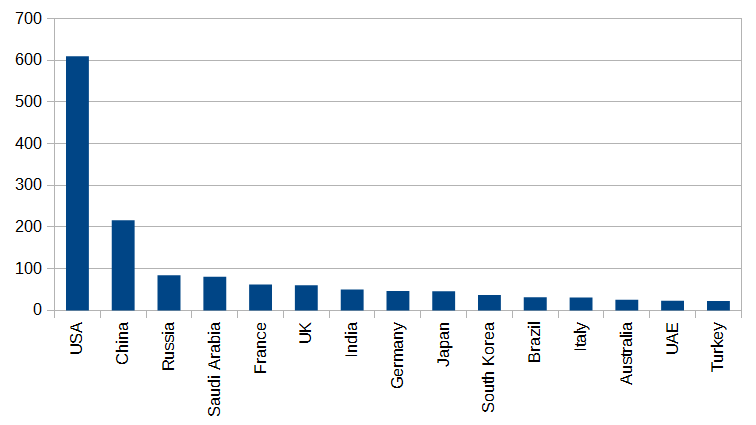
One of these things is not like the other ones…
It probably makes the most sense to compare military spending as a portion of GDP, which makes the US no longer an outlier worldwide, but still very high by First World standards:

If we do want to compare military spending to other forms of spending, I think we should do that in international perspective as well. Here is a graph of education spending versus military spending as a portion of GDP, in several First World countries (military from SIPRI and the CIA, and education from the UNDP):
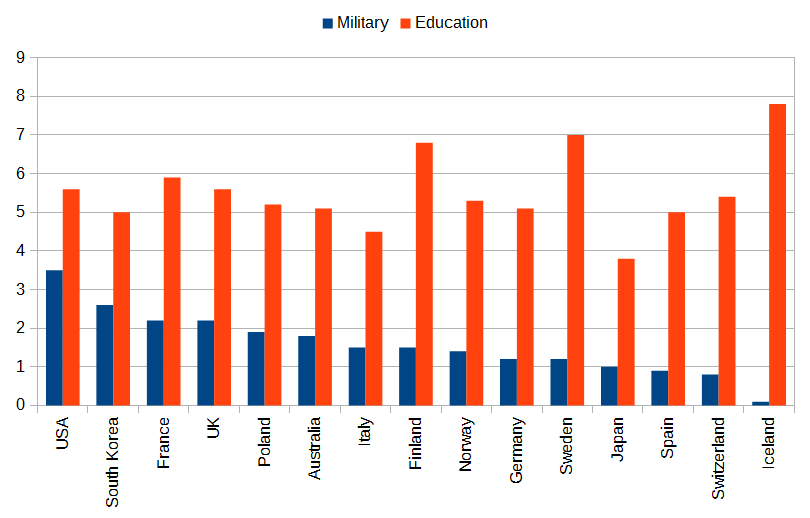
Our education spending is about average (though somehow we do it so inefficiently that we don’t provide college for free, unlike Germany, France, Finland, Sweden, or Norway), but our military spending is by far the highest.
How about a meme about that?
Elasticity and the Law of Supply
JDN 2457292 EDT 16:16.
Today’s post is kind of a mirror image of the previous post earlier this week; I was talking about demand before, and now I’m talking about supply. (In the next post, I’ll talk about how the two work together to determine the actual price of goods.)
Just as there is an elasticity of demand which describes how rapidly the quantity demanded changes with changes in price, likewise there is an elasticity of supply which describes how much the quantity supplied changes with changes in price.
The elasticity of supply is defined as the proportional change in quantity supplied divided by the proportional change in price; so for example if the number of cars produced increases 10% when the price of cars increases by 5%, the elasticity of supply of cars would be 10%/5% = 2.
Goods that have high elasticity of supply will rapidly flood the market if the price increases even a small amount; goods that have low elasticity of supply will sell at about the same rate as ever even if the price increases dramatically.
Generally, the more initial investment of capital a good requires, the lower its elasticity of supply is going to be.
If most of the cost of production is in the actual marginal cost of producing each new gizmo, then elasticity of supply will be high, because it’s easy to produce more or produce less as the market changes.
But if most of the cost is in building machines or inventing technologies or training employees which already has to be done in order to make any at all, while the cost of each individual gizmo is unimportant, the elasticity of supply will be low, because there’s no sense letting all that capital you invested go to waste.
We can see these differences in action by comparing different sources of electric power.
Photovoltaic solar power has a high elasticity of supply, because building new solar panels is cheap and fast. As the price of solar energy fluctuates, the amount of solar panel produced changes rapidly. Technically this is actually a “fixed capital” cost, but it’s so modular that you can install as little or as much solar power capacity as you like, which makes it behave a lot more like a variable cost than a fixed cost. As a result, a 1% increase in the price paid for solar power increases the amount supplied by a whopping 2.7%, a supply elasticity of 2.7.
Oil has a moderate elasticity of supply, because finding new oil reserves is expensive but feasible. A lot of oil in the US is produced by small wells; 18% of US oil is produced by wells that put out less than 10 barrels per day. Those small wells can be turned on and off as the price of oil changes, and new ones can be built if it becomes profitable. As a result, investment in oil production is very strongly correlated with oil prices. Still, overall production of oil changes only moderate amounts; in the US it had been steadily decreasing since 1970 until very recently when new technologies and weakened regulations resulted in a rapid increase to near-1970s levels. We sort of did hit peak oil; but it’s never quite that simple.
Nuclear fission has a very low elasticity of supply, because building a nuclear reactor is extremely expensive and requires highly advanced expertise. Building a nuclear power plant costs upward of $35 billion. Once a reactor is built, the cost of generating more power is relatively trivial; three-fourths of the cost a nuclear power plant will ever pay is paid simply to build it (or to pay back the debt incurred by doing so). Even if the price of uranium plummets or the price of oil skyrockets, it would take a long time before more nuclear power plants would be built in response.
Elasticity of supply is generally a lot larger in the long run than in the short run. Over a period of a few days or months, many types of production can’t be changed significantly. If you have a corn field, you grow as much corn as you can this season; even if the price rose substantially you couldn’t actually grow any more than your field will allow. But over a period of a year to a few years, most types of production can be changed; continuing with the corn example, you could buy new land to plant corn next season.
The Law of Supply is actually a lot closer to a true law than the Law of Demand. A negative elasticity of supply is almost unheard of; at worst elasticity of supply can sometimes drop close to zero. It really is true that elasticity of supply is almost always positive.
Land has an elasticity near zero; it’s extremely expensive (albeit not impossible; Singapore does it rather frequently) to actually create new land. As a result there’s really no good reason to ever raise the price of land; higher land prices don’t incentivize new production, they just transfer wealth to landowners. That’s why a land tax is such a good idea; it would transfer some of that wealth away from landowners and let us use it for public goods like infrastructure or research, or even just give it to the poor. A few countries actually have tried this; oddly enough, they include Singapore and Denmark, two of the few places in the world where the elasticity of land supply is appreciably above zero!
Real estate in general (which is what most property taxes are imposed on) is much trickier: In the short run it seems to have a very low elasticity, because building new houses or buildings takes a lot of time and money. But in the long run it actually has a high elasticity of supply, because there is a lot of profit to be made in building new structures if you can fund projects 10 or 15 years out. The short-run elasticity is something like 0.2, meaning a 1% increase in price only yields a 0.2% increase in supply; but the long-run elasticity may be as high as 8, meaning that a 1% increase in price yields an 8% increase in supply. This is why property taxes and rent controls seem like a really good idea at the time but actually probably have the effect of making housing more expensive. The economics of real estate has a number of fundamental differences from the economics of most other goods.
Many important policy questions ultimately hinge upon the elasticity of supply: If elasticity is high, then taxing or regulating something is likely to cause large distortions of the economy, while if elasticity is low, taxes and regulations can be used to support public goods or redistribute wealth without significant distortion to the economy. On the other hand, if elasticity is high, markets generally function well on their own, while if elasticity is low, prices can get far out of whack. As a general rule of thumb, government intervention in markets is most useful and most necessary when elasticity is low.
Elasticity and the Law of Demand
JDN 2457289 EDT 21:04
This will be the second post in my new bite-size format, the first one that’s in the middle of the week.
I’ve alluded previously to the subject of demand elasticity, but I think it’s worth explaining in a little more detail. The basic concept is fairly straightforward: Demand is more elastic when the amount that people want to buy changes a large amount for a small change in price. The opposite is inelastic.
Apples are a relatively elastic good. If the price of apples goes up, people buy fewer apples. Maybe they buy other fruit instead, such as oranges or bananas; or maybe they give up on fruit and eat something else, like rice.
Salt is an extremely inelastic good. No matter what the price of salt is, at least within the range it has been for the last few centuries, people are going to continue to buy pretty much the same amount of salt. (In ancient times salt was actually expensive enough that people couldn’t afford enough of it, which was particularly harmful in desert regions. Mark Kulansky’s book Salt on this subject is surprisingly compelling, given the topic.)
Specifically, the elasticity is equal to the proportional change in quantity demanded, divided by the proportional change in price.
For example, if the price of gas rises from $2 per gallon to $3 per gallon, that’s a 50% increase. If the quantity of gas purchase then falls from 100 billion gallons to 90 billion gallons, that’s a 10% decrease. If increasing the price by 50% decreased the quantity demanded by 10%, that would be a demand elasticity of -10%/50% = -1/5 = -0.2
In practice, measuring elasticity is more complicated than that, because supply and demand are both changing at the same time; so when we see a price change and a quantity change, it isn’t always clear how much of each change is due to supply and how much is due to demand. Sophisticated econometric techniques have been developed to try to separate these two effects (in future posts I plan to explain the basics of some of these techniques), but it’s difficult and not always successful.
In general, markets function better when supply and demand are more elastic. When shifts in price trigger large shifts in quantity, this creates pressure on the price to remain at a fixed level rather than jumping up and down. This in turn means that the market will generally be predictable and stable.
It’s also much harder to make monopoly profits in a market with elastic demand; even if you do have a monopoly, if demand is highly elastic then raising the price won’t make you any money, because whatever you gain in selling each gizmo for more, you’ll lose in selling fewer gizmos. In fact, the profit margin for a monopoly is inversely proportional to the elasticity of demand.
Markets do not function well when supply and demand are highly inelastic. Monopolies can become very powerful and result in very large losses of human welfare. A particularly vivid example of this was in the news recently, when a company named Turing purchased the rights to a drug called Daraprim used primarily by AIDS patients, then hiked the price from $13.50 to $750. This made enough people mad that the CEO has since promised to bring it back down, though he hasn’t said how far.
That price change was only possible because Daraprim has highly inelastic demand—if you’ve got AIDS, you’re going to take AIDS medicine, as much as prescribed, provided only that it doesn’t drive you completely bankrupt. (Not an unreasonable fear, as medical costs are the leading cause of bankruptcy in the United States.) This raised price probably would bankrupt a few people, but for the most part it wouldn’t affect the amount of drug sold; it would just funnel a huge amount of money from AIDS patients to the company. This is probably part of why it made people so mad; that and there would probably be a few people who died because they couldn’t afford this new expensive medication.
Imagine if a company had tried to pull the same stunt for a more elastic good, like apples. “CEO buys up all apple farms, raises price of apples from $2 per pound to $100 per pound.” What’s going to happen then? People are not going to buy any apples. Perhaps a handful of the most die-hard apple lovers still would, but the rest of us are going to meet our fruit needs elsewhere.
For most goods most of the time, elasticity of demand is negative, meaning that as price increases, quantity demanded decreases. This is in fact called the Law of Demand; but as I’ve said, “laws” in economics are like the Pirate Code: They’re really more what you’d call “guidelines”.
There are three major exceptions to the Law of Demand. The first one is the one most economists talk about, and it almost never happens. The second one is talked about occasionally, and it’s quite common. The third one is almost never talked about, and yet it is by far the most common and one of the central driving forces in modern capitalism.
The exception that we usually talk about in economics is called the Giffen Effect. A Giffen good is a good that’s so cheap and such a bare necessity that when it becomes more expensive, you won’t be able to buy less of it; instead you’ll buy more of it, and buy less of other things with your reduced income.
It’s very hard to come up with empirical examples of Giffen goods, but it’s an easy theoretical argument to make. Suppose you’re buying grapes for a party, and you know you need 4 bags of grapes. You have $10 to spend. Suppose there are green grapes selling for $1 per bag and red grapes selling for $4 per bag, and suppose you like red grapes better. With your $10, you can buy 2 bags of green grapes and 2 bags of red grapes, and that’s the 4 bags you need. But now suppose that the price of green grapes rises to $2 per bag. In order to afford 4 bags of grapes, you now need to buy 3 bags of green grapes and only 1 bag of red grapes. Even though it was the price of green grapes that rose, you ended up buying more green grapes. In this scenario, green grapes are a Giffen good.
The exception that is talked about occasionally and occurs a lot in real life is the Veblen Effect. Whereas a Giffen good is a very cheap bare necessity, a Veblen good is a very expensive pure luxury.
The whole point of buying a Veblen good is to prove that you can. You don’t buy a Ferrari because a Ferrari is a particularly nice automobile (a Prius is probably better, and a Tesla certainly is); you buy a Ferrari to show off that you’re so rich you can buy a Ferrari.
On my previous post, jenszorn asked: “Much of consumer behavior is irrational by your standards. But people often like to spend money just for the sake of spending and for showing off. Why else does a Rolex carry a price tag for $10,000 for a Rolex watch when a $100 Seiko keeps better time and requires far less maintenance?” Veblen goods! It’s not strictly true that Veblen goods are irrational; it can be in any particular individual’s best interest is served by buying Veblen goods in order to signal their status and reap the benefits of that higher status. However, it’s definitely true that Veblen goods are inefficient; because ostentatious displays of wealth are a zero-sum game (it’s not about what you have, it’s about what you have that others don’t), any resources spent on rich people proving how rich they are are resources that society could otherwise have used, say, feeding the poor, curing diseases, building infrastructure, or colonizing other planets.
Veblen goods can also result in a violation of the Law of Demand, because raising the price of a Veblen good like Ferraris or Rolexes can make them even better at showing off how rich you are, and therefore more appealing to the kind of person who buys them. Conversely, lowering the price might not result in any more being purchased, because they wouldn’t seem as impressive anymore. Currently a Ferrari costs about $250,000; if they reduced that figure to $100,000, there aren’t a lot of people who would suddenly find it affordable, but many people who currently buy Ferraris might switch to Bugattis or Lamborghinis instead. There are limits to this, of course: If the price of a Ferrari dropped to $2,000, people wouldn’t buy them to show off anymore; but the far larger effect would be the millions of people buying them because you can now get a perfectly good car for $2,000. Yes, I would sell my dear little Smart if it meant I could buy a Ferrari instead and save $8,000 at the same time.
But the third major exception to the Law of Demand is actually the most important one, yet it’s the one that economists hardly ever talk about: Speculation.
The most common reason why people would buy more of something that has gotten more expensive is that they expect it to continue getting more expensive, and then they will be able to sell what they bought at an even higher price and make a profit.
When the price of Apple stock goes up, do people stop buying Apple stock? On the contrary, they almost certainly start buying more—and then the price goes up even further still. If rising prices get self-fulfilling enough, you get an asset bubble; it grows and grows until one day it can’t, and then the bubble bursts and prices collapse again. This has happened hundreds of times in history, from the Tulip Mania to the Beanie Baby Bubble to the Dotcom Boom to the US Housing Crisis.
It isn’t necessarily irrational to participate in a bubble; some people must be irrational, but most people can buy above what they would be willing to pay by accurately predicting that they’ll find someone else who is willing to pay an even higher price later. It’s called Greater Fool Theory: The price I paid may be foolish, but I’ll find someone who is even more foolish to take it off my hands. But like Veblen goods, speculation goods are most definitely inefficient; nothing good comes from prices that rise and fall wildly out of sync with the real value of goods.
Speculation goods are all around us, from stocks to gold to real estate. Most speculation goods also serve some other function (though some, like gold, are really mostly just Veblen goods otherwise; actual useful applications of gold are extremely rare), but their speculative function often controls their price in a way that dominates all other considerations. There’s no real limit to how high or low the price can go for a speculation good; no longer tied to the real value of the good, it simply becomes a question of how much people decide to pay.
Indeed, speculation bubbles are one of the fundamental problems with capitalism as we know it; they are one of the chief causes of the boom-and-bust business cycle that has cost the world trillions of dollars and thousands of lives. Most of our financial industry is now dedicated to the trading of speculation goods, and finance is taking over a larger and larger section of our economy all the time. Many of the world’s best and brightest are being funneled into finance instead of genuinely productive industries; 15% of Harvard grads take a job in finance, and almost half did just before the crash. The vast majority of what goes on in our financial system is simply elaborations on speculation; very little real productivity ever enters into the equation.
In fact, as a general rule I think when we see a violation of the Law of Demand, we know that something is wrong in the economy. If there are Giffen goods, some people are too poor to buy what they really need. If there are Veblen goods, inequality is too large and people are wasting resources competing for status. And since there are always speculation goods, the history of capitalism has been a history of market instability.
Fortunately, elasticity of demand is usually negative: As the price goes up, people want to buy less. How much less is the elasticity.
Advertising: Someone is being irrational
JDN 2457285 EDT 12:52
I’m working on moving toward a slightly different approach to posting; instead of one long 3000-word post once a week, I’m going to try to do two more bite-sized posts of about 1500 words or less spread throughout the week. I’m actually hoping to work toward setting up a Patreon and making blogging into a source of income.
Today’s bite-sized post is about advertising, and a rather simple, basic argument that shows that irrational economic behavior is widespread.
First, there are advertisements that don’t make sense. They don’t tell you anything about the product, they are often completely absurd, and while sometimes entertaining they are rarely so entertaining that people would pay to see them in theaters or buy them on DVD—which means that any entertainment value they had is outweighed by the opportunity cost of seeing them instead of the actual TV show, movie, or whatever else it was you wanted to see.
If you doubt that there are advertisements that don’t make sense, I have one example in particular for you which I think will settle this matter:
If you didn’t actually watch it, you must. It is too absurd to be explained.
And of course there are many other examples, from Coca-Cola’s weird associations with polar bears to the series of GEICO TV spots about Neanderthals that they thought were so entertaining as to deserve a TV show (the world proved them wrong), to M&M commercials that present a terrifying world in which humans regularly consume the chocolatey flesh of other sapient citizens (and I thought beef was bad!).
Or here’s another good one:
In the above commercial, Walmart attempts to advertise themselves by showing a heartwarming story of a child who works hard to make money by doing odd jobs, including using the model of door-to-door individual sales that Walmart exists to make obsolete. The only contribution Walmart makes to the story is apparently “we have affordable bicycles for children”. Coca-Cola is also thrown in for some reason.
Certain products seem to attract nonsensical advertising more than others, with car insurance being the prime culprit of totally nonsensical and irrelevant commercials, perhaps because of GEICO in particular who do not actually seem to be any good at providing car insurance but instead spend all of their resources making commercials.
Commercials for cars themselves are an interesting case, as certain ads actually appeal in at least a general way to the quality of the vehicle itself:
Then there are those that vaguely allude to qualities of their vehicles, but mostly immerse us in optimistic cyberpunk:
Others, however, make no attempt to say anything about the vehicle, instead spinning us exciting tales of giant hamsters who use the car and the power of dance to somehow form a truce between warring robot factions in a dystopian future (if you haven’t seen this commercial, none of that is a joke; see for yourself below):
So, I hope that I have satisfied you that there are in fact advertisements which don’t make sense, which could not possibly give anyone a rational reason to purchase the product contained within.
Therefore, at least one of the following statements must be true:
1. Consumers behave irrationally by buying products for irrational reasons
2. Corporations behave irrationally by buying advertisements that don’t work
Both could be true (in fact I think both are true), but at least one must be, on pain of contradiction, as long as you accept that there are advertisements which don’t provide rational reasons to buy products. There’s no wiggling out of this one, neoclassicists.
Advertising forms a large part of our economy—Americans spend $171 billion per year on ads, more than the federal government spends on education, and also more than the nominal GDP of Hungary or Vietnam. This figure is growing thanks to the Internet and its proliferation of “free” ad-supported content. Insofar as advertising is irrational, this money is being thrown down the drain.
The waste from spending on ads that don’t work is limited; you can’t waste more than you actually spent. But the waste from buying things you don’t actually need is not limited in the same way; an ad that cost $1 million to air (cheaper than a typical Super Bowl ad) could lead to $10 million in worthless purchases.
I wouldn’t say that all advertising is irrational; some ads do actually provide enough meaningful information about a product that they could reasonably motivate you to buy it (or at least look into buying it), and it is in both your best interest and the company’s best interest for you to have such information.
But I think it’s not unreasonable to estimate that about half of our advertising spending is irrational, either by making people buy things for bad reasons or by making corporations waste time and money on buying ads that don’t work. This amounts to some $85 billion per year, or enough to pay every undergraduate tuition at every public university in the United States.
This state of affairs is not inevitable.
Most meaningless ads could be undermined by regulation; instead of the current “blacklist” model where an ad is legal as long as it doesn’t explicitly state anything that is verifiably false, we could move to a “whitelist” model where an ad is illegal if it states anything that isn’t verifiably true. Red Bull cannot give you wings, Maxwell House isn’t good to the last drop, and Volkswagen needs to be more specific than “round for a reason”. We may never be able to completely eliminate irrelevant emotionally-salient allusions (pictures of families, children, puppies, etc.), but as long as the actual content of the words is regulated it would be much harder to deluge people with advertisements that provide no actual information.
We have a choice, as a civilization: Do we want to continue to let meaningless ads invade our brains and waste the resources of our society?
9/11, 14 years on—and where are our civil liberties?
JDN 2457278 (09/11/2015) EDT 20:53
Today is the 14th anniversary of the 9/11 attacks. A lot has changed since then—yet it’s quite remarkable what hasn’t. In particular, we still don’t have our civil liberties back.
In our immediate panicked response to the attacks, the United States passed almost unanimously the USA PATRIOT ACT, giving unprecedented power to our government in surveillance, searches, and even arrests and detentions. Most of those powers have been renewed repeatedly and remain in effect; the only major change has been a slight weakening of the NSA’s authority to use mass dragnet surveillance on Internet traffic and phone metadata. And this change in turn was almost certainly only made because of Edward Snowden, who is still forced to live in Russia for fear of being executed if he returns to the US. That is, the man most responsible for the only significant improvement in civil liberties in the United States in the last decade is living in Russia because he has been branded a traitor. No, the traitors here are the over one hundred standing US Congress members who voted for an act that is in explicit and direct violation of the Constitution. At the very least every one of them should be removed from office, and we as voters have the power to do that—so why haven’t we? In particular, why are Dan Lipinski and Steny Hoyer, both Democrats from non-southern states who voted every single time to extend provisions of the PATRIOT ACT, still in office? At least Carl Levin had the courtesy to resign after sponsoring the act allowing indefinite detention—I hope we would have voted him out anyway, since I’d much rather have a Republican (and all the absurd economic policy that entails) than someone who apparently doesn’t believe the Fourth and Sixth Amendments have any meaning at all.
We have become inured to this loss of liberty; it feels natural or inevitable to us. But these are not minor inconveniences; they are not small compromises. Giving our government the power to surveil, search, arrest, imprison, torture, and execute anyone they want at any time without the system of due process—and make no mistake, that is what the PATRIOT ACT and the indefinite detention law do—means giving away everything that separates us from tyranny. Bypassing the justice system and the rule of law means bypassing everything that America stands for.
So far, these laws have actually mostly been used against people reasonably suspected of terrorism, that much is true; but it’s also irrelevant. Democracy doesn’t mean you give the government extreme power and they uphold your trust and use it benevolently. Democracy means you don’t give them that power in the first place.
If there’s really sufficient evidence to support an arrest for terrorism, get a warrant. If you don’t have enough evidence for a warrant, you don’t have enough evidence for an arrest. If there’s really sufficient evidence to justify imprisoning someone for terrorism, get a jury to convict. If you don’t have enough evidence to convince a jury, guess what? You don’t have enough evidence to imprison them. These are not negotiable. They are not “political opinions” in any ordinary sense. The protection of due process is so fundamental to democracy that without it political opinions lose all meaning.
People talk about “Big Government” when we suggest increasing taxes on capital gains or expanding Medicare. No, that isn’t Big Government. Searching without warrants is Big Government. Imprisoning people without trial is Big Government. From all the decades of crying wolf in which any policy someone doesn’t like is accused of being “tyranny”, we seem to have lost the ability to recognize actual tyranny. I hope you understand the full force of my meaning when I say that the PATRIOT ACT is literally fascist. Fascism has come to America, and as predicted it was wrapped in the flag and carrying a cross.
In this sort of situation, a lot of people like to quote (or misquote) Benjamin Franklin:
“Those who would give up essential Liberty, to purchase a little temporary Safety, deserve neither Liberty nor Safety.”
With the qualifiers “essential” and “temporary”, this quote seems right; but a lot of people forget them and quote him as saying:
“Those would give up liberty to purchase safety, deserve neither liberty nor safety.”
That’s clearly wrong. We do in fact give up liberty to purchase safety, and as well we should. We give up our liberty to purchase weapons-grade plutonium; we give up our liberty to drive at 220 mph. The question we need to be asking is: How much liberty are we giving up to gain how much safety?
Spoken like an economist, the question is not whether you will give up liberty to purchase safety—the question is at what price you’re willing to make the purchase. The price we’ve been paying in response to terrorism is far too high. Indeed, the price we are paying is tantamount to America itself.
As horrific as 9/11 was, it’s important to remember: It only killed 3,000 people.
This statement probably makes you uncomfortable; it may even offend you. How dare I say “only”?
I don’t mean to minimize the harm of those deaths. I don’t mean to minimize the suffering of people who lost friends, colleagues, parents, siblings, children. The death of any human being is the permanent destruction of something irreplaceable, a spark of life that can never be restored; it is always a tragedy and there is never any way to repay it.
But I think people are actually doing the opposite—they are ignoring or minimizing millions of other deaths because those deaths didn’t happen to be dramatic enough. A parent killed by a heart attack is just as lost as a parent who died in 9/11. A friend who died of brain cancer is just as gone as a friend who was killed in a terrorist attack. A child killed in a car accident is just as much a loss as a child killed by suicide bombers. If you really care about human suffering, I contend that you should care about all human suffering, not just the kind that makes the TV news.
Here is a list, from the CDC, of things that kill more Americans per month than terrorists have killed in the last three decades:
Heart disease: 50,900 per month
Cancer: 48,700 per month
Lung disease: 12,400 per month
Accidents: 10,800 per month
Stroke: 10,700 per month
Alzheimer’s: 7,000 per month
Diabetes: 6,300 per month
Influenza: 4,700 per month
Kidney failure: 3,900 per month
Terrorism deaths since 1985: 3,455
Yes, that’s right; influenza kills more Americans per month (on average; flu is seasonal, after all) than terrorism has killed in the last thirty years.
And for comparison, other violent deaths, not quite but almost as many per month as terrorism has killed in my entire life so far:
Suicide: 3,400 per month
Homicide: 1,300 per month
Now, with those figures in mind, I want you to ask yourself the following question: Would you be willing to give up basic, fundamental civil liberties in order to avoid any of these things?
Would you want the government to be able to arrest you and imprison you without trial for eating too many cheeseburgers, so as to reduce the risk of heart disease and stroke?
Would you want the government to monitor your phone calls and Internet traffic to make sure you don’t smoke, so as to avoid lung disease? Or to watch for signs of depression, to reduce the rate of suicide?
Would you want the government to be able to use targeted drone strikes, ordered directly by the President, pre-emptively against probable murderers (with a certain rate of collateral damage, of course), to reduce the rate of homicide?
I presume that the answer to all the above questions is “no”. Then now I have to ask you: Why are you willing to give up those same civil liberties to prevent a risk that is three hundred times smaller?
And then of course there’s the Iraq War, which killed 4,400 Americans and at least 100,000 civilians, and the Afghanistan War, which killed 3,400 allied soldiers and over 90,000 civilians.
In response to the horrific murder of 3,000 people, we sacrificed another 7,800 soldiers and killed another 190,000 innocent civilians. What exactly did that accomplish? What benefit did we get for such an enormous cost?
The people who sold us these deadly wars and draconian policies did so based on the threat that terrorism could somehow become vastly worse, involving the release of some unstoppable bioweapon or the detonation of a full-scale nuclear weapon, killing millions of people—but that has never happened, has never gotten close to happening, and would be thousands of times worse than the worst terrorist attacks that have ever actually happened.
If we’re worried about millions of people dying, it is far more likely that there would be a repeat of the 1918 influenza pandemic, or an accidental detonation of a nuclear weapon, or a flashpoint event with Russia or China triggering World War III; it’s probably more likely that there would be an asteroid impact large enough to kill a million people than there would be a terrorist attack large enough to do the same.
As it is, heart disease is already killing millions of people—about a million every two years—and we aren’t so panicked about that as to give up civil liberties. Elsewhere in the world, malnutrition kills over 3 million children per year, essentially all of it due to extreme poverty, which we could eliminate by spending between a quarter ($150 billion) and a half ($300 billion) of our current military budget ($600 billion); but we haven’t even done that even though it would require no loss of civil liberties at all.
Why is terrorism different? In short, the tribal paradigm.
There are in fact downsides to not being infinite identical psychopaths, and this is one of them. An infinite identical psychopath would simply maximize their own probability of survival; but finite diverse tribalists such as we underreact to some threats (such as heart disease) and overreact to others (such as terrorism). We’ll do almost anything to stop the latter—and almost nothing to stop the former.
Terrorists are perceived as a threat not just to our individual survival like heart disease or stroke, but a threat to our tribe from another tribe. This triggers a deep, instinctual sense of panic and hatred that makes us willing to ignore principles we would otherwise uphold and commit acts of violence we would otherwise find unimaginable.
Indeed, it’s precisely that instinct which motivates the terrorists in the first place. From their perspective, we are the other tribe that threatens their tribe, and they are therefore willing to stop at nothing until we are destroyed.
In a fundamental way, when we respond to terrorism in this way we do not defeat them—we become them.
If you ask people who support the PATRIOT ACT, it’s very clear that they don’t see themselves as imposing upon the civil liberties of Americans. Instead, they see themselves as protecting Americans (our tribe), and they think the impositions upon civil liberties will only harm those who don’t count as Americans (other tribes). This is a pretty bizarre notion if you think about it carefully—if you don’t need a warrant or probable cause to imprison people, then what stops you from imprisoning people who aren’t terrorists?—but people don’t think about it carefully. They act on emotion, on instinct.
The odds of terrorists actually destroying America by killing people are basically negligible. Even the most deadly terrorist attack in recorded history—9/11—killed fewer Americans than die every month from diabetes, or every week from heart disease. Even the most extreme attacks feared (which are extremely unlikely) wouldn’t be any worse than World War II, which of course we won.
But the odds of terrorists destroying America by making us give up the rights and freedoms that define us as a nation? That’s well underway.

