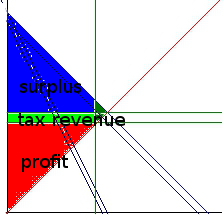
Tax incidence revisited, part 3: Taxation and the value of money

JDN 2457352

Our journey through the world of taxes continues. I’ve already talked about how taxes have upsides and downsides, as well as how taxes directly affect prices and “before-tax” prices are almost meaningless.

Now it’s time to get into something that even a lot of economists don’t quite seem to grasp, yet which turns out to be fundamental to what taxes truly are.

In the usual way of thinking, it works something like this: We have an economy, through which a bunch of money flows, and then the government comes in and takes some of that money in the form of taxes. They do this because they want to spend money on a variety of services, from military defense to public schools, and in order to afford doing that they need money, so they take in taxes.

This view is not simply wrong—it’s almost literally backwards. Money is not something the economy had that the government comes in and takes. Money is something that the government creates and then adds to the economy to make it function more efficiently. Taxes are not the government taking out money that they need to use; taxes are the government regulating the quantity of money in the system in order to stabilize its value. The government could spend as much money as they wanted without collecting a cent in taxes (not should, but could—it would be a bad idea, but definitely possible); taxes do not exist to fund the government, but to regulate the money supply.

Indeed—and this is the really vital and counter-intuitive point—without taxes, money would have no value.

There is an old myth of how money came into existence that involves bartering: People used to trade goods for other goods, and then people found that gold was particularly good for trading, and started using it for everything, and then eventually people started making paper notes to trade for gold, and voila, money was born.

In fact, such a “barter economy” has never been documented to exist. It probably did once or twice, just given the enormous variety of human cultures; but it was never widespread. Ancient economies were based on family sharing, gifts, and debts of honor.

It is true that gold and silver emerged as the first forms of money, “commodity money”, but they did not emerge endogenously out of trading that was already happening—they were created by the actions of governments. The real value of the gold or silver may have helped things along, but it was not the primary reason why people wanted to hold the money. Money has been based upon government for over 3000 years—the history of money and civilization as we know it. “Fiat money” is basically a redundancy; almost all money, even in a gold standard system, is ultimately fiat money.

The primary reason why people wanted the money was so that they could use it to pay taxes.

It’s really quite simple, actually.

When there is a rule imposed by the government that you will be punished if you don’t turn up on April 15 with at least $4,287 pieces of green paper marked “US Dollar”, you will try to acquire $4,287 pieces of green paper marked “US Dollar”. You will not care whether those notes are exchangeable for gold or silver; you will not care that they were printed by the government originally. Because you will be punished if you don’t come up with those pieces of paper, you will try to get some.

If someone else has some pieces of green paper marked “US Dollar”, and knows that you need them to avoid being punished on April 15, they will offer them to you—provided that you give them something they want in return. Perhaps it’s a favor you could do for them, or something you own that they’d like to have. You will be willing to make this exchange, in order to avoid being punished on April 15.
Thus, taxation gives money value, and allows purchases to occur.

Once you establish a monetary system, it becomes self-sustaining. If you know other people will accept money as payment, you are more willing to accept money as payment because you know that you can go spend it with those people. “Legal tender” also helps this process along—the government threatens to punish people who refuse to accept money as payment. In practice, however, this sort of law is rarely enforced, and doesn’t need to be, because taxation by itself is sufficient to form the basis of the monetary system.

It’s deeply ironic that people who complain about printing money often say we are “debasing” the currency; when you think carefully about what debasement was, it clearly shows that the value of money never really resided in the gold or silver itself. If a government can successfully extract revenue from its monetary system by changing the amount of gold or silver in each coin, then the value of those coins can’t be in the gold and silver—it has to be in the power of the government. You can’t make a profit by dividing a commodity into smaller pieces and then selling the pieces. (Okay, you sort of can, by buying in bulk and selling at retail. But that’s not what we’re talking about. You can’t make money by buying 100 50-gallon barrels of oil and then selling them as 125 40-gallon barrels of oil; it’s the same amount of oil.)

Similarly, the fact that there is such a thing as seignioragethe value of currency in excess of its cost to create—shows that governments impart value to their money. Indeed, one of the reasons for debasement was to realign the value of coins with the value of the metals in the coins, which wouldn’t be necessary if those were simply by definition the same thing.

Taxation serves another important function in the monetary system, which is to regulate the supply of money. The government adds money to the economy by spending, and removes it by taxing; if they add more than they remove—a deficit—the money supply increases, while if they remove more than they add—a surplus—the money supply decreases. In order to maintain stable prices, you want the money supply to increase at approximately the rate of growth; for moderate inflation (which is probably better than actual price stability), you want the money supply to increase slightly faster than the rate of growth. Thus, in general we want the government deficit as a portion of GDP to be slightly larger than the growth rate of the economy. Thus, our current deficit of 2.8% of GDP is actually about where it should be, and we have no particular reason to want to decrease it. (This is somewhat oversimplified, because it ignores the contribution of the Federal Reserve, interest rates, and bank-created money. Most of the money in the world is actually not created by the government, but by banks which are restrained to greater or lesser extent by the government.)

Even a lot of people who try to explain modern monetary theory mistakenly speak as though there was a fundamental shift when we fully abandoned the gold standard in the 1970s. (This is a good explanation overall, but it makes this very error.) But in fact a gold standard really isn’t money “backed” by anything—gold is not what gives the money value, gold is almost worthless by itself. It’s pretty and it doesn’t corrode, but otherwise, what exactly can you do with it? Being tied to money is what made gold valuable, not the other way around. To see this, imagine a world where you have 20,000 tons of gold, but you know that you can never sell it. No one will ever purchase a single ounce. Would you feel particularly rich in that scenario? I think not. Now suppose you have a virtually limitless quantity of pieces of paper that you know people will accept for anything you would ever wish to buy. They are backed by nothing, they are just pieces of paper—but you are now rich, by the standard definition of the word. I can even make the analogy remove the exchange value of money and just use taxation: if you know that in two days you will be imprisoned if you don’t have this particular piece of paper, for the next two days you will guard that piece of paper with your life. It won’t bother you that you can’t exchange that piece of paper for anything else—you wouldn’t even want to. If instead someone else has it, you’ll be willing to do some rather large favors for them in order to get it.

Whenever people try to tell me that our money is “worthless” because it’s based on fiat instead of backed by gold (this happens surprisingly often), I always make them an offer: If you truly believe that our money is worthless, I’ll gladly take any you have off of your hands. I will even provide you with something of real value in return, such as an empty aluminum can or a pair of socks. If they truly believe that fiat money is worthless, they should eagerly accept my offer—yet oddly, nobody ever does.

This does actually create a rather interesting argument against progressive taxation: If the goal of taxation is simply to control inflation, shouldn’t we tax people based only on their spending? Well, if that were the only goal, maybe. But we also have other goals, such as maintaining employment and controlling inequality. Progressive taxation may actually take a larger amount of money out of the system than would be necessary simply to control inflation; but it does so in order to ensure that the super-rich do not become even more rich and powerful.

Governments are limited by real constraints of power and resources, but they they have no monetary constraints other than those they impose themselves. There is definitely something strongly coercive about taxation, and therefore about a monetary system which is built upon taxation. Unfortunately, I don’t know of any good alternatives. We might be able to come up with one: Perhaps people could donate to public goods in a mutually-enforced way similar to Kickstarter, but nobody has yet made that practical; or maybe the government could restructure itself to make a profit by selling private goods at the same time as it provides public goods, but then we have all the downsides of nationalized businesses. For the time being, the only system which has been shown to work to provide public goods and maintain long-term monetary stability is a system in which the government taxes and spends.

A gold standard is just a fiat monetary system in which the central bank arbitrarily decides that their money supply will be directly linked to the supply of an arbitrarily chosen commodity. At best, this could be some sort of commitment strategy to ensure that they don’t create vastly too much or too little money; but at worst, it prevents them from actually creating the right amount of money—and the gold standard was basically what caused the Great Depression. A gold standard is no more sensible a means of backing your currency than would be a standard requiring only prime-numbered interest rates, or one which requires you to print exactly as much money per minute as the price of a Ferrari.

No, the real thing that backs our money is the existence of the tax system. Far from taxation being “taking your hard-earned money”, without taxes money itself could not exist.
Tax incidence revisited, part 2: How taxes affect prices

JDN 2457341

One of the most important aspects of taxation is also one of the most counter-intuitive and (relatedly) least-understood: Taxes are not externally applied to pre-existing exchanges of money. Taxes endogenously interact with the system of prices, changing what the prices will be and then taking a portion of the money exchanged.

The price of something “before taxes” is not actually the price you would pay for it if there had been no taxes on it. Your “pre-tax income” is not actually the income you would have had if there were no income or payroll taxes.

The most obvious case to consider is that of government employees: If there were no taxes, public school teachers could not exist, so the “pre-tax income” of a public school teacher is a meaningless quantity. You don’t “take taxes out” of a government salary; you decide how much money the government employee will actually receive, and then at the same time allocate a certain amount into other budgets based on the tax code—a certain amount into the state general fund, a certain amount into the Social Security Trust Fund, and so on. These two actions could in principle be done completely separately; instead of saying that a teacher has a “pre-tax salary” of $50,000 and is taxed 20%, you could simply say that the teacher receives $40,000 and pay $10,000 into the appropriate other budgets.

In fact, when there is a conflict of international jurisdiction this is sometimes literally what we do. Employees of the World Bank are given immunity from all income and payroll taxes (effectively, diplomatic immunity, though this is not usually how we use the term) based on international law, except for US citizens, who have their taxes paid for them by the World Bank. As a result, all World Bank salaries are quoted “after-tax”, that is, the actual amount of money employees will receive in their paychecks. As a result, a $120,000 salary at the World Bank is considerably higher than a $120,000 salary at Goldman Sachs; the latter would only (“only”) pay about $96,000 in real terms.

For private-sector salaries, it’s not as obvious, but it’s still true. There is actually someone who pays that “before-tax” salary—namely, the employer. “Pre-tax” salaries are actually a measure of labor expenditure (sometimes erroneously called “labor costs”, even by economists—but a true labor cost is the amount of effort, discomfort, stress, and opportunity cost involved in doing labor; it’s an amount of utility, not an amount of money). The salary “before tax” is the amount of money that the employer has to come up with in order to pay their payroll. It is a real amount of money being exchanged, divided between the employee and the government.

The key thing to realize is that salaries are not set in a vacuum. There are various economic (and political) pressures which drive employers to set different salaries. In the real world, there are all sorts of pressures that affect salaries: labor unions, regulations, racist and sexist biases, nepotism, psychological heuristics, employees with different levels of bargaining skill, employers with different concepts of fairness or levels of generosity, corporate boards concerned about public relations, shareholder activism, and so on.

But even if we abstract away from all that for a moment and just look at the fundamental economics, assuming that salaries are set at the price the market will bear, that price depends upon the tax system.

This is because taxes effectively drive a wedge between supply and demand.

Indeed, on a graph, it actually looks like a wedge, as you’ll see in a moment.

Let’s pretend that we’re in a perfectly competitive market. Everyone is completely rational, we all have perfect information, and nobody has any power to manipulate the market. We’ll even assume that we are dealing with hourly wages and we can freely choose the number of hours worked. (This is silly, of course; but removing this complexity helps to clarify the concept and doesn’t change the basic result that prices depend upon taxes.)

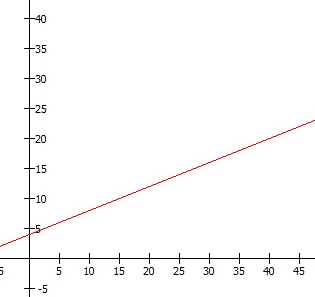
We’ll have a supply curve, which is a graph of the minimum price the worker is willing to accept for each hour in order to work a given number of hours. We generally assume that the supply curve slopes upward, meaning that people are willing to work more hours if you offer them a higher wage for each hour. The idea is that it gets progressively harder to find the time—it eats into more and more important alternative activities. (This is in fact a gross oversimplification, but it’ll do for now. In the real world, labor is the one thing for which the supply curve frequently bends backward.)

supply_curve

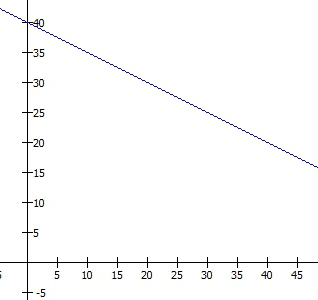
We’ll also have a demand curve, which is a graph of the maximum price the employer is willing to pay for each hour, if the employee works that many hours. We generally assume that the demand curve slopes downward, meaning that the employer is willing to pay less for each hour if the employee works more hours. The reason is that most activities have diminishing marginal returns, so each extra hour of work generally produces less output than the previous hour, and is therefore not worth paying as much for. (This too is an oversimplification, as I discussed previously in my post on the Law of Demand.)

demand_curve

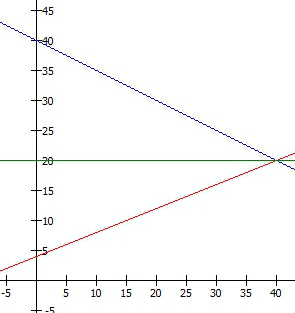
Put these two together, and in a competitive market the price will be set at the point at which supply is equal to demand, so that the very last hour of work was worth exactly what the employer paid for it. That last hour is just barely worth it to the employer, and just barely worth it to the worker; any additional time would either be too expensive for the employer or not lucrative enough for the worker. But for all the previous hours, the value to the employer is higher than the wage, and the cost to the worker is lower than the wage. As a result, both the employer and the worker benefit.

equilibrium_notax

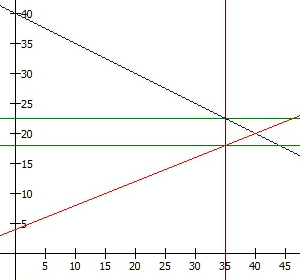
But now, suppose we implement a tax. For concreteness, suppose the previous market-clearing wage was $20 per hour, the worker was working 40 hours, and the tax is 20%. If the employer still offers a wage of $20 for 40 hours of work, the worker is no longer going to accept it, because they will only receive $16 per hour after taxes, and $16 isn’t enough for them to be willing to work 40 hours. The worker could ask for a pre-tax wage of $25 so that the after-tax wage would be $20, but then the employer will balk, because $25 per hour is too expensive for 40 hours of work.

In order to restore the balance (and when we say “equilibrium”, that’s really all we mean—balance), the employer will need to offer a higher pre-tax wage, which means they will demand fewer hours of work. The worker will then be willing to accept a lower after-tax wage for those reduced hours.

In effect, there are now two prices at work: A supply price, the after-tax wage that the worker receives, which must be at or above the supply curve; and a demand price, the pre-tax wage that the employer pays, which must be at or below the demand curve. The difference between those two prices is the tax.

equilibrium_tax

In this case, I’ve set it up so that the pre-tax wage is $22.50, the after-tax wage is $18, and the amount of the tax is $4.50 or 20% of $22.50. In order for both the employer and the worker to accept those prices, the amount of hours worked has been reduced to 35.

As a result of the tax, the wage that we’ve been calling “pre-tax” is actually higher than the wage that the worker would have received if the tax had not existed. This is a general phenomenon; it’s almost always true that your “pre-tax” wage or salary overestimates what you would have actually gotten if the tax had not existed. In one extreme case, it might actually be the same; in another extreme case, your after-tax wage is what you would have received and the “pre-tax” wage rises high enough to account for the entirety of the tax revenue. It’s not really “pre-tax” at all; it’s the after-tax demand price.

Because of this, it’s fundamentally wrongheaded for people to complain that taxes are “taking your hard-earned money”. In all but the most exceptional cases, that “pre-tax” salary that’s being deducted from would never have existed. It’s more of an accounting construct than anything else, or like I said before a measure of labor expenditure. It is generally true that your after-tax salary is lower than the salary you would have gotten without the tax, but the difference is generally much smaller than the amount of the tax that you see deducted. In this case, the worker would see $4.50 per hour deducted from their wage, but in fact they are only down $2 per hour from where they would have been without the tax. And of course, none of this includes the benefits of the tax, which in many cases actually far exceed the costs; if we extended the example, it wouldn’t be hard to devise a scenario in which the worker who had their wage income reduced received an even larger benefit in the form of some public good such as national defense or infrastructure.

Tax Incidence Revisited, Part 1: The downside of taxes

JDN 2457345 EST 22:02

As I was writing this, it was very early (I had to wake up at 04:30) and I was groggy, because we were on an urgent road trip to Pennsylvania for the funeral of my aunt who died quite suddenly a few days ago. I have since edited this post more thoroughly to minimize the impact of my sleep deprivation upon its content. Actually maybe this is a good thing; the saying goes, “write drunk, edit sober” and sleep deprivation and alcohol have remarkably similar symptoms, probably because alcohol is GABA-ergic and GABA is involved in sleep regulation.

Awhile ago I wrote a long post on tax incidence, but the primary response I got was basically the online equivalent of a perplexed blank stare. Struck once again by the Curse of Knowledge, I underestimated the amount of background knowledge necessary to understand my explanation. But tax incidence is very important for public policy, so I really would like to explain it.

Therefore I am now starting again, slower, in smaller pieces. Today’s piece is about the downsides of taxation in general, why we don’t just raise taxes as high as we feel like and make the government roll in dough.

To some extent this is obvious; if income tax were 100%, why would anyone bother working for a salary? You might still work for fulfillment, or out of a sense of duty, or simply because you enjoy what you do—after all, most artists and musicians are hardly in it for the money. But many jobs are miserable and not particularly fulfilling, yet still need to get done. How many janitors or bus drivers work purely for the sense of fulfillment it gives them? Mostly they do it to pay the bills—and if income tax were 100%, it wouldn’t anymore. The formal economy would basically collapse, and then nobody would end up actually paying that 100% tax—so the government would actually get very little revenue, if any.

At the other end of the scale, it’s kind of obvious that if your taxes are all 0% you don’t get any revenue. This is actually more feasible than it may sound; provided you spend only a very small amount (say, 4% of GDP, though that’s less than any country actually spends—maybe you could do 6% like Bangladesh) and you can still get people to accept your currency, you could, in principle, have a government that funds its spending entirely by means of printing money, and could do this indefinitely. In practice, that has never been done, and the really challenging part is getting people to accept your money if you don’t collect taxes in it. One of the more counter-intuitive aspects of modern monetary theory (or perhaps I should capitalize it, Modern Monetary Theory, though the part I agree with is not that different from standard Keynesian theory) is that taxation is the primary mechanism by which money acquires its value.

And then of course with intermediate tax rates such as 20%, 30%, and 50% that actual countries actually use, we do get some positive amount of revenue.

Everything I’ve said so far may seem pretty obvious. Yeah, usually taxes raise revenue, but if you taxed at 0% or 100% they wouldn’t; so what?

Well, this leads to quite an important result. Assuming that tax revenue is continuous (which isn’t quite true, but since we can collect taxes in fractions of a percent and pay in pennies, it’s pretty close), it follows directly from the Extreme Value Theorem that there is in fact a revenue-maximizing tax rate. Both below and above that tax rate, the government takes in less total money. These theorems don’t tell us what the revenue-maximizing rate is; but they tell us that it must exist, somewhere between 0% and 100%.

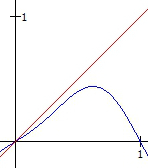
Indeed, it follows that there is what we call the Laffer Curve, a graph of tax revenue as a function of tax rate, and it is in fact a curve, as opposed to the straight line it would be if taxes had no effect on the rest of the economy.

Very roughly, it looks something like this (the blue curve is my sketch of the real-world Laffer curve, while the red line is what it would be if taxes had no distortionary effects):

Laffer_curve

Now, the Laffer curve has been abused many times; in particular, it’s been used to feed into the “trickle-down” “supply-sideReaganomics that has been rightly derided as “voodoo economics” by serious economists. Jeb Bush (or should I say, Jeb!) and Marco Rubio would have you believe that we are on the right edge of the Laffer curve, and we could actually increase tax revenue by cutting taxes, particularly on capital gains and incomes at the top 1%; that’s obviously false. We tried that, it didn’t work. Even theoretically we probably should have known that it wouldn’t; but now that we’ve actually done the experiment and it failed, there should be no serious doubt anymore.

No, we are on the left side of the Laffer curve, where increasing taxes increases revenue, much as you’d intuitively expect. It doesn’t quite increase one-to-one, because adding more taxes does make the economy less efficient; but from where we currently stand, a 1% increase in taxes leads to about a 0.9% increase in revenue (actually estimated as between 0.78% and 0.99%).

Denmark may be on the right side of the Laffer curve, where they could raise more revenue by decreasing tax rates (even then I’m not so sure). But Denmark’s tax rates are considerably higher than ours; while in the US we pay about 27% of GDP in taxes, folks in Denmark pay 49% of GDP in taxes.

The fact remains, however, that there is a Laffer curve, and no serious economist would dispute this. Increasing taxes does in fact create distortions in the economy, and as a result raising tax rates does not increase revenue in a one-to-one fashion. When calculating the revenue from a new tax, you must include not only the fact that the government will get an increased portion, but also that the total amount of income will probably decrease.

Now, I must say probably, because it does depend on what exactly you are taxing. If you tax something that is perfectly inelastic—the same amount of it is going to be made and sold no matter what—then total income will remain exactly the same after the tax. It may be distributed differently, but the total won’t change. This is one of the central justifications for a land tax; land is almost perfectly inelastic, so taxing it allows us to raise revenue without reducing total income.

In fact, there are certain kinds of taxes which increase total income, which makes them basically no-brainer taxes that should always be implemented if at all feasible. These are Pigovian taxes, which are taxes on products with negative externalities; when a product causes harm to other people (the usual example is pollution of air and water), taxing that product equal to the harm caused provides a source of government revenue that also increases the efficiency of the economy as a whole. If we had a tax on carbon emissions that was used to fund research into sustainable energy, this would raise our total GDP in the long run. Taxes on oil and natural gas are not “job killing”; they are job creating. This is why we need a carbon tax, a higher gasoline tax, and a financial transaction tax (to reduce harmful speculation); it’s also why we already have high taxes on alcohol and tobacco.

The alcohol tax is one of the great success stories of Pigouvian taxation.The alcohol tax is actually one of the central factors holding our crime rate so low right now. Another big factor is overall economic growth and anti-poverty programs. The most important factor, however, is lead, or rather the lack thereof; environmental regulations reducing pollutants like lead and mercury from the environment are the leading factor in reducing crime rates over the last generation. Yes, that’s right—our fall in crime had little to do with state police, the FBI, the DEA, or the ATF; our most effective crime-fighting agency is the EPA. This is really not that surprising, as a cognitive economist. Most crime is impulsive and irrational, or else born of economic desperation. Rational crime that it would make sense to punish harshly as a deterrent is quite rare (well, except for white-collar crime, which of course we don’t punish harshly enough—I know I harp on this a lot, but HSBC laundered money for terrorists). Maybe crime would be more common if we had no justice system in place at all, but making our current system even harsher accomplishes basically nothing. Far better to tax the alcohol that leads good people to bad decisions.

It also matters whom you tax, though one of my goals in this tax incidence series is to explain why that doesn’t mean quite what most people think it does. The person who writes the check to the government is not necessarily the person who really pays the tax. The person who really pays is the one whose net income ends up lower after the tax is implemented. Often these are the same person; but often they aren’t, for fundamental reasons I’m hoping to explain.

For now, it’s worth pointing out that a tax which primarily hits the top 1% is going to have a very different impact on the economy than one which hits the entire population. Because of the income and substitution effects, poor people tend to work less as their taxes go up, but rich people tend to work more. Even within income brackets, a tax that hits doctors and engineers is going to have a different effect than a tax that hits bankers and stock traders, and a tax that hits teachers is going to have a different effect than a tax that hits truck drivers. A tax on particular products or services will reduce demand for those products or services, which is good if that’s what you’re trying to do (such as alcohol) but not so good if it isn’t.

So, yes, there are cases where raising taxes can actually increase, or at least not reduce, total income. These are the exception, however; as a general rule, in a Pirate Code sort of way, taxes reduce total income. It’s not simply that income goes down for everyone but the government (which would again be sort of obvious); income goes down for everyone including the government. The difference is simply lost, wasted away by a loss in economic efficiency. We call that difference deadweight loss, and for a poorly-designed tax it can actually far exceed the revenue received.

I think an extreme example may help to grasp the intuition: Suppose we started taxing cars at 200,000%, so that a typical new car costs something like $40 million with taxes. (That’s not a Lamborghini, mind you; that’s a Honda Accord.) What would happen? Nobody is going to buy cars anymore. Overnight, you’ve collapsed the entire auto industry. Dozens of companies go bankrupt, thousands of employees get laid off, the economy immediately falls into recession. And after all that, your car tax will raise no revenue at all, because not a single car will sell. It’s just pure deadweight loss.

That’s an intentionally extreme example; most real-world taxes in fact create less deadweight loss than they raise in revenue. But most real-world taxes do in fact create deadweight loss, and that’s a good reason to be concerned about any new tax.

In general, higher taxes create lower total income, or equivalently higher deadweight loss. All other things equal, lower taxes are therefore better.

What most Americans don’t seem to quite grasp is that all other things are not equal. That tax revenue is central to the proper functioning of our government and our monetary system. We need a certain amount of taxes in order to ensure that we can maintain a stable currency and still pay for things like Medicare, Social Security, and the Department of Defense (to name our top three budget items).

Alternatively, we could not spend so much on those things, and that is a legitimate question of public policy. I personally think that Medicare and Social Security are very good things (and I do have data to back that up—Medicare saves thousands of lives), but they aren’t strictly necessary for basic government functioning; we could get rid of them, it’s just that it would be a bad idea. As for the defense budget, some kind of defense budget is necessary for national security, but I don’t think I’m going out on a very big limb here when I say that one country making 40% of all world military spending probably isn’t.

We can’t have it both ways; if you want Medicare, Social Security, and the Department of Defense, you need to have taxes. “Cutting spending” always means cutting spending on something—so what is it you want to cut? A lot of people seem to think that we waste a huge amount of money on pointless bureaucracy, pork-barrel spending, or foreign aid; but that’s simply not true. All government administration is less than 1% of the budget, and most of it is necessary; earmarks are also less than 1%; foreign aid is also less than 1%. Since our deficit is about 15% of spending, we could eliminate all of those things and we’d barely put a dent in it.

Americans don’t like taxes; I understand that. It’s basically one of our founding principles, in fact, though “No taxation without representation” seems to have mutated of late into simply “No taxation”, or maybe “Read my lips, no new taxes!” It’s never pleasant to see that chunk taken out of your paycheck before you even get it. (Though one thing I hope to explain in this series is that these figures are really not very meaningful; there’s no particular reason to think you’d have made the same gross salary if those taxes hadn’t been present.)

There are in fact sound economic reasons to keep taxes low. The Laffer Curve is absolutely a real thing, even though most of its applications are wrong. But sometimes we need taxes to be higher, and that’s a tradeoff we have to make.We need to have a serious public policy discussion about where our priorities lie, not keep trading sound-bytes about “cutting wasteful spending” and “job-killing tax hikes”.

How about we listen to the Nobel Laureate when we set our taxes?

JDN 2457321 EDT 11:20

I know I’m going out on a limb here, but I think it would generally be a good thing if we based our tax system on the advice of Nobel Laureate economists. Joseph Stiglitz wrote a tax policy paper for the Roosevelt Institution last year that describes in detail how our tax system could be reformed to simultaneously restore economic growth, reduce income inequality, promote environmental sustainability, and in the long run even balance the budget. What’s more, he did the math (I suppose Nobel Laureate economists are known for that), and it looks like his plan would actually work.

The plan is good enough that I think it’s worth going through in some detail.

He opens by reminding us that our “debt crisis” is of our own making, the result of politicians (and voters) who don’t understand economics:

“But we should be clear that these crises – which have resulted in a government shutdown and a near default on the national debt – are not economic but political. The U.S. is not like Greece, unable to borrow to fund its debt and deficit. Indeed, the U.S. has been borrowing at negative real interest rates.”

Stiglitz pulls no punches against bad policies, and isn’t afraid to single out conservatives:

“We also show that some of the so-called reforms that conservatives propose would be counterproductive – they could simultaneously reduce growth and economic welfare and increase unemployment and inequality. It would be better to have no reform than these reforms.”

A lot of the news media keep trying to paint Bernie Sanders as a far-left radical candidate (like this article in Politico calling his hometown the “People’s Republic of Burlington”), because he says things like this: “in recent years, over 99 percent of all new income generated in the economy has gone to the top 1 percent.”

But the following statement was not said by Bernie Sanders, it was said by Joseph Stiglitz, who I will remind you one last time is a world-renowned Nobel Laureate economist:

“The weaknesses in the labor market are reflected in low wages and stagnating incomes. That helps explain why 95 percent of the increase in incomes in the three years after the recovery officially began went to the upper 1 percent. For most Americans, there has been no recovery.”

It was also Stiglitz who said this:

“The American Dream is, in reality, a myth. The U.S. has some of the worst inequality across generations (social mobility) among wealthy nations. The life prospects of a young American are more dependent on the income and education of his parents than in other advanced countries.”

In this country, we have reached the point where policies supported by the analysis of world-renowned economists is considered far-left radicalism, while the “mainstream conservative” view is a system of tax policy that is based on pure fantasy, which has been called “puppies and rainbows” by serious policy analysts and “voodoo economics” by yet another Nobel Laureate economist. A lot of very smart people don’t understand what’s happening in our political system, and want “both sides” to be “equally wrong”, but that is simply not the case: Basic facts of not just social science (e.g. Keynesian monetary policy), but indeed natural science (evolutionary biology, anthropogenic climate change) are now considered “political controversies” because the right wing doesn’t want to believe them.

But let’s get back to the actual tax plan Stiglitz is proposing. He is in favor of raising some taxes and lowering others, spending more on some things and less on other things. His basic strategy is actually quite simple: Raise taxes with low multipliers and cut taxes with high multipliers. Raise spending with high multipliers and cut spending with low multipliers.

“While in general taxes take money out of the system, and therefore have a deflationary bias, some taxes have a larger multiplier than others, i.e. lead to a greater reduction in aggregate demand per dollar of revenue raised. Taxes on the rich and superrich, who save a large fraction of their income, have the least adverse effect on aggregate demand. Taxes on lower income individuals have the most adverse effect on aggregate demand.”

In other words, by making the tax system more progressive, we can directly stimulate economic growth while still increasing the amount of tax revenue we raise. And of course we have plenty of other moral and economic reasons to prefer progressive taxation.

Stiglitz tears apart the “job creator” myth:

“It is important to dispel a misunderstanding that one often hears from advocates of lower taxes for the rich and corporations, which contends that the rich are the job producers, and anything that reduces their income will reduce their ability and incentive to create jobs. First, at the current time, it is not lack of funds that is holding back investment. It is not even a weak and dysfunctional financial sector. America’s large corporations are sitting on more than $2 trillion in cash. What is holding back investment, especially by large corporations, is the lack of demand for their products.”

Stiglitz talks about two principles of taxation to follow:

First is the Generalized Henry George Principle, that we should focus taxes on things that are inelastic, meaning their supply isn’t likely to change much with the introduction of a tax. Henry George favored taxing land, which is quite inelastic indeed. The reason we do this is to reduce the economic distortions created by a tax; the goal is to collect revenue without changing the number of real products that are bought and sold. We need to raise revenue and we want to redistribute income, but we want to do it without creating unnecessary inefficiencies in the rest of the economy.

Second is the Generalized Polluter Pays Principle, that we should tax things that have negative externalities—effects on other people that are harmful. When a transaction causes harm to others who were not party to the transaction, we should tax that transaction in an amount equal to the harm that it would cause, and then use that revenue to offset the damage. In effect, if you hurt someone else, you should have to pay to clean up your own mess. This makes obvious moral sense, but it also makes good economic sense; taxing externalities can improve economic efficiency and actually make everyone better off. The obvious example is again pollution (the original Polluter Pays Principle), but there are plenty of other examples as well.

Stiglitz of course supports taxes on pollution and carbon emissions, which really should be a no-brainer. They aren’t just good for the environment, they would directly increase economic efficiency. The only reason we don’t have comprehensive pollution taxes (or something similar like cap-and-trade) is again the political pressure of right-wing interests.

Stiglitz focuses in particular on the externalities of the financial system, the boom-and-bust cycle of bubble, crisis, crash that has characterized so much of our banking system for generations. With a few exceptions, almost every major economic crisis has been preceded by some sort of breakdown of the financial system (and typically widespread fraud by the way). It is not much exaggeration to say that without Wall Street there would be no depressions. Externalities don’t get a whole lot bigger than that.

Stiglitz proposes a system of financial transaction taxes that are designed to create incentives against the most predatory practices in finance, especially the high-frequency trading in which computer algorithms steal money from the rest of the economy thousands of times per second. Even a 0.01% tax on each financial transaction would probably be enough to eliminate this particular activity.

He also suggests the implementation of “bonus taxes” which disincentivize paying bonuses, which could basically be as simple as removing the deductions placed during the Clinton administration (in a few years are we going to have to say “the first Clinton administration”?) that exempt “performance-based pay” from most forms of income tax. All pay is performance-based, or supposed to be. There should be no special exemption for bonuses and stock options.

Stiglitz also proposes a “bank rescue fund” which would be something like an expansion of the FDIC insurance that banks are already required to have, but designed as catastrophe insurance for the whole macroeconomy. Instead of needing bailed out from general government funds, banks would only be bailed out from a pool of insurance funds they paid in themselves. This could work, but honestly I think I’d rather reduce the moral hazard even more by saying that we will never again bail out banks directly, but instead bail out consumers and real businesses. This would probably save banks anyway (most people don’t default on debts if they can afford to pay them), and if it doesn’t, I don’t see why we should care. The only reason banks exist is to support the real economy; if we can support the real economy without them, they deserve to die. That basic fact seems to have been lost somewhere along the way, and we keep talking about how to save or stabilize the financial system as if it were valuable unto itself.

Stiglitz also proposes much stricter regulations on credit cards, which would require them to charge much lower transaction fees and also pay a portion of their transaction revenue in taxes. I think it’s fair to ask whether we need credit cards at all, or if there’s some alternative banking system that would allow people to make consumer purchases without paying 20% annual interest. (It seems like there ought to be, doesn’t it?)

Next Stiglitz gets to his proposal to reform the corporate income tax. Like many of us, he is sick of corporations like Apple and GE with ten and eleven-figure profits paying little or no taxes by exploiting a variety of loopholes. He points out some of the more egregious ones, like the “step up of basis at death” which allows inherited capital to avoid taxation (personally, I think both morally and economically the optimal inheritance tax rate is 100%!), as well as the various loopholes on offshore accounting which allow corporations to design and sell their products in the US, even manufacture them here, and pay taxes as if all their work were done in the Cayman Islands. He also points out that the argument that corporate taxes disincentivize investment is ridiculous, because most investment is financed by corporate bonds which are tax-deductible.

Stiglitz departs from most other economists in that he actually proposes raising the corporate tax rate itself. Most economists favor cutting the rate on paper, then closing the loopholes to ensure that the new rate is actually paid. Stiglitz says this is not enough, and we must both close the loopholes and increase the rate.

I’m actually not sure I agree with him on this; the incidence of corporate taxes is not very well-understood, and I think there’s a legitimate worry that taxing Apple will make iPhones more expensive without actually taking any money from Tim Cook. I think it would be better to get rid of the corporate tax entirely and then dramatically raise the marginal rates on personal income, including not only labor income but also all forms of capital income. Instead of taxing Apple hoping it will pass through to Tim Cook, I say we just tax Tim Cook. Directly tax his $4 million salary and $70 million in stock options.

Stiglitz does have an interesting proposal to introduce “rent-seeking” taxes that specifically apply to corporations which exercise monopoly or oligopoly power. If you can actually get this to work, it’s very clever; you could actually create a market incentive for corporations to support their own competition—and not in the sense of collusion but in the sense of actually trying to seek out more competitive markets in order to avoid the monopoly tax. Unfortunately, Stiglitz is a little vague on how we’d actually pull that off.

One thing I do agree with Stiglitz on is the use of refundable tax credits to support real investment. Instead of this weird business about not taxing dividends and capital gains in the hope that maybe somehow this will support real investment, we actually give tax credits specifically to companies that build factories or hire more workers.

Stiglitz also does a good job of elucidating the concept of “corporate welfare”, officially called “tax expenditures”, in which subsidies for corporations are basically hidden in the tax code as rebates or deductions. This is actually what Obama was talking about when he said “spending in the tax code”, (he did not invent the concept of tax expenditures), but since he didn’t explain himself well even Jon Stewart accused him of Orwellian Newspeak. Economically a refundable tax rebate of $10,000 is exactly the same thing as a subsidy of $10,000. There are some practical and psychological differences, but there are no real economic differences. If you’re still confused about tax expenditures, the Center for American Progress has a good policy memo on the subject.

Stiglitz also has some changes to make to the personal income tax, all of which I think are spot-on. First we increase the marginal rates, particularly at the very top. Next we equalize rates on all forms of income, including capital income. Next, we remove most, if not all, of the deductions that allow people to avoid paying the rate it says on paper. Finally, we dramatically simplify the tax code so that the majority of people can file a simplified return which basically just says, “This is my income. This is the tax rate for that income. This is what I owe.” You wouldn’t have to worry about itemizing your student loans or mortgage payments or whatever else; just tally up your income and look up your rate. As he points out, this would save a lot of people a lot of stress and also remove a lot of economic distortions.

He talks about how we can phase out the mortgage-interest deduction in particular, because it’s clearly inefficient and regressive but it’s politically popular and dropping it suddenly could lead to another crisis in housing prices.

Stiglitz has a deorbit for anyone who thinks capital income should not be taxed:

“There is, moreover, no justification for taxing those who work hard to earn a living at a higher rate than those who derive their income from speculation.”

By equalizing rates on labor and capital income, he estimates we could raise an additional $130 billion per year—just shy of what it would take to end world hunger. (Actually some estimates say it would be more than enough, others that it would be about half what we need. It’s definitely in the ballpark, however.)

Stiglitz actually proposes making a full deduction of gross household income at $100,000, meaning that the vast majority of Americans would pay no income tax at all. This is where he begins to lose me, because it necessarily means we aren’t going to raise enough revenue by income taxes alone.

He proposes to make up the shortfall by introducing a value-added tax, a VAT. I have to admit a lot of countries have these (including most of Europe) and seem to do all right with them; but I never understood why they are so popular among economists. They are basically sales taxes, and it’s very hard to make any kind of sales tax meaningfully progressive. In fact, they are typically regressive, because rich people spend a smaller proportion of their income than poor people do. Unless we specifically want to disincentivize buying things (and a depression is not the time to do that!), I don’t see why we would want to switch to a sales tax.

At the end of the paper Stiglitz talks about the vital difference between short-term spending cuts and long-term fiscal sustainability:

“Thus, policies that promote output and employment today also contribute to future growth – particularly if they lead to more investment. Thus, austerity measures that take the form of cutbacks in spending on infrastructure, technology, or education not only weaken the economy today, but weaken it in the future, both directly (through the obvious impacts, for example, on the capital stock) but also indirectly, through the diminution in human capital that arises out of employment or educational experience. […] Mindless “deficit fetishism” is likely to be counterproductive. It will weaken the economy and prove counterproductive to raising revenues because the main reason that we are in our current fiscal position is the weak economy.”

It amazes me how many people fail to grasp this. No one would say that paying for college is fiscally irresponsible, because we know that all that student debt will be repaid by your increased productivity and income later on; yet somehow people still think that government subsidies for education are fiscally irresponsible. No one would say that it is a waste of money for a research lab to buy new equipment in order to have a better chance at making new discoveries, yet somehow people still think it is a waste of money for the government to fund research. The most legitimate form of this argument is “crowding-out”, the notion that the increased government spending will be matched by an equal or greater decrease in private spending; but the evidence shows that many public goods—like education, research, and infrastructure—are currently underfunded, and if there is any crowding-out, it is much smaller than the gain produced by the government investment. Crowding-out is theoretically possible but empirically rare.

Above all, now is not the time to fret about deficits. Now is the time to fret about unemployment. We need to get more people working; we need to create jobs for those who are already seeking them, better jobs for those who have them but want more, and opportunities for people who have given up searching for work to keep trying. To do that, we need spending, and we will probably need deficits. That’s all right; once the economy is restored to full capacity then we can adjust our spending to balance the budget (or we may not even need to, if we devise taxes correctly).

Of course, I fear that most of these policies will fall upon deaf ears; but Stiglitz calls us to action:

“We can reform our tax system in ways that will strengthen the economy today, address current economic and social problems, and strengthen our economy for the future. The economic agenda is clear. The question is, will the vested interests which have played such a large role in creating the current distorted system continue to prevail? Do we have the political will to create a tax system that is fair and serves the interests of all Americans?”

Why the Republican candidates like flat income tax—and we really, really don’t

JDN 2456160 EDT 13:55.

The Republican Party is scrambling to find viable Presidential candidates for next year’s election. The Democrats only have two major contenders: Hillary Clinton looks like the front-runner (and will obviously have the most funding), but Bernie Sanders is doing surprisingly well, and is particularly refreshing because he is running purely on his principles and ideas. He has no significant connections, no family dynasty (unlike Jeb Bush and, again, Hillary Clinton) and not a huge amount of wealth (Bernie’s net wealth is about $500,000, making him comfortably upper-middle class; compare to Hillary’s $21.5 million and her husband’s $80 million); but he has ideas that resonate with people. Bernie Sanders is what politics is supposed to be. Clinton’s campaign will certainly raise more than his; but he has already raised over $4 million, and if he makes it to about $10 million studies suggest that additional spending above that point is largely negligible. He actually has a decent chance of winning, and if he did it would be a very good sign for the future of America.

But the Republican field is a good deal more contentious, and the 19 candidates currently running have been scrambling to prove that they are the most right-wing in order to impress far-right primary voters. (When the general election comes around, whoever wins will of course pivot back toward the center, changing from, say, outright fascism to something more like reactionism or neo-feudalism. If you were hoping they’d pivot so far back as to actually be sensible center-right capitalists, think again; Hillary Clinton is the only one who will take that role, and they’ll go out of their way to disagree with her in every way they possibly can, much as they’ve done with Obama.) One of the ways that Republicans are hoping to prove their right-wing credentials is by proposing a flat income tax and eliminating the IRS.

Unlike most of their proposals, I can see why many people think this actually sounds like a good idea. It would certainly dramatically reduce bureaucracy, and that’s obviously worthwhile since excess bureaucracy is pure deadweight loss. (A surprising number of economists seem to forget that government does other things besides create excess bureaucracy, but I must admit it does in fact create excess bureaucracy.)

Though if they actually made the flat tax rate 20% or even—I can’t believe this is seriously being proposed—10%, there is no way the federal government would have enough revenue. The only options would be (1) massive increases in national debt (2) total collapse of government services—including their beloved military, mind you, or (3) directly linking the Federal Reserve quantitative easing program to fiscal policy and funding the deficit with printed money. Of these, 3 might not actually be that bad (it would probably trigger some inflation, but actually we could use that right now), but it’s extremely unlikely to happen, particularly under Republicans. In reality, after getting a taste of 2, we’d clearly end up with 1. And then they’d be complaining about the debt and clamor for more spending cuts, more spending cuts, ever more spending cuts, but there would simply be no way to run a functioning government on 10% of GDP in anything like our current system. Maybe you could do it on 20%—maybe—but we currently spend more like 35%, and that’s already a very low amount of spending for a First World country. The UK is more typical at 47%, while Germany is a bit low at 44%; Sweden spends 52% and France spends a whopping 57%. Anyone who suggests we cut government spending from 35% to 20% needs to explain which 3/7 of government services are going to immediately disappear—not to mention which 3/7 of government employees are going to be immediately laid off.

And then they want to add investment deductions; in general investment deductions are a good thing, as long as you tie them to actual investments in genuinely useful things like factories and computer servers. (Or better yet, schools, research labs, or maglev lines, but private companies almost never invest in that sort of thing, so the deduction wouldn’t apply.) The kernel of truth in the otherwise ridiculous argument that we should never tax capital is that taxing real investment would definitely be harmful in the long run. As I discussed with Miles Kimball (a cognitive economist at Michigan and fellow econ-blogger I hope to work with at some point), we could minimize the distortionary effects of corporate taxes by establishing a strong deduction for real investment, and this would allow us to redistribute some of this enormous wealth inequality without dramatically harming economic growth.

But if you deduct things that aren’t actually investments—like stock speculation and derivatives arbitrage—then you reduce your revenue dramatically and don’t actually incentivize genuinely useful investments. This is the problem with our current system, in which GE can pay no corporate income tax on $108 billion in annual profit—and you know they weren’t using all that for genuinely productive investment activities. But then, if you create a strong enforcement system for ensuring it is real investment, you need bureaucracy—which is exactly what the flat tax was claimed to remove. At the very least, the idea of eliminating the IRS remains ridiculous if you have any significant deductions.

Thus, the benefits of a flat income tax are minimal if not outright illusory; and the costs, oh, the costs are horrible. In order to have remotely reasonable amounts of revenue, you’d need to dramatically raise taxes on the majority of people, while significantly lowering them on the rich. You would create a direct transfer of wealth from the poor to the rich, increasing our already enormous income inequality and driving millions of people into poverty.

Thus, it would be difficult to more clearly demonstrate that you care only about the interests of the top 1% than to propose a flat income tax. I guess Mitt Romney’s 47% rant actually takes the cake on that one though (Yes, all those freeloading… soldiers… and children… and old people?).

Many Republicans are insisting that a flat tax would create a surge of economic growth, but that’s simply not how macroeconomics works. If you steeply raise taxes on the majority of people while cutting them on the rich, you’ll see consumer spending plummet and the entire economy will be driven into recession. Rich people simply don’t spend their money in the same way as the rest of us, and the functioning of the economy depends upon a continuous flow of spending. There is a standard neoclassical economic argument about how reducing spending and increasing saving would lead to increased investment and greater prosperity—but that model basically assumes that we have a fixed amount of stuff we’re either using up or making more stuff with, which is simply not how money works; as James Kroeger cogently explains on his blog “Nontrivial Pursuits”, money is created as it is needed; investment isn’t determined by people saving what they don’t spend. Indeed, increased consumption generally leads to increased investment, because our economy is currently limited by demand, not supply. We could build a lot more stuff, if only people could afford to buy it.

And that’s not even considering the labor incentives; as I already talked about in my previous post on progressive taxation, there are two incentives involved when you increase someone’s hourly wage. On the one hand, they get paid more for each hour, which is a reason to work; that’s the substitution effect. But on the other hand, they have more money in general, which is a reason they don’t need to work; that’s the income effect. Broadly speaking, the substitution effect dominates at low incomes (about $20,000 or less), the income effect dominates at high incomes (about $100,000 or more), and the two effects cancel out at moderate incomes. Since a tax on your income hits you in much the same way as a reduction in your wage, this means that raising taxes on the poor makes them work less, while raising taxes on the rich makes them work more. But if you go from our currently slightly-progressive system to a flat system, you raise taxes on the poor and cut them on the rich, which would mean that the poor would work less, and the rich would also work less! This would reduce economic output even further. If you want to maximize the incentive to work, you want progressive taxes, not flat taxes.

Flat taxes sound appealing because they are so simple; even the basic formula for our current tax rates is complicated, and we combine it with hundreds of pages of deductions and credits—not to mention tens of thousands of pages of case law!—making it a huge morass of bureaucracy that barely anyone really understands and corporate lawyers can easily exploit. I’m all in favor of getting rid of that; but you don’t need a flat tax to do that. You can fit the formula for a progressive tax on a single page—indeed, on a single line: r = 1 – I^-p

That’s it. It’s simple enough to be plugged into any calculator that is capable of exponents, not to mention efficiently implemented in Microsoft Excel (more efficiently than our current system in fact).

Combined with that simple formula, you could list all of the sensible deductions on a couple of additional pages (business investments and educational expenses, mostly—poverty should be addressed by a basic income, not by tax deductions on things like heating and housing, which are actually indirect corporate subsidies), along with a land tax (one line: $3000 per hectare), a basic income (one more line: $8,000 per adult and $4,000 per child), and some additional excise taxes on goods with negative externalities (like alcohol, tobacco, oil, coal, and lead), with a line for each; then you can provide a supplementary manual of maybe 50 pages explaining the detailed rules for applying each of those deductions in unusual cases. The entire tax code should be readable by an ordinary person in a single sitting no longer than a few hours. That means no more than 100 pages and no more than a 7th-grade reading level.

Why do I say this? Isn’t that a ridiculous standard? No, it is a Constitutional imperative. It is a fundamental violation of your liberty to tax you according to rules you cannot reasonably understand—indeed, bordering on Kafkaesque. While this isn’t taxation without representation—we do vote for representatives, after all—it is something very much like it; what good is the ability to change rules if you don’t even understand the rules in the first place? Nor would it be all that difficult: You first deduct these things from your income, then plug the result into this formula.

So yes, I absolutely agree with the basic principle of tax reform. The tax code should be scrapped and recreated from scratch, and the final product should be a primary form of only a few pages combined with a supplementary manual of no more than 100 pages. But you don’t need a flat tax to do that, and indeed for many other reasons a flat tax is a terrible idea, particularly if the suggested rate is 10% or 15%, less than half what we actually spend. The real question is why so many Republican candidates think that this will appeal to their voter base—and why they could actually be right about that.

Part of it is the entirely justified outrage at the complexity of our current tax system, and the appealing simplicity of a flat tax. Part of it is the long history of American hatred of taxes; we were founded upon resisting taxes, and we’ve been resisting taxes ever since. In some ways this is healthy; taxes per se are not a good thing, they are a bad thing, a necessary evil.

But those two things alone cannot explain why anyone would advocate raising taxes on the poorest half of the population while dramatically cutting them on the top 1%. If you are opposed to taxes in general, you’d cut them on everyone; and if you recognize the necessity of taxation, you’d be trying to find ways to minimize the harm while ensuring sufficient tax revenue, which in general means progressive taxation.

To understand why they would be pushing so hard for flat taxes, I think we need to say that many Republicans, particularly those in positions of power, honestly do think that rich people are better than poor people and we should always give more to the rich and less to the poor. (Maybe it’s partly halo effect, in which good begets good and bad begets bad? Or maybe just world theory, the ingrained belief that the world is as it ought to be?)

Romney’s 47% rant wasn’t an exception; it was what he honestly believes, what he says when he doesn’t know he’s on camera. He thinks that he earned every penny of his $250 million net wealth; yes, even the part he got from marrying his wife and the part he got from abusing tax laws, arbitraging assets and liquidating companies. He thinks that people who live on $4,000 or even $400 a year are simply lazy freeloaders, who could easily work harder, perhaps do some arbitrage and liquidation of their own (check out these alleged “rags to riches” stories including the line “tried his hand at mortgage brokering”), but choose not to, and as a result deserve what they get. (It’s important to realize just how bizarre this moral attitude truly is; even if I thought you were the laziest person on Earth, I wouldn’t let you starve to death.) He thinks that the social welfare programs which have reduced poverty but never managed to eliminate it are too generous—if he even thinks they should exist at all. And in thinking these things, he is not some bizarre aberration; he is representing an entire class of people, nearly all of whom vote Republican.

The good news is, these people are still in the minority. They hold significant sway over the Republican primary, but will not have nearly as much impact in the general election. And right now, the Republican candidates are so numerous and so awful that I have trouble seeing how the Democrats could possibly lose. (But please, don’t take that as a challenge, you guys.)

What you need to know about tax incidence

JDN 2457152 EDT 14:54.

I said in my previous post that I consider tax incidence to be one of the top ten things you should know about economics. If I actually try to make a top ten list, I think it goes something like this:

  1. Supply and demand
  2. Monopoly and oligopoly
  3. Externalities
  4. Tax incidence
  5. Utility, especially marginal utility of wealth
  6. Pareto-efficiency
  7. Risk and loss aversion
  8. Biases and heuristics, including sunk-cost fallacy, scope neglect, herd behavior, anchoring and representative heuristic
  9. Asymmetric information
  10. Winner-takes-all effect

So really tax incidence is in my top five things you should know about economics, and yet I still haven’t talked about it very much. Well, today I will. The basic principles of supply and demand I’m basically assuming you know, but I really should spend some more time on monopoly and externalities at some point.

Why is tax incidence so important? Because of one central fact: The person who pays the tax is not the person who writes the check.

It doesn’t matter whether a tax is paid by the buyer or the seller; it matters what the buyer and seller can do to avoid the tax. If you can change your behavior in order to avoid paying the tax—buy less stuff, or buy somewhere else, or deduct something—you will not bear the tax as much as someone else who can’t do anything to avoid the tax, even if you are the one who writes the check. If you can avoid it and they can’t, other parties in the transaction will adjust their prices in order to eat the tax on your behalf.

Thus, if you have a good that you absolutely must buy no matter what—like, say, table saltand then we make everyone who sells that good pay an extra $5 per kilogram, I can guarantee you that you will pay an extra $5 per kilogram, and the suppliers will make just as much money as they did before. (A salt tax would be an excellent way to redistribute wealth from ordinary people to corporations, if you’re into that sort of thing. Not that we have any trouble doing that in America.)

On the other hand, if you have a good that you’ll only buy at a very specific price—like, say, fast food—then we can make you write the check for a tax of an extra $5 per kilogram you use, and in real terms you’ll pay hardly any tax at all, because the sellers will either eat the cost themselves by lowering the prices or stop selling the product entirely. (A fast food tax might actually be a good idea as a public health measure, because it would reduce production and consumption of fast food—remember, heart disease is one of the leading causes of death in the United States, making cheeseburgers a good deal more dangerous than terrorists—but it’s a bad idea as a revenue measure, because rather than pay it, people are just going to buy and sell less.)

In the limit in which supply and demand are both completely fixed (perfectly inelastic), you can tax however you want and it’s just free redistribution of wealth however you like. In the limit in which supply and demand are both locked into a single price (perfectly elastic), you literally cannot tax that good—you’ll just eliminate production entirely. There aren’t a lot of perfectly elastic goods in the real world, but the closest I can think of is cash. If you instituted a 2% tax on all cash withdrawn, most people would stop using cash basically overnight. If you want a simple way to make all transactions digital, find a way to enforce a cash tax. When you have a perfect substitute available, taxation eliminates production entirely.

To really make sense out of tax incidence, I’m going to need a lot of a neoclassical economists’ favorite thing: Supply and demand curves. These things pop up everywhere in economics; and they’re quite useful. I’m not so sure about their application to things like aggregate demand and the business cycle, for example, but today I’m going to use them for the sort of microeconomic small-market stuff that they were originally designed for; and what I say here is going to be basically completely orthodox, right out of what you’d find in an ECON 301 textbook.

Let’s assume that things are linear, just to make the math easier. You’d get basically the same answers with nonlinear demand and supply functions, but it would be a lot more work. Likewise, I’m going to assume a unit tax on goods—like $2890 per hectare—as opposed to a proportional tax on sales—like 6% property tax—again, for mathematical simplicity.

The next concept I’m going to have to talk about is elasticitywhich is the proportional amount that quantity sold changes relative to price. If price increases 2% and you buy 4% less, you have a demand elasticity of -2. If price increases 2% and you buy 1% less, you have a demand elasticity of -1/2. If price increases 3% and you sell 6% more, you have a supply elasticity of 2. If price decreases 5% and you sell 1% less, you have a supply elasticity of 1/5.

Elasticity doesn’t have any units of measurement, it’s just a number—which is part of why we like to use it. It also has some very nice mathematical properties involving logarithms, but we won’t be needing those today.

The price that renters are willing and able to pay, the demand price PD will start at their maximum price, the reserve price PR, and then it will decrease linearly according to the quantity of land rented Q, according to a linear function (simply because we assumed that) which will vary according to a parameter e that represents the elasticity of demand (it isn’t strictly equal to it, but it’s sort of a linearization).

We’re interested in what is called the consumer surplus; it is equal to the total amount of value that buyers get from their purchases, converted into dollars, minus the amount they had to pay for those purchases. This we add to the producer surplus, which is the amount paid for those purchases minus the cost of producing themwhich is basically just the same thing as profit. Togerther the consumer surplus and producer surplus make the total economic surplus, which economists generally try to maximize. Because different people have different marginal utility of wealth, this is actually a really terrible idea for deep and fundamental reasons—taking a house from Mitt Romney and giving it to a homeless person would most definitely reduce economic surplus, even though it would obviously make the world a better place. Indeed, I think that many of the problems in the world, particularly those related to inequality, can be traced to the fact that markets maximize economic surplus rather than actual utility. But for now I’m going to ignore all that, and pretend that maximizing economic surplus is what we want to do.

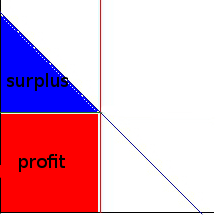
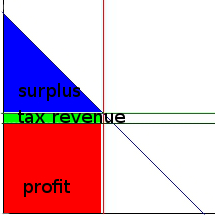
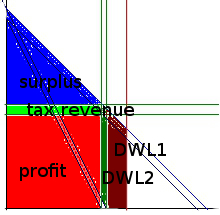
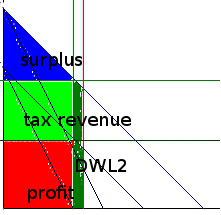
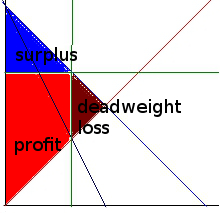
You can read off the economic surplus straight from the supply and demand curves; it’s the area between the lines. (Mathematically, it’s an integral; but that’s equivalent to the area under a curve, and with straight lines they’re just triangles.) I’m going to call the consumer surplus just “surplus”, and producer surplus I’ll call “profit”.

Below the demand curve and above the price is the surplus, and below the price and above the supply curve is the profit:

elastic_supply_competitive_labeled

I’m going to be bold here and actually use equations! Hopefully this won’t turn off too many readers. I will give each equation in both a simple text format and in proper LaTeX. Remember, you can render LaTeX here.

PD = PR – 1/e * Q

P_D = P_R – \frac{1}{e} Q \\

The marginal cost that landlords have to pay, the supply price PS, is a bit weirder, as I’ll talk about more in a moment. For now let’s say that it is a linear function, starting at zero cost for some quantity Q0 and then increases linearly according to a parameter n that similarly represents the elasticity of supply.

PS = 1/n * (Q – Q0)

P_S = \frac{1}{n} \left( Q – Q_0 \right) \\

Now, if you introduce a tax, there will be a difference between the price that renters pay and the price that landlords receive—namely, the tax, which we’ll call T. I’m going to assume that, on paper, the landlord pays the whole tax. As I said above, this literally does not matter. I could assume that on paper the renter pays the whole tax, and the real effect on the distribution of wealth would be identical. All we’d have to do is set PD = P and PS = P – T; the consumer and producer surplus would end up exactly the same. Or we could do something in between, with P’D = P + rT and P’S = P – (1 – r) T.

Then, if the market is competitive, we just set the prices equal, taking the tax into account:

P = PD – T = PR – 1/e * Q – T = PS = 1/n * (Q – Q0)

P= P_D – T = P_R – \frac{1}{e} Q – T= P_S = \frac{1}{n} \left(Q – Q_0 \right) \\

P_R – 1/e * Q – T = 1/n * (Q – Q0)

P_R – \frac{1}{e} Q – T = \frac{1}{n} \left(Q – Q_0 \right) \\

Notice the equivalency here; if we set P’D = P + rT and P’S = P – (1 – r) T, so that the consumer now pays a fraction of the tax r.

P = P’D – rT = P_r – 1/e*Q = P’S + (1 – r) T + 1/n * (Q – Q0) + (1 – r) T

P^\prime_D – r T = P = P_R – \frac{1}{e} Q = P^\prime_S = \frac{1}{n} \left(Q – Q_0 \right) + (1 – r) T\\

The result is exactly the same:

P_R – 1/e * Q – T = 1/n * (Q – Q0)

P_R – \frac{1}{e} Q – T = \frac{1}{n} \left(Q – Q_0 \right) \\

I’ll spare you the algebra, but this comes out to:

Q = (PR – T)/(1/n + 1/e) + (Q0)/(1 + n/e)

Q = \frac{P_R – T}{\frac{1}{n} + \frac{1}{e}} + \frac{Q_0}{1 + \frac{n}{e}}

P = (PR – T)/(1+ n/e) – (Q0)/(e + n)

P = \frac{P_R – T}}{1 + \frac{n}{e}} – \frac{Q_0}{e+n} \\

That’s if the market is competitive.

If the market is a monopoly, instead of setting the prices equal, we set the price the landlord receives equal to the marginal revenue—which takes into account the fact that increasing the amount they sell forces them to reduce the price they charge everyone else. Thus, the marginal revenue drops faster than the price as the quantity sold increases.

After a bunch of algebra (and just a dash of calculus), that comes out to these very similar, but not quite identical, equations:

Q = (PR – T)/(1/n + 2/e) + (Q0)/(1+ 2n/e)

Q = \frac{P_R – T}{\frac{1}{n} + \frac{2}{e}} + \frac{Q_0}{1 + \frac{2n}{e}} \\

P = (PR – T)*((1/n + 1/e)/(1/n + 2/e) – (Q0)/(e + 2n)

P = \left( P_R – T\right)\frac{\frac{1}{n} + \frac{1}{e}}{\frac{1}{n} + \frac{2}{e}} – \frac{Q_0}{e+2n} \\

Yes, it changes some 1s into 2s. That by itself accounts for the full effect of monopoly. That’s why I think it’s worthwhile to use the equations; they are deeply elegant and express in a compact form all of the different cases. They look really intimidating right now, but for most of the cases we’ll consider these general equations simplify quite dramatically.

There are several cases to consider.

Land has an extremely high cost to create—for practical purposes, we can consider its supply fixed, that is, perfectly inelastic. If the market is competitive, so that landlords have no market power, then they will simply rent out all the land they have at whatever price the market will bear:

Inelastic_supply_competitive_labeled

This is like setting n = 0 and T = 0 in the above equations, the competitive ones.

Q = Q0

Q = Q_0 \\

P = PR – Q0/e

P = P_R – \frac{Q_0}{e} \\

If we now introduce a tax, it will fall completely on the landlords, because they have little choice but to rent out all the land they have, and they can only rent it at a price—including tax—that the market will bear.

inelastic_supply_competitive_tax_labeled

Now we still have n = 0 but not T = 0.

Q = Q0

Q = Q_0 \\

P = PR – T – Q0/e

P = P_R – T – \frac{Q_0}{e} \\

The consumer surplus will be:

½ (Q)(PR – P – T) = 1/(2e)* Q02

\frac{1}{2}Q(P_R – P – T) = \frac{1}{2e}Q_0^2 \\

Notice how T isn’t in the result. The consumer surplus is unaffected by the tax.

The producer surplus, on the other hand, will be reduced by the tax:

(Q)(P) = (PR – T – Q0/e) Q0 = PR Q0 – 1/e Q02 – TQ0

(Q)(P) = (P_R – T – \frac{Q_0}{e})Q_0 = P_R Q_0 – \frac{1}{e} Q_0^2 – T Q_0 \\

T appears linearly as TQ0, which is the same as the tax revenue. All the money goes directly from the landlord to the government, as we want if our goal is to redistribute wealth without raising rent.

But now suppose that the market is not competitive, and by tacit collusion or regulatory capture the landlords can exert some market power; this is quite likely the case in reality. Actually in reality we’re probably somewhere in between monopoly and competition, either oligopoly or monopolistic competitionwhich I will talk about a good deal more in a later post, I promise.

It could be that demand is still sufficiently high that even with their market power, landlords have an incentive to rent out all their available land, in which case the result will be the same as in the competitive market.

inelastic_supply_monopolistic_labeled

A tax will then fall completely on the landlords as before:

inelastic_supply_monopolistic_tax_labeled

Indeed, in this case it doesn’t really matter that the market is monopolistic; everything is the same as it would be under a competitive market. Notice how if you set n = 0, the monopolistic equations and the competitive equations come out exactly the same. The good news is, this is quite likely our actual situation! So even in the presence of significant market power the land tax can redistribute wealth in just the way we want.

But there are a few other possibilities. One is that demand is not sufficiently high, so that the landlords’ market power causes them to actually hold back some land in order to raise the price:

zerobound_supply_monopolistic_labeled

This will create some of what we call deadweight loss, in which some economic value is wasted. By restricting the land they rent out, the landlords make more profit, but the harm they cause to tenant is created than the profit they gain, so there is value wasted.

Now instead of setting n = 0, we actually set n = infinity. Why? Because the reason that the landlords restrict the land they sell is that their marginal revenue is actually negative beyond that point—they would actually get less money in total if they sold more land. Instead of being bounded by their cost of production (because they have none, the land is there whether they sell it or not), they are bounded by zero. (Once again we’ve hit upon a fundamental concept in economics, particularly macroeconomics, that I don’t have time to talk about today: the zero lower bound.) Thus, they can change quantity all they want (within a certain range) without changing the price, which is equivalent to a supply elasticity of infinity.

Introducing a tax will then exacerbate this deadweight loss (adding DWL2 to the original DWL1), because it provides even more incentive for the landlords to restrict the supply of land:

zerobound_supply_monopolistic_tax_labeled

Q = e/2*(PR – T)

Q = \frac{e}{2} \left(P_R – T\right)\\

P = 1/2*(PR – T)

P = \frac{1}{2} \left(P_R – T\right) \\

The quantity Q0 completely drops out, because it doesn’t matter how much land is available (as long as it’s enough); it only matters how much land it is profitable to rent out.

We can then find the consumer and producer surplus, and see that they are both reduced by the tax. The consumer surplus is as follows:

½ (Q)(PR – 1/2(PR – T)) = e/4*(PR2 – T2)

\frac{1}{2}Q \left( P_R – \frac{1}{2}left( P – T \right) \right) = \frac{e}{4}\left( P_R^2 – T^2 \right) \\

This time, the tax does have an effect on reducing the consumer surplus.

The producer surplus, on the other hand, will be:

(Q)(P) = 1/2*(PR – T)*e/2*(PR – T) = e/4*(PR – T)2

(Q)(P) = \frac{1}{2}\left(P_R – T \right) \frac{e}{2} \left(P_R – T\right) = \frac{e}{4} \left(P_R – T)^2 \\

Notice how it is also reduced by the tax—and no longer in a simple linear way.

The tax revenue is now a function of the demand:

TQ = e/2*T(PR – T)

T Q = \frac{e}{2} T (P_R – T) \\

If you add all these up, you’ll find that the sum is this:

e/2 * (PR^2 – T^2)

\frac{e}{2} \left(P_R^2 – T^2 \right) \\

The sum is actually reduced by an amount equal to e/2*T^2, which is the deadweight loss.

Finally there is an even worse scenario, in which the tax is so large that it actually creates an incentive to restrict land where none previously existed:

zerobound_supply_monopolistic_hugetax_labeled

Notice, however, that because the supply of land is inelastic the deadweight loss is still relatively small compared to the huge amount of tax revenue.

But actually this isn’t the whole story, because a land tax provides an incentive to get rid of land that you’re not profiting from. If this incentive is strong enough, the monopolistic power of landlords will disappear, as the unused land gets sold to more landholders or to the government. This is a way of avoiding the tax, but it’s one that actually benefits society, so we don’t mind incentivizing it.

Now, let’s compare this to our current system of property taxes, which include the value of buildings. Buildings are expensive to create, but we build them all the time; the supply of buildings is strongly dependent upon the price at which those buildings will sell. This makes for a supply curve that is somewhat elastic.

If the market were competitive and we had no taxes, it would be optimally efficient:

elastic_supply_competitive_labeled

Property taxes create an incentive to produce fewer buildings, and this creates deadweight loss. Notice that this happens even if the market is perfectly competitive:

elastic_supply_competitive_tax_labeled

Since both n and e are finite and nonzero, we’d need to use the whole equations: Since the algebra is such a mess, I don’t see any reason to subject you to it; but suffice it to say, the T does not drop out. Tenants do see their consumer surplus reduced, and the larger the tax the more this is so.

Now, suppose that the market for buildings is monopolistic, as it most likely is. This would create deadweight loss even in the absence of a tax:

elastic_supply_monopolistic_labeled

But a tax will add even more deadweight loss:

elastic_supply_monopolistic_tax_labeled

Once again, we’d need the full equations, and once again it’s a mess; but the result is, as before, that the tax gets passed on to the tenants in the form of more restricted sales and therefore higher rents.

Because of the finite supply elasticity, there’s no way that the tax can avoid raising the rent. As long as landlords have to pay more taxes when they build more or better buildings, they are going to raise the rent in those buildings accordingly—whether the market is competitive or not.

If the market is indeed monopolistic, there may be ways to bring the rent down: suppose we know what the competitive market price of rent should be, and we can establish rent control to that effect. If we are truly correct about the price to set, this rent control can not only reduce rent, it can actually reduce the deadweight loss:

effective_rent_control_tax_labeled

But if we set the rent control too low, or don’t properly account for the varying cost of different buildings, we can instead introduce a new kind of deadweight loss, by making it too expensive to make new buildings.

ineffective_rent_control_tax_labeled

In fact, what actually seems to happen is more complicated than that—because otherwise the number of buildings is obviously far too small, rent control is usually set to affect some buildings and not others. So what seems to happen is that the rent market fragments into two markets: One, which is too small, but very good for those few who get the chance to use it; and the other, which is unaffected by the rent control but is more monopolistic and therefore raises prices even further. This is why almost all economists are opposed to rent control (PDF); it doesn’t solve the problem of high rent and simply causes a whole new set of problems.

A land tax with a basic income, on the other hand, would help poor people at least as much as rent control presently does—probably a good deal more—without discouraging the production and maintenance of new apartment buildings.

But now we come to a key point: The land tax must be uniform per hectare.

If it is instead based on the value of the land, then this acts like a finite elasticity of supply; it provides an incentive to reduce the value of your own land in order to avoid the tax. As I showed above, this is particularly pernicious if the market is monopolistic, but even if it is competitive the effect is still there.

One exception I can see is if there are different tiers based on broad classes of land that it’s difficult to switch between, such as “land in Manhattan” versus “land in Brooklyn” or “desert land” versus “forest land”. But even this policy would have to be done very carefully, because any opportunity to substitute can create an opportunity to pass on the tax to someone else—for instance if land taxes are lower in Brooklyn developers are going to move to Brooklyn. Maybe we want that, in which case that is a good policy; but we should be aware of these sorts of additional consequences. The simplest way to avoid all these problems is to simply make the land tax uniform. And given the quantities we’re talking about—less than $3000 per hectare per year—it should be affordable for anyone except the very large landholders we’re trying to distribute wealth from in the first place.

The good news is, most economists would probably be on board with this proposal. After all, the neoclassical models themselves say it would be more efficient than our current system of rent control and property taxes—and the idea is at least as old as Adam Smith. Perhaps we can finally change the fact that the rent is too damn high.

What if you couldn’t own land?

JDN 2457145 EDT 20:49.

Today’s post we’re on the socialism scale somewhere near the The Guess Who, but not quite all the way to John Lennon. I’d like to questions one of the fundamental tenets of modern capitalism, but not the basic concept of private ownership itself:

What if you couldn’t own land?

Many things that you can own were more-or-less straightforwardly created by someone. A car, a computer, a television, a pair of shoes; for today let’s even take for granted intellectual property like books, movies, and songs; at least those things (“things”) were actually made by someone.

But land? We’re talking about chunks of the Earth here. They were here billions of years before us, and in all probability will be here billions of years after we’re gone. There’s no need to incentivize its creation; the vast majority of land was already here and did not need to be created. (I do have to say “the vast majority”, because in places like Japan, Hong Kong, and the Netherlands real estate has become so scarce that people do literally build land out into the sea. But this is something like 0.0001% of the world’s land.)

What we want to incentivize is land development; we want it to be profitable to build buildings and irrigate deserts, and yes, even cut down forests sometimes (though then there should be a carbon tax with credits for forested land to ensure that there isn’t too much incentive). Yet our current property tax system doesn’t do this very well; if you build bigger buildings, you end up paying more property taxes. Yes, you may also make some profit on the buildings—but it’s risky, and you may not get enough benefit to justify the added property taxes.

Moreover, we want to allocate land—we want some way of deciding who is allowed to use what land where and when (and perhaps why). Allowing land to be bought and sold is one way to do that, but it is not the only way.

Indeed, land ownership suffers from a couple of truly glaring flaws as an allocation system:

      1. It creates self-perpetuating inequality. Because land grows in value over time (due to population growth and urbanization, among other things), those who currently own land end up getting an ever-growing quantity of wealth while those who do not own land do not, and very likely end up having to pay ever-growing rents to the landlords. (I like calling them “landlords”; it really drives home the fact that our landholding system is still basically the same as it was under feudalism.) In fact, the recent rise in the share of income that goes to owners of capital rather than workers is almost entirely attributable to the rise in the price of real estate. As that post rightly recognizes, this does nothing to undermine Piketty’s central message of rising inequality due to capital income (pace The Washington Post); it merely tells us to focus on real estate instead of other forms of capital.
      2. It has no non-arbitrary allocation. If we want to decide who owns a car, we can ask questions like, “Who built it? Did someone buy it from them? Did they pay a fair price?”; if we want to decide who owns a book, we can ask questions like, “Who wrote it? Did they sell it to a publisher? What was the royalty rate?” That is, there is a clear original owner, and there is a sense of whether the transfer of ownership can be considered fair. But if we want to decide who owns a chunk of land, basically all we can ask is, “What does the deed say?” The owner is the owner because they are the owner; there’s no sense in which that ownership is fair. We certainly can’t go back to the original creation of the land, because that was due to natural forces gigayears ago. If we keep tracing the ownership backward, we will eventually end up with some guy (almost certainly a man, a White man in fact) with a gun who pointed that gun at other people and said, “This is mine.” This is true of basically all the land in the world (aside from those little bits of Japan and such); it was already there, and the only reason someone got to own it was because they said so and had a bigger gun. And a flag, perhaps: “Do you have a flag?” I suppose, in theory at least, there are a few ways of allocating land which seem less arbitrary: One would be to give everyone an equal amount. But this is practically very difficult: What do you do when the population changes? If you have 2% annual population growth, do you carve off 2% of everybody’s lot each year? Another would be to let people squat land, and automatically own the land that they live on—but again practical difficulties quickly become enormous. In any case, these two methods bear about as much resemblance to our actual allocation of land as a squirrel does to a Tyrannosaurus.

So, what else might we use? The system that makes the most sense to me is that we would own all land as a society. In practical terms this would mean that all land is Federal land, and if you want to use it for something, you need to pay rent to the government. There are many different ways the government could set the rent, but the most sensible might be to charge a flat rate per hectare regardless of where the land is or what it’s being used for, because that would maximize the incentive to develop the land. It would also make the rent fall entirely on the landowner, because the rent would be perfectly inelasticmeaning that you can’t change the quantity you make based on the price, because you aren’t making it; it’s just already sitting there.

Of course, this idea is obviously politically impossible in our current environment—or indeed any foreseeable political environment. I’m just fantasizing here, right?

Well, not quite. There is one thing we could do that would be economically quite similar to government-only land ownership; it’s called a land tax. The idea is incredibly simple: you just collect a flat tax per hectare of land. Economists have known that a land tax is efficient at providing revenue and reducing inequality since at least Adam Smith. So maybe ownership of land isn’t actually foundational to capitalism, after all; maybe we’ve just never fully gotten over feudalism. (I basically agree with Adam Smith, and for doing so I am often called a socialist.) The beautiful thing about a land tax is that it has a tax incidence in which the owners of the land end up bearing the full brunt of the tax.

Tax incidence is something it’s very important to understand; it would be on my list of the top ten economic principles that people should learn. We often have fierce political debates over who will actually write the check: Should employers pay the health insurance premium, or should employees? Will buyers pay sales tax, or sellers? Should we tax corporate profits or personal capital gains?

Please understand that I am not exaggerating when I say that these sorts of questions are totally irrelevant. It simply does not matter who actually writes the check; what matters is who bears the cost. Making the employer pay the health insurance premium doesn’t make the slightest difference if all they’re going to do is cut wages by the exact same amount. You can see the irrelevance of the fact that sellers pay sales tax every time you walk into a store—you always end up paying the price plus the tax, don’t you? (I found that the base price of most items was the same between Long Beach and Ann Arbor, but my total expenditure was always 3% more because of the 9% sales tax versus the 6%.) How do we determine who actually pays the tax? It depends on the elasticity—how easily can you change your behavior in order to avoid the tax? Can you find a different job because the health insurance premiums are too high? No? Then you’re probably paying that premium, even if your employer writes the check. If you can find a new job whenever you want, your employer might have to pay it for you even if you write the check.

The incidence of corporate taxes and taxes on capital gains are even more complicated, because it could affect the behavior of corporations in many different ways; indeed, many economists argue that the corporate tax simply results in higher unemployment or lower wages for workers. I don’t think that’s actually true, but I honestly can’t rule it out completely, precisely because corporate taxes are so complicated. You need to know all sorts of things about the structure of stock markets, and the freedom of trade, and the mobility of immigration… it’s a complete and total mess.

It’s because of tax incidence that a land tax makes so much sense; there’s no way for the landowner to escape it, other than giving up the land entirely. In particular, they can’t charge more for rent without being out-competed (unless landowners are really good at colluding—which might be true for large developers, but not individual landlords). Their elasticity is so low that they’re forced to bear the full cost of the tax.

If the land tax were high enough, it could eliminate the automatic growth in wealth that comes from holding land, and thereby reducing long-run inequality dramatically. The revenue could be used for my other favorite fiscal policy, the basic income—and real estate is a big enough part of our nation’s wealth that it’s actually entirely realistic to fund an $8,000 per person per year basic income entirely on land tax revenue. The total value of US land is about $14 trillion, and an $8,000 basic income for 320 million people would cost about $2.6 trillion; that’s only 19%. You’d actually want to make it a flat tax per hectare, so how much would that be? Well, 60% of US land is privately owned at present (no sense taxing the land the government already owns), and total US land area is about 9 million square kilometers, so to raise $2.5 trillion you’d need a tax of $289,000 per square kilometer, or $2,890 per hectare. If you own a hectare—which is bigger than most single-family lots—you’d only pay $2,890 per year in land tax, well within what most middle-class families could handle. But if you own 290,000 acres like Jeff Bezos, (that’s 117,000 hectares) you’re paying $338 million per year. Since Jeff Bezos has about $38 billion in net wealth, he can actually afford to pay that ($338 million per year is about one-tenth of what Jeff Bezos makes automatically on dividends), though he might consider selling off some of the land to avoid the taxes, which is exactly the sort of incentive we wanted to create.

Indeed, when I contemplate this policy I’m struck by the fact that it has basically no downside—usually in public policy you’re forced to make hard compromises and tradeoffs, but a land tax plus basic income is a system that carries almost no downsides at all. It won’t disincentivize investment, it won’t disincentivize working, it will dramatically reduce inequality, it will save the government a great deal of money on social welfare spending, and best of all it will eliminate poverty immediately and forever. The only people it would hurt at all are extremely rich, and they wouldn’t even be hurt very much, while it would benefit millions of people including some of the most needy.

Why aren’t we doing this already!?

The winner-takes-all effect

JDN 2457054 PST 14:06.

As I write there is some sort of mariachi band playing on my front lawn. It is actually rather odd that I have a front lawn, since my apartment is set back from the road; yet there is the patch of grass, and there is the band playing upon it. This sort of thing is part of the excitement of living in a large city (and Long Beach would seem like a large city were it not right next to the sprawling immensity that is Los Angeles—there are more people in Long Beach than in Cleveland, but there are more people in greater Los Angeles than in Sweden); with a certain critical mass of human beings comes unexpected pieces of culture.

The fact that people agglomerate in this way is actually relevant to today’s topic, which is what I will call the winner-takes-all effect. I actually just finished reading a book called The Winner-Take-All Society, which is particularly horrifying to read because it came out in 1996. That’s almost twenty years ago, and things were already bad; and since then everything it describes has only gotten worse.

What is the winner-takes-all effect? It is the simple fact that in competitive capitalist markets, a small difference in quality can yield an enormous difference in return. The third most popular soda drink company probably still makes drinks that are pretty good, but do you have any idea what it is? There’s Coke, there’s Pepsi, and then there’s… uh… Dr. Pepper, apparently! But I didn’t know that before today and I bet you didn’t either. Now think about what it must be like to be the 15th most popular soda drink company, or the 37th. That’s the winner-takes-all effect.

I don’t generally follow football, but since tomorrow is the Super Bowl I feel some obligation to use that example as well. The highest-paid quarterback is Russell Wilson of the Seattle Seahawks, who is signing onto a five-year contract worth $110 million ($22 million a year). In annual income that will make him pass Jay Cutler of the Chicago Bears who has a seven-year contract worth $127 million ($18.5 million a year). This shift may have something to do with the fact that the Seahawks are in the Super Bowl this year and the Bears are not (they haven’t since 2007). Now consider what life is like for most football players; the median income of football players is most likely zero (at least as far as football-related income), and the median income of NFL players—the cream of the crop already—is $770,000; that’s still very good money of course (more than Krugman makes, actually! But he could make more, if he were willing to sell out to Wall Street), but it’s barely 1/30 of what Wilson is going to be making. To make that million-dollar salary, you need to be the best, of the best, of the best (sir!). That’s the winner-takes-all effect.

To go back to the example of cities, it is for similar reasons that the largest cities (New York, Los Angeles, London, Tokyo, Shanghai, Hong Kong, Delhi) become packed with tens of millions of people while others (Long Beach, Ann Arbor, Cleveland) get hundreds of thousands and most (Petoskey, Ketchikan, Heber City, and hundreds of others you’ve never heard of) get only a few thousand. Beyond that there are thousands of tiny little hamlets that many don’t even consider cities. The median city probably has about 10,000 people in it, and that only because we’d stop calling it a city if it fell below 1,000. If we include every tiny little village, the median town size is probably about 20 people. Meanwhile the largest city in the world is Tokyo, with a greater metropolitan area that holds almost 38 million people—or to put it another way almost exactly as many people as California. Huh, LA doesn’t seem so big now does it? How big is a typical town? Well, that’s the thing about this sort of power-law distribution; the concept of “typical” or “average” doesn’t really apply anymore. Each little piece of the distribution has basically the same shape as the whole distribution, so there isn’t a “typical” size or scale. That’s the winner-takes-all effect.

As they freely admit in the book, it isn’t literally that a single winner takes everything. That is the theoretical maximum level of wealth inequality, and fortunately no society has ever quite reached it. The closest we get in today’s society is probably Saudi Arabia, which recently lost its king—and yes I do mean king in the fullest sense of the word, a man of virtually unlimited riches and near-absolute power. His net wealth was estimated at $18 billion, which frankly sounds low; still even if that’s half the true amount it’s oddly comforting to know that he is still not quite as rich as Bill Gates ($78 billion), who earned his wealth at least semi-legitimately in a basically free society. Say what you will about intellectual property rents and market manipulation—and you know I do—but they are worlds away from what Abdullah’s family did, which was literally and directly robbed from millions of people by the power of the sword. Mostly he just inherited all that, and he did implement some minor reforms, but make no mistake: He was ruthless and by no means willing to give up his absolute power—he beheaded dozens of political dissidents, for example. Saudi Arabia does spread their wealth around a little, such that basically no one is below the UN poverty lines of $1.25 and $2 per day, but about a fourth of the population is below the national poverty line—which is just about the same distribution of wealth as what we have in the US, which actually makes me wonder just how free and legitimate our markets really are.

The winner-takes-all effect would really be more accurately described as the “top small fraction takes the vast majority” effect, but that isn’t nearly as catchy, now is it?

There are several different causes that can all lead to this same result. In the book, Robert Frank and Philip Cook argue that we should not attribute the cause to market manipulation, but in fact to the natural functioning of competitive markets. There’s something to be said for this—I used to buy the whole idea that competitive markets are the best, but increasingly I’ve been seeing ways that less competitive markets can make better overall outcomes.

Where they lose me is in arguing that the skyrocketing compensation packages for CEOs are due to their superior performance, and corporations are just being rational in competing for the best CEOs. If that were true, we wouldn’t find that the rank correlation between the CEO’s pay and the company’s stock performance is statistically indistinguishable from zero. Actually even a small positive correlation wouldn’t prove that the CEOs are actually performing well; it could just be that companies that perform well are willing to pay their CEOs more—and stock option compensation will do this automatically. But in fact the correlation is so tiny as to be negligible; corporations would be better off hiring a random person off the street and paying them $50,000 for all the CEO does for their stock performance. If you adjust for the size of the company, you find that having a higher-paid CEO is positively related to performance for small startups, but negatively correlated for large well-established corporations. No, clearly there’s something going on here besides competitive pay for high performance—corruption comes to mind, which you’ll remember was the subject of my master’s thesis.

But in some cases there isn’t any apparent corruption, and yet we still see these enormously unequal distributions of income. Another good example of this is the publishing industry, in which J.K. Rowling can make over $1 billion (she donated enough to charity to officially lose her billionaire status) but most authors make little or nothing, particularly those who can’t get published in the first place. I have no reason to believe that J.K. Rowling acquired this massive wealth by corruption; she just sold an awful lot of booksover 100 million of the first Harry Potter book alone.

But why would she be able to sell 100 million while thousands of authors write books that are probably just as good or nearly so make nothing? Am I just bitter and envious, as Mitt Romney would say? Is J.K. Rowling actually a million times as good an author as I am?

Obviously not, right? She may be better, but she’s not that much better. So how is it that she ends up making a million times as much as I do from writing? It feels like squaring the circle: How can markets be efficient and competitive, yet some people are being paid millions of times as others despite being only slightly more productive?

The answer is simple but enormously powerful: positive feedback.Once you start doing well, it’s easier to do better. You have what economists call an economy of scale. The first 10,000 books sold is the hardest; then the next 10,000 is a little easier; the next 10,000 a little easier still. In fact I suspect that in many cases the first 10% growth is harder than the second 10% growth and so on—which is actually a much stronger claim. For my sales to grow 10% I’d need to add like 20 people. For J.K. Rowling’s sales to grow 10% she’d need to add 10 million. Yet it might actually be easier for J.K. Rowling to add 10 million than for me to add 20. If not, it isn’t much harder. Suppose we tried by just sending out enticing tweets. I have about 100 Twitter followers, so I’d need 0.2 sales per follower; she has about 4 million, so she’d need an average of 2.5 sales per follower. That’s an advantage for me, percentage-wise—but if we have the same uptake rate I sell 20 books and she sells 800,000.

If you have only a handful of book sales like I do, those sales are static; but once you cross that line into millions of sales, it’s easy for that to spread into tens or even hundreds of millions. In the particular case of books, this is because it spreads by word-of-mouth; say each person who reads a book recommends it to 10 friends, and you only read a book if at least 2 of your friends recommended it. In a city of 100,000 people, if you start with 50 people reading it, odds are that most of those people don’t have friends that overlap and so you stop at 50. But if you start at 50,000, there is bound to be a great deal of overlap; so then that 50,000 recruits another 10,000, then another 10,000, and pretty soon the whole 100,000 have read it. In this case we have what are called network externalitiesyou’re more likely to read a book if your friends have read it, so the more people there are who have read it, the more people there are who want to read it. There’s a very similar effect at work in social networks; why does everyone still use Facebook, even though it’s actually pretty awful? Because everyone uses Facebook. Less important than the quality of the software platform (Google Plus is better, and there are some third-party networks that are likely better still) is the fact that all your friends and family are on it. We all use Facebook because we all use Facebook? We all read Harry Potter books because we all read Harry Potter books? The first rule of tautology club is…

Languages are also like this, which is why I can write this post in English and yet people can still read it around the world. English is the winner of the language competition (we call it the lingua franca, as weird as that is—French is not the lingua franca anymore). The losers are those hundreds of New Guinean languages you’ve never heard of, many of which are dying. And their distribution obeys, once again, a power-law. (Individual words actually obey a power-law as well, which makes this whole fractal business delightfully ever more so.)
Network externalities are not the only way that the winner-takes-all effect can occur, though I think it is the most common. You can also have economies of scale from the supply side, particularly in the case of information: Recording a song is a lot of time and effort, but once you record a song, it’s trivial to make more copies of it. So that first recording costs a great deal, while every subsequent recording costs next to nothing. This is probably also at work in the case of J.K. Rowling and the NFL; the two phenomena are by no means mutually exclusive. But clearly the sizes of cities are due to network externalities: It’s quite expensive to live in a big city—no supply-side economy of scale—but you want to live in a city where other people live because that’s where friends and family and opportunities are.

The most worrisome kind of winner-takes-all effect is what Frank and Cook call deep pockets: Once you have concentration of wealth in a few hands, those few individuals can now choose their own winners in a much more literal sense: the rich can commission works of art from their favorite artists, exacerbating the inequality among artists; worse yet they can use their money to influence politicians (as the Kochs are planning on spending $900 million—$3 for every person in America—to do in 2016) and exacerbate the inequality in the whole system. That gives us even more positive feedback on top of all the other positive feedbacks.

Sure enough, if you run the standard neoclassical economic models of competition and just insert the assumption of economies of scale, the result is concentration of wealth—in fact, if nothing about the rules prevents it, the result is a complete monopoly. Nor is this result in any sense economically efficient; it’s just what naturally happens in the presence of economies of scale.

Frank and Cook seem most concerned about the fact that these winner-take-all incomes will tend to push too many people to seek those careers, leaving millions of would-be artists, musicians and quarterbacks with dashed dreams when they might have been perfectly happy as electrical engineers or high school teachers. While this may be true—next week I’ll go into detail about prospect theory and why human beings are terrible at making judgments based on probability—it isn’t really what I’m most concerned about. For all the cost of frustrated ambition there is also a good deal of benefit; striving for greatness does not just make the world better if we succeed, it can make ourselves better even if we fail. I’d strongly encourage people to have backup plans; but I’m not going to tell people to stop painting, singing, writing, or playing football just because they’re unlikely to make a living at it. The one concern I do have is that the competition is so fierce that we are pressured to go all in, to not have backup plans, to use performance-enhancing drugs—they may carry awful risks, but they also work. And it’s probably true, actually, that you’re a bit more likely to make it all the way to the top if you don’t have a backup plan. You’re also vastly more likely to end up at the bottom. Is raising your probability of being a bestselling author from 0.00011% to 0.00012% worth giving up all other career options? Skipping chemistry class to practice football may improve your chances of being an NFL quarterback from 0.000013% to 0.000014%, but it will also drop your chances of being a chemical engineer from 95% (a degree in chemical engineering almost guarantees you a job eventually) to more like 5% (it’s hard to get a degree when you flunk all your classes).

Frank and Cook offer a solution that I think is basically right; they call it positional arms control agreements. By analogy with arms control agreements between nations—and what is war, if not the ultimate winner-takes-all contest?—they propose that we use taxation and regulation policy to provide incentives to make people compete less fiercely for the top positions. Some of these we already do: Performance-enhancing drugs are banned in professional sports, for instance. Even where there are no regulations, we can use social norms: That’s why it’s actually a good thing that your parents rarely support your decision to drop out of school and become a movie star.

That’s yet another reason why progressive taxation is a good idea, as if we needed another; by paring down those top incomes it makes the prospect of winning big less enticing. If NFL quarterbacks only made 10 times what chemical engineers make instead of 300 times, people would be a lot more hesitant to give up on chemical engineering to become a quarterback. If top Wall Street executives only made 50 times what normal people make instead of 5000, people with physics degrees might go back to actually being physicists instead of speculating on stock markets.

There is one case where we might not want fewer people to try, and that is entrepreneurship. Most startups fail, and only a handful go on to make mind-bogglingly huge amounts of money (often for no apparent reason, like the Snuggie and Flappy Bird), yet entrepreneurship is what drives the dynamism of a capitalist economy. We need people to start new businesses, and right now they do that mainly because of a tiny chance of a huge benefit. Yet we don’t want them to be too unrealistic in their expectations: Entrepreneurs are much more optimistic than the general population, but the most successful entrepreneurs are a bit less optimistic than other entrepreneurs. The most successful strategy is to be optimistic but realistic; this outperforms both unrealistic optimism and pessimism. That seems pretty intuitive; you have to be confident you’ll succeed, but you can’t be totally delusional. Yet it’s precisely the realistic optimists who are most likely to be disincentivized by a reduction in the top prizes.

Here’s my solution: Let’s change it from a tiny change of a huge benefit to a large chance of a moderately large benefit. Let’s reward entrepreneurs for trying—with standards for what constitutes a really serious, good attempt rather than something frivolous that was guaranteed to fail. Use part of the funds from the progressive tax as a fund for angel grants, provided to a large number of the most promising entrepreneurs. It can’t be a million-dollar prize for the top 100. It needs to be more like a $50,000 prize for the top 100,000 (which would cost $5 billion a year, affordable for the US government). It should be paid at the proposal phase; the top 100,000 business plans receive the funding and are under no obligation to repay it. It has to be enough money that someone can rationally commit themselves to years of dedicated work without throwing themselves into poverty, and it has to be confirmed money so that they don’t have to worry about throwing themselves into debt. As for the upper limit, it only needs to be small enough that there is still an incentive for the business to succeed; but even with a 99% tax Mark Zuckerberg would still be a millionaire, so the rewards for success are high indeed.

The good news is that we actually have such a system to some extent. For research scientists rather than entrepreneurs, NSF grants are pretty close to what I have in mind, but at present they are a bit too competitive: 8,000 research grants with a median of $130,000 each and a 20% acceptance rate isn’t quite enough people—the acceptance rate should be higher, since most of these proposals are quite worthy. Still, it’s close, and definitely a much better incentive system than what we have for entrepreneurs; there are almost 12 million entrepreneurs in the United States, starting 6 million businesses a year, 75% of which fail before they can return their venture capital. Those that succeed have incomes higher than the general population, with a median income of around $70,000 per year, but most of this is accounted for by the fact that entrepreneurs are more educated and talented than the general population. Once you factor that in, successful entrepreneurs have about 50% more income on average, but their standard deviation of income is also 60% higher—so some are getting a lot and some are getting very little. Since 75% fail, we’re talking about a 25% chance of entering an income distribution that’s higher on average but much more variable, and a 75% chance of going through a period with little or no income at all—is it worth it? Maybe, maybe not. But if you could get a guaranteed $50,000 for having a good idea—and let me be clear, only serious proposals that have a good chance of success should qualify—that deal sounds an awful lot better.

No, capital taxes should not be zero

JDN 2456998 PST 11:38.

It’s an astonishingly common notion among neoclassical economists that we should never tax capital gains, and all taxes should fall upon labor income. Here Scott Sumner writing for The Economist has the audacity to declare this a ‘basic principle of economics’. Many of the arguments are based on rather esoteric theorems like the Atkinson-Stiglitz Theorem (I thought you were better than that, Stiglitz!) and the Chamley-Judd Theorem.

All of these theorems rest upon two very important assumptions, which many economists take for granted—yet which are utterly and totally untrue. For once it’s not assumed that we are infinite identical psychopaths; actually psychopaths might not give wealth to their children in inheritance, which would undermine the argument in a different way, by making each individual have a finite time horizon. No, the assumptions are that saving is the source of investment, and investment is the source of capital income.

Investment is the source of capital, that’s definitely true—the total amount of wealth in society is determined by investment. You do have to account for the fact that real investment isn’t just factories and machines, it’s also education, healthcare, infrastructure. With that in mind, yes, absolutely, the total amount of wealth is a function of the investment rate.

But that doesn’t mean that investment is the source of capital income—because in our present system the distribution of capital income is in no way determined by real investment or the actual production of goods. Virtually all capital income comes from financial markets, which are rife with corruption—they are indeed the main source of corruption that remains in First World nations—and driven primarily by arbitrage and speculation, not real investment. Contrary to popular belief and economic theory, the stock market does not fund corporations; corporations fund the stock market. It’s this bizarre game our society plays, in which a certain portion of the real output of our productive industries is siphoned off so that people who are already rich can gamble over it. Any theory of capital income which fails to take these facts into account is going to be fundamentally distorted.

The other assumption is that investment is savings, that the way capital increases is by labor income that isn’t spent on consumption. This isn’t even close to true, and I never understood why so many economists think it is. The notion seems to be that there is a certain amount of money in the world, and what you don’t spend on consumption goods you can instead spend on investment. But this is just flatly not true; the money supply is dynamically flexible, and the primary means by which money is created is through banks creating loans for the purpose of investment. It’s that I term I talked about in my post on the deficit; it seems to come out of nowhere, because that’s literally what happens.

On the reasoning that savings is just labor income that you don’t spend on consumption, then if you compute the figure W – C , wages and salaries minus consumption, that figure should be savings, and it should be equal to investment. Well, that figure is negative—for reasons I gave in that post. Total employee compensation in the US in 2014 is $9.2 trillion, while total personal consumption expenditure is $11.4 trillion. The reason we are able to save at all is because of government transfers, which account for $2.5 trillion. To fill up our GDP to its total of $16.8 trillion, you need to add capital income: proprietor income ($1.4 trillion) and receipts on assets ($2.1 trillion); then you need to add in the part of government spending that isn’t transfers ($1.4 trillion).

If you start with the fanciful assumption that the way capital increases is by people being “thrifty” and choosing to save a larger proportion of their income, then it makes some sense not to tax capital income. (Scott Sumner makes exactly that argument, having us compare two brothers with equal income, one of whom chooses to save more.) But this is so fundamentally removed from how capital—and for that matter capitalism—actually operates that I have difficulty understanding why anyone could think that it is true.

The best I can come up with is something like this: They model the world by imagining that there is only one good, peanuts, and everyone starts with the same number of peanuts, and everyone has a choice to either eat their peanuts or save and replant them. Then, the total production of peanuts in the future will be due to the proportion of peanuts that were replanted today, and the amount of peanuts each person has will be due to their past decisions to save rather than consume. Therefore savings will be equal to investment and investment will be the source of capital income.

I bet you can already see the problem even in this simple model, if we just relax the assumption of equal wealth endowments: Some people have a lot more peanuts than others. Why do some people eat all their peanuts? Well it probably has something to do with the fact they’d starve if they didn’t. Reducing your consumption below the level at which you can survive isn’t “thrifty”, it’s suicidal. (And if you think this is a strawman, the IMF has literally told Third World countries that their problem is they need to save more. Here they are arguing that in Ghana.) In fact, economic growth leads to saving, not the other way around. Most Americans aren’t starving, and could probably stand to save more than we do, but honestly it might not be good if we did—everyone trying to save more can lead to the Paradox of Thrift and cause a recession.

Even worse, in that model world, there is only capital income. There is no such thing as labor income, only the number of peanuts you grow from last year’s planting. If we now add in labor income, what happens? Well, peanuts don’t work anymore… let’s try robots. You have a certain number of robots, and you can either use the robots to do things you need (including somehow feeding you, I guess), or you can use them to build more robots to use later. You can also build more robots yourself. Then the “zero capital tax” argument amounts to saying that the government should take some of your robots for public use if you made them yourself, but not if they were made by other robots you already had.

In order for that argument to carry through, you need to say that there was no such thing as an initial capital endowment; all robots that exist were either made by their owners or saved from previous construction. If there is anyone who simply happened to be born with more robots, or has more because they stole them from someone else (or, more likely, both, they inherited from someone who stole), the argument falls apart.

And even then you need to think about the incentives: If capital income is really all from savings, then taxing capital income provides an incentive to spend. Is that a bad thing? I feel like it isn’t; the economy needs spending. In the robot toy model, we’re giving people a reason to use their robots to do actual stuff, instead of just leaving them to make more robots. That actually seems like it might be a good thing, doesn’t it? More stuff gets done that helps people, instead of just having vast warehouses full of robots building other robots in the hopes that someday we can finally use them for something. Whereas, taxing labor income may give people an incentive not to work, which is definitely going to reduce economic output. More precisely, higher taxes on labor would give low-wage workers an incentive to work less, and give high-wage workers an incentive to work more, which is a major part of the justification of progressive income taxes. A lot of the models intended to illustrate the Chamley-Judd Theorem assume that taxes have an effect on capital but no effect on labor, which is kind of begging the question.

Another thought that occurred to me is: What if the robots in the warehouse are all destroyed by a war or an earthquake? And indeed the possibility of sudden capital destruction would be a good reason not to put everything into investment. This is generally modeled as “uninsurable depreciation risk”, but come on; of course it’s uninsurable. All real risk is uninsurable in the aggregate. Insurance redistributes resources from those who have them but don’t need them to those who suddenly find they need them but don’t have them. This actually does reduce the real risk in utility, but it certainly doesn’t reduce the real risk in terms of goods. Stephen Colbert made this point very well: “Obamacare needs the premiums of healthier people to cover the costs of sicker people. It’s a devious con that can only be described as—insurance.” (This suggests that Stephen Colbert understands insurance better than many economists.) Someone has to make that new car that you bought using your insurance when you totaled the last one. Insurance companies cannot create cars or houses—or robots—out of thin air. And as Piketty and Saez point out, uninsurable risk undermines the Chamley-Judd Theorem. Unlike all these other economists, Piketty and Saez actually understand capital and inequality.
Sumner hand-waves that point away by saying we should just institute a one-time transfer of wealth to equalized the initial distribution, as though this were somehow a practically (not to mention politically) feasible alternative. Ultimately, yes, I’d like to see something like that happen; restore the balance and then begin anew with a just system. But that’s exceedingly difficult to do, while raising the tax rate on capital gains is very easy—and furthermore if we leave the current stock market and derivatives market in place, we will not have a just system by any stretch of the imagination. Perhaps if we can actually create a system where new wealth is really due to your own efforts, where there is no such thing as inheritance of riches (say a 100% estate tax above $1 million), no such thing as poverty (a basic income), no speculation or arbitrage, and financial markets that actually have a single real interest rate and offer all the credit that everyone needs, maybe then you can say that we should not tax capital income.

Until then, we should tax capital income, probably at least as much as we tax labor income.

The moral—and economic—case for progressive taxation

JDN 2456935 PDT 09:44.

Broadly speaking, there are three ways a tax system can be arranged: It can be flat, in which every person pays the same tax rate; it can be regressive, in which people with higher incomes pay lower rates; or it can be progressive, in which case people with higher incomes pay higher rates.

There are certain benefits to a flat tax: Above all, it’s extremely easy to calculate. It’s easy to determine how much revenue a given tax rate will raise; multiply the rate times your GDP. It’s also easy to determine how much a given person should owe; multiply the rate times their income. This also makes the tax withholding process much easier; a fixed proportion can be withheld from all income everyone makes without worrying about how much they made before or are expected to make later. If your goal is minimal bureaucracy, a flat tax does have something to be said for it.

A regressive tax, on the other hand, is just as complicated as a progressive tax but has none of the benefits. It’s unfair because you’re actually taking more from people who can afford the least. (Note that this is true even if the rich actually pay a higher total; the key point, which I will explain in detail shortly, is that a dollar is worth more to you if you don’t have very many.) There is basically no reason you would ever want to have a regressive tax system—and yet, all US states have regressive tax systems. This is mainly because they rely upon sales taxes, which are regressive because rich people spend a smaller portion of what they have. If you make $10,000 per year, you probably spend $9,500 (you may even spend $15,000 and rack up the difference in debt!). If you make $50,000, you probably spend $40,000. But if you make $10 million, you probably only spend $4 million. Since sales taxes only tax on what you spend, the rich effectively pay a lower rate. This could be corrected to some extent by raising the sales tax on luxury goods—say a 20% rate on wine and a 50% rate on yachts—but this is awkward and very few states even try. Not even my beloved California; they fear drawing the ire of wineries and Silicon Valley.

The best option is to make the tax system progressive. Thomas Piketty has been called a “Communist” for favoring strongly progressive taxation, but in fact most Americans—including Republicans—agree that our tax system should be progressive. (Most Americans also favor cutting the Department of Defense rather than Medicare. This then raises the question: Why isn’t Congress doing that? Why aren’t people voting in representatives to Congress who will do that?) Most people judge whether taxes are fair based on what they themselves pay—which is why, in surveys, the marginal rate on the top 1% is basically unrelated to whether people think taxes are too high, even though that one bracket is the critical decision in deciding any tax system—you can raise about 20% of your revenue by hurting about 1% of your people. In a typical sample of 1,000 respondents, only about 10 are in the top 1%. If you want to run for Congress, the implication is clear: Cut taxes on all but the top 1%, raise them enormously on the top 0.1%, 0.01%, and 0.001%, and leave the 1% the same. People will feel that you’ve made the taxes more fair, and you’ve also raised more revenue. In other words, make the tax system more progressive.

The good news on this front is that the US federal tax system is progressive—barely. Actually the US tax system is especially progressive over the whole distribution—by some measures the most progressive in the world—but the problem is that it’s not nearly progressive enough at the very top, where the real money is. The usual measure based on our Gini coefficient ignores the fact that Warren Buffett pays a lower rate than his secretary. The Gini is based on population, and billionaires are a tiny portion of the population—but they are not a tiny portion of the money. Net wealth of the 400 richest people (the top 0.0001%) adds up to about $2 trillion (13% of our $15 trillion GDP, or about 4% of our $54 trillion net wealth). It also matters of course how you spend your tax revenue; even though Sweden’s tax system is no more progressive than ours and their pre-tax inequality is about the same, their spending is much more targeted at reducing inequality.

Progressive taxation is inherently more fair, because the value of a dollar decreases the more you have. We call this diminishing marginal utility of wealth. There is a debate within the cognitive economics literature about just how quickly the marginal utility of wealth decreases. On the low end, Easterlin argues that it drops off extremely fast, becoming almost negligible as low as $75,000 per year. This paper is on the high end, arguing that marginal utility decreases “only” as the logarithm of how much you have. That’s what I’ll use in this post, because it’s the most conservative reasonable estimate. I actually think the truth is somewhere in between, with marginal utility decreasing about exponentially.

Logarithms are also really easy to work with, once you get used to them. So let’s say that the amount of happiness (utility) U you get from an amount of income I is like this: U = ln(I)

Now let’s suppose the IRS comes along and taxes your money at a rate r. We must have r < 1, or otherwise they’re trying to take money you don’t have. We don’t need to have r > 0; r < 0 would just mean that you receive more in transfers than you lose in taxes. For the poor we should have r < 0.

Now your happiness is U = ln((1-r)I).

By the magic of logarithms, this is U = ln(I) + ln(1-r).

If r is between 0 and 1, ln(1-r) is negative and you’re losing happiness. (If r < 0, you’re gaining happiness.) The amount of happiness you lose, ln(1-r), is independent of your income. So if your goal is to take a fixed amount of happiness, you should tax at a fixed rate of income—a flat tax.

But that really isn’t fair, is it? If I’m getting 100 utilons of happiness from my money and you’re only getting 2 utilons from your money, then taking that 1 utilon, while it hurts the same—that’s the whole point of utility—leaves you an awful lot worse off than I. It actually makes the ratio between us worse, going from 50 to 1, all the way up to 99 to 1.

Notice how if we had a regressive tax, it would be obviously unfair—we’d actually take more utility from poor people than rich people. I have 100 utilons, you have 2 utilons; the taxes take 1.5 of yours but only 0.5 of mine. That seems frankly outrageous; but it’s what all US states have.

Most of the money you have is ultimately dependent on your society. Let’s say you own a business and made your wealth selling products; it seems like you deserve to have that wealth, doesn’t it? (Don’t get me started on people who inherited their wealth!) Well, in order to do that, you need to have strong institutions of civil government; you need security against invasion; you need protection of property rights and control of crime; you need a customer base who can afford your products (that’s our problem in the Second Depression); you need workers who are healthy and skilled; you need a financial system that provides reliable credit (also a problem). I’m having trouble finding any good research on exactly what proportion of individual wealth is dependent upon the surrounding society, but let’s just say Bill Gates wouldn’t be spending billions fighting malaria in villages in Ghana if he had been born in a village in Ghana. It doesn’t matter how brilliant or determined or hard-working you are, if you live in a society that can’t support economic activity.

In other words, society is giving you a lot of happiness you wouldn’t otherwise have. Because of this, it makes sense that in order to pay for all that stuff society is doing for you (and maintain a stable monetary system), they would tax you according to how much happiness they’re giving you. Hence we shouldn’t tax your money at a constant rate; we should tax your utility at a constant rate and then convert back to money. This defines a new sort of “tax rate” which I’ll call p. Like our tax rate r, p needs to be less than 1, but it doesn’t need to be greater than 0.

Of the U = ln(I) utility you get from your money, you will get to keep U = (1-p) ln(I). Say it’s 10%; then if I have 100 utilons, they take 10 utilons and leave me with 90. If you have 2 utilons, they take 0.2 and leave you with 1.8. The ratio between us remains the same: 50 to 1.

What does this mean for the actual tax rate? It has to be progressive. Very progressive, as a matter of fact. And in particular, progressive all the way up—there is no maximum tax bracket.

The amount of money you had before is just I.

The amount of money you have now can be found as the amount of money I’ that gives you the right amount of utility. U = ln(I’) = (1-p) ln(I). Take the exponential of both sides: I’ = I^(1-p).

The units on this are a bit weird, “dollars to the 0.8 power”? Oddly, this rarely seems to bother economists when they use Cobb-Douglas functions which are like K^(1/3) L^(2/3). It bothers me though; to really make this tax system in practice you’d need to fix the units of measurement, probably using some subsistence level. Say that’s set at $10,000; instead of saying you make $2 million, we’d say you make 200 subsistence levels.

The tax rate you pay is then r = 1 – I’/I, which is r = 1 – I^-p. As I increases, I^-p decreases, so r gets closer and closer to 1. It never actually hits 1 (that would be a 100% tax rate, which hardly anyone thinks is fair), but for very large income is does get quite close.

Here, let’s use some actual numbers. Suppose as I said we make the subsistence level $10,000. Let’s also set p = 0.1, meaning we tax 10% of your utility. Then, if you make the US median individual income, that’s about $30,000 which would be I = 3. US per-capita GDP of $55,000 would be I = 5.5, and so on. I’ll ignore incomes below the subsistence level for now—basically what you want to do there is establish a basic income so that nobody is below the subsistence level.

I made a table of tax rates and after-tax incomes that would result:

Pre-tax income Tax rate After-tax income
$10,000 0.0% $10,000
$20,000 6.7% $18,661
$30,000 10.4% $26,879
$40,000 12.9% $34,822
$50,000 14.9% $42,567
$60,000 16.4% $50,158
$70,000 17.7% $57,622
$80,000 18.8% $64,980
$90,000 19.7% $72,247
$100,000 20.6% $79,433
$1,000,000 36.9% $630,957
$10,000,000 49.9% $5,011,872
$100,000,000 60.2% $39,810,717
$1,000,000,000 68.4% $316,227,766

What if that’s not enough revenue? We could raise to p = 0.2:

Pre-tax income Tax rate After-tax income
$10,000 0.0% $10,000
$20,000 12.9% $17,411
$30,000 19.7% $24,082
$40,000 24.2% $30,314
$50,000 27.5% $36,239
$60,000 30.1% $41,930
$70,000 32.2% $47,433
$80,000 34.0% $52,780
$90,000 35.6% $57,995
$100,000 36.9% $63,096
$1,000,000 60.2% $398,107
$10,000,000 74.9% $2,511,886
$100,000,000 84.2% $15,848,932
$1,000,000,000 90.0% $100,000,000

The richest 400 people in the US have a combined net wealth of about $2.2 trillion. If we assume that billionaires make about a 10% return on their net wealth, this 90% rate would raise over $200 billion just from those 400 billionaires alone, enough to pay all interest on the national debt. Let me say that again: This tax system would raise enough money from a group of people who could fit in a large lecture hall to provide for servicing the national debt. And it could do so indefinitely, because we are only taxing the interest, not the principal.

And what if that’s still not enough? We could raise it even further, to p = 0.3. Now the tax rates look a bit high for most people, but not absurdly so—and notice how the person at the poverty line is still paying nothing, as it should be. The millionaire is unhappy with 75%, but the billionaire is really unhappy with his 97% rate. But the government now has plenty of money.

Pre-tax income Tax rate After-tax income
$10,000 0.0% $10,000
$20,000 18.8% $16,245
$30,000 28.1% $21,577
$40,000 34.0% $26,390
$50,000 38.3% $30,852
$60,000 41.6% $35,051
$70,000 44.2% $39,045
$80,000 46.4% $42,871
$90,000 48.3% $46,555
$100,000 49.9% $50,119
$1,000,000 74.9% $251,189
$10,000,000 87.4% $1,258,925
$100,000,000 93.7% $6,309,573
$1,000,000,000 96.8% $31,622,777

Is it fair to tax the super-rich at such extreme rates? Well, why wouldn’t it be? They are living fabulously well, and most of their opportunity to do so is dependent upon living in our society. It’s actually not at all unreasonable to think that over 97% of the wealth a billionaire has is dependent upon society in this way—indeed, I think it’s unreasonable to imagine that it’s any less than 99.9%. If you say that the portion a billionaire receives from society is less than 99.9%, you are claiming that it is possible to become a millionaire while living on a desert island. (Remember, 0.1% of $1 billion is $1 million.) Forget the money system; do you really think that anything remotely like a millionaire standard of living is possible from catching your own fish and cutting down your own trees?Another fun fact is that this tax system will not change the ordering of income at all. If you were the 37,824th richest person yesterday, you will be the 37,824th richest person today; you’ll just have a lot less money while you do so. And if you were the 300,120,916th richest person, you’ll still be the 300,120,916th person, and probably still have the same amount of money you did before (or even more, if the basic income is doled out on tax day).

And these figures, remember, are based on a conservative estimate of how quickly the marginal utility of wealth decreases. I’m actually pretty well convinced that it’s much faster than that, in which case even these tax rates may not be progressive enough.

Many economists worry that taxes reduce the incentive to work. If you are taxed at 30%, that’s like having a wage that’s 30% lower. It’s not hard to imagine why someone might not work as much if they were being paid 30% less.

But there are actually two effects here. One is the substitution effect: a higher wage gives you more reason to work. The other is the income effect: having more money means that you can meet your needs without working as much.

For low incomes, the substitution effect dominates; if your pay rises from $12,000 a year to $15,000, you’re probably going to work more, because you get paid more to work and you’re still hardly wealthy enough to rest on your laurels.

For moderate incomes, the effects actually balance quite well; people who make $40,000 work about the same number of hours as people who make $50,000.

For high incomes, the income effect dominates; if your pay rises from $300,000 to $400,000, you’re probably going to work less, because you can pay all your bills while putting in less work.

So if you want to maximize work incentives, what should you do? You want to raise the wages of poor people and lower the wages of rich people. In other words, you want very low—or negative—taxes on the lower brackets, and very high taxes on the upper brackets. If you’re genuinely worried about taxes distorting incentives to work, you should be absolutely in favor of progressive taxation.

In conclusion: Because money is worth less to you the more of it you have, in order to take a fixed proportion of the happiness, we should be taking an increasing proportion of the money. In order to be fair in terms of real utility, taxes should be progressive. And this would actually increase work incentives.