The power of exponential growth

JDN 2457390

There’s a famous riddle: If the water in a lakebed doubles in volume every day, and the lakebed started filling on January 1, and is half full on June 17, when will it be full?

The answer is of course June 18—if it doubles every day, it will go from half full to full in a single day.

But most people assume that half the work takes about half the time, so they usually give answers in December. Others try to correct, but don’t go far enough, and say something like October.

Human brains are programmed to understand linear processes. We expect things to come in direct proportion: If you work twice as hard, you expect to get twice as much done. If you study twice as long, you expect to learn twice as much. If you pay twice as much, you expect to get twice as much stuff.

We tend to apply this same intuition to situations where it does not belong, processes that are not actually linear but exponential. As a result, when we extrapolate the slow growth early in the process, we wildly underestimate the total growth in the long run.

For example, suppose we have two countries. Arcadia has a GDP of $100 billion per year, and they grow at 4% per year. Berkland has a GDP of $200 billion, and they grow at 2% per year. Assuming that they maintain these growth rates, how long will it take for Arcadia’s GDP to exceed Berkland’s?

If we do this intuitively, we might sort of guess that at 4% you’d add 100% in 25 years, and at 2% you’d add 100% in 50 years; so it should be something like 75 years, because then Arcadia will have added $300 million while Berkland added $200 million. You might even just fudge the numbers in your head and say “about a century”.

In fact, it is only 35 years. You could solve this exactly by setting (100)(1.04^x) = (200)(1.02^x); but I have an intuitive method that I think may help you to estimate exponential processes in the future.

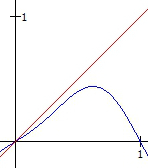
Divide the percentage into 69. (For some numbers it’s easier to use 70 or 72; remember, these are just to be approximate. The exact figure is 100*ln(2) = 69.3147… and then it wouldn’t be the percentage p but 100*ln(1+p/100); try plotting those and you’ll see why using p works.) This is the time it will take to double.

So at 4%, Arcadia will double in about 17.5 years, quadrupling in 35 years. At 2%, Berkland will double in about 35 years. Thus, in 35 years, Arcadia will quadruple and Berkland will double, so their GDPs will be equal.

Economics is full of exponential processes: Compound interest is exponential, and over moderately long periods GDP and population both tend to grow exponentially. (In fact they grow logistically, which is similar to exponential until it gets very large and begins to slow down. If you smooth out our recessions, you can get a sense that since the 1940s, US GDP growth has slowed down from about 4% per year to about 2% per year.) It is therefore quite important to understand how exponential growth works.

Let’s try another one. If one account has $1 million, growing at 5% per year, and another has $1,000, growing at 10% per year, how long will it take for the second account to have more money in it?

69/5 is about 14, so the first account doubles in 14 years. 69/10 is about 7, so the second account doubles in 7 years. A factor of 1000 is about 10 doublings (2^10 = 1024), so the second account needs to have doubled 10 times more than the first account. Since it doubles twice as often, this means that it must have doubled 20 times while the other doubled 10 times. Therefore, it will take about 140 years.

In fact, it takes 141—so our quick approximation is actually remarkably good.

This example is instructive in another way; 141 years is a pretty long time, isn’t it? You can’t just assume that exponential growth is “as fast as you want it to be”. Once people realize that exponential growth is very fast, they often overcorrect, assuming that exponential growth automatically means growth that is absurdly—or arbitrarily—fast. (XKCD made a similar point in this comic.)

I think the worst examples of this mistake are among Singularitarians. They—correctly—note that computing power has become exponentially greater and cheaper over time, doubling about every 18 months, which has been dubbed Moore’s Law. They assume that this will continue into the indefinite future (this is already problematic; the growth rate seems to be already slowing down). And therefore they conclude there will be a sudden moment, a technological singularity, at which computers will suddenly outstrip humans in every way and bring about a new world order of artificial intelligence basically overnight. They call it a “hard takeoff”; here’s a direct quote:

But many thinkers in this field including Nick Bostrom and Eliezer Yudkowsky worry that AI won’t work like this at all. Instead there could be a “hard takeoff”, a huge subjective discontinuity in the function mapping AI research progress to intelligence as measured in ability-to-get-things-done. If on January 1 you have a toy AI as smart as a cow, one which can identify certain objects in pictures and navigate a complex environment, and on February 1 it’s proved the Riemann hypothesis and started building a ring around the sun, that was a hard takeoff.

Wait… what? For someone like me who understands exponential growth, the last part is a baffling non sequitur. If computers start half as smart as us and double every 18 months, in 18 months, they will be as smart as us. In 36 months, they will be twice as smart as us. Twice as smart as us literally means that two people working together perfectly can match them—certainly a few dozen working realistically can. We’re not in danger of total AI domination from that. With millions of people working against the AI, we should be able to keep up with it for at least another 30 years. So are you assuming that this trend is continuing or not? (Oh, and by the way, we’ve had AIs that can identify objects and navigate complex environments for a couple years now, and so far, no ringworld around the Sun.)

That same essay make a biological argument, which misunderstands human evolution in a way that is surprisingly subtle yet ultimately fundamental:

If you were to come up with a sort of objective zoological IQ based on amount of evolutionary work required to reach a certain level, complexity of brain structures, etc, you might put nematodes at 1, cows at 90, chimps at 99, homo erectus at 99.9, and modern humans at 100. The difference between 99.9 and 100 is the difference between “frequently eaten by lions” and “has to pass anti-poaching laws to prevent all lions from being wiped out”.

No, actually, what makes humans what we are is not that we are 1% smarter than chimpanzees.

First of all, we’re actually more like 200% smarter than chimpanzees, measured by encephalization quotient; they clock in at 2.49 while we hit 7.44. If you simply measure by raw volume, they have about 400 mL to our 1300 mL, so again roughly 3 times as big. But that’s relatively unimportant; with Moore’s Law, tripling only takes about 2.5 years.

But even having triple the brain power is not what makes humans different. It was a necessary condition, but not a sufficient one. Indeed, it was so insufficient that for about 200,000 years we had brains just as powerful as we do now and yet we did basically nothing in technological or economic terms—total, complete stagnation on a global scale. This is a conservative estimate of when we had brains of the same size and structure as we do today.

What makes humans what we are? Cooperation. We are what we are because we are together.
The capacity of human intelligence today is not 1300 mL of brain. It’s more like 1.3 gigaliters of brain, where a gigaliter, a billion liters, is about the volume of the Empire State Building. We have the intellectual capacity we do not because we are individually geniuses, but because we have built institutions of research and education that combine, synthesize, and share the knowledge of billions of people who came before us. Isaac Newton didn’t understand the world as well as the average third-grader in the 21st century does today. Does the third-grader have more brain? Of course not. But they absolutely do have more knowledge.

(I recently finished my first playthrough of Legacy of the Void, in which a central point concerns whether the Protoss should detach themselves from the Khala, a psychic union which combines all their knowledge and experience into one. I won’t spoil the ending, but let me say this: I can understand their hesitation, for it is basically our equivalent of the Khala—first literacy, and now the Internet—that has made us what we are. It would no doubt be the Khala that made them what they are as well.)

Is AI still dangerous? Absolutely. There are all sorts of damaging effects AI could have, culturally, economically, militarily—and some of them are already beginning to happen. I even agree with the basic conclusion of that essay that OpenAI is a bad idea because the cost of making AI available to people who will abuse it or create one that is dangerous is higher than the benefit of making AI available to everyone. But exponential growth not only isn’t the same thing as instantaneous takeoff, it isn’t even compatible with it.

The next time you encounter an example of exponential growth, try this. Don’t just fudge it in your head, don’t overcorrect and assume everything will be fast—just divide the percentage into 69 to see how long it will take to double.
The Tragedy of the Commons

JDN 2457387

In a previous post I talked about one of the most fundamental—perhaps the most fundamental—problem in game theory, the Prisoner’s Dilemma, and how neoclassical economic theory totally fails to explain actual human behavior when faced with this problem in both experiments and the real world.

As a brief review, the essence of the game is that both players can either cooperate or defect; if they both cooperate, the outcome is best overall; but it is always in each player’s interest to defect. So a neoclassically “rational” player would always defect—resulting in a bad outcome for everyone. But real human beings typically cooperate, and thus do better. The “paradox” of the Prisoner’s Dilemma is that being “rational” results in making less money at the end.

Obviously, this is not actually a good definition of rational behavior. Being short-sighted and ignoring the impact of your behavior on others doesn’t actually produce good outcomes for anybody, including yourself.

But the Prisoner’s Dilemma only has two players. If we expand to a larger number of players, the expanded game is called a Tragedy of the Commons.

When we do this, something quite surprising happens: As you add more people, their behavior starts converging toward the neoclassical solution, in which everyone defects and we get a bad outcome for everyone.

Indeed, people in general become less cooperative, less courageous, and more apathetic the more of them you put together. K was quite apt when he said, “A person is smart; people are dumb, panicky, dangerous animals and you know it.” There are ways to counteract this effect, as I’ll get to in a moment—but there is a strong effect that needs to be counteracted.

We see this most vividly in the bystander effect. If someone is walking down the street and sees someone fall and injure themselves, there is about a 70% chance that they will go try to help the person who fell—humans are altruistic. But if there are a dozen people walking down the street who all witness the same event, there is only a 40% chance that any of them will help—humans are irrational.

The primary reason appears to be diffusion of responsibility. When we are alone, we are the only one could help, so we feel responsible for helping. But when there are others around, we assume that someone else could take care of it for us, so if it isn’t done that’s not our fault.

There also appears to be a conformity effect: We want to conform our behavior to social norms (as I said, to a first approximation, all human behavior is social norms). The mere fact that there are other people who could have helped but didn’t suggests the presence of an implicit social norm that we aren’t supposed to help this person for some reason. It never occurs to most people to ask why such a norm would exist or whether it’s a good one—it simply never occurs to most people to ask those questions about any social norms. In this case, by hesitating to act, people actually end up creating the very norm they think they are obeying.

This can lead to what’s called an Abilene Paradox, in which people simultaneously try to follow what they think everyone else wants and also try to second-guess what everyone else wants based on what they do, and therefore end up doing something that none of them actually wanted. I think a lot of the weird things humans do can actually be attributed to some form of the Abilene Paradox. (“Why are we sacrificing this goat?” “I don’t know, I thought you wanted to!”)

Autistic people are not as good at following social norms (though some psychologists believe this is simply because our social norms are optimized for the neurotypical population). My suspicion is that autistic people are therefore less likely to suffer from the bystander effect, and more likely to intervene to help someone even if they are surrounded by passive onlookers. (Unfortunately I wasn’t able to find any good empirical data on that—it appears no one has ever thought to check before.) I’m quite certain that autistic people are less likely to suffer from the Abilene Paradox—if they don’t want to do something, they’ll tell you so (which sometimes gets them in trouble).

Because of these psychological effects that blunt our rationality, in large groups human beings often do end up behaving in a way that appears selfish and short-sighted.

Nowhere is this more apparent than in ecology. Recycling, becoming vegetarian, driving less, buying more energy-efficient appliances, insulating buildings better, installing solar panels—none of these things are particularly difficult or expensive to do, especially when weighed against the tens of millions of people who will die if climate change continues unabated. Every recyclable can we throw in the trash is a silent vote for a global holocaust.

But as it no doubt immediately occurred to you to respond: No single one of us is responsible for all that. There’s no way I myself could possibly save enough carbon emissions to significantly reduce climate change—indeed, probably not even enough to save a single human life (though maybe). This is certainly true; the error lies in thinking that this somehow absolves us of the responsibility to do our share.

I think part of what makes the Tragedy of the Commons so different from the Prisoner’s Dilemma, at least psychologically, is that the latter has an identifiable victimwe know we are specifically hurting that person more than we are helping ourselves. We may even know their name (and if we don’t, we’re more likely to defect—simply being on the Internet makes people more aggressive because they don’t interact face-to-face). In the Tragedy of the Commons, it is often the case that we don’t know who any of our victims are; moreover, it’s quite likely that we harm each one less than we benefit ourselves—even though we harm everyone overall more.

Suppose that driving a gas-guzzling car gives me 1 milliQALY of happiness, but takes away an average of 1 nanoQALY from everyone else in the world. A nanoQALY is tiny! Negligible, even, right? One billionth of a year, a mere 30 milliseconds! Literally less than the blink of an eye. But take away 30 milliseconds from everyone on Earth and you have taken away 7 years of human life overall. Do that 10 times, and statistically one more person is dead because of you. And you have gained only 10 milliQALY, roughly the value of $300 to a typical American. Would you kill someone for $300?

Peter Singer has argued that we should in fact think of it this way—when we cause a statistical death by our inaction, we should call it murder, just as if we had left a child to drown to keep our clothes from getting wet. I can’t agree with that. When you think seriously about the scale and uncertainty involved, it would be impossible to live at all if we were constantly trying to assess whether every action would lead to statistically more or less happiness to the aggregate of all human beings through all time. We would agonize over every cup of coffee, every new video game. In fact, the global economy would probably collapse because none of us would be able to work or willing to buy anything for fear of the consequences—and then whom would we be helping?

That uncertainty matters. Even the fact that there are other people who could do the job matters. If a child is drowning and there is a trained lifeguard right next to you, the lifeguard should go save the child, and if they don’t it’s their responsibility, not yours. Maybe if they don’t you should try; but really they should have been the one to do it.
But we must also not allow ourselves to simply fall into apathy, to do nothing simply because we cannot do everything. We cannot assess the consequences of every specific action into the indefinite future, but we can find general rules and patterns that govern the consequences of actions we might take. (This is the difference between act utilitarianism, which is unrealistic, and rule utilitarianism, which I believe is the proper foundation for moral understanding.)

Thus, I believe the solution to the Tragedy of the Commons is policy. It is to coordinate our actions together, and create enforcement mechanisms to ensure compliance with that coordinated effort. We don’t look at acts in isolation, but at policy systems holistically. The proper question is not “What should I do?” but “How should we live?”

In the short run, this can lead to results that seem deeply suboptimal—but in the long run, policy answers lead to sustainable solutions rather than quick-fixes.

People are starving! Why don’t we just steal money from the rich and use it to feed people? Well, think about what would happen if we said that the property system can simply be unilaterally undermined if someone believes they are achieving good by doing so. The property system would essentially collapse, along with the economy as we know it. A policy answer to that same question might involve progressive taxation enacted by a democratic legislature—we agree, as a society, that it is justified to redistribute wealth from those who have much more than they need to those who have much less.

Our government is corrupt! We should launch a revolution! Think about how many people die when you launch a revolution. Think about past revolutions. While some did succeed in bringing about more just governments (e.g. the French Revolution, the American Revolution), they did so only after a long period of strife; and other revolutions (e.g. the Russian Revolution, the Iranian Revolution) have made things even worse. Revolution is extremely costly and highly unpredictable; we must use it only as a last resort against truly intractable tyranny. The policy answer is of course democracy; we establish a system of government that elects leaders based on votes, and then if they become corrupt we vote to remove them. (Sadly, we don’t seem so good about that second part—the US Congress has a 14% approval rating but a 95% re-election rate.)

And in terms of ecology, this means that berating ourselves for our sinfulness in forgetting to recycle or not buying a hybrid car does not solve the problem. (Not that it’s bad to recycle, drive a hybrid car, and eat vegetarian—by all means, do these things. But it’s not enough.) We need a policy solution, something like a carbon tax or cap-and-trade that will enforce incentives against excessive carbon emissions.

In case you don’t think politics makes a difference, all of the Democrat candidates for President have proposed such plans—Bernie Sanders favors a carbon tax, Martin O’Malley supports an aggressive cap-and-trade plan, and Hillary Clinton favors heavily subsidizing wind and solar power. The Republican candidates on the other hand? Most of them don’t even believe in climate change. Chris Christie and Carly Fiorina at least accept the basic scientific facts, but (1) they are very unlikely to win at this point and (2) even they haven’t announced any specific policy proposals for dealing with it.

This is why voting is so important. We can’t do enough on our own; the coordination problem is too large. We need to elect politicians who will make policy. We need to use the systems of coordination enforcement that we have built over generations—and that is fundamentally what a government is, a system of coordination enforcement. Only then can we overcome the tendency among human beings to become apathetic and short-sighted when faced with a Tragedy of the Commons.

How we can best help refugees

JDN 2457376

Though the debate seems to have simmered down a little over the past few weeks, the fact remains that we are in the middle of a global refugee crisis. There are 4 million refugees from Syria alone, part of 10 million refugees worldwide from various conflicts.

The ongoing occupation of the terrorist group / totalitarian state Daesh (also known as Islamic State, ISIS and ISIL, but like John Kerry, I like to use Daesh precisely because they seem to hate it) has displaced almost 14 million people, 3.3 million of them refugees from Syria.

Most of these refugees have fled to Lebanon, Jordan, Turkey, and, Iraq, for the obvious reason that these countries are both geographically closest and culturally best equipped to handle them.
There is another reason, however: Some of the other countries in the region, notably Saudi Arabia, have taken no refugees at all. In an upcoming post I intend to excoriate Saudi Arabia for a number of reasons, but this one is perhaps the most urgent. Their response? They simply deny it outright, claiming they’ve taken millions of refugees and somehow nobody noticed.

Turkey and Lebanon are stretched to capacity, however; they simply do not have the resources to take on more refugees. This gives the other nations of the world only two morally legitimate options:

1. We could take more refugees ourselves.

2. We could supply funding and support to Turkey and Lebanon for them to take on more refugees.

Most of the debate has centered around option (1), and in particular around Obama’s plan to take on about 10,000 refugees to the United States, which Ted Cruz calls “lunacy” (to be fair, if it takes one to know one…).

This debate has actually served more to indict the American population for paranoia and xenophobia than anything else. The fact that 17 US states—including some with Democrat governors—have unilaterally declared that they will not accept refugees (despite having absolutely no Constitutional authority to make such a declaration) is truly appalling.

Even if everything that the xenophobic bigots say were true—even if we really were opening ourselves to increased risk of terrorism and damaging our economy and subjecting ourselves to mass unemployment—we would still have a moral duty as human beings to help these people.

And of course almost all of it is false.

Only a tiny fraction of refugees are terrorists, indeed very likely smaller than the fraction of the native population or the fraction of those who arrive on legal visas, meaning that we would actually be diluting our risk of terrorism by accepting more refugees. And as you may recall from my post on 9/11, our risk of terrorism is already so small that the only thing we have to fear is fear itself.

There is a correlation between terrorism and refugees, but it’s almost entirely driven by the opposite effect: terrorism causes refugee crises.

The net aggregate economic effect of immigration is most likely positive. The effect on employment is more ambiguous; immigration does appear to create a small increase in unemployment in the short run as all those new people try to find jobs, and there is some evidence that it may reduce wages for local low-skill workers. But the employment effect is small temporary, and there is a long-run boost in overall productivity. However, it may not have much effect on overall growth: the positive correlation between immigration and economic growth is primarily due to the fact that higher growth triggers more immigration.

And of course, it’s important to keep in mind that the reason wages are depressed at all is that people come from places where wages are even lower, so they improve their standard of living, but may also reduce the standard of living of some of the workers who were already here. The paradigmatic example is immigrants who leave a wage of $4 per hour in Mexico, arrive in California, and end up reducing wages in California from $10 to $8. While this certainly hurts some people who went from $10 to $8, it’s so narrow-sighted as to border on racism to ignore the fact that it also raised other people from $4 to $8. The overall effect is not simply to redistribute wealth from some to others, but actually to create more wealth. If there are things we can do to prevent low-skill wages from falling, perhaps we should; but systematically excluding people who need work is not the way to do that.

Accepting 10,000 more refugees would have a net positive effect on the American economy—though given our huge population and GDP, probably a negligible one. It has been pointed out that Germany’s relatively open policy advances the interests of Germany as much as it does those of the refugees; but so what? They are doing the right thing, even if it’s not for entirely altruistic reasons. One of the central insights of economics is that the universe is nonzero-sum; helping someone else need not mean sacrificing your own interests, and when it doesn’t, the right thing to do should be a no-brainer. Instead of castigating Germany for doing what needs to be done for partially selfish reasons, we should be castigating everyone else for not even doing what’s in their own self-interest because they are so bigoted and xenophobic they’d rather harm themselves than help someone else. (Also, it does not appear to be in Angela Merkel’s self-interest to take more refugees; she is spending a lot of political capital to make this happen.)

We could follow Germany’s example, and Obama’s plan would move us in that direction.

But the fact remains that we could go through with Obama’s plan, indeed double, triple, quadruple it—and still not make a significant dent in the actual population of refugees who need help. When 1,500,000 people need help and the most powerful nation in the world offers to help 10,000, that isn’t an act of great openness and generosity; it’s almost literally the least we could do. 10,000 is only 0.7% of 1.5 million; even if we simply accepted an amount of refugees proportional to our own population it would be more like 70,000. If we instead accepted an amount of refugees proportional to our GDP we should be taking on closer to 400,000.

This is why in fact I think option (2) may be the better choice.

There actually are real cultural and linguistic barriers to assimilation for Syrian people in the United States, barriers which are much lower in Turkey and Lebanon. Immigrant populations always inevitably assimilate eventually, but there is a period of transition which is painful for both immigrants and locals, often lasting a decade or more. On top of this there is the simple logistical cost of moving all those people that far; crossing the border into Lebanon is difficult enough without having to raft across the Mediterranean, let alone being airlifted or shipped all the way across the Atlantic afterward. The fact that many refugees are willing to bear such a cost serves to emphasize their desperation; but it also suggests that there may be alternatives that would work out better for everyone.

The United States has a large population at 322 million; but Turkey (78 million) has about a quarter of our population and Jordan (8 million) and Lebanon (6 million) are about the size of our largest cities.

Our GDP, on the other hand, is vastly larger. At $18 trillion, we have 12 times the GDP of Turkey ($1.5 T), and there are individual American billionaires with wealth larger than the GDPs of Lebanon ($50 B) and Jordan ($31 B).

This means that while we have an absolute advantage in population, we have a comparative advantage in wealth—and the benefits of trade depend on comparative advantage. It therefore makes sense for us to in a sense “trade” wealth for population; in exchange for taking on fewer refugees, we would offer to pay a larger share of the expenses involved in housing, feeding, and ultimately assimilating those refugees.

Another thing we could offer (and have a comparative as well as absolute advantage in) is technology. These surprisingly-nice portable shelters designed by IKEA are an example of how First World countries can contribute to helping refugees without necessarily accepting them into their own borders (as well as an example of why #Scandinaviaisbetter). We could be sending equipment and technicians to provide electricity, Internet access, or even plumbing to the refugee camps. We could ship them staple foods or even MREs. (On the other hand, I am not impressed by the tech entrepreneurs whose “solutions” apparently involve selling more smartphone apps.)

The idea of actually taking on 400,000 or even 70,000 additional people into the United States is daunting even for those of us who strongly believe in helping the refugees—in the former case we’re adding another Cleveland, and even in the latter we’d be almost doubling Dearborn. But if we estimate the cost of simply providing money to support the refugee camps, the figures come out a lot less demanding.
Charities are currently providing money on the order of millions—which is to say on the order of single dollars per person. GBP 887,000 sounds like a lot of money until you realize it’s less than $0.50 per Syrian refugee.

Suppose we were to grant $5,000 per refugee per year. That’s surely more than enough. The UN is currently asking for $6.5 billion, which is only about $1,500 per refugee.

Yet to supply that much for all 4 million refugees would cost us only $20 billion per year, a mere 0.1% of our GDP. (Or if you like, a mere 3% of our military budget, which is probably smaller than what the increase would be if we stepped up our military response to Daesh.)

I say we put it to a vote among the American people: Are you willing to accept a flat 0.1% increase in income tax in order to help the refugees? (Would you even notice?) This might create an incentive to become a refugee when you’d otherwise have tried to stay in Syria, but is that necessarily a bad thing? Daesh, like any state, depends upon its tax base to function, so encouraging emigration undermines Daesh taxpayer by taxpayer. We could make it temporary and tied to the relief efforts—or, more radically, we could not do that, and use it as a starting point to build an international coalition for a global basic income.

Right now a global $5,000 per person per year would not be feasible (that would be almost half of the world’s GDP); but something like $1,000 would be, and would eliminate world hunger immediately and dramatically reduce global poverty. The US alone could in fact provide a $1,000 global basic income, though it would cost $7.2 trillion, which is over 40% of our $18.1 trillion GDP—not beyond our means, but definitely stretching them to the limit. Yet simply by including Europe ($18.5 T), China ($12.9 T), Japan ($4.2 T), India ($2.2 T), and Brazil ($1.8 T), we’d reduce the burden among the whole $57.7 trillion coalition to 12.5% of GDP. That’s roughly what we already spend on Medicare and Social Security. Not a small amount, to be sure; but this would get us within arm’s reach of permanently ending global poverty.

Think of the goodwill we’d gain around the world; think of how much it would undermine Daesh’s efforts to recruit followers if everyone knew that just across the border is a guaranteed paycheck from that same United States that Daesh keeps calling the enemy. This isn’t necessarily contradictory to a policy of accepting more refugees, but it would be something we could implement immediately, with minimal cost to ourselves.

And I’m sure there’d be people complaining that we were only doing it to make ourselves look good and stabilize the region economically, and it will all ultimately benefit us eventually—which is very likely true. But again, I say: So what? Would you rather we do the right thing and benefit from it, or do the wrong thing just so we dare not help ourselves?

Tax incidence revisited, part 5: Who really pays the tax?

JDN 2457359

I think all the pieces are now in place to really talk about tax incidence.

In earlier posts I discussed how taxes have important downsides, then talked about how taxes can distort prices, then explained that taxes are actually what gives money its value. In the most recent post in the series, I used supply and demand curves to show precisely how taxes create deadweight loss.

Now at last I can get to the fundamental question: Who really pays the tax?

The common-sense answer would be that whoever writes the check to the government pays the tax, but this is almost completely wrong. It is right about one aspect, a sort of political economy notion, which is that if there is any trouble collecting the tax, it’s generally that person who is on the hook to pay it. But especially in First World countries, most taxes are collected successfully almost all the time. Tax avoidance—using loopholes to reduce your tax burden—is all over the place, but tax evasion—illegally refusing to pay the tax you owe—is quite rare. And for this political economy argument to hold, you really need significant amounts of tax evasion and enforcement against it.

The real economic answer is that the person who pays the tax is the person who bears the loss in surplus. In essence, the person who bears the tax is the person who is most unhappy about it.

In the previous post in this series, I explained what surplus is, but it bears a brief repetition. Surplus is the value you get from purchases you make, in excess of the price you paid to get them. It’s measured in dollars, because that way we can read it right off the supply and demand curve. We should actually be adjusting for marginal utility of wealth and measuring in QALY, but that’s a lot harder so it rarely gets done.

In the graphs I drew in part 4, I already talked about how the deadweight loss is much greater if supply and demand are elastic than if they are inelastic. But in those graphs I intentionally set it up so that the elasticities of supply and demand were about the same. What if they aren’t?

Consider what happens if supply is very inelastic, but demand is very elastic. In fact, to keep it simple, lets suppose that supply is perfectly inelastic, but demand is perfectly elastic. This means that supply elasticity is 0, but demand elasticity is infinite.

The zero supply elasticity means that the worker would actually be willing to work up to their maximum hours for nothing, but is unwilling to go above that regardless of the wage. They have a specific amount of hours they want to work, regardless of what they are paid.

The infinite demand elasticity means that each hour of work is worth exactly the same amount the employer, with no diminishing returns. They have a specific wage they are willing to pay, regardless of how many hours it buys.

Both of these are quite extreme; it’s unlikely that in real life we would ever have an elasticity that is literally zero or infinity. But we do actually see elasticities that get very low or very high, and qualitatively they act the same way.

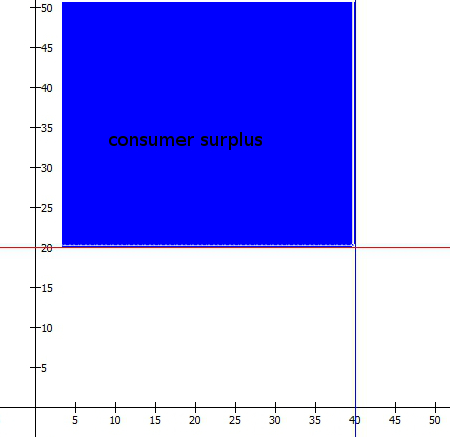
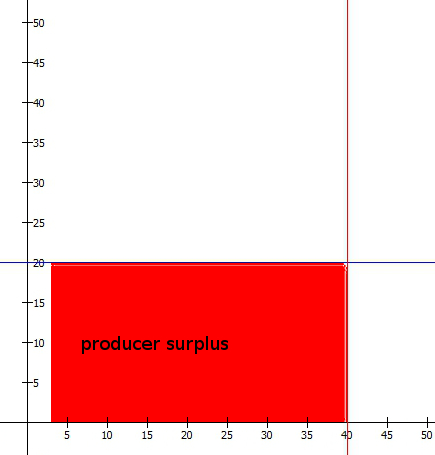
So let’s suppose as before that the wage is $20 and the number of hours worked is 40. The supply and demand graph actually looks a little weird: There is no consumer surplus whatsoever.

incidence_infinite_notax_surplus

Each hour is worth $20 to the employer, and that is what they shall pay. The whole graph is full of producer surplus; the worker would have been willing to work for free, but instead gets $20 per hour for 40 hours, so they gain a whopping $800 in surplus.

incidence_infinite_tax_surplus

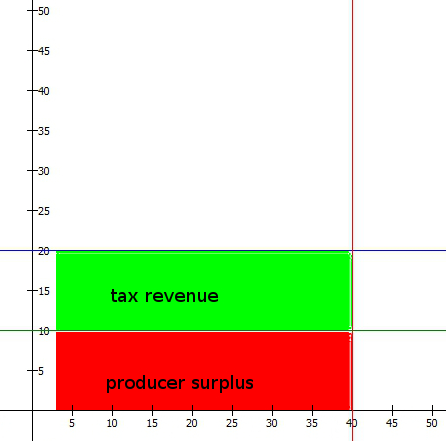
Now let’s implement a tax, say 50% to make it easy. (That’s actually a huge payroll tax, and if anybody ever suggested implementing that I’d be among the people pulling out a Laffer curve to show them why it’s a bad idea.)

Normally a tax would push the demand wage higher, but in this case $20 is exactly what they can afford, so they continue to pay exactly the same as if nothing had happened. This is the extreme example in which your “pre-tax” wage is actually your pre-tax wage, what you’d get if there hadn’t been a tax. This is the only such example—if demand elasticity is anything less than infinity, the wage you see listed as “pre-tax” will in fact be higher than what you’d have gotten in the absence of the tax.

The tax revenue is therefore borne entirely by the worker; they used to take home $20 per hour, but now they only get $10. Their new surplus is only $400, precisely 40% lower. The extra $400 goes directly to the government, which makes this example unusual in another way: There is no deadweight loss. The employer is completely unaffected; their surplus goes from zero to zero. No surplus is destroyed, only moved. Surplus is simply redistributed from the worker to the government, so the worker bears the entirety of the tax. Note that this is true regardless of who actually writes the check; I didn’t even have to include that in the model. Once we know that there was a tax imposed on each hour of work, the market prices decided who would bear the burden of that tax.

By Jove, we’ve actually found an example in which it’s fair to say “the government is taking my hard-earned money!” (I’m fairly certain if you replied to such people with “So you think your supply elasticity is zero but your employer’s demand elasticity is infinite?” you would be met with blank stares or worse.)

This is however quite an extreme case. Let’s try a more realistic example, where supply elasticity is very small, but not zero, and demand elasticity is very high, but not infinite. I’ve made the demand elasticity -10 and the supply elasticity 0.5 for this example.

incidence_supply_notax_surplus

Before the tax, the wage was $20 for 40 hours of work. The worker received a producer surplus of $700. The employer received a consumer surplus of only $80. The reason their demand is so elastic is that they are only barely getting more from each hour of work than they have to pay.

Total surplus is $780.

incidence_supply_tax_surplus

After the tax, the number of hours worked has dropped to 35. The “pre-tax” (demand) wage has only risen to $20.25. The after-tax (supply) wage the worker actually receives has dropped all the way to $10. The employer’s surplus has only fallen to $65.63, a decrease of $14.37 or 18%. Meanwhile the worker’s surplus has fallen all the way to $325, a decrease of $275 or 46%. The employer does feel the tax, but in both absolute and relative terms, the worker feels the tax much more than the employer does.

The tax revenue is $358.75, which means that the total surplus has been reduced to $749.38. There is now $30.62 of deadweight loss. Where both elasticities are finite and nonzero, deadweight loss is basically inevitable.

In this more realistic example, the burden was shared somewhat, but it still mostly fell on the worker, because the worker had a much lower elasticity. Let’s try turning the tables and making demand elasticity low while supply elasticity is high—in fact, once again let’s illustrate by using the extreme case of zero versus infinity.

In order to do this, I need to also set a maximum wage the employer is willing to pay. With nonzero elasticity, that maximum sort of came out automatically when the demand curve hits zero; but when elasticity is zero, the line is parallel so it never crosses. Let’s say in this case that the maximum is $50 per hour.

(Think about why we didn’t need to set a minimum wage for the worker when supply was perfectly inelastic—there already was a minimum, zero.)

incidence_infinite2_notax_surplus

This graph looks deceptively similar to the previous; basically all that has happened is the supply and demand curves have switched places, but that makes all the difference. Now instead of the worker getting all the surplus, it’s the employer who gets all the surplus. At their maximum wage of $50, they are getting $1200 in surplus.

Now let’s impose that same 50% tax again.

incidence_infinite2_tax_surplus

The worker will not accept any wage less than $20, so the demand wage must rise all the way to $40. The government will then receive $800 in revenue, while the employer will only get $400 in surplus. Notice again that the deadweight loss is zero. The employer will now bear the entire burden of the tax.

In this case the “pre-tax” wage is basically meaningless; regardless of the value of the tax the worker would receive the same amount, and the “pre-tax” wage is really just an accounting mechanism the government uses to say how large the tax is. They could just as well have said, “Hey employer, give us $800!” and the outcome would be the same. This is called a lump-sum tax, and they don’t work in the real world but are sometimes used for comparison. The thing about a lump-sum tax is that it doesn’t distort prices in any way, so in principle you could use it to redistribute wealth however you want. But in practice, there’s no way to implement a lump-sum tax that would be large enough to raise sufficient revenue but small enough to be affordable by the entire population. Also, a lump-sum tax is extremely regressive, hurting the poor tremendously while the rich feel nothing. (Actually the closest I can think of to a realistic lump-sum tax would be a basic income, which is essentially a negative lump-sum tax.)

I could keep going with more examples, but the basic argument is the same.

In general what you will find is that the person who bears a tax is the person who has the most to lose if less of that good is sold. This will mean their supply or demand is very inelastic and their surplus is very large.

Inversely, the person who doesn’t feel the tax is the person who has the least to lose if the good stops being sold. That will mean their supply or demand is very elastic and their surplus is very small.
Once again, it really does not matter how the tax is collected. It could be taken entirely from the employer, or entirely from the worker, or shared 50-50, or 60-40, or whatever. As long as it actually does get paid, the person who will actually feel the tax depends upon the structure of the market, not the method of tax collection. Raising “employer contributions” to payroll taxes won’t actually make workers take any more home; their “pre-tax” wages will simply be adjusted downward to compensate. Likewise, raising the “employee contribution” won’t actually put more money in the pockets of the corporation, it will just force them to raise wages to avoid losing employees. The actual amount that each party must contribute to the tax isn’t based on how the checks are written; it’s based on the elasticities of the supply and demand curves.

And that’s why I actually can’t get that strongly behind corporate taxes; even though they are formally collected from the corporation, they could simply be hurting customers or employees. We don’t actually know; we really don’t understand the incidence of corporate taxes. I’d much rather use income taxes or even sales taxes, because we understand the incidence of those.

Tax incidence revisited, part 4: Surplus and deadweight loss

JDN 2457355

I’ve already mentioned the fact that taxation creates deadweight loss, but in order to understand tax incidence it’s important to appreciate exactly how this works.

Deadweight loss is usually measured in terms of total economic surplus, which is a strange and deeply-flawed measure of value but relatively easy to calculate.

Surplus is based upon the concept of willingness-to-pay; the value of something is determined by the maximum amount of money you would be willing to pay for it.

This is bizarre for a number of reasons, and I think the most important one is that people differ in how much wealth they have, and therefore in their marginal utility of wealth. $1 is worth more to a starving child in Ghana than it is to me, and worth more to me than it is to a hedge fund manager, and worth more to a hedge fund manager than it is to Bill Gates. So when you try to set what something is worth based on how much someone will pay for it, which someone are you using?

People also vary, of course, in how much real value a good has to them: Some people like dark chocolate, some don’t. Some people love spicy foods and others despise them. Some people enjoy watching sports, others would rather read a book. A meal is worth a lot more to you if you haven’t eaten in days than if you just ate half an hour ago. That’s not actually a problem; part of the point of a market economy is to distribute goods to those who value them most. But willingness-to-pay is really the product of two different effects: The real effect, how much utility the good provides you; and the wealth effect, how your level of wealth affects how much you’d pay to get the same amount of utility. By itself, willingness-to-pay has no means of distinguishing these two effects, and actually I think one of the deepest problems with capitalism is that ultimately capitalism has no means of distinguishing these two effects. Products will be sold to the highest bidder, not the person who needs it the most—and that’s why Americans throw away enough food to end world hunger.

But for today, let’s set that aside. Let’s pretend that willingness-to-pay is really a good measure of value. One thing that is really nice about it is that you can read it right off the supply and demand curves.

When you buy something, your consumer surplus is the difference between your willingness-to-pay and how much you actually did pay. If a sandwich is worth $10 to you and you pay $5 to get it, you have received $5 of consumer surplus.

When you sell something, your producer surplus is the difference between how much you were paid and your willingness-to-accept, which is the minimum amount of money you would accept to part with it. If making that sandwich cost you $2 to buy ingredients and $1 worth of your time, your willingness-to-accept would be $3; if you then sell it for $5, you have received $2 of producer surplus.

Total economic surplus is simply the sum of consumer surplus and producer surplus. One of the goals of an efficient market is to maximize total economic surplus.

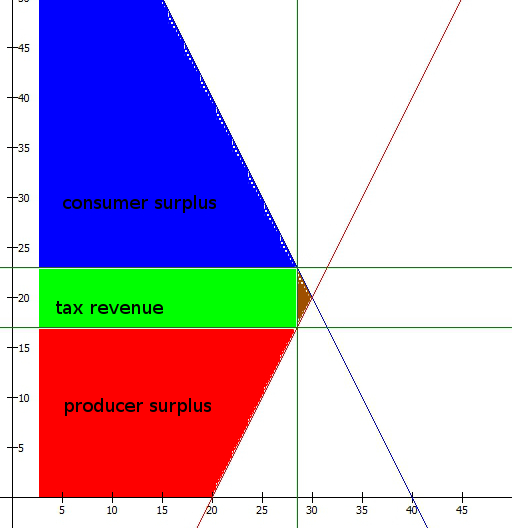
Let’s return to our previous example, where a 20% tax raised the original wage from $22.50 and thus resulted in an after-tax wage of $18.

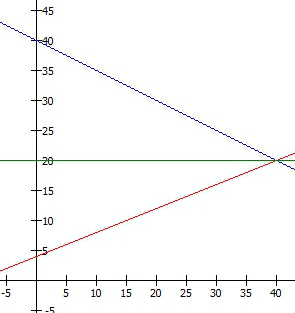
Before the tax, the supply and demand curves looked like this:

equilibrium_notax

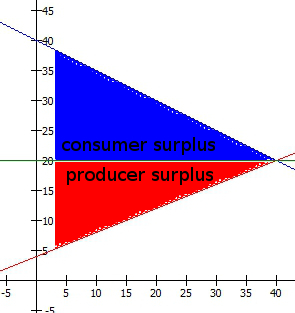
Consumer surplus is the area below the demand curve, above the price, up to the total number of goods sold. The basic reasoning behind this is that the demand curve gives the willingness-to-pay for each good, which decreases as more goods are sold because of diminishing marginal utility. So what this curve is saying is that the first hour of work was worth $40 to the employer, but each following hour was worth a bit less, until the 10th hour of work was only worth $35. Thus the first hour gave $40-$20 = $20 of surplus, while the 10th hour only gave $35-$20 = $15 of surplus.

Producer surplus is the area above the supply curve, below the price, again up to the total number of goods sold. The reasoning is the same: If the first hour of work cost $5 worth of time but the 10th hour cost $10 worth of time, the first hour provided $20-$5 = $15 in producer surplus, but the 10th hour only provided $20-$10 = $10 in producer surplus.

Imagine drawing a little 1-pixel-wide line straight down from the demand curve to the price for each hour and then adding up all those little lines into the total area under the curve, and similarly drawing little 1-pixel-wide lines straight up from the supply curve.

surplus

The employer was paying $20 * 40 = $800 for an amount of work that they actually valued at $1200 (the total area under the demand curve up to 40 hours), so they benefit by $400. The worker was being paid $800 for an amount of work that they would have been willing to accept $480 to do (the total area under the supply curve up to 40 hours), so they benefit $320. The sum of these is the total surplus $720.

equilibrium_notax_surplus

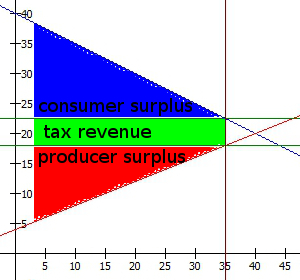
After the tax, the employer is paying $22.50 * 35 = $787.50, but for an amount of work that they only value at $1093.75, so their new surplus is only $306.25. The worker is receiving $18 * 35 = $630, for an amount of work they’d have been willing to accept $385 to do, so their new surplus is $245. Even when you add back in the government revenue of $4.50 * 35 = $157.50, the total surplus is still only $708.75. What happened to that extra $11.25 of value? It simply disappeared. It’s gone. That’s what we mean by “deadweight loss”. That’s why there is a downside to taxation.

equilibrium_tax_surplus

How large the deadweight loss is depends on the precise shape of the supply and demand curves, specifically on how elastic they are. Remember that elasticity is the proportional change in the quantity sold relative to the change in price. If increasing the price 1% makes you want to buy 2% less, you have a demand elasticity of -2. (Some would just say “2”, but then how do we say it if raising the price makes you want to buy more? The Law of Demand is more like what you’d call a guideline.) If increasing the price 1% makes you want to sell 0.5% more, you have a supply elasticity of 0.5.

If supply and demand are highly elastic, deadweight loss will be large, because even a small tax causes people to stop buying and selling a large amount of goods. If either supply or demand is inelastic, deadweight loss will be small, because people will more or less buy and sell as they always did regardless of the tax.

I’ve filled in the deadweight loss with brown in each of these graphs. They are designed to have the same tax rate, and the same price and quantity sold before the tax.

When supply and demand are elastic, the deadweight loss is large:

equilibrium_elastic_tax_surplus

But when supply and demand are inelastic, the deadweight loss is small:

equilibrium_inelastic_tax_surplus

Notice that despite the original price and the tax rate being the same, the tax revenue is also larger in the case of inelastic supply and demand. (The total surplus is also larger, but it’s generally thought that we don’t have much control over the real value and cost of goods, so we can’t generally make something more inelastic in order to increase total surplus.)

Thus, all other things equal, it is better to tax goods that are inelastic, because this will raise more tax revenue while producing less deadweight loss.

But that’s not all that elasticity does!

At last, the end of our journey approaches: In the next post in this series, I will explain how elasticity affects who actually ends up bearing the burden of the tax.

The Prisoner’s Dilemma

JDN 2457348
When this post officially goes live, it will have been one full week since I launched my Patreon, on which I’ve already received enough support to be more than halfway to my first funding goal. After this post, I will be far enough ahead in posting that I can release every post one full week ahead of time for my Patreon patrons (can I just call them Patreons?).

It’s actually fitting that today’s topic is the Prisoner’s Dilemma, for Patreon is a great example of how real human beings can find solutions to this problem even if infinite identical psychopaths could not.

The Prisoner’s Dilemma is the most fundamental problem in game theory—arguably the reason game theory is worth bothering with in the first place. There is a standard story that people generally tell to set up the dilemma, but honestly I find that they obscure more than they illuminate. You can find it in the Wikipedia article if you’re interested.

The basic idea of the Prisoner’s Dilemma is that there are many times in life when you have a choice: You can do the nice thing and cooperate, which costs you something, but benefits the other person more; or you can do the selfish thing and defect, which benefits you but harms the other person more.

The game can basically be defined as four possibilities: If you both cooperate, you each get 1 point. If you both defect, you each get 0 points. If you cooperate when the other player defects, you lose 1 point while the other player gets 2 points. If you defect when the other player cooperates, you get 2 points while the other player loses 1 point.

P2 Cooperate P2 Defect
P1 Cooperate +1, +1 -1, +2
P2 Defect +2, -1 0, 0

These games are nonzero-sum, meaning that the total amount of benefit or harm incurred is not constant; it depends upon what players choose to do. In my example, the total benefit varies from +2 (both cooperate) to +1 (one cooperates, one defects) to 0 (both defect).

The answer which is “neat, plausible, and wrong” (to use Mencken’s oft-misquoted turn of phrase) is to reason this way: If the other player cooperates, I can get +1 if I cooperate, or +2 if I defect. So I should defect. If the other player defects, I can get -1 if I cooperate, or 0 if I defect. So I should defect. In either case I defect, therefore I should always defect.

The problem with this argument is that your behavior affects the other player. You can’t simply hold their behavior fixed when making your choice. If you always defect, the other player has no incentive to cooperate, so you both always defect and get 0. But if you credibly promise to cooperate every time they also cooperate, you create an incentive to cooperate that can get you both +1 instead.

If there were a fixed amount of benefit, the game would be zero-sum, and cooperation would always be damaging yourself. In zero-sum games, the assumption that acting selfishly maximizes your payoffs is correct; we could still debate whether it’s necessarily more rational (I don’t think it’s always irrational to harm yourself to benefit someone else an equal amount), but it definitely is what maximizes your money.

But in nonzero-sum games, that assumption no longer holds; we can both end up better off by cooperating than we would have been if we had both defected.
Below is a very simple zero-sum game (notice how indeed in each outcome, the payoffs sum to zero; any zero-sum game can be written so that this is so, hence the name):

Player 2 cooperates Player 2 defects
Player 1 cooperates 0, 0 -1, +1
Player 1 defects +1, -1 0, 0

In that game, there really is no reason for you to cooperate; you make yourself no better off if they cooperate, and you give them a strong incentive to defect and make you worse off. But that game is not a Prisoner’s Dilemma, even though it may look superficially similar.

The real world, however, is full of variations on the Prisoner’s Dilemma. This sort of situation is fundamental to our experience; it probably happens to you multiple times every single day.
When you finish eating at a restaurant, you could pay the bill (cooperate) or you could dine and dash (defect). When you are waiting in line, you could quietly take your place in the queue (cooperate) or you could cut ahead of people (defect). If you’re married, you could stay faithful to your spouse (cooperate) or you could cheat on them (defect). You could pay more for the shoes made in the USA (cooperate), or buy the cheap shoes that were made in a sweatshop (defect). You could pay more to buy a more fuel-efficient car (cooperate), or buy that cheap gas-guzzler even though you know how much it pollutes (defect). Most of us cooperate most of the time, but occasionally are tempted into defecting.

The “Prisoner’s Dilemma” is honestly not much of a dilemma. A lot of neoclassical economists really struggle with it; their model of rational behavior is so narrow that it keeps putting out the result that they are supposed to always defect, but they know that this results in a bad outcome. More recently we’ve done experiments and we find that very few people actually behave that way (though typically neoclassical economists do), and also that people end up making more money in these experimental games than they would if they behaved as neoclassical economics says would be optimal.

Let me repeat that: People make more money than they would if they acted according to what’s supposed to be optimal according to neoclassical economists. I think that’s why it feels like such a paradox to them; their twin ideals of infinite identical psychopaths and maximizing the money you make have shown themselves to be at odds with one another.

But in fact, it’s really not that paradoxical: Rationality doesn’t mean being maximally selfish at every opportunity. It also doesn’t mean maximizing the money you make, but even if it did, it still wouldn’t mean being maximally selfish.

We have tested experimentally what sort of strategy is most effective at making the most money in the Prisoner’s Dilemma; basically we make a bunch of competing computer programs to play the game against one another for points, and tally up the points. When we do that, the winner is almost always a remarkably simple strategy, called “Tit for Tat”. If your opponent cooperated last time, cooperate. If your opponent defected last time, defect. Reward cooperation, punish defection.

In more complex cases (such as allowing for random errors in behavior), some subtle variations on that strategy turn out to be better, but are still basically focused around rewarding cooperation and punishing defection.
This probably seems quite intuitive, yes? It may even be the strategy that it occurred to you to try when you first learned about the game. This strategy comes naturally to humans, not because it is actually obvious as a mathematical result (the obvious mathematical result is the neoclassical one that turns out to be wrong), but because it is effective—human beings evolved to think this way because it gave us the ability to form stable cooperative coalitions. This is what gives us our enormous evolutionary advantage over just about everything else; we have transcended the limitations of a single individual and now work together in much larger groups. E.O. Wilson likes to call us “eusocial”, a term formally applied only to a very narrow range of species such as ants and bees (and for some reason, naked mole rats); but I don’t think this is actually strong enough, because human beings are social in a way that even ants are not. We cooperate on the scale of millions of individuals, who are basically unrelated genetically (or very distantly related). That is what makes us the species who eradicate viruses and land robots on other planets. Much more so than intelligence per se, the human superpower is cooperation.

Indeed, it is not a great exaggeration to say that morality exists as a concept in the human mind because cooperation is optimal in many nonzero-sum games such as these. If the world were zero-sum, morality wouldn’t work; the immoral action would always make you better off, and the bad guys would always win. We probably would never even have evolved to think in moral terms, because any individual or species that started to go that direction would be rapidly outcompeted by those that remained steadfastly selfish.

What does correlation have to do with causation?

JDN 2457345

I’ve been thinking of expanding the topics of this blog into some basic statistics and econometrics. It has been said that there are “Lies, damn lies, and statistics”; but in fact it’s almost the opposite—there are truths, whole truths, and statistics. Almost everything in the world that we know—not merely guess, or suppose, or intuit, or believe, but actually know, with a quantifiable level of certainty—is done by means of statistics. All sciences are based on them, from physics (when they say the Higgs discovery is a “5-sigma event”, that’s a statistic) to psychology, ecology to economics. Far from being something we cannot trust, they are in a sense the only thing we can trust.

The reason it sometimes feels like we cannot trust statistics is that most people do not understand statistics very well; this creates opportunities for both accidental confusion and willful distortion. My hope is therefore to provide you with some of the basic statistical knowledge you need to combat the worst distortions and correct the worst confusions.

I wasn’t quite sure where to start on this quest, but I suppose I have to start somewhere. I figured I may as well start with an adage about statistics that I hear commonly abused: “Correlation does not imply causation.”

Taken at its original meaning, this is definitely true. Unfortunately, it can be easily abused or misunderstood.

In its original meaning, the formal sense of the word “imply” meaning logical implication, to “imply” something is an extremely strong statement. It means that you logically entail that result, that if the antecedent is true, the consequent must be true, on pain of logical contradiction. Logical implication is for most practical purposes synonymous with mathematical proof. (Unfortunately, it’s not quite synonymous, because of things like Gödel’s incompleteness theorems and Löb’s theorem.)

And indeed, correlation does not logically entail causation; it’s quite possible to have correlations without any causal connection whatsoever, simply by chance. One of my former professors liked to brag that from 1990 to 2010 whether or not she ate breakfast had a statistically significant positive correlation with that day’s closing price for the Dow Jones Industrial Average.

How is this possible? Did my professor actually somehow influence the stock market by eating breakfast? Of course not; if she could do that, she’d be a billionaire by now. And obviously the Dow’s price at 17:00 couldn’t influence whether she ate breakfast at 09:00. Could there be some common cause driving both of them, like the weather? I guess it’s possible; maybe in good weather she gets up earlier and people are in better moods so they buy more stocks. But the most likely reason for this correlation is much simpler than that: She tried a whole bunch of different combinations until she found two things that correlated. At the usual significance level of 0.05, on average you need to try about 20 combinations of totally unrelated things before two of them will show up as correlated. (My guess is she used a number of different stock indexes and varied the starting and ending year. That’s a way to generate a surprisingly large number of degrees of freedom without it seeming like you’re doing anything particularly nefarious.)

But how do we know they aren’t actually causally related? Well, I suppose we don’t. Especially if the universe is ultimately deterministic and nonlocal (as I’ve become increasingly convinced by the results of recent quantum experiments), any two data sets could be causally related somehow. But the point is they don’t have to be; you can pick any randomly-generated datasets, pair them up in 20 different ways, and odds are, one of those ways will show a statistically significant correlation.

All of that is true, and important to understand. Finding a correlation between eating grapefruit and getting breast cancer, or between liking bitter foods and being a psychopath, does not necessarily mean that there is any real causal link between the two. If we can replicate these results in a bunch of other studies, that would suggest that the link is real; but typically, such findings cannot be replicated. There is something deeply wrong with the way science journalists operate; they like to publish the new and exciting findings, which 9 times out of 10 turn out to be completely wrong. They never want to talk about the really important and fascinating things that we know are true because we’ve been confirming them over hundreds of different experiments, because that’s “old news”. The journalistic desire to be new and first fundamentally contradicts the scientific requirement of being replicated and confirmed.

So, yes, it’s quite possible to have a correlation that tells you absolutely nothing about causation.

But this is exceptional. In most cases, correlation actually tells you quite a bit about causation.

And this is why I don’t like the adage; “imply” has a very different meaning in common speech, meaning merely to suggest or evoke. Almost everything you say implies all sorts of things in this broader sense, some more strongly than others, even though it may logically entail none of them.

Correlation does in fact suggest causation. Like any suggestion, it can be overridden. If we know that 20 different combinations were tried until one finally yielded a correlation, we have reason to distrust that correlation. If we find a correlation between A and B but there is no logical way they can be connected, we infer that it is simply an odd coincidence.

But when we encounter any given correlation, there are three other scenarios which are far more likely than mere coincidence: A causes B, B causes A, or some other factor C causes A and B. These are also not mutually exclusive; they can all be true to some extent, and in many cases are.

A great deal of work in science, and particularly in economics, is based upon using correlation to infer causation, and has to be—because there is simply no alternative means of approaching the problem.

Yes, sometimes you can do randomized controlled experiments, and some really important new findings in behavioral economics and development economics have been made this way. Indeed, much of the work that I hope to do over the course of my career is based on randomized controlled experiments, because they truly are the foundation of scientific knowledge. But sometimes, that’s just not an option.

Let’s consider an example: In my master’s thesis I found a strong correlation between the level of corruption in a country (as estimated by the World Bank) and the proportion of that country’s income which goes to the top 0.01% of the population. Countries that have higher levels of corruption also tend to have a larger proportion of income that accrues to the top 0.01%. That correlation is a fact; it’s there. There’s no denying it. But where does it come from? That’s the real question.

Could it be pure coincidence? Well, maybe; but when it keeps showing up in several different models with different variables included, that becomes unlikely. A single p < 0.05 will happen about 1 in 20 times by chance; but five in a row should happen less than 1 in 1 million times (assuming they’re independent, which, to be fair, they usually aren’t).

Could it be some artifact of the measurement methods? It’s possible. In particular, I was concerned about the possibility of Halo Effect, in which people tend to assume that something which is better (or worse) in one way is automatically better (or worse) in other ways as well. People might think of their country as more corrupt simply because it has higher inequality, even if there is no real connection. But it would have taken a very large halo bias to explain this effect.

So, does corruption cause income inequality? It’s not hard to see how that might happen: More corrupt individuals could bribe leaders or exploit loopholes to make themselves extremely rich, and thereby increase inequality.

Does inequality cause corruption? This also makes some sense, since it’s a lot easier to bribe leaders and manipulate regulations when you have a lot of money to work with in the first place.

Does something else cause both corruption and inequality? Also quite plausible. Maybe some general cultural factors are involved, or certain economic policies lead to both corruption and inequality. I did try to control for such things, but I obviously couldn’t include all possible variables.

So, which way does the causation run? Unfortunately, I don’t know. I tried some clever statistical techniques to try to figure this out; in particular, I looked at which tends to come first—the corruption or the inequality—and whether they could be used to predict each other, a method called Granger causality. Those results were inconclusive, however. I could neither verify nor exclude a causal connection in either direction. But is there a causal connection? I think so. It’s too robust to just be coincidence. I simply don’t know whether A causes B, B causes A, or C causes A and B.

Imagine trying to do this same study as a randomized controlled experiment. Are we supposed to create two societies and flip a coin to decide which one we make more corrupt? Or which one we give more income inequality? Perhaps you could do some sort of experiment with a proxy for corruption (cheating on a test or something like that), and then have unequal payoffs in the experiment—but that is very far removed from how corruption actually works in the real world, and worse, it’s prohibitively expensive to make really life-altering income inequality within an experimental context. Sure, we can give one participant $1 and the other $1,000; but we can’t give one participant $10,000 and the other $10 million, and it’s the latter that we’re really talking about when we deal with real-world income inequality. I’m not opposed to doing such an experiment, but it can only tell us so much. At some point you need to actually test the validity of your theory in the real world, and for that we need to use statistical correlations.

Or think about macroeconomics; how exactly are you supposed to test a theory of the business cycle experimentally? I guess theoretically you could subject an entire country to a new monetary policy selected at random, but the consequences of being put into the wrong experimental group would be disastrous. Moreover, nobody is going to accept a random monetary policy democratically, so you’d have to introduce it against the will of the population, by some sort of tyranny or at least technocracy. Even if this is theoretically possible, it’s mind-bogglingly unethical.

Now, you might be thinking: But we do change real-world policies, right? Couldn’t we use those changes as a sort of “experiment”? Yes, absolutely; that’s called a quasi-experiment or a natural experiment. They are tremendously useful. But since they are not truly randomized, they aren’t quite experiments. Ultimately, everything you get out of a quasi-experiment is based on statistical correlations.

Thus, abuse of the adage “Correlation does not imply causation” can lead to ignoring whole subfields of science, because there is no realistic way of running experiments in those subfields. Sometimes, statistics are all we have to work with.

This is why I like to say it a little differently:

Correlation does not prove causation. But correlation definitely can suggest causation.

Tax incidence revisited, part 2: How taxes affect prices

JDN 2457341

One of the most important aspects of taxation is also one of the most counter-intuitive and (relatedly) least-understood: Taxes are not externally applied to pre-existing exchanges of money. Taxes endogenously interact with the system of prices, changing what the prices will be and then taking a portion of the money exchanged.

The price of something “before taxes” is not actually the price you would pay for it if there had been no taxes on it. Your “pre-tax income” is not actually the income you would have had if there were no income or payroll taxes.

The most obvious case to consider is that of government employees: If there were no taxes, public school teachers could not exist, so the “pre-tax income” of a public school teacher is a meaningless quantity. You don’t “take taxes out” of a government salary; you decide how much money the government employee will actually receive, and then at the same time allocate a certain amount into other budgets based on the tax code—a certain amount into the state general fund, a certain amount into the Social Security Trust Fund, and so on. These two actions could in principle be done completely separately; instead of saying that a teacher has a “pre-tax salary” of $50,000 and is taxed 20%, you could simply say that the teacher receives $40,000 and pay $10,000 into the appropriate other budgets.

In fact, when there is a conflict of international jurisdiction this is sometimes literally what we do. Employees of the World Bank are given immunity from all income and payroll taxes (effectively, diplomatic immunity, though this is not usually how we use the term) based on international law, except for US citizens, who have their taxes paid for them by the World Bank. As a result, all World Bank salaries are quoted “after-tax”, that is, the actual amount of money employees will receive in their paychecks. As a result, a $120,000 salary at the World Bank is considerably higher than a $120,000 salary at Goldman Sachs; the latter would only (“only”) pay about $96,000 in real terms.

For private-sector salaries, it’s not as obvious, but it’s still true. There is actually someone who pays that “before-tax” salary—namely, the employer. “Pre-tax” salaries are actually a measure of labor expenditure (sometimes erroneously called “labor costs”, even by economists—but a true labor cost is the amount of effort, discomfort, stress, and opportunity cost involved in doing labor; it’s an amount of utility, not an amount of money). The salary “before tax” is the amount of money that the employer has to come up with in order to pay their payroll. It is a real amount of money being exchanged, divided between the employee and the government.

The key thing to realize is that salaries are not set in a vacuum. There are various economic (and political) pressures which drive employers to set different salaries. In the real world, there are all sorts of pressures that affect salaries: labor unions, regulations, racist and sexist biases, nepotism, psychological heuristics, employees with different levels of bargaining skill, employers with different concepts of fairness or levels of generosity, corporate boards concerned about public relations, shareholder activism, and so on.

But even if we abstract away from all that for a moment and just look at the fundamental economics, assuming that salaries are set at the price the market will bear, that price depends upon the tax system.

This is because taxes effectively drive a wedge between supply and demand.

Indeed, on a graph, it actually looks like a wedge, as you’ll see in a moment.

Let’s pretend that we’re in a perfectly competitive market. Everyone is completely rational, we all have perfect information, and nobody has any power to manipulate the market. We’ll even assume that we are dealing with hourly wages and we can freely choose the number of hours worked. (This is silly, of course; but removing this complexity helps to clarify the concept and doesn’t change the basic result that prices depend upon taxes.)

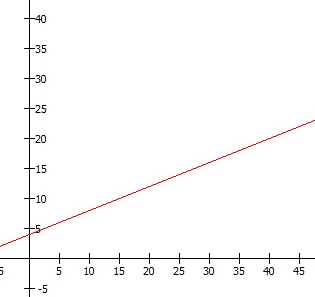
We’ll have a supply curve, which is a graph of the minimum price the worker is willing to accept for each hour in order to work a given number of hours. We generally assume that the supply curve slopes upward, meaning that people are willing to work more hours if you offer them a higher wage for each hour. The idea is that it gets progressively harder to find the time—it eats into more and more important alternative activities. (This is in fact a gross oversimplification, but it’ll do for now. In the real world, labor is the one thing for which the supply curve frequently bends backward.)

supply_curve

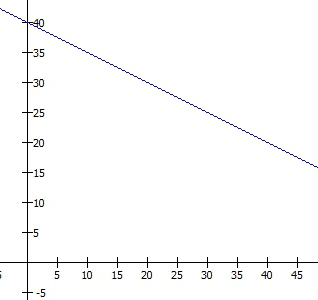
We’ll also have a demand curve, which is a graph of the maximum price the employer is willing to pay for each hour, if the employee works that many hours. We generally assume that the demand curve slopes downward, meaning that the employer is willing to pay less for each hour if the employee works more hours. The reason is that most activities have diminishing marginal returns, so each extra hour of work generally produces less output than the previous hour, and is therefore not worth paying as much for. (This too is an oversimplification, as I discussed previously in my post on the Law of Demand.)

demand_curve

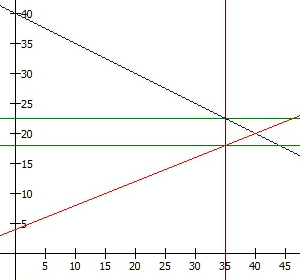
Put these two together, and in a competitive market the price will be set at the point at which supply is equal to demand, so that the very last hour of work was worth exactly what the employer paid for it. That last hour is just barely worth it to the employer, and just barely worth it to the worker; any additional time would either be too expensive for the employer or not lucrative enough for the worker. But for all the previous hours, the value to the employer is higher than the wage, and the cost to the worker is lower than the wage. As a result, both the employer and the worker benefit.

equilibrium_notax

But now, suppose we implement a tax. For concreteness, suppose the previous market-clearing wage was $20 per hour, the worker was working 40 hours, and the tax is 20%. If the employer still offers a wage of $20 for 40 hours of work, the worker is no longer going to accept it, because they will only receive $16 per hour after taxes, and $16 isn’t enough for them to be willing to work 40 hours. The worker could ask for a pre-tax wage of $25 so that the after-tax wage would be $20, but then the employer will balk, because $25 per hour is too expensive for 40 hours of work.

In order to restore the balance (and when we say “equilibrium”, that’s really all we mean—balance), the employer will need to offer a higher pre-tax wage, which means they will demand fewer hours of work. The worker will then be willing to accept a lower after-tax wage for those reduced hours.

In effect, there are now two prices at work: A supply price, the after-tax wage that the worker receives, which must be at or above the supply curve; and a demand price, the pre-tax wage that the employer pays, which must be at or below the demand curve. The difference between those two prices is the tax.

equilibrium_tax

In this case, I’ve set it up so that the pre-tax wage is $22.50, the after-tax wage is $18, and the amount of the tax is $4.50 or 20% of $22.50. In order for both the employer and the worker to accept those prices, the amount of hours worked has been reduced to 35.

As a result of the tax, the wage that we’ve been calling “pre-tax” is actually higher than the wage that the worker would have received if the tax had not existed. This is a general phenomenon; it’s almost always true that your “pre-tax” wage or salary overestimates what you would have actually gotten if the tax had not existed. In one extreme case, it might actually be the same; in another extreme case, your after-tax wage is what you would have received and the “pre-tax” wage rises high enough to account for the entirety of the tax revenue. It’s not really “pre-tax” at all; it’s the after-tax demand price.

Because of this, it’s fundamentally wrongheaded for people to complain that taxes are “taking your hard-earned money”. In all but the most exceptional cases, that “pre-tax” salary that’s being deducted from would never have existed. It’s more of an accounting construct than anything else, or like I said before a measure of labor expenditure. It is generally true that your after-tax salary is lower than the salary you would have gotten without the tax, but the difference is generally much smaller than the amount of the tax that you see deducted. In this case, the worker would see $4.50 per hour deducted from their wage, but in fact they are only down $2 per hour from where they would have been without the tax. And of course, none of this includes the benefits of the tax, which in many cases actually far exceed the costs; if we extended the example, it wouldn’t be hard to devise a scenario in which the worker who had their wage income reduced received an even larger benefit in the form of some public good such as national defense or infrastructure.

To truly honor veterans, end war

JDN 2457339 EST 20:00 (Nov 11, 2015)

Today is Veterans’ Day, on which we are asked to celebrate the service of military veterans, particularly those who have died as a result of war. We tend to focus on those who die in combat, but actually these have always been relatively uncommon; throughout history, most soldiers have died later of their wounds or of infections. More recently as a result of advances in body armor and medicine, actually relatively few soldiers die even of war wounds or infections—instead, they are permanently maimed and psychologically damaged, and the most common way that war kills soldiers now is by making them commit suicide.

Even adjusting for the fact that soldiers are mostly young men (the group of people most likely to commit suicide), military veterans still have about 50 excess suicides per million people per year, for a total of about 300 suicides per million per year. Using the total number, that’s over 8000 veteran suicides per year, or 22 per day. Using only the excess compared to men of the same ages, it’s still an additional 1300 suicides per year.

While the 14-years-and-counting Afghanistan War has killed 2,271 American soldiers and the 11-year Iraq War has killed 4,491 American soldiers directly (or as a result of wounds), during that same time period from 2001 to 2015 there have been about 18,000 excess suicides as a result of the military—excess in the sense that they would not have occurred if those men had been civilians. Altogether that means there would be nearly 25,000 additional American soldiers alive today were it not for these two wars.

War does not only kill soldiers while they are on the battlefield—indeed, most of the veterans it kills die here at home.

There is a reason Woodrow Wilson chose November 11 as the date for Veterans’ Day: It was on this day in 1918 that World War 1, up to that point the war that had caused the most deaths in human history, was officially ended. Sadly, it did not remain the deadliest war, but was surpassed by World War 2 a generation later. Fortunately, no other war has ever exceeded World War 2—at least, not yet.

We tend to celebrate holidays like this with a lot of ritual and pageantry (or even in the most inane and American way possible, with free restaurant meals and discounts on various consumer products), and there’s nothing inherently wrong with that. Nor is there anything wrong with taking a moment to salute the flag or say “Thank you for your service.” But that is not how I believe veterans should be honored. If I were a veteran, that is not how I would want to be honored.

We are getting much closer to how I think they should be honored when the White House announces reforms at Veterans’ Affairs hospitals and guaranteed in-state tuition at public universities for families of veterans—things that really do in a concrete and measurable way improve the lives of veterans and may even save some of them from that cruel fate of suicide.

But ultimately there is only one way that I believe we can truly honor veterans and the spirit of the holiday as Wilson intended it, and that is to end war once and for all.

Is this an ambitious goal? Absolutely. But is it an impossible dream? I do not believe so.

In just the last half century, we have already made most of the progress that needed to be made. In this brilliant video animation, you can see two things: First, the mind-numbingly horrific scale of World War 2, the worst war in human history; but second, the incredible progress we have made since then toward world peace. It was as if the world needed that one time to be so unbearably horrible in order to finally realize just what war is and why we need a better way of solving conflicts.

This is part of a very long-term trend in declining violence, for a variety of reasons that are still not thoroughly understood. In simplest terms, human beings just seem to be getting better at not killing each other.

Nassim Nicholas Taleb argues that this is just a statistical illusion, because technologies like nuclear weapons create the possibility of violence on a previously unimaginable scale, and it simply hasn’t happened yet. For nuclear weapons in particular, I think he may be right—the consequences of nuclear war are simply so catastrophic that even a small risk of it is worth paying almost any price to avoid.

Fortunately, nuclear weapons are not necessary to prevent war: South Africa has no designs on attacking Japan anytime soon, but neither has nuclear weapons. Germany and Poland lack nuclear arsenals and were the first countries to fight in World War 2, but now that both are part of the European Union, war between them today seems almost unthinkable. When American commentators fret about China today it is always about wage competition and Treasury bonds, not aircraft carriers and nuclear missiles. Conversely, North Korea’s acquisition of nuclear weapons has by no means stabilized the region against future conflicts, and the fact that India and Pakistan have nuclear missiles pointed at one another has hardly prevented them from killing each other over Kashmir. We do not need nuclear weapons as a constant threat of annihilation in order to learn to live together; political and economic ties achieve that goal far more reliably.

And I think Taleb is wrong about the trend in general. He argues that the only reason violence is declining is that concentration of power has made violence rarer but more catastrophic when it occurs. Yet we know that many forms of violence which used to occur no longer do, not because of the overwhelming force of a Leviathan to prevent them, but because people simply choose not to do them anymore. There are no more gladiator fights, no more cat-burnings, no more public lynchings—not because of the expansion in government power, but because our society seems to have grown out of that phase.

Indeed, what horrifies us about ISIS and Boko Haram would have been considered quite normal, even civilized, in the Middle Ages. (If you’ve ever heard someone say we should “bring back chivalry”, you should explain to them that the system of knight chivalry in the 12th century had basically the same moral code as ISIS today—one of the commandments Gautier’s La Chevalerie attributes as part of the chivalric code is literally “Thou shalt make war against the infidel without cessation and without mercy.”) It is not so much that they are uniquely evil by historical standards, as that we grew out of that sort of barbaric violence awhile ago but they don’t seem to have gotten the memo.

In fact, one thing people don’t seem to understand about Steven Pinker’s argument about this “Long Peace” is that it still works if you include the world wars. The reason World War 2 killed so many people was not that it was uniquely brutal, nor even simply because its weapons were more technologically advanced. It also had to do with the scale of integration—we called it a single war even though it involved dozens of countries because those countries were all united into one of two sides, whereas in centuries past that many countries could be constantly fighting each other in various combinations but it would never be called the same war. But the primary reason World War 2 killed the largest raw number of people was simply because the world population was so much larger. Controlling for world population, World War 2 was not even among the top 5 worst wars—it barely makes the top 10. The worst war in history by proportion of the population killed was almost certainly the An Lushan Rebellion in 8th century China, which many of you may not even have heard of until today.

Though it may not seem so as ISIS kidnaps Christians and drone strikes continue, shrouded in secrecy, we really are on track to end war. Not today, not tomorrow, maybe not in any of our lifetimes—but someday, we may finally be able to celebrate Veterans’ Day as it was truly intended: To honor our soldiers by making it no longer necessary for them to die.

Tax Incidence Revisited, Part 1: The downside of taxes

JDN 2457345 EST 22:02

As I was writing this, it was very early (I had to wake up at 04:30) and I was groggy, because we were on an urgent road trip to Pennsylvania for the funeral of my aunt who died quite suddenly a few days ago. I have since edited this post more thoroughly to minimize the impact of my sleep deprivation upon its content. Actually maybe this is a good thing; the saying goes, “write drunk, edit sober” and sleep deprivation and alcohol have remarkably similar symptoms, probably because alcohol is GABA-ergic and GABA is involved in sleep regulation.

Awhile ago I wrote a long post on tax incidence, but the primary response I got was basically the online equivalent of a perplexed blank stare. Struck once again by the Curse of Knowledge, I underestimated the amount of background knowledge necessary to understand my explanation. But tax incidence is very important for public policy, so I really would like to explain it.

Therefore I am now starting again, slower, in smaller pieces. Today’s piece is about the downsides of taxation in general, why we don’t just raise taxes as high as we feel like and make the government roll in dough.

To some extent this is obvious; if income tax were 100%, why would anyone bother working for a salary? You might still work for fulfillment, or out of a sense of duty, or simply because you enjoy what you do—after all, most artists and musicians are hardly in it for the money. But many jobs are miserable and not particularly fulfilling, yet still need to get done. How many janitors or bus drivers work purely for the sense of fulfillment it gives them? Mostly they do it to pay the bills—and if income tax were 100%, it wouldn’t anymore. The formal economy would basically collapse, and then nobody would end up actually paying that 100% tax—so the government would actually get very little revenue, if any.

At the other end of the scale, it’s kind of obvious that if your taxes are all 0% you don’t get any revenue. This is actually more feasible than it may sound; provided you spend only a very small amount (say, 4% of GDP, though that’s less than any country actually spends—maybe you could do 6% like Bangladesh) and you can still get people to accept your currency, you could, in principle, have a government that funds its spending entirely by means of printing money, and could do this indefinitely. In practice, that has never been done, and the really challenging part is getting people to accept your money if you don’t collect taxes in it. One of the more counter-intuitive aspects of modern monetary theory (or perhaps I should capitalize it, Modern Monetary Theory, though the part I agree with is not that different from standard Keynesian theory) is that taxation is the primary mechanism by which money acquires its value.

And then of course with intermediate tax rates such as 20%, 30%, and 50% that actual countries actually use, we do get some positive amount of revenue.

Everything I’ve said so far may seem pretty obvious. Yeah, usually taxes raise revenue, but if you taxed at 0% or 100% they wouldn’t; so what?

Well, this leads to quite an important result. Assuming that tax revenue is continuous (which isn’t quite true, but since we can collect taxes in fractions of a percent and pay in pennies, it’s pretty close), it follows directly from the Extreme Value Theorem that there is in fact a revenue-maximizing tax rate. Both below and above that tax rate, the government takes in less total money. These theorems don’t tell us what the revenue-maximizing rate is; but they tell us that it must exist, somewhere between 0% and 100%.

Indeed, it follows that there is what we call the Laffer Curve, a graph of tax revenue as a function of tax rate, and it is in fact a curve, as opposed to the straight line it would be if taxes had no effect on the rest of the economy.

Very roughly, it looks something like this (the blue curve is my sketch of the real-world Laffer curve, while the red line is what it would be if taxes had no distortionary effects):

Laffer_curve

Now, the Laffer curve has been abused many times; in particular, it’s been used to feed into the “trickle-down” “supply-sideReaganomics that has been rightly derided as “voodoo economics” by serious economists. Jeb Bush (or should I say, Jeb!) and Marco Rubio would have you believe that we are on the right edge of the Laffer curve, and we could actually increase tax revenue by cutting taxes, particularly on capital gains and incomes at the top 1%; that’s obviously false. We tried that, it didn’t work. Even theoretically we probably should have known that it wouldn’t; but now that we’ve actually done the experiment and it failed, there should be no serious doubt anymore.

No, we are on the left side of the Laffer curve, where increasing taxes increases revenue, much as you’d intuitively expect. It doesn’t quite increase one-to-one, because adding more taxes does make the economy less efficient; but from where we currently stand, a 1% increase in taxes leads to about a 0.9% increase in revenue (actually estimated as between 0.78% and 0.99%).

Denmark may be on the right side of the Laffer curve, where they could raise more revenue by decreasing tax rates (even then I’m not so sure). But Denmark’s tax rates are considerably higher than ours; while in the US we pay about 27% of GDP in taxes, folks in Denmark pay 49% of GDP in taxes.

The fact remains, however, that there is a Laffer curve, and no serious economist would dispute this. Increasing taxes does in fact create distortions in the economy, and as a result raising tax rates does not increase revenue in a one-to-one fashion. When calculating the revenue from a new tax, you must include not only the fact that the government will get an increased portion, but also that the total amount of income will probably decrease.

Now, I must say probably, because it does depend on what exactly you are taxing. If you tax something that is perfectly inelastic—the same amount of it is going to be made and sold no matter what—then total income will remain exactly the same after the tax. It may be distributed differently, but the total won’t change. This is one of the central justifications for a land tax; land is almost perfectly inelastic, so taxing it allows us to raise revenue without reducing total income.

In fact, there are certain kinds of taxes which increase total income, which makes them basically no-brainer taxes that should always be implemented if at all feasible. These are Pigovian taxes, which are taxes on products with negative externalities; when a product causes harm to other people (the usual example is pollution of air and water), taxing that product equal to the harm caused provides a source of government revenue that also increases the efficiency of the economy as a whole. If we had a tax on carbon emissions that was used to fund research into sustainable energy, this would raise our total GDP in the long run. Taxes on oil and natural gas are not “job killing”; they are job creating. This is why we need a carbon tax, a higher gasoline tax, and a financial transaction tax (to reduce harmful speculation); it’s also why we already have high taxes on alcohol and tobacco.

The alcohol tax is one of the great success stories of Pigouvian taxation.The alcohol tax is actually one of the central factors holding our crime rate so low right now. Another big factor is overall economic growth and anti-poverty programs. The most important factor, however, is lead, or rather the lack thereof; environmental regulations reducing pollutants like lead and mercury from the environment are the leading factor in reducing crime rates over the last generation. Yes, that’s right—our fall in crime had little to do with state police, the FBI, the DEA, or the ATF; our most effective crime-fighting agency is the EPA. This is really not that surprising, as a cognitive economist. Most crime is impulsive and irrational, or else born of economic desperation. Rational crime that it would make sense to punish harshly as a deterrent is quite rare (well, except for white-collar crime, which of course we don’t punish harshly enough—I know I harp on this a lot, but HSBC laundered money for terrorists). Maybe crime would be more common if we had no justice system in place at all, but making our current system even harsher accomplishes basically nothing. Far better to tax the alcohol that leads good people to bad decisions.

It also matters whom you tax, though one of my goals in this tax incidence series is to explain why that doesn’t mean quite what most people think it does. The person who writes the check to the government is not necessarily the person who really pays the tax. The person who really pays is the one whose net income ends up lower after the tax is implemented. Often these are the same person; but often they aren’t, for fundamental reasons I’m hoping to explain.

For now, it’s worth pointing out that a tax which primarily hits the top 1% is going to have a very different impact on the economy than one which hits the entire population. Because of the income and substitution effects, poor people tend to work less as their taxes go up, but rich people tend to work more. Even within income brackets, a tax that hits doctors and engineers is going to have a different effect than a tax that hits bankers and stock traders, and a tax that hits teachers is going to have a different effect than a tax that hits truck drivers. A tax on particular products or services will reduce demand for those products or services, which is good if that’s what you’re trying to do (such as alcohol) but not so good if it isn’t.

So, yes, there are cases where raising taxes can actually increase, or at least not reduce, total income. These are the exception, however; as a general rule, in a Pirate Code sort of way, taxes reduce total income. It’s not simply that income goes down for everyone but the government (which would again be sort of obvious); income goes down for everyone including the government. The difference is simply lost, wasted away by a loss in economic efficiency. We call that difference deadweight loss, and for a poorly-designed tax it can actually far exceed the revenue received.

I think an extreme example may help to grasp the intuition: Suppose we started taxing cars at 200,000%, so that a typical new car costs something like $40 million with taxes. (That’s not a Lamborghini, mind you; that’s a Honda Accord.) What would happen? Nobody is going to buy cars anymore. Overnight, you’ve collapsed the entire auto industry. Dozens of companies go bankrupt, thousands of employees get laid off, the economy immediately falls into recession. And after all that, your car tax will raise no revenue at all, because not a single car will sell. It’s just pure deadweight loss.

That’s an intentionally extreme example; most real-world taxes in fact create less deadweight loss than they raise in revenue. But most real-world taxes do in fact create deadweight loss, and that’s a good reason to be concerned about any new tax.

In general, higher taxes create lower total income, or equivalently higher deadweight loss. All other things equal, lower taxes are therefore better.

What most Americans don’t seem to quite grasp is that all other things are not equal. That tax revenue is central to the proper functioning of our government and our monetary system. We need a certain amount of taxes in order to ensure that we can maintain a stable currency and still pay for things like Medicare, Social Security, and the Department of Defense (to name our top three budget items).

Alternatively, we could not spend so much on those things, and that is a legitimate question of public policy. I personally think that Medicare and Social Security are very good things (and I do have data to back that up—Medicare saves thousands of lives), but they aren’t strictly necessary for basic government functioning; we could get rid of them, it’s just that it would be a bad idea. As for the defense budget, some kind of defense budget is necessary for national security, but I don’t think I’m going out on a very big limb here when I say that one country making 40% of all world military spending probably isn’t.

We can’t have it both ways; if you want Medicare, Social Security, and the Department of Defense, you need to have taxes. “Cutting spending” always means cutting spending on something—so what is it you want to cut? A lot of people seem to think that we waste a huge amount of money on pointless bureaucracy, pork-barrel spending, or foreign aid; but that’s simply not true. All government administration is less than 1% of the budget, and most of it is necessary; earmarks are also less than 1%; foreign aid is also less than 1%. Since our deficit is about 15% of spending, we could eliminate all of those things and we’d barely put a dent in it.

Americans don’t like taxes; I understand that. It’s basically one of our founding principles, in fact, though “No taxation without representation” seems to have mutated of late into simply “No taxation”, or maybe “Read my lips, no new taxes!” It’s never pleasant to see that chunk taken out of your paycheck before you even get it. (Though one thing I hope to explain in this series is that these figures are really not very meaningful; there’s no particular reason to think you’d have made the same gross salary if those taxes hadn’t been present.)

There are in fact sound economic reasons to keep taxes low. The Laffer Curve is absolutely a real thing, even though most of its applications are wrong. But sometimes we need taxes to be higher, and that’s a tradeoff we have to make.We need to have a serious public policy discussion about where our priorities lie, not keep trading sound-bytes about “cutting wasteful spending” and “job-killing tax hikes”.