Is America uniquely… mean?

JDN 2457454

I read this article yesterday which I found both very resonant and very disturbing: At least among First World countries, the United States really does seem uniquely, for lack of a better word, mean.

The formal psychological terminology is social dominance orientation; the political science term is authoritarianism. In economics, we notice the difference due to its effect on income inequality. But all of these concepts are capturing part of a deeper underlying reality that in the age of Trump I am finding increasingly hard to deny. The best predictor of support for Trump is authoritarianism.

Of course I’ve already talked about our enormous military budget; but then Tennessee had to make their official state rifle a 50-caliber weapon capable of destroying light tanks. There is something especially dominant, aggressive, and violent about American culture.

We are certainly not unique in the world as a whole—actually I think the amount of social dominance orientation, authoritarianism, and inequality in the US is fairly similar to the world average. We are unique in our gun ownership, but our military spending proportional to GDP is not particularly high by world standards—we’re just an extremely rich country. But in all these respects we are a unique outlier among First World countries; in many ways we resemble a rich authoritarian petrostate like Qatar rather than a European social democracy like France or the UK. (At least we’re not Saudi Arabia?)

More than other First World cultures, Americans believe in hierarchy; they believe that someone should be on top and other people should be on the bottom. More than that, they believe that people “like us” should be on top and people “not like us” should be on the bottom, however that is defined—often in terms of race or religion, but not necessarily.

Indeed, one of the things I find most baffling about this is that it is often more important to people that others be held down than that they themselves be lifted up. This is the only way I can make sense of the fact that people who have watched their wages be drained into the pockets of billionaires for a generation can think that the most important things to do right now are block out illegal immigrants and deport Muslims.

It seems to be that people become convinced that their own status, whatever it may be, is deserved: If they are rich, it is obviously because they are so brilliant and hard-working (something Trump clearly believes about himself, being a textbook example of Narcissistic Personality Disorder); if they are poor, it is obviously because they are so incompetent and lazy. Thus, being lifted up doesn’t make sense; why would you give me things I don’t deserve?

But then when they see people who are different from them, they know automatically that those people must be by definition inferior, as all who are Not of Our Tribe are by definition inferior. And therefore, any of them who are rich gained their position through corruption or injustice, and all of them who are poor deserve their fate for being so inferior. Thus, it is most vital to ensure that these Not of Our Tribe are held down from reaching high positions they so obviously do not deserve.

I’m fairly sure that most of this happens at a very deep unconscious level; it calls upon ancient evolutionary instincts to love our own tribe, to serve the alpha male, to fear and hate those of other tribes. These instincts may well have served us 200,000 years ago (then again, they may just have been the best our brains could manage at the time); but they are becoming a dangerous liability today.

As E.O. Wilson put it: “The real problem of humanity is the following: we have paleolithic emotions; medieval institutions; and god-like technology.”

Yet this cannot be a complete explanation, for there is variation in these attitudes. A purely instinctual theory should say that all human cultures have this to an essentially equal degree; but I started this post by pointing out that the United States appears to have a particularly large amount relative to Europe.

So, there must be something in the cultures or institutions of different nations that makes them either enhance or suppress this instinctual tribalism. There must be something that Europe is doing right, the US is doing wrong, and Saudi Arabia is doing very, very wrong.
Well, the obvious one that sticks out at me is religion. It seems fairly obvious to me that Sweden is less religious than the US, which is less religious than Saudi Arabia.

Data does back me up on this. Religiosity isn’t easy to measure, but we have methods of doing so. If we ask people in various countries if religion is very important in their lives, the percentage of people who say yes gives us an indication of how religious that country is.

In Saudi Arabia, 93% say yes. In the United States, 65% say yes. In Sweden, only 17% say yes.

Religiosity tends to be highest in the poorest countries, but the US is an outlier, far too rich for our religion (or too religious for our wealth).

Religiosity also tends to be highest in countries with high inequality—this time, the US fits right in.

The link between religion and inequality is quite clear. It’s harder to say which way the causation runs. Perhaps high inequality makes people cling more to religion as a comfort, and getting rid of religion would only mean taking that comfort away. Or, perhaps religion actually makes people believe more in social dominance, and thus is part of what keeps that high inequality in place. It could also be a feedback loop, in which higher inequality leads to higher religiosity which leads to higher inequality.

That said, I think we actually have some evidence that causality runs from religion to inequality, rather than the other way around. The secularization of France took place around the same time as the French Revolution that overthrew the existing economic system and replaced it with one that had substantially less inequality. Iran’s government became substantially more based on religion in the latter half of the 20th century, and their inequality soared thereafter.

Above all, Donald Trump dominates the evangelical vote, which makes absolutely no sense if religion is a comfort against inequality—but perfect sense if religion solidifies the tendency of people to think in terms of hierarchy and authoritarianism.

This also makes sense in terms of the content of religion, especially Abrahamaic religion; read the Bible and the Qur’an, and you will see that their primary goal seems to be to convince you that some people, namely people who believe in this book, are just better than other people, and we should be in charge because God says so. (And you wouldn’t try to argue with God, would you?) They really make no particular effort to convince you that God actually exists; they spend all their argumentative effort on what God wants you to do and who God wants you to put in charge—and for some strange reason it always seems to be the same guys who are writing down “God’s words” in the book! What a coincidence!

If religion is indeed the problem, or a large part of the problem, what can we do about it? That’s the most difficult part. We’ve been making absolutely conclusive rational arguments against religion since literally 300 years before Jesus was even born (there has never been a time in human history in which it was rational for an educated person to believe in Christianity or Islam, for the religions did not come into existence until well after the arguments to refute them were well-known!), and the empirical evidence against theism has only gotten stronger ever since; so that clearly isn’t enough.

I think what we really need to do at this point is confront the moral monopoly that religion has asserted for itself. The “Moral Majority” was neither, but its name still sort of makes sense to us because we so strongly associate being moral with being religious. We use terms like “Christian” and “generous” almost interchangeably. And whenever you get into a debate about religion, shortly after you have thoroughly demolished any shred of empirical credibility religion still had left, you can basically guarantee that the response will be: “But without God, how can you know right from wrong?”

What is perhaps most baffling about this concept of morality so commonplace in our culture is that not only is the command of a higher authority that rewards and punishes you not the highest level of moral development—it is literally the lowest. Of the six stages of moral thinking Kohlberg documented in children, the reward and punishment orientation exemplified by the Bible and the Qur’an is the very first. I think many of these people really truly haven’t gotten past level 1, which is why when you start trying to explain how you base your moral judgments on universal principles of justice and consequences (level 6) they don’t seem to have any idea what you’re talking about.

Perhaps this is a task for our education system (philosophy classes in middle school?), perhaps we need something more drastic than that, or perhaps it is enough that we keep speaking about it in public. But somehow we need to break up the monopoly that religion has on moral concepts, so that people no longer feel ashamed to say that something is morally wrong without being able to cite a particular passage from a particular book from the Iron Age. Perhaps once we can finally make people realize that morality does not depend on religion, we can finally free them from the grip of religion—and therefore from the grip of authoritarianism and social dominance.

If this is right, then the reason America is so mean is that we are so Christian—and people need to realize that this is not a paradoxical statement.

Will robots take our jobs?

JDN 2457451
I briefly discussed this topic before, but I thought it deserved a little more depth. Also, the SF author in me really likes writing this sort of post where I get to speculate about futures that are utopian, dystopian, or (most likely) somewhere in between.

The fear is quite widespread, but how realistic is it? Will robots in fact take all our jobs?

Most economists do not think so. Robert Solow famously quipped, “You can see the computer age everywhere but in the productivity statistics.” (It never quite seemed to occur to him that this might be a flaw in the way we measure productivity statistics.)

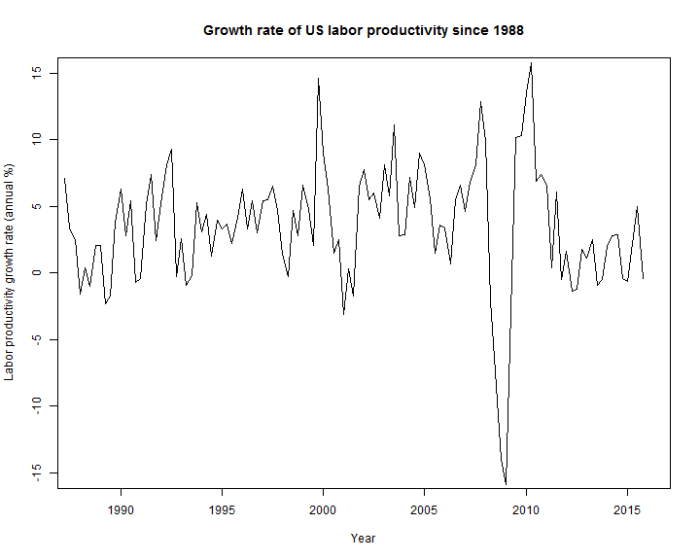
By the usual measure of labor productivity, robots do not appear to have had a large impact. Indeed, their impact appears to have been smaller than almost any other major technological innovation.

Using BLS data (which was formatted badly and thus a pain to clean, by the way—albeit not as bad as the World Bank data I used on my master’s thesis, which was awful), I made this graph of the growth rate of labor productivity as usually measured:

Productivity_growth

The fluctuations are really jagged due to measurement errors, so I also made an annually smoothed version:

Productivity_growth_smooth

Based on this standard measure, productivity has grown more or less steadily during my lifetime, fluctuating with the business cycle around a value of about 3.5% per year (3.4 log points). If anything, the growth rate seems to be slowing down; in recent years it’s been around 1.5% (1.5 lp).

This was clearly the time during which robots became ubiquitous—autonomous robots did not emerge until the 1970s and 1980s, and robots became widespread in factories in the 1980s. Then there’s the fact that computing power has been doubling every 1.5 years during this period, which is an annual growth rate of 59% (46 lp). So why hasn’t productivity grown at anywhere near that rate?

I think the main problem is that we’re measuring productivity all wrong. We measure it in terms of money instead of in terms of services. Yes, we try to correct for inflation; but we fail to account for the fact that computers have allowed us to perform literally billions of services every day that could not have been performed without them. You can’t adjust that away by plugging into the CPI or the GDP deflator.

Think about it: Your computer provides you the services of all the following:

  1. A decent typesetter and layout artist
  2. A truly spectacular computer (remember, that used to be a profession!)
  3. A highly skilled statistician (who takes no initiative—you must tell her what calculations to do)
  4. A painting studio
  5. A photographer
  6. A video camera operator
  7. A professional orchestra of the highest quality
  8. A decent audio recording studio
  9. Thousands of books, articles, and textbooks
  10. Ideal seats at every sports stadium in the world

And that’s not even counting things like social media and video games that can’t even be readily compared to services that were provided before computers.

If you added up the value of all of those jobs, the amount you would have had to pay in order to hire all those people to do all those things for you before computers existed, your computer easily provides you with at least $1 million in professional services every year. Put another way, your computer has taken jobs that would have provided $1 million in wages. You do the work of a hundred people with the help of your computer.

This isn’t counted in our productivity statistics precisely because it’s so efficient. If we still had to pay that much for all these services, it would be included in our GDP and then our GDP per worker would properly reflect all this work that is getting done. But then… whom would we be paying? And how would we have enough to pay that? Capitalism isn’t actually set up to handle this sort of dramatic increase in productivity—no system is, really—and thus the market price for work has almost no real relation to the productive capacity of the technology that makes that work possible.

Instead it has to do with scarcity of work—if you are the only one in the world who can do something (e.g. write Harry Potter books), you can make an awful lot of money doing that thing, while something that is far more important but can be done by almost anyone (e.g. feed babies) will pay nothing or next to nothing. At best we could say it has to do with marginal productivity, but marginal in the sense of your additional contribution over and above what everyone else could already do—not in the sense of the value actually provided by the work that you are doing. Anyone who thinks that markets automatically reward hard work or “pay you what you’re worth” clearly does not understand how markets function in the real world.

So, let’s ask again: Will robots take our jobs?

Well, they’ve already taken many jobs already. There isn’t even a clear high-skill/low-skill dichotomy here; robots are just as likely to make pharmacists obsolete as they are truck drivers, just as likely to replace surgeons as they are cashiers.

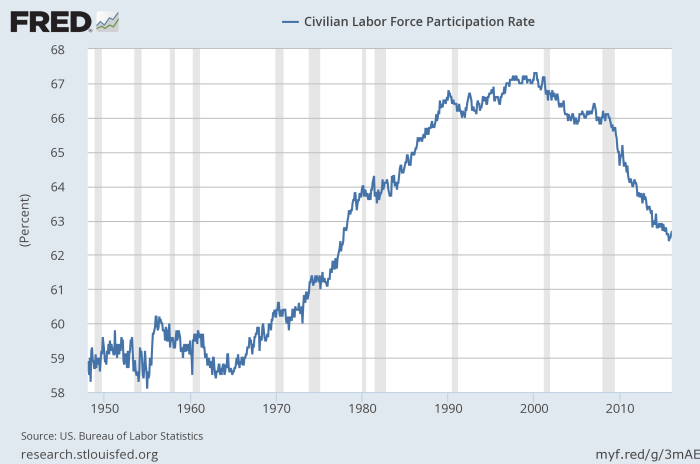
Labor force participation is declining, though slowly:

Labor_force_participation

Yet I think this also underestimates the effect of technology. As David Graeber points out, most of the new jobs we’ve been creating seem to be for lack of a better term bullshit jobs—jobs that really don’t seem like they need to be done, other than to provide people with something to do so that we can justify paying them salaries.

As he puts it:

Again, an objective measure is hard to find, but one easy way to get a sense is to ask: what would happen were this entire class of people to simply disappear? Say what you like about nurses, garbage collectors, or mechanics, it’s obvious that were they to vanish in a puff of smoke, the results would be immediate and catastrophic. A world without teachers or dock-workers would soon be in trouble, and even one without science fiction writers or ska musicians would clearly be a lesser place. It’s not entirely clear how humanity would suffer were all private equity CEOs, lobbyists, PR researchers, actuaries, telemarketers, bailiffs or legal consultants to similarly vanish. (Many suspect it might markedly improve.)

The paragon of all bullshit jobs is sales. Sales is a job that simply should not exist. If something is worth buying, you should be able to present it to the market and people should choose to buy it. If there are many choices for a given product, maybe we could have some sort of independent product rating agencies that decide which ones are the best. But sales means trying to convince people to buy your product—you have an absolutely overwhelming conflict of interest that makes your statements to customers so utterly unreliable that they are literally not even information anymore. The vast majority of advertising, marketing, and sales is thus, in a fundamental sense, literally noise. Sales contributes absolutely nothing to our economy, and because we spend so much effort on it and advertising occupies so much of our time and attention, takes a great deal away. But sales is one of our most steadily growing labor sectors; once we figure out how to make things without people, we employ the people in trying to convince customers to buy the new things we’ve made. Sales is also absolutely miserable for many of the people who do it, as I know from personal experience in two different sales jobs that I had to quit before the end of the first week.

Fortunately we have not yet reached the point where sales is the fastest growing labor sector. Currently the fastest-growing jobs fall into three categories: Medicine, green energy, and of course computers—but actually mostly medicine. Yet even this is unlikely to last; one of the easiest ways to reduce medical costs would be to replace more and more medical staff with automated systems. A nursing robot may not be quite as pleasant as a real professional nurse—but if by switching to robots the hospital can save several million dollars a year, they’re quite likely to do so.

Certain tasks are harder to automate than others—particularly anything requiring creativity and originality is very hard to replace, which is why I believe that in the 2050s or so there will be a Revenge of the Humanities Majors as all the supposedly so stable and forward-thinking STEM jobs disappear and the only jobs that are left are for artists, authors, musicians, game designers and graphic designers. (Also, by that point, very likely holographic designers, VR game designers, and perhaps even neurostim artists.) Being good at math won’t mean anything anymore—frankly it probably shouldn’t right now. No human being, not even great mathematical savants, is anywhere near as good at arithmetic as a pocket calculator. There will still be a place for scientists and mathematicians, but it will be the creative aspects of science and math that persist—design of experiments, development of new theories, mathematical intuition to develop new concepts. The grunt work of cleaning data and churning through statistical models will be fully automated.

Most economists appear to believe that we will continue to find tasks for human beings to perform, and this improved productivity will simply raise our overall standard of living. As any ECON 101 textbook will tell you, “scarcity is a fundamental fact of the universe, because human needs are unlimited and resources are finite.”

In fact, neither of those claims are true. Human needs are not unlimited; indeed, on Maslow’s hierarchy of needs First World countries have essentially reached the point where we could provide the entire population with the whole pyramid, guaranteed, all the time—if we were willing and able to fundamentally reform our economic system.

Resources are not even finite; what constitutes a “resource” depends on technology, as does how accessible or available any given source of resources will be. When we were hunter-gatherers, our only resources were the plants and animals around us. Agriculture turned seeds and arable land into a vital resource. Whale oil used to be a major scarce resource, until we found ways to use petroleum. Petroleum in turn is becoming increasingly irrelevant (and cheap) as solar and wind power mature. Soon the waters of the oceans themselves will be our power source as we refine the deuterium for fusion. Eventually we’ll find we need something for interstellar travel that we used to throw away as garbage (perhaps it will in fact be dilithium!) I suppose that if the universe is finite or if FTL is impossible, we will be bound by what is available in the cosmic horizon… but even that is not finite, as the universe continues to expand! If the universe is open (as it probably is) and one day we can harness the dark energy that seethes through the ever-expanding vacuum, our total energy consumption can grow without bound just as the universe does. Perhaps we could even stave off the heat death of the universe this way—we after all have billions of years to figure out how.

If scarcity were indeed this fundamental law that we could rely on, then more jobs would always continue to emerge, producing whatever is next on the list of needs ordered by marginal utility. Life would always get better, but there would always be more work to be done. But in fact, we are basically already at the point where our needs are satiated; we continue to try to make more not because there isn’t enough stuff, but because nobody will let us have it unless we do enough work to convince them that we deserve it.

We could continue on this route, making more and more bullshit jobs, pretending that this is work that needs done so that we don’t have to adjust our moral framework which requires that people be constantly working for money in order to deserve to live. It’s quite likely in fact that we will, at least for the foreseeable future. In this future, robots will not take our jobs, because we’ll make up excuses to create more.

But that future is more on the dystopian end, in my opinion; there is another way, a better way, the world could be. As technology makes it ever easier to produce as much wealth as we need, we could learn to share that wealth. As robots take our jobs, we could get rid of the idea of jobs as something people must have in order to live. We could build a new economic system: One where we don’t ask ourselves whether children deserve to eat before we feed them, where we don’t expect adults to spend most of their waking hours pushing papers around in order to justify letting them have homes, where we don’t require students to take out loans they’ll need decades to repay before we teach them history and calculus.

This second vision is admittedly utopian, and perhaps in the worst way—perhaps there’s simply no way to make human beings actually live like this. Perhaps our brains, evolved for the all-too-real scarcity of the ancient savannah, simply are not plastic enough to live without that scarcity, and so create imaginary scarcity by whatever means they can. It is indeed hard to believe that we can make so fundamental a shift. But for a Homo erectus in 500,000 BP, the idea that our descendants would one day turn rocks into thinking machines that travel to other worlds would be pretty hard to believe too.

Will robots take our jobs? Let’s hope so.

Why are all our Presidents war criminals?

JDN 2457443

Today I take on a topic that we really don’t like to talk about. It creates grave cognitive dissonance in our minds, forcing us to deeply question the moral character of our entire nation.

Yet it is undeniably a fact:

Most US Presidents are war criminals.

There is a long tradition of war crimes by US Presidents which includes Obama, Bush, Nixon, and above all Johnson and Truman.

Barack Obama has ordered so-called “double-tap” drone strikes, which kill medics and first responders, in express violation of the Geneva Convention.

George W. Bush orchestrated a global program of torture and indefinite detention.

Bill Clinton ordered “extraordinary renditions” in which suspects were detained without trial and transferred to other countries for interrogation, where we knew they would most likely be tortured.

I actually had trouble finding any credible accusations of war crimes by George H.W. Bush (there are definitely accusations, but none of them are credible—seriously, people are listening to Manuel Noriega?), even as Director of the CIA. He might not be a war criminal.

Ronald Reagan supported a government in Guatemala that was engaged in genocide. He knew this was happening and did not seem to care. This was only one of many tyrannical, murderous regimes supported by Reagan’s administration. In fact, Ronald Reagan was successfully convicted of war crimes by the International Court of Justice. Chomsky isn’t wrong about this one. Ronald Reagan was a convicted war criminal.

Jimmy Carter is a major exception to the rule; not only are there no credible accusations of war crimes against him, he has actively fought to pursue war crimes investigations against Israel and even publicly discussed the war crimes of George W. Bush.

I also wasn’t able to find any credible accusations of war crimes by Gerald Ford, so he might be clean.

But then we get to Richard Nixon, who deployed chemical weapons against civilians in Vietnam. (Calling Agent Orange “herbicide” probably shouldn’t matter morally—but it might legally, as tactical “herbicides” are not always war crimes.) But Nixon does deserve some credit for banning biological weapons.

Indeed, most of the responsibility for war crimes in Vietnam falls upon Johnson. The US deployed something very close to a “total war” strategy involving carpet bombing—more bombs were dropped by the US in Vietnam than by all countries in WW2—as well as napalm and of course chemical weapons; basically it was everything short of nuclear weapons. Kennedy and Johnson also substantially expanded the US biological weapons program.

Speaking of weapons of mass destruction, I’m not sure if it was actually illegal to expand the US nuclear arsenal as dramatically as Kennedy did, but it definitely should have been. Kennedy brought our nuclear arsenal up to its greatest peak, a horrifying 30,000 deployable warheads—more than enough to wipe out human civilization, and possibly enough to destroy the entire human race.

While Eisenhower was accused of the gravest war crime on this list, namely the genocide of over 1 million people in Germany, most historians do not consider this accusation credible. Rather, his war crimes were committed as Supreme Allied Commander, in the form of carpet bombing, especially of Tokyo, which killed as many as 200,000 people, and of Dresden, which had no apparent military significance and even held a number of Allied POWs.

But then we get to Truman, the coup de grace, the only man in history to order the use of nuclear weapons in warfare. Truman gave the order to deploy nuclear weapons against civilians. He was the only person in the history of the world to ever give such an order. It wasn’t Hitler; it wasn’t Stalin. It was Harry S. Truman.

Then of course there’s Roosevelt’s internment of over 100,000 Japanese Americans. It really pales in comparison to Truman’s order to vaporize an equal number of Japanese civilians in the blink of an eye.

I think it will suffice to end the list here, though I could definitely go on. I think Truman is a really good one to focus on, for two reasons that pull quite strongly in opposite directions.

1. The use of nuclear weapons against civilians is among the gravest possible crimes. It may be second to genocide, but then again it may not, as genocide does not risk the destruction of the entire human race. If we only had the option of outlawing one thing in war, and had to allow everything else, we would have no choice but to ban the use of nuclear weapons against civilians.

2. Truman’s decision may have been justified. To this day is still hotly debated whether the atomic bombings were justifiable; mainstream historians have taken both sides. On Debate.org, the vote is almost exactly divided—51% yes, 49% no. Many historians believe that had Truman not deployed nuclear weapons, there would have been an additional 5 million deaths as a result of the continuation of the war.

Perhaps now you can see why this matter makes me so ambivalent.

There is a part of me that wants to take an absolute hard line against war crimes, and say that they must never be tolerated, that even otherwise good Presidents like Clinton and Obama deserve to be tried at the Hague for what they have done. (Truman and Eisenhower are dead, so it’s too late for them.)

But another part of me wonders what would happen if we did this. What if the world really is so dangerous that we have no choice but to allow our leaders to commit horrible atrocities in order to defend us?

There are easy cases—Bush’s torture program didn’t even result in very much useful intelligence, so it was simply a pointless degradation of our national character. The same amount of effort invested in more humane intelligence gathering would very likely have provided more reliable information. And in any case, terrorism is such a minor threat in the scheme of things that the effort would be better spent on improving environmental regulations or auto safety.

Similarly, there’s no reason to engage in “extraordinary rendition” to a country that tortures people when you could simply conduct a legitimate trial in absentia and then arrest the convicted terrorist with special forces and imprison him in a US maximum-security prison until his execution. (Or even carry out the execution directly by the special forces; as long as the trial is legitimate, I see no problem with that.) At that point, the atrocities are being committed simply to avoid inconvenience.

But especially when we come to the WW2 examples, where the United States—nay, the world—was facing a genuine threat of being conquered by genocidal tyrants, I do begin to wonder if “victory by any means necessary” is a legitimate choice.

There is a way to cut the Gordian knot here, and say that yes, these are crimes, and should be punished; but yes, they were morally justified. Then, the moral calculus any President must undergo when contemplating such an atrocity is that he himself will be tried and executed if he goes through with it. If your situation is truly so dire that you are willing to kill 100,000 civilians, perhaps you should be willing to go down with the ship. (Roger Fisher made a similar argument when he suggested implanting the nuclear launch codes inside the body of a US military officer. If you’re not willing to tear one man apart with a knife, why are you willing to vaporize an entire city?)

But if your actions really were morally justified… what sense does it make to punish you for them? And if we hold up this threat of punishment, could it cause a President to flinch when we really need him to take such drastic action?

Another possibility to consider is that perhaps our standards for war crimes really are too strict, and some—not all, but some—of the actions I just listed are in fact morally justifiable and should be made legal under international law. Perhaps the US government is right to fight the UN convention against cluster munitions; maybe we need cluster bombs to successfully defend national security. Perhaps it should not be illegal to kill the combat medics who directly serve under the command of enemy military forces—as opposed to civilian first-responders or Medecins Sans Frontieres. Perhaps our tolerance for civilian casualties is unrealistically low, and it is impossible to fight a war in the real world without killing a large number of civilians.

Then again, perhaps not. Perhaps we are too willing to engage in war in the first place, too accustomed to deploying military force as our primary response to international conflict. Perhaps the prospect of facing a war crimes tribunal in a couple of years should be an extra layer of deterrent against any President ordering yet another war—by some estimates we have been at war 93% of the time since our founding as a nation, and it is a well-documented fact that we have by far the highest military spending in the world. Why is it that so many Americans see diplomacy as foolish, see compromise as weakness?

Perhaps the most terrifying thing is not that so many US Presidents are war criminals; it is that so many Americans don’t seem to have any problem with that.

Do we always want to internalize externalities?

JDN 2457437

I often talk about the importance of externalitiesa full discussion in this earlier post, and one of their important implications, the tragedy of the commons, in another. Briefly, externalities are consequences of actions incurred upon people who did not perform those actions. Anything I do affecting you that you had no say in, is an externality.

Usually I’m talking about how we want to internalize externalities, meaning that we set up a system of incentives to make it so that the consequences fall upon the people who chose the actions instead of anyone else. If you pollute a river, you should have to pay to clean it up. If you assault someone, you should serve jail time as punishment. If you invent a new technology, you should be rewarded for it. These are all attempts to internalize externalities.

But today I’m going to push back a little, and ask whether we really always want to internalize externalities. If you think carefully, it’s not hard to come up with scenarios where it actually seems fairer to leave the externality in place, or perhaps reduce it somewhat without eliminating it.

For example, suppose indeed that someone invents a great new technology. To be specific, let’s think about Jonas Salk, inventing the polio vaccine. This vaccine saved the lives of thousands of people and saved millions more from pain and suffering. Its value to society is enormous, and of course Salk deserved to be rewarded for it.

But we did not actually fully internalize the externality. If we had, every family whose child was saved from polio would have had to pay Jonas Salk an amount equal to what they saved on medical treatments as a result, or even an amount somehow equal to the value of their child’s life (imagine how offended people would get if you asked that on a survey!). Those millions of people spared from suffering would need to each pay, at minimum, thousands of dollars to Jonas Salk, making him of course a billionaire.

And indeed this is more or less what would have happened, if he had been willing and able to enforce a patent on the vaccine. The inability of some to pay for the vaccine at its monopoly prices would add some deadweight loss, but even that could be removed if Salk Industries had found a way to offer targeted price vouchers that let them precisely price-discriminate so that every single customer paid exactly what they could afford to pay. If that had happened, we would have fully internalized the externality and therefore maximized economic efficiency.

But doesn’t that sound awful? Doesn’t it sound much worse than what we actually did, where Jonas Salk received a great deal of funding and support from governments and universities, and lived out his life comfortably upper-middle class as a tenured university professor?

Now, perhaps he should have been awarded a Nobel Prize—I take that back, there’s no “perhaps” about it, he definitely should have been awarded a Nobel Prize in Medicine, it’s absurd that he did not—which means that I at least do feel the externality should have been internalized a bit more than it was. But a Nobel Prize is only 10 million SEK, about $1.1 million. That’s about enough to be independently wealthy and live comfortably for the rest of your life; but it’s a small fraction of the roughly $7 billion he could have gotten if he had patented the vaccine. Yet while the possible world in which he wins a Nobel is better than this one, I’m fairly well convinced that the possible world in which he patents the vaccine and becomes a billionaire is considerably worse.

Internalizing externalities makes sense if your goal is to maximize total surplus (a concept I explain further in the linked post), but total surplus is actually a terrible measure of human welfare.

Total surplus counts every dollar of willingness-to-pay exactly the same across different people, regardless of whether they live on $400 per year or $4 billion.

It also takes no account whatsoever of how wealth is distributed. Suppose a new technology adds $10 billion in wealth to the world. As far as total surplus, it makes no difference whether that $10 billion is spread evenly across the entire planet, distributed among a city of a million people, concentrated in a small town of 2,000, or even held entirely in the bank account of a single man.

Particularly a propos of the Salk example, total surplus makes no distinction between these two scenarios: a perfectly-competitive market where everything is sold at a fair price, and a perfectly price-discriminating monopoly, where everything is sold at the very highest possible price each person would be willing to pay.

This is a perfectly-competitive market, where the benefits are more or less equally (in this case exactly equally, but that need not be true in real life) between sellers and buyers:

elastic_supply_competitive_labeled

This is a perfectly price-discriminating monopoly, where the benefits accrue entirely to the corporation selling the good:

elastic_supply_price_discrimination

In the former case, the company profits, consumers are better off, everyone is happy. In the latter case, the company reaps all the benefits and everyone else is left exactly as they were. In real terms those are obviously very different outcomes—the former being what we want, the latter being the cyberpunk dystopia we seem to be hurtling mercilessly toward. But in terms of total surplus, and therefore the kind of “efficiency” that is maximize by internalizing all externalities, they are indistinguishable.

In fact (as I hope to publish a paper about at some point), the way willingness-to-pay works, it weights rich people more. Redistributing goods from the poor to the rich will typically increase total surplus.

Here’s an example. Suppose there is a cake, which is sufficiently delicious that it offers 2 milliQALY in utility to whoever consumes it (this is a truly fabulous cake). Suppose there are two people to whom we might give this cake: Richie, who has $10 million in annual income, and Hungry, who has only $1,000 in annual income. How much will each of them be willing to pay?

Well, assuming logarithmic marginal utility of wealth (which is itself probably biasing slightly in favor of the rich), 1 milliQALY is about $1 to Hungry, so Hungry will be willing to pay $2 for the cake. To Richie, however, 1 milliQALY is about $10,000; so he will be willing to pay a whopping $20,000 for this cake.

What this means is that the cake will almost certainly be sold to Richie; and if we proposed a policy to redistribute the cake from Richie to Hungry, economists would emerge to tell us that we have just reduced total surplus by $19,998 and thereby committed a great sin against economic efficiency. They will cajole us into returning the cake to Richie and thus raising total surplus by $19,998 once more.

This despite the fact that I stipulated that the cake is worth just as much in real terms to Hungry as it is to Richie; the difference is due to their wildly differing marginal utility of wealth.

Indeed, it gets worse, because even if we suppose that the cake is worth much more in real utility to Hungry—because he is in fact hungry—it can still easily turn out that Richie’s willingness-to-pay is substantially higher. Suppose that Hungry actually gets 20 milliQALY out of eating the cake, while Richie still only gets 2 milliQALY. Hungry’s willingness-to-pay is now $20, but Richie is still going to end up with the cake.

Now, if your thought is, “Why would Richie pay $20,000, when he can go to another store and get another cake that’s just as good for $20?” Well, he wouldn’t—but in the sense we mean for total surplus, willingness-to-pay isn’t just what you’d actually be willing to pay given the actual prices of the goods, but the absolute maximum price you’d be willing to pay to get that good under any circumstances. It is instead the marginal utility of the good divided by your marginal utility of wealth. In this sense the cake is “worth” $20,000 to Richie, and “worth” substantially less to Hungry—but not because it’s actually worth less in real terms, but simply because Richie has so much more money.

Even economists often equate these two, implicitly assuming that we are spending our money up to the point where our marginal willingness-to-pay is the actual price we choose to pay; but in general our willingness-to-pay is higher than the price if we are willing to buy the good at all. The consumer surplus we get from goods is in fact equal to the difference between willingness-to-pay and actual price paid, summed up over all the goods we have purchased.

Internalizing all externalities would definitely maximize total surplus—but would it actually maximize happiness? Probably not.

If you asked most people what their marginal utility of wealth is, they’d have no idea what you’re talking about. But most people do actually have an intuitive sense that a dollar is worth more to a homeless person than it is to a millionaire, and that’s really all we mean by diminishing marginal utility of wealth.

I think the reason we’re uncomfortable with the idea of Jonas Salk getting $7 billion from selling the polio vaccine, rather than the same number of people getting the polio vaccine and Jonas Salk only getting the $1.1 million from a Nobel Prize, is that we intuitively grasp that after that $1.1 million makes him independently wealthy, the rest of the money is just going to sit in some stock account and continue making even more money, while if we’d let the families keep it they would have put it to much better use raising their children who are now protected from polio. We do want to reward Salk for his great accomplishment, but we don’t see why we should keep throwing cash at him when it could obviously be spent in better ways.

And indeed I think this intuition is correct; great accomplishments—which is to say, large positive externalities—should be rewarded, but not in direct proportion. Maybe there should be some threshold above which we say, “You know what? You’re rich enough now; we can stop giving you money.” Or maybe it should simply damp down very quickly, so that a contribution which is worth $10 billion to the world pays only slightly more than one that is worth $100 million, but a contribution that is worth $100,000 pays considerably more than one which is only worth $10,000.

What it ultimately comes down to is that if we make all the benefits incur to the person who did it, there aren’t any benefits anymore. The whole point of Jonas Salk inventing the polio vaccine (or Einstein discovering relativity, or Darwin figuring out natural selection, or any great achievement) is that it will benefit the rest of humanity, preferably on to future generations. If you managed to fully internalize that externality, this would no longer be true; Salk and Einstein and Darwin would have become fabulously wealthy, and then somehow we’d all have to continue paying into their estates or something an amount equal to the benefits we received from their discoveries. (Every time you use your GPS, pay a royalty to the Einsteins. Every time you take a pill, pay a royalty to the Darwins.) At some point we’d probably get fed up and decide we’re no better off with them than without them—which is exactly by construction how we should feel if the externality were fully internalized.

Internalizing negative externalities is much less problematic—it’s your mess, clean it up. We don’t want other people to be harmed by your actions, and if we can pull that off that’s fantastic. (In reality, we usually can’t fully internalize negative externalities, but we can at least try.)

But maybe internalizing positive externalities really isn’t so great after all.

The power of exponential growth

JDN 2457390

There’s a famous riddle: If the water in a lakebed doubles in volume every day, and the lakebed started filling on January 1, and is half full on June 17, when will it be full?

The answer is of course June 18—if it doubles every day, it will go from half full to full in a single day.

But most people assume that half the work takes about half the time, so they usually give answers in December. Others try to correct, but don’t go far enough, and say something like October.

Human brains are programmed to understand linear processes. We expect things to come in direct proportion: If you work twice as hard, you expect to get twice as much done. If you study twice as long, you expect to learn twice as much. If you pay twice as much, you expect to get twice as much stuff.

We tend to apply this same intuition to situations where it does not belong, processes that are not actually linear but exponential. As a result, when we extrapolate the slow growth early in the process, we wildly underestimate the total growth in the long run.

For example, suppose we have two countries. Arcadia has a GDP of $100 billion per year, and they grow at 4% per year. Berkland has a GDP of $200 billion, and they grow at 2% per year. Assuming that they maintain these growth rates, how long will it take for Arcadia’s GDP to exceed Berkland’s?

If we do this intuitively, we might sort of guess that at 4% you’d add 100% in 25 years, and at 2% you’d add 100% in 50 years; so it should be something like 75 years, because then Arcadia will have added $300 million while Berkland added $200 million. You might even just fudge the numbers in your head and say “about a century”.

In fact, it is only 35 years. You could solve this exactly by setting (100)(1.04^x) = (200)(1.02^x); but I have an intuitive method that I think may help you to estimate exponential processes in the future.

Divide the percentage into 69. (For some numbers it’s easier to use 70 or 72; remember, these are just to be approximate. The exact figure is 100*ln(2) = 69.3147… and then it wouldn’t be the percentage p but 100*ln(1+p/100); try plotting those and you’ll see why using p works.) This is the time it will take to double.

So at 4%, Arcadia will double in about 17.5 years, quadrupling in 35 years. At 2%, Berkland will double in about 35 years. Thus, in 35 years, Arcadia will quadruple and Berkland will double, so their GDPs will be equal.

Economics is full of exponential processes: Compound interest is exponential, and over moderately long periods GDP and population both tend to grow exponentially. (In fact they grow logistically, which is similar to exponential until it gets very large and begins to slow down. If you smooth out our recessions, you can get a sense that since the 1940s, US GDP growth has slowed down from about 4% per year to about 2% per year.) It is therefore quite important to understand how exponential growth works.

Let’s try another one. If one account has $1 million, growing at 5% per year, and another has $1,000, growing at 10% per year, how long will it take for the second account to have more money in it?

69/5 is about 14, so the first account doubles in 14 years. 69/10 is about 7, so the second account doubles in 7 years. A factor of 1000 is about 10 doublings (2^10 = 1024), so the second account needs to have doubled 10 times more than the first account. Since it doubles twice as often, this means that it must have doubled 20 times while the other doubled 10 times. Therefore, it will take about 140 years.

In fact, it takes 141—so our quick approximation is actually remarkably good.

This example is instructive in another way; 141 years is a pretty long time, isn’t it? You can’t just assume that exponential growth is “as fast as you want it to be”. Once people realize that exponential growth is very fast, they often overcorrect, assuming that exponential growth automatically means growth that is absurdly—or arbitrarily—fast. (XKCD made a similar point in this comic.)

I think the worst examples of this mistake are among Singularitarians. They—correctly—note that computing power has become exponentially greater and cheaper over time, doubling about every 18 months, which has been dubbed Moore’s Law. They assume that this will continue into the indefinite future (this is already problematic; the growth rate seems to be already slowing down). And therefore they conclude there will be a sudden moment, a technological singularity, at which computers will suddenly outstrip humans in every way and bring about a new world order of artificial intelligence basically overnight. They call it a “hard takeoff”; here’s a direct quote:

But many thinkers in this field including Nick Bostrom and Eliezer Yudkowsky worry that AI won’t work like this at all. Instead there could be a “hard takeoff”, a huge subjective discontinuity in the function mapping AI research progress to intelligence as measured in ability-to-get-things-done. If on January 1 you have a toy AI as smart as a cow, one which can identify certain objects in pictures and navigate a complex environment, and on February 1 it’s proved the Riemann hypothesis and started building a ring around the sun, that was a hard takeoff.

Wait… what? For someone like me who understands exponential growth, the last part is a baffling non sequitur. If computers start half as smart as us and double every 18 months, in 18 months, they will be as smart as us. In 36 months, they will be twice as smart as us. Twice as smart as us literally means that two people working together perfectly can match them—certainly a few dozen working realistically can. We’re not in danger of total AI domination from that. With millions of people working against the AI, we should be able to keep up with it for at least another 30 years. So are you assuming that this trend is continuing or not? (Oh, and by the way, we’ve had AIs that can identify objects and navigate complex environments for a couple years now, and so far, no ringworld around the Sun.)

That same essay make a biological argument, which misunderstands human evolution in a way that is surprisingly subtle yet ultimately fundamental:

If you were to come up with a sort of objective zoological IQ based on amount of evolutionary work required to reach a certain level, complexity of brain structures, etc, you might put nematodes at 1, cows at 90, chimps at 99, homo erectus at 99.9, and modern humans at 100. The difference between 99.9 and 100 is the difference between “frequently eaten by lions” and “has to pass anti-poaching laws to prevent all lions from being wiped out”.

No, actually, what makes humans what we are is not that we are 1% smarter than chimpanzees.

First of all, we’re actually more like 200% smarter than chimpanzees, measured by encephalization quotient; they clock in at 2.49 while we hit 7.44. If you simply measure by raw volume, they have about 400 mL to our 1300 mL, so again roughly 3 times as big. But that’s relatively unimportant; with Moore’s Law, tripling only takes about 2.5 years.

But even having triple the brain power is not what makes humans different. It was a necessary condition, but not a sufficient one. Indeed, it was so insufficient that for about 200,000 years we had brains just as powerful as we do now and yet we did basically nothing in technological or economic terms—total, complete stagnation on a global scale. This is a conservative estimate of when we had brains of the same size and structure as we do today.

What makes humans what we are? Cooperation. We are what we are because we are together.
The capacity of human intelligence today is not 1300 mL of brain. It’s more like 1.3 gigaliters of brain, where a gigaliter, a billion liters, is about the volume of the Empire State Building. We have the intellectual capacity we do not because we are individually geniuses, but because we have built institutions of research and education that combine, synthesize, and share the knowledge of billions of people who came before us. Isaac Newton didn’t understand the world as well as the average third-grader in the 21st century does today. Does the third-grader have more brain? Of course not. But they absolutely do have more knowledge.

(I recently finished my first playthrough of Legacy of the Void, in which a central point concerns whether the Protoss should detach themselves from the Khala, a psychic union which combines all their knowledge and experience into one. I won’t spoil the ending, but let me say this: I can understand their hesitation, for it is basically our equivalent of the Khala—first literacy, and now the Internet—that has made us what we are. It would no doubt be the Khala that made them what they are as well.)

Is AI still dangerous? Absolutely. There are all sorts of damaging effects AI could have, culturally, economically, militarily—and some of them are already beginning to happen. I even agree with the basic conclusion of that essay that OpenAI is a bad idea because the cost of making AI available to people who will abuse it or create one that is dangerous is higher than the benefit of making AI available to everyone. But exponential growth not only isn’t the same thing as instantaneous takeoff, it isn’t even compatible with it.

The next time you encounter an example of exponential growth, try this. Don’t just fudge it in your head, don’t overcorrect and assume everything will be fast—just divide the percentage into 69 to see how long it will take to double.

The Tragedy of the Commons

JDN 2457387

In a previous post I talked about one of the most fundamental—perhaps the most fundamental—problem in game theory, the Prisoner’s Dilemma, and how neoclassical economic theory totally fails to explain actual human behavior when faced with this problem in both experiments and the real world.

As a brief review, the essence of the game is that both players can either cooperate or defect; if they both cooperate, the outcome is best overall; but it is always in each player’s interest to defect. So a neoclassically “rational” player would always defect—resulting in a bad outcome for everyone. But real human beings typically cooperate, and thus do better. The “paradox” of the Prisoner’s Dilemma is that being “rational” results in making less money at the end.

Obviously, this is not actually a good definition of rational behavior. Being short-sighted and ignoring the impact of your behavior on others doesn’t actually produce good outcomes for anybody, including yourself.

But the Prisoner’s Dilemma only has two players. If we expand to a larger number of players, the expanded game is called a Tragedy of the Commons.

When we do this, something quite surprising happens: As you add more people, their behavior starts converging toward the neoclassical solution, in which everyone defects and we get a bad outcome for everyone.

Indeed, people in general become less cooperative, less courageous, and more apathetic the more of them you put together. K was quite apt when he said, “A person is smart; people are dumb, panicky, dangerous animals and you know it.” There are ways to counteract this effect, as I’ll get to in a moment—but there is a strong effect that needs to be counteracted.

We see this most vividly in the bystander effect. If someone is walking down the street and sees someone fall and injure themselves, there is about a 70% chance that they will go try to help the person who fell—humans are altruistic. But if there are a dozen people walking down the street who all witness the same event, there is only a 40% chance that any of them will help—humans are irrational.

The primary reason appears to be diffusion of responsibility. When we are alone, we are the only one could help, so we feel responsible for helping. But when there are others around, we assume that someone else could take care of it for us, so if it isn’t done that’s not our fault.

There also appears to be a conformity effect: We want to conform our behavior to social norms (as I said, to a first approximation, all human behavior is social norms). The mere fact that there are other people who could have helped but didn’t suggests the presence of an implicit social norm that we aren’t supposed to help this person for some reason. It never occurs to most people to ask why such a norm would exist or whether it’s a good one—it simply never occurs to most people to ask those questions about any social norms. In this case, by hesitating to act, people actually end up creating the very norm they think they are obeying.

This can lead to what’s called an Abilene Paradox, in which people simultaneously try to follow what they think everyone else wants and also try to second-guess what everyone else wants based on what they do, and therefore end up doing something that none of them actually wanted. I think a lot of the weird things humans do can actually be attributed to some form of the Abilene Paradox. (“Why are we sacrificing this goat?” “I don’t know, I thought you wanted to!”)

Autistic people are not as good at following social norms (though some psychologists believe this is simply because our social norms are optimized for the neurotypical population). My suspicion is that autistic people are therefore less likely to suffer from the bystander effect, and more likely to intervene to help someone even if they are surrounded by passive onlookers. (Unfortunately I wasn’t able to find any good empirical data on that—it appears no one has ever thought to check before.) I’m quite certain that autistic people are less likely to suffer from the Abilene Paradox—if they don’t want to do something, they’ll tell you so (which sometimes gets them in trouble).

Because of these psychological effects that blunt our rationality, in large groups human beings often do end up behaving in a way that appears selfish and short-sighted.

Nowhere is this more apparent than in ecology. Recycling, becoming vegetarian, driving less, buying more energy-efficient appliances, insulating buildings better, installing solar panels—none of these things are particularly difficult or expensive to do, especially when weighed against the tens of millions of people who will die if climate change continues unabated. Every recyclable can we throw in the trash is a silent vote for a global holocaust.

But as it no doubt immediately occurred to you to respond: No single one of us is responsible for all that. There’s no way I myself could possibly save enough carbon emissions to significantly reduce climate change—indeed, probably not even enough to save a single human life (though maybe). This is certainly true; the error lies in thinking that this somehow absolves us of the responsibility to do our share.

I think part of what makes the Tragedy of the Commons so different from the Prisoner’s Dilemma, at least psychologically, is that the latter has an identifiable victimwe know we are specifically hurting that person more than we are helping ourselves. We may even know their name (and if we don’t, we’re more likely to defect—simply being on the Internet makes people more aggressive because they don’t interact face-to-face). In the Tragedy of the Commons, it is often the case that we don’t know who any of our victims are; moreover, it’s quite likely that we harm each one less than we benefit ourselves—even though we harm everyone overall more.

Suppose that driving a gas-guzzling car gives me 1 milliQALY of happiness, but takes away an average of 1 nanoQALY from everyone else in the world. A nanoQALY is tiny! Negligible, even, right? One billionth of a year, a mere 30 milliseconds! Literally less than the blink of an eye. But take away 30 milliseconds from everyone on Earth and you have taken away 7 years of human life overall. Do that 10 times, and statistically one more person is dead because of you. And you have gained only 10 milliQALY, roughly the value of $300 to a typical American. Would you kill someone for $300?

Peter Singer has argued that we should in fact think of it this way—when we cause a statistical death by our inaction, we should call it murder, just as if we had left a child to drown to keep our clothes from getting wet. I can’t agree with that. When you think seriously about the scale and uncertainty involved, it would be impossible to live at all if we were constantly trying to assess whether every action would lead to statistically more or less happiness to the aggregate of all human beings through all time. We would agonize over every cup of coffee, every new video game. In fact, the global economy would probably collapse because none of us would be able to work or willing to buy anything for fear of the consequences—and then whom would we be helping?

That uncertainty matters. Even the fact that there are other people who could do the job matters. If a child is drowning and there is a trained lifeguard right next to you, the lifeguard should go save the child, and if they don’t it’s their responsibility, not yours. Maybe if they don’t you should try; but really they should have been the one to do it.
But we must also not allow ourselves to simply fall into apathy, to do nothing simply because we cannot do everything. We cannot assess the consequences of every specific action into the indefinite future, but we can find general rules and patterns that govern the consequences of actions we might take. (This is the difference between act utilitarianism, which is unrealistic, and rule utilitarianism, which I believe is the proper foundation for moral understanding.)

Thus, I believe the solution to the Tragedy of the Commons is policy. It is to coordinate our actions together, and create enforcement mechanisms to ensure compliance with that coordinated effort. We don’t look at acts in isolation, but at policy systems holistically. The proper question is not “What should I do?” but “How should we live?”

In the short run, this can lead to results that seem deeply suboptimal—but in the long run, policy answers lead to sustainable solutions rather than quick-fixes.

People are starving! Why don’t we just steal money from the rich and use it to feed people? Well, think about what would happen if we said that the property system can simply be unilaterally undermined if someone believes they are achieving good by doing so. The property system would essentially collapse, along with the economy as we know it. A policy answer to that same question might involve progressive taxation enacted by a democratic legislature—we agree, as a society, that it is justified to redistribute wealth from those who have much more than they need to those who have much less.

Our government is corrupt! We should launch a revolution! Think about how many people die when you launch a revolution. Think about past revolutions. While some did succeed in bringing about more just governments (e.g. the French Revolution, the American Revolution), they did so only after a long period of strife; and other revolutions (e.g. the Russian Revolution, the Iranian Revolution) have made things even worse. Revolution is extremely costly and highly unpredictable; we must use it only as a last resort against truly intractable tyranny. The policy answer is of course democracy; we establish a system of government that elects leaders based on votes, and then if they become corrupt we vote to remove them. (Sadly, we don’t seem so good about that second part—the US Congress has a 14% approval rating but a 95% re-election rate.)

And in terms of ecology, this means that berating ourselves for our sinfulness in forgetting to recycle or not buying a hybrid car does not solve the problem. (Not that it’s bad to recycle, drive a hybrid car, and eat vegetarian—by all means, do these things. But it’s not enough.) We need a policy solution, something like a carbon tax or cap-and-trade that will enforce incentives against excessive carbon emissions.

In case you don’t think politics makes a difference, all of the Democrat candidates for President have proposed such plans—Bernie Sanders favors a carbon tax, Martin O’Malley supports an aggressive cap-and-trade plan, and Hillary Clinton favors heavily subsidizing wind and solar power. The Republican candidates on the other hand? Most of them don’t even believe in climate change. Chris Christie and Carly Fiorina at least accept the basic scientific facts, but (1) they are very unlikely to win at this point and (2) even they haven’t announced any specific policy proposals for dealing with it.

This is why voting is so important. We can’t do enough on our own; the coordination problem is too large. We need to elect politicians who will make policy. We need to use the systems of coordination enforcement that we have built over generations—and that is fundamentally what a government is, a system of coordination enforcement. Only then can we overcome the tendency among human beings to become apathetic and short-sighted when faced with a Tragedy of the Commons.

How we can best help refugees

JDN 2457376

Though the debate seems to have simmered down a little over the past few weeks, the fact remains that we are in the middle of a global refugee crisis. There are 4 million refugees from Syria alone, part of 10 million refugees worldwide from various conflicts.

The ongoing occupation of the terrorist group / totalitarian state Daesh (also known as Islamic State, ISIS and ISIL, but like John Kerry, I like to use Daesh precisely because they seem to hate it) has displaced almost 14 million people, 3.3 million of them refugees from Syria.

Most of these refugees have fled to Lebanon, Jordan, Turkey, and, Iraq, for the obvious reason that these countries are both geographically closest and culturally best equipped to handle them.
There is another reason, however: Some of the other countries in the region, notably Saudi Arabia, have taken no refugees at all. In an upcoming post I intend to excoriate Saudi Arabia for a number of reasons, but this one is perhaps the most urgent. Their response? They simply deny it outright, claiming they’ve taken millions of refugees and somehow nobody noticed.

Turkey and Lebanon are stretched to capacity, however; they simply do not have the resources to take on more refugees. This gives the other nations of the world only two morally legitimate options:

1. We could take more refugees ourselves.

2. We could supply funding and support to Turkey and Lebanon for them to take on more refugees.

Most of the debate has centered around option (1), and in particular around Obama’s plan to take on about 10,000 refugees to the United States, which Ted Cruz calls “lunacy” (to be fair, if it takes one to know one…).

This debate has actually served more to indict the American population for paranoia and xenophobia than anything else. The fact that 17 US states—including some with Democrat governors—have unilaterally declared that they will not accept refugees (despite having absolutely no Constitutional authority to make such a declaration) is truly appalling.

Even if everything that the xenophobic bigots say were true—even if we really were opening ourselves to increased risk of terrorism and damaging our economy and subjecting ourselves to mass unemployment—we would still have a moral duty as human beings to help these people.

And of course almost all of it is false.

Only a tiny fraction of refugees are terrorists, indeed very likely smaller than the fraction of the native population or the fraction of those who arrive on legal visas, meaning that we would actually be diluting our risk of terrorism by accepting more refugees. And as you may recall from my post on 9/11, our risk of terrorism is already so small that the only thing we have to fear is fear itself.

There is a correlation between terrorism and refugees, but it’s almost entirely driven by the opposite effect: terrorism causes refugee crises.

The net aggregate economic effect of immigration is most likely positive. The effect on employment is more ambiguous; immigration does appear to create a small increase in unemployment in the short run as all those new people try to find jobs, and there is some evidence that it may reduce wages for local low-skill workers. But the employment effect is small temporary, and there is a long-run boost in overall productivity. However, it may not have much effect on overall growth: the positive correlation between immigration and economic growth is primarily due to the fact that higher growth triggers more immigration.

And of course, it’s important to keep in mind that the reason wages are depressed at all is that people come from places where wages are even lower, so they improve their standard of living, but may also reduce the standard of living of some of the workers who were already here. The paradigmatic example is immigrants who leave a wage of $4 per hour in Mexico, arrive in California, and end up reducing wages in California from $10 to $8. While this certainly hurts some people who went from $10 to $8, it’s so narrow-sighted as to border on racism to ignore the fact that it also raised other people from $4 to $8. The overall effect is not simply to redistribute wealth from some to others, but actually to create more wealth. If there are things we can do to prevent low-skill wages from falling, perhaps we should; but systematically excluding people who need work is not the way to do that.

Accepting 10,000 more refugees would have a net positive effect on the American economy—though given our huge population and GDP, probably a negligible one. It has been pointed out that Germany’s relatively open policy advances the interests of Germany as much as it does those of the refugees; but so what? They are doing the right thing, even if it’s not for entirely altruistic reasons. One of the central insights of economics is that the universe is nonzero-sum; helping someone else need not mean sacrificing your own interests, and when it doesn’t, the right thing to do should be a no-brainer. Instead of castigating Germany for doing what needs to be done for partially selfish reasons, we should be castigating everyone else for not even doing what’s in their own self-interest because they are so bigoted and xenophobic they’d rather harm themselves than help someone else. (Also, it does not appear to be in Angela Merkel’s self-interest to take more refugees; she is spending a lot of political capital to make this happen.)

We could follow Germany’s example, and Obama’s plan would move us in that direction.

But the fact remains that we could go through with Obama’s plan, indeed double, triple, quadruple it—and still not make a significant dent in the actual population of refugees who need help. When 1,500,000 people need help and the most powerful nation in the world offers to help 10,000, that isn’t an act of great openness and generosity; it’s almost literally the least we could do. 10,000 is only 0.7% of 1.5 million; even if we simply accepted an amount of refugees proportional to our own population it would be more like 70,000. If we instead accepted an amount of refugees proportional to our GDP we should be taking on closer to 400,000.

This is why in fact I think option (2) may be the better choice.

There actually are real cultural and linguistic barriers to assimilation for Syrian people in the United States, barriers which are much lower in Turkey and Lebanon. Immigrant populations always inevitably assimilate eventually, but there is a period of transition which is painful for both immigrants and locals, often lasting a decade or more. On top of this there is the simple logistical cost of moving all those people that far; crossing the border into Lebanon is difficult enough without having to raft across the Mediterranean, let alone being airlifted or shipped all the way across the Atlantic afterward. The fact that many refugees are willing to bear such a cost serves to emphasize their desperation; but it also suggests that there may be alternatives that would work out better for everyone.

The United States has a large population at 322 million; but Turkey (78 million) has about a quarter of our population and Jordan (8 million) and Lebanon (6 million) are about the size of our largest cities.

Our GDP, on the other hand, is vastly larger. At $18 trillion, we have 12 times the GDP of Turkey ($1.5 T), and there are individual American billionaires with wealth larger than the GDPs of Lebanon ($50 B) and Jordan ($31 B).

This means that while we have an absolute advantage in population, we have a comparative advantage in wealth—and the benefits of trade depend on comparative advantage. It therefore makes sense for us to in a sense “trade” wealth for population; in exchange for taking on fewer refugees, we would offer to pay a larger share of the expenses involved in housing, feeding, and ultimately assimilating those refugees.

Another thing we could offer (and have a comparative as well as absolute advantage in) is technology. These surprisingly-nice portable shelters designed by IKEA are an example of how First World countries can contribute to helping refugees without necessarily accepting them into their own borders (as well as an example of why #Scandinaviaisbetter). We could be sending equipment and technicians to provide electricity, Internet access, or even plumbing to the refugee camps. We could ship them staple foods or even MREs. (On the other hand, I am not impressed by the tech entrepreneurs whose “solutions” apparently involve selling more smartphone apps.)

The idea of actually taking on 400,000 or even 70,000 additional people into the United States is daunting even for those of us who strongly believe in helping the refugees—in the former case we’re adding another Cleveland, and even in the latter we’d be almost doubling Dearborn. But if we estimate the cost of simply providing money to support the refugee camps, the figures come out a lot less demanding.
Charities are currently providing money on the order of millions—which is to say on the order of single dollars per person. GBP 887,000 sounds like a lot of money until you realize it’s less than $0.50 per Syrian refugee.

Suppose we were to grant $5,000 per refugee per year. That’s surely more than enough. The UN is currently asking for $6.5 billion, which is only about $1,500 per refugee.

Yet to supply that much for all 4 million refugees would cost us only $20 billion per year, a mere 0.1% of our GDP. (Or if you like, a mere 3% of our military budget, which is probably smaller than what the increase would be if we stepped up our military response to Daesh.)

I say we put it to a vote among the American people: Are you willing to accept a flat 0.1% increase in income tax in order to help the refugees? (Would you even notice?) This might create an incentive to become a refugee when you’d otherwise have tried to stay in Syria, but is that necessarily a bad thing? Daesh, like any state, depends upon its tax base to function, so encouraging emigration undermines Daesh taxpayer by taxpayer. We could make it temporary and tied to the relief efforts—or, more radically, we could not do that, and use it as a starting point to build an international coalition for a global basic income.

Right now a global $5,000 per person per year would not be feasible (that would be almost half of the world’s GDP); but something like $1,000 would be, and would eliminate world hunger immediately and dramatically reduce global poverty. The US alone could in fact provide a $1,000 global basic income, though it would cost $7.2 trillion, which is over 40% of our $18.1 trillion GDP—not beyond our means, but definitely stretching them to the limit. Yet simply by including Europe ($18.5 T), China ($12.9 T), Japan ($4.2 T), India ($2.2 T), and Brazil ($1.8 T), we’d reduce the burden among the whole $57.7 trillion coalition to 12.5% of GDP. That’s roughly what we already spend on Medicare and Social Security. Not a small amount, to be sure; but this would get us within arm’s reach of permanently ending global poverty.

Think of the goodwill we’d gain around the world; think of how much it would undermine Daesh’s efforts to recruit followers if everyone knew that just across the border is a guaranteed paycheck from that same United States that Daesh keeps calling the enemy. This isn’t necessarily contradictory to a policy of accepting more refugees, but it would be something we could implement immediately, with minimal cost to ourselves.

And I’m sure there’d be people complaining that we were only doing it to make ourselves look good and stabilize the region economically, and it will all ultimately benefit us eventually—which is very likely true. But again, I say: So what? Would you rather we do the right thing and benefit from it, or do the wrong thing just so we dare not help ourselves?

Tax incidence revisited, part 5: Who really pays the tax?

JDN 2457359

I think all the pieces are now in place to really talk about tax incidence.

In earlier posts I discussed how taxes have important downsides, then talked about how taxes can distort prices, then explained that taxes are actually what gives money its value. In the most recent post in the series, I used supply and demand curves to show precisely how taxes create deadweight loss.

Now at last I can get to the fundamental question: Who really pays the tax?

The common-sense answer would be that whoever writes the check to the government pays the tax, but this is almost completely wrong. It is right about one aspect, a sort of political economy notion, which is that if there is any trouble collecting the tax, it’s generally that person who is on the hook to pay it. But especially in First World countries, most taxes are collected successfully almost all the time. Tax avoidance—using loopholes to reduce your tax burden—is all over the place, but tax evasion—illegally refusing to pay the tax you owe—is quite rare. And for this political economy argument to hold, you really need significant amounts of tax evasion and enforcement against it.

The real economic answer is that the person who pays the tax is the person who bears the loss in surplus. In essence, the person who bears the tax is the person who is most unhappy about it.

In the previous post in this series, I explained what surplus is, but it bears a brief repetition. Surplus is the value you get from purchases you make, in excess of the price you paid to get them. It’s measured in dollars, because that way we can read it right off the supply and demand curve. We should actually be adjusting for marginal utility of wealth and measuring in QALY, but that’s a lot harder so it rarely gets done.

In the graphs I drew in part 4, I already talked about how the deadweight loss is much greater if supply and demand are elastic than if they are inelastic. But in those graphs I intentionally set it up so that the elasticities of supply and demand were about the same. What if they aren’t?

Consider what happens if supply is very inelastic, but demand is very elastic. In fact, to keep it simple, lets suppose that supply is perfectly inelastic, but demand is perfectly elastic. This means that supply elasticity is 0, but demand elasticity is infinite.

The zero supply elasticity means that the worker would actually be willing to work up to their maximum hours for nothing, but is unwilling to go above that regardless of the wage. They have a specific amount of hours they want to work, regardless of what they are paid.

The infinite demand elasticity means that each hour of work is worth exactly the same amount the employer, with no diminishing returns. They have a specific wage they are willing to pay, regardless of how many hours it buys.

Both of these are quite extreme; it’s unlikely that in real life we would ever have an elasticity that is literally zero or infinity. But we do actually see elasticities that get very low or very high, and qualitatively they act the same way.

So let’s suppose as before that the wage is $20 and the number of hours worked is 40. The supply and demand graph actually looks a little weird: There is no consumer surplus whatsoever.

incidence_infinite_notax_surplus

Each hour is worth $20 to the employer, and that is what they shall pay. The whole graph is full of producer surplus; the worker would have been willing to work for free, but instead gets $20 per hour for 40 hours, so they gain a whopping $800 in surplus.

incidence_infinite_tax_surplus

Now let’s implement a tax, say 50% to make it easy. (That’s actually a huge payroll tax, and if anybody ever suggested implementing that I’d be among the people pulling out a Laffer curve to show them why it’s a bad idea.)

Normally a tax would push the demand wage higher, but in this case $20 is exactly what they can afford, so they continue to pay exactly the same as if nothing had happened. This is the extreme example in which your “pre-tax” wage is actually your pre-tax wage, what you’d get if there hadn’t been a tax. This is the only such example—if demand elasticity is anything less than infinity, the wage you see listed as “pre-tax” will in fact be higher than what you’d have gotten in the absence of the tax.

The tax revenue is therefore borne entirely by the worker; they used to take home $20 per hour, but now they only get $10. Their new surplus is only $400, precisely 40% lower. The extra $400 goes directly to the government, which makes this example unusual in another way: There is no deadweight loss. The employer is completely unaffected; their surplus goes from zero to zero. No surplus is destroyed, only moved. Surplus is simply redistributed from the worker to the government, so the worker bears the entirety of the tax. Note that this is true regardless of who actually writes the check; I didn’t even have to include that in the model. Once we know that there was a tax imposed on each hour of work, the market prices decided who would bear the burden of that tax.

By Jove, we’ve actually found an example in which it’s fair to say “the government is taking my hard-earned money!” (I’m fairly certain if you replied to such people with “So you think your supply elasticity is zero but your employer’s demand elasticity is infinite?” you would be met with blank stares or worse.)

This is however quite an extreme case. Let’s try a more realistic example, where supply elasticity is very small, but not zero, and demand elasticity is very high, but not infinite. I’ve made the demand elasticity -10 and the supply elasticity 0.5 for this example.

incidence_supply_notax_surplus

Before the tax, the wage was $20 for 40 hours of work. The worker received a producer surplus of $700. The employer received a consumer surplus of only $80. The reason their demand is so elastic is that they are only barely getting more from each hour of work than they have to pay.

Total surplus is $780.

incidence_supply_tax_surplus

After the tax, the number of hours worked has dropped to 35. The “pre-tax” (demand) wage has only risen to $20.25. The after-tax (supply) wage the worker actually receives has dropped all the way to $10. The employer’s surplus has only fallen to $65.63, a decrease of $14.37 or 18%. Meanwhile the worker’s surplus has fallen all the way to $325, a decrease of $275 or 46%. The employer does feel the tax, but in both absolute and relative terms, the worker feels the tax much more than the employer does.

The tax revenue is $358.75, which means that the total surplus has been reduced to $749.38. There is now $30.62 of deadweight loss. Where both elasticities are finite and nonzero, deadweight loss is basically inevitable.

In this more realistic example, the burden was shared somewhat, but it still mostly fell on the worker, because the worker had a much lower elasticity. Let’s try turning the tables and making demand elasticity low while supply elasticity is high—in fact, once again let’s illustrate by using the extreme case of zero versus infinity.

In order to do this, I need to also set a maximum wage the employer is willing to pay. With nonzero elasticity, that maximum sort of came out automatically when the demand curve hits zero; but when elasticity is zero, the line is parallel so it never crosses. Let’s say in this case that the maximum is $50 per hour.

(Think about why we didn’t need to set a minimum wage for the worker when supply was perfectly inelastic—there already was a minimum, zero.)

incidence_infinite2_notax_surplus

This graph looks deceptively similar to the previous; basically all that has happened is the supply and demand curves have switched places, but that makes all the difference. Now instead of the worker getting all the surplus, it’s the employer who gets all the surplus. At their maximum wage of $50, they are getting $1200 in surplus.

Now let’s impose that same 50% tax again.

incidence_infinite2_tax_surplus

The worker will not accept any wage less than $20, so the demand wage must rise all the way to $40. The government will then receive $800 in revenue, while the employer will only get $400 in surplus. Notice again that the deadweight loss is zero. The employer will now bear the entire burden of the tax.

In this case the “pre-tax” wage is basically meaningless; regardless of the value of the tax the worker would receive the same amount, and the “pre-tax” wage is really just an accounting mechanism the government uses to say how large the tax is. They could just as well have said, “Hey employer, give us $800!” and the outcome would be the same. This is called a lump-sum tax, and they don’t work in the real world but are sometimes used for comparison. The thing about a lump-sum tax is that it doesn’t distort prices in any way, so in principle you could use it to redistribute wealth however you want. But in practice, there’s no way to implement a lump-sum tax that would be large enough to raise sufficient revenue but small enough to be affordable by the entire population. Also, a lump-sum tax is extremely regressive, hurting the poor tremendously while the rich feel nothing. (Actually the closest I can think of to a realistic lump-sum tax would be a basic income, which is essentially a negative lump-sum tax.)

I could keep going with more examples, but the basic argument is the same.

In general what you will find is that the person who bears a tax is the person who has the most to lose if less of that good is sold. This will mean their supply or demand is very inelastic and their surplus is very large.

Inversely, the person who doesn’t feel the tax is the person who has the least to lose if the good stops being sold. That will mean their supply or demand is very elastic and their surplus is very small.
Once again, it really does not matter how the tax is collected. It could be taken entirely from the employer, or entirely from the worker, or shared 50-50, or 60-40, or whatever. As long as it actually does get paid, the person who will actually feel the tax depends upon the structure of the market, not the method of tax collection. Raising “employer contributions” to payroll taxes won’t actually make workers take any more home; their “pre-tax” wages will simply be adjusted downward to compensate. Likewise, raising the “employee contribution” won’t actually put more money in the pockets of the corporation, it will just force them to raise wages to avoid losing employees. The actual amount that each party must contribute to the tax isn’t based on how the checks are written; it’s based on the elasticities of the supply and demand curves.

And that’s why I actually can’t get that strongly behind corporate taxes; even though they are formally collected from the corporation, they could simply be hurting customers or employees. We don’t actually know; we really don’t understand the incidence of corporate taxes. I’d much rather use income taxes or even sales taxes, because we understand the incidence of those.

Tax incidence revisited, part 4: Surplus and deadweight loss

JDN 2457355

I’ve already mentioned the fact that taxation creates deadweight loss, but in order to understand tax incidence it’s important to appreciate exactly how this works.

Deadweight loss is usually measured in terms of total economic surplus, which is a strange and deeply-flawed measure of value but relatively easy to calculate.

Surplus is based upon the concept of willingness-to-pay; the value of something is determined by the maximum amount of money you would be willing to pay for it.

This is bizarre for a number of reasons, and I think the most important one is that people differ in how much wealth they have, and therefore in their marginal utility of wealth. $1 is worth more to a starving child in Ghana than it is to me, and worth more to me than it is to a hedge fund manager, and worth more to a hedge fund manager than it is to Bill Gates. So when you try to set what something is worth based on how much someone will pay for it, which someone are you using?

People also vary, of course, in how much real value a good has to them: Some people like dark chocolate, some don’t. Some people love spicy foods and others despise them. Some people enjoy watching sports, others would rather read a book. A meal is worth a lot more to you if you haven’t eaten in days than if you just ate half an hour ago. That’s not actually a problem; part of the point of a market economy is to distribute goods to those who value them most. But willingness-to-pay is really the product of two different effects: The real effect, how much utility the good provides you; and the wealth effect, how your level of wealth affects how much you’d pay to get the same amount of utility. By itself, willingness-to-pay has no means of distinguishing these two effects, and actually I think one of the deepest problems with capitalism is that ultimately capitalism has no means of distinguishing these two effects. Products will be sold to the highest bidder, not the person who needs it the most—and that’s why Americans throw away enough food to end world hunger.

But for today, let’s set that aside. Let’s pretend that willingness-to-pay is really a good measure of value. One thing that is really nice about it is that you can read it right off the supply and demand curves.

When you buy something, your consumer surplus is the difference between your willingness-to-pay and how much you actually did pay. If a sandwich is worth $10 to you and you pay $5 to get it, you have received $5 of consumer surplus.

When you sell something, your producer surplus is the difference between how much you were paid and your willingness-to-accept, which is the minimum amount of money you would accept to part with it. If making that sandwich cost you $2 to buy ingredients and $1 worth of your time, your willingness-to-accept would be $3; if you then sell it for $5, you have received $2 of producer surplus.

Total economic surplus is simply the sum of consumer surplus and producer surplus. One of the goals of an efficient market is to maximize total economic surplus.

Let’s return to our previous example, where a 20% tax raised the original wage from $22.50 and thus resulted in an after-tax wage of $18.

Before the tax, the supply and demand curves looked like this:

equilibrium_notax

Consumer surplus is the area below the demand curve, above the price, up to the total number of goods sold. The basic reasoning behind this is that the demand curve gives the willingness-to-pay for each good, which decreases as more goods are sold because of diminishing marginal utility. So what this curve is saying is that the first hour of work was worth $40 to the employer, but each following hour was worth a bit less, until the 10th hour of work was only worth $35. Thus the first hour gave $40-$20 = $20 of surplus, while the 10th hour only gave $35-$20 = $15 of surplus.

Producer surplus is the area above the supply curve, below the price, again up to the total number of goods sold. The reasoning is the same: If the first hour of work cost $5 worth of time but the 10th hour cost $10 worth of time, the first hour provided $20-$5 = $15 in producer surplus, but the 10th hour only provided $20-$10 = $10 in producer surplus.

Imagine drawing a little 1-pixel-wide line straight down from the demand curve to the price for each hour and then adding up all those little lines into the total area under the curve, and similarly drawing little 1-pixel-wide lines straight up from the supply curve.

surplus

The employer was paying $20 * 40 = $800 for an amount of work that they actually valued at $1200 (the total area under the demand curve up to 40 hours), so they benefit by $400. The worker was being paid $800 for an amount of work that they would have been willing to accept $480 to do (the total area under the supply curve up to 40 hours), so they benefit $320. The sum of these is the total surplus $720.

equilibrium_notax_surplus

After the tax, the employer is paying $22.50 * 35 = $787.50, but for an amount of work that they only value at $1093.75, so their new surplus is only $306.25. The worker is receiving $18 * 35 = $630, for an amount of work they’d have been willing to accept $385 to do, so their new surplus is $245. Even when you add back in the government revenue of $4.50 * 35 = $157.50, the total surplus is still only $708.75. What happened to that extra $11.25 of value? It simply disappeared. It’s gone. That’s what we mean by “deadweight loss”. That’s why there is a downside to taxation.

equilibrium_tax_surplus

How large the deadweight loss is depends on the precise shape of the supply and demand curves, specifically on how elastic they are. Remember that elasticity is the proportional change in the quantity sold relative to the change in price. If increasing the price 1% makes you want to buy 2% less, you have a demand elasticity of -2. (Some would just say “2”, but then how do we say it if raising the price makes you want to buy more? The Law of Demand is more like what you’d call a guideline.) If increasing the price 1% makes you want to sell 0.5% more, you have a supply elasticity of 0.5.

If supply and demand are highly elastic, deadweight loss will be large, because even a small tax causes people to stop buying and selling a large amount of goods. If either supply or demand is inelastic, deadweight loss will be small, because people will more or less buy and sell as they always did regardless of the tax.

I’ve filled in the deadweight loss with brown in each of these graphs. They are designed to have the same tax rate, and the same price and quantity sold before the tax.

When supply and demand are elastic, the deadweight loss is large:

equilibrium_elastic_tax_surplus

But when supply and demand are inelastic, the deadweight loss is small:

equilibrium_inelastic_tax_surplus

Notice that despite the original price and the tax rate being the same, the tax revenue is also larger in the case of inelastic supply and demand. (The total surplus is also larger, but it’s generally thought that we don’t have much control over the real value and cost of goods, so we can’t generally make something more inelastic in order to increase total surplus.)

Thus, all other things equal, it is better to tax goods that are inelastic, because this will raise more tax revenue while producing less deadweight loss.

But that’s not all that elasticity does!

At last, the end of our journey approaches: In the next post in this series, I will explain how elasticity affects who actually ends up bearing the burden of the tax.

The Prisoner’s Dilemma

JDN 2457348
When this post officially goes live, it will have been one full week since I launched my Patreon, on which I’ve already received enough support to be more than halfway to my first funding goal. After this post, I will be far enough ahead in posting that I can release every post one full week ahead of time for my Patreon patrons (can I just call them Patreons?).

It’s actually fitting that today’s topic is the Prisoner’s Dilemma, for Patreon is a great example of how real human beings can find solutions to this problem even if infinite identical psychopaths could not.

The Prisoner’s Dilemma is the most fundamental problem in game theory—arguably the reason game theory is worth bothering with in the first place. There is a standard story that people generally tell to set up the dilemma, but honestly I find that they obscure more than they illuminate. You can find it in the Wikipedia article if you’re interested.

The basic idea of the Prisoner’s Dilemma is that there are many times in life when you have a choice: You can do the nice thing and cooperate, which costs you something, but benefits the other person more; or you can do the selfish thing and defect, which benefits you but harms the other person more.

The game can basically be defined as four possibilities: If you both cooperate, you each get 1 point. If you both defect, you each get 0 points. If you cooperate when the other player defects, you lose 1 point while the other player gets 2 points. If you defect when the other player cooperates, you get 2 points while the other player loses 1 point.

P2 Cooperate P2 Defect
P1 Cooperate +1, +1 -1, +2
P2 Defect +2, -1 0, 0

These games are nonzero-sum, meaning that the total amount of benefit or harm incurred is not constant; it depends upon what players choose to do. In my example, the total benefit varies from +2 (both cooperate) to +1 (one cooperates, one defects) to 0 (both defect).

The answer which is “neat, plausible, and wrong” (to use Mencken’s oft-misquoted turn of phrase) is to reason this way: If the other player cooperates, I can get +1 if I cooperate, or +2 if I defect. So I should defect. If the other player defects, I can get -1 if I cooperate, or 0 if I defect. So I should defect. In either case I defect, therefore I should always defect.

The problem with this argument is that your behavior affects the other player. You can’t simply hold their behavior fixed when making your choice. If you always defect, the other player has no incentive to cooperate, so you both always defect and get 0. But if you credibly promise to cooperate every time they also cooperate, you create an incentive to cooperate that can get you both +1 instead.

If there were a fixed amount of benefit, the game would be zero-sum, and cooperation would always be damaging yourself. In zero-sum games, the assumption that acting selfishly maximizes your payoffs is correct; we could still debate whether it’s necessarily more rational (I don’t think it’s always irrational to harm yourself to benefit someone else an equal amount), but it definitely is what maximizes your money.

But in nonzero-sum games, that assumption no longer holds; we can both end up better off by cooperating than we would have been if we had both defected.
Below is a very simple zero-sum game (notice how indeed in each outcome, the payoffs sum to zero; any zero-sum game can be written so that this is so, hence the name):

Player 2 cooperates Player 2 defects
Player 1 cooperates 0, 0 -1, +1
Player 1 defects +1, -1 0, 0

In that game, there really is no reason for you to cooperate; you make yourself no better off if they cooperate, and you give them a strong incentive to defect and make you worse off. But that game is not a Prisoner’s Dilemma, even though it may look superficially similar.

The real world, however, is full of variations on the Prisoner’s Dilemma. This sort of situation is fundamental to our experience; it probably happens to you multiple times every single day.
When you finish eating at a restaurant, you could pay the bill (cooperate) or you could dine and dash (defect). When you are waiting in line, you could quietly take your place in the queue (cooperate) or you could cut ahead of people (defect). If you’re married, you could stay faithful to your spouse (cooperate) or you could cheat on them (defect). You could pay more for the shoes made in the USA (cooperate), or buy the cheap shoes that were made in a sweatshop (defect). You could pay more to buy a more fuel-efficient car (cooperate), or buy that cheap gas-guzzler even though you know how much it pollutes (defect). Most of us cooperate most of the time, but occasionally are tempted into defecting.

The “Prisoner’s Dilemma” is honestly not much of a dilemma. A lot of neoclassical economists really struggle with it; their model of rational behavior is so narrow that it keeps putting out the result that they are supposed to always defect, but they know that this results in a bad outcome. More recently we’ve done experiments and we find that very few people actually behave that way (though typically neoclassical economists do), and also that people end up making more money in these experimental games than they would if they behaved as neoclassical economics says would be optimal.

Let me repeat that: People make more money than they would if they acted according to what’s supposed to be optimal according to neoclassical economists. I think that’s why it feels like such a paradox to them; their twin ideals of infinite identical psychopaths and maximizing the money you make have shown themselves to be at odds with one another.

But in fact, it’s really not that paradoxical: Rationality doesn’t mean being maximally selfish at every opportunity. It also doesn’t mean maximizing the money you make, but even if it did, it still wouldn’t mean being maximally selfish.

We have tested experimentally what sort of strategy is most effective at making the most money in the Prisoner’s Dilemma; basically we make a bunch of competing computer programs to play the game against one another for points, and tally up the points. When we do that, the winner is almost always a remarkably simple strategy, called “Tit for Tat”. If your opponent cooperated last time, cooperate. If your opponent defected last time, defect. Reward cooperation, punish defection.

In more complex cases (such as allowing for random errors in behavior), some subtle variations on that strategy turn out to be better, but are still basically focused around rewarding cooperation and punishing defection.
This probably seems quite intuitive, yes? It may even be the strategy that it occurred to you to try when you first learned about the game. This strategy comes naturally to humans, not because it is actually obvious as a mathematical result (the obvious mathematical result is the neoclassical one that turns out to be wrong), but because it is effective—human beings evolved to think this way because it gave us the ability to form stable cooperative coalitions. This is what gives us our enormous evolutionary advantage over just about everything else; we have transcended the limitations of a single individual and now work together in much larger groups. E.O. Wilson likes to call us “eusocial”, a term formally applied only to a very narrow range of species such as ants and bees (and for some reason, naked mole rats); but I don’t think this is actually strong enough, because human beings are social in a way that even ants are not. We cooperate on the scale of millions of individuals, who are basically unrelated genetically (or very distantly related). That is what makes us the species who eradicate viruses and land robots on other planets. Much more so than intelligence per se, the human superpower is cooperation.

Indeed, it is not a great exaggeration to say that morality exists as a concept in the human mind because cooperation is optimal in many nonzero-sum games such as these. If the world were zero-sum, morality wouldn’t work; the immoral action would always make you better off, and the bad guys would always win. We probably would never even have evolved to think in moral terms, because any individual or species that started to go that direction would be rapidly outcompeted by those that remained steadfastly selfish.