Downsides of rent control

May 13 JDN 2458252

One of the largest ideological divides between economists and the rest of the population concerns rent control.

Tent control is very popular among the general population, especially in California—with support hovering around 60% in Orange County, San Diego County, and across California in general. About 60% of people in the UK and over 50% in Ontario, Canada also support rent control.

Meanwhile, economists overwhelmingly oppose rent control: When evaluating the statement “A ceiling on rents reduces the quantity and quality of housing available.”, over 76% of economists agreed, and 16% agreed with qualifications. For the record, I would be an “agree with qualifications” as well (as they say, there are few one-handed economists).

There is evidence of some benefits of rent control, at least for the small number of people who can actually manage to stay in rent-controlled units. People who live in rent-controlled units are about 15% more likely to stay where they are, even in places as expensive as San Francisco, which could be considered a good thing (though I’m not convinced it always is; mobility is one of the key forces driving the dynamism of the US economy).

But there are winners and losers. Landlords whose properties are rent-controlled decreased their supply of housing by an average of 15%, via a combination of converting them to condos, removing them from the market, or demolishing the buildings outright. As a result, rent control increases average rent in a city by an average of 5%. One of the most effective ways to get out of rent control is to remove a building from the market entirely; this allows you to evict all of your tenants with very little notice, and is responsible for thousands of tenants being evicted every year in Los Angeles.

Rent control disincentivizes both new housing construction and the proper maintenance of existing housing. The quality of rent-controlled homes is systematically lower than the quality of other homes.

The benefits of rent control mainly fall upon the upper-middle class, not the poor. Rent control can make an area more racially diverse—but it benefits middle-class members of racial minorities, not poor members. Most of the benefits of rent control go to older families who have lived in a city for a long time—which makes them a transfer of wealth away from young people.

Cities such as Chicago without rent control systematically have lower rents, not higher; partly this is a cause, rather than an effect, as tenants are less likely to panic and demand rent control when rents are not high. But it’s also an effect, as rent control holds down the price in part of the market but ends up driving it up in the rest. Over 40% of San Francisco’s apartments are rent-controlled, and they have the highest rents in the world.

Rent control also contributes to the tendency toward building high-end luxury apartments; if you know that you will never be able to raise the rent on your existing buildings, and may end up being stuck with whatever rent you charge the first year on your new buildings, you have a strong reason to want to charge as much as possible the first year you build new apartments. Rent control also creates subtler distortions in the size and location of apartment construction. The effects of rent control even spill over into other housing markets, such as owner-occupied homes and mobile homes.
Because it locks people into place and reduces the construction of new homes near city centers, rent control increases commute times and carbon emissions. This is probably something we should especially point out to people in California, as the two things Californians hate most are environmental degradation and traffic congestion. (Then again, the third is high rent.) California is good at avoiding the first one—our GDP/carbon emission ratio is near the best in the US. The other two? Not so much.

Of course, simply removing rent control would not immediately solve the housing shortage; while it would probably have benefits in the long run, during the transition period a lot of people currently protected by rent control would lose their homes. Even in the long run, it would probably not be enough to actually make rent affordable in the largest coastal cities.

But it’s vital not to confuse “lower rent” with “rent control”; there are much, much better ways to reduce rent prices than simply enforcing arbitrary caps on them.

We have learned not to use price controls in other markets, but not housing for some reason. Think about the gasoline market, for example. High gas prices are very politically unpopular (though frankly I never quite understood why; it’s a tiny fraction of consumption expenditure, and if we ever want to make a dent in our carbon emissions we need to make our gas prices much higher), but imagine how ridiculous it would seem for a politician to propose simply making an arbitrary cap that says you aren’t allowed to sell gasoline for more than $2.50 per gallon in a particular city. The obvious outcome would be for most gas stations in that city to immediately close, and everyone to end up buying their gas at the new gas stations that spring up just outside the city limits charging $4.00 per gallon. This is basically what happens in the housing market: Rent-controlled apartments apartments are taken off the market, and the new housing that is built ends up even more expensive.

In a future post, I’ll discuss things we can do instead of rent control that would reliably make housing more affordable. Most of these would involve additional government spending; but there are two things I’d like to say about that. First, we are already spending this money, we just don’t see it, because it comes in the form of inefficiencies and market distortions instead of a direct expenditure. Second, do we really care about making housing affordable, or not? If we really care, we should be willing to spend money on it. If we aren’t willing to spend money on it, then we must not really care.

Sympathy for the incel

Post 237: May 6 JDN 2458245

If you’ve been following the news surrounding the recent terrorist attack in Toronto, you may have encountered the word “incel” for the first time via articles in NPR, Vox, USA Today, or other sources linking the attack to the incel community.

If this was indeed your first exposure to the concept of “incel”, I think you are getting a distorted picture of their community, which is actually a surprisingly large Internet subculture. Finding out about incel this way would be like finding out about Islam from 9/11. (Actually, I’m fairly sure a lot of Americans did learn that way, which is awful.) The incel community is remarkably large one—hundreds of thousands of members at least, and quite likely millions.

While a large proportion subscribe to a toxic and misogynistic ideology, a similarly large proportion do not; while the ideology has contributed to terrorism and other violence, the vast majority of members of the community are not violent.

Note that the latter sentence is also entirely true of Islam. So if you are sympathetic toward Muslims and want to protect them from abuse and misunderstanding, I maintain that you should want to do the same for incels, and for basically the same reasons.

I want to make something abundantly clear at the outset:

This attack was terrorism. I am in no way excusing or defending the use of terrorism. Once someone crosses the line and starts attacking random civilians, I don’t care what their grievances were; the best response to their behavior involves snipers on rooftops. I frankly don’t even understand the risks police are willing to take in order to capture these people alive—especially considering how trigger-happy they are when it comes to random Black men. If you start shooting (or bombing, or crashing vehicles into) civilians, the police should shoot you. It’s that simple.

I do not want to evoke sympathy for incel-motivated terrorism. I want to evoke sympathy for the hundreds of thousands of incels who would never support terrorism and are now being publicly demonized.

I also want to make it clear that I am not throwing in my hat with the likes of Robin Hanson (who is also well-known as a behavioral economist, blogger, science fiction fan, Less Wrong devotee, and techno-utopian—so I feel a particular need to clarify my differences with him) when he defends something he calls in purposefully cold language “redistribution of sex” (that one is from right after the attack, but he has done this before, in previous blog posts).

Hanson has drunk Robert Nozick‘s Kool-Aid, and thinks that redistribution of wealth via taxation is morally equivalent to theft or even slavery. He is fond of making comparisons between redistribution of wealth and other forms of “redistribution” that obviously would be tantamount to theft and slavery, and asking “What’s the difference?” when in fact the difference is glaringly obvious to everyone but him. He is also fond of saying that “inequality between households within a nation” is a small portion of inequality, and then wondering aloud why we make such a big deal out of it. The answer here is also quite obvious: First of all, it’s not that small a portion of inequality—it’s a third of global income inequality by most measures, it’s increasing while across-nation inequality is decreasing, and the absolute magnitude of within-nation inequality is staggering: there are households with incomes over one million times that of other households within the same nation. (Where are the people who have had sex one hundred billion times, let alone the ones who had sex forty billion times in one year? Because here’s the man who has one hundred billion dollars and made almost $40 billion in one year.) Second, within-nation inequality is extremely simple to fix by public policy; just change a few numbers in the tax code—in fact, just change them back to what they were in the 1950s. Cross-national inequality is much more complicated (though I believe it can be solved, eventually) and some forms of what he’s calling “inequality” (like “inequality across periods of human history” or “inequality of innate talent”) don’t seem amenable to correction under any conceivable circumstances.

Hanson has lots of just-so stories about the evolutionary psychology of why “we don’t care” about cross-national inequality (gee, I thought maybe devoting my career to it was a pretty good signal otherwise?) or inequality in access to sex (which is thousands of times smaller than income inequality), but no clear policy suggestions for how these other forms of inequality could be in any way addressed. This whole idea of “redistribution of sex”; what does that mean, exactly? Legalized or even subsidized prostitution or sex robots would be one thing; I can see pros and cons there at least. But without clarification, it sounds like he’s endorsing the most extremist misogynist incels who think that women should be rightfully compelled to have sex with sexually frustrated men—which would be quite literally state-sanctioned rape. I think really Hanson isn’t all that interested in incels, and just wants to make fun of silly “socialists” who would dare suppose that maybe Jeff Bezos doesn’t need his 120 billion dollars as badly as some of the starving children in Africa could benefit from them, or that maybe having a tax system similar to Sweden or Denmark (which consistently rate as some of the happiest, most prosperous nations on Earth) sounds like a good idea. He takes things that are obviously much worse than redistributive taxation, and compares them to redistributive taxation to make taxation seem worse than it is.

No, I do not support “redistribution of sex”. I might be able to support legalized prostitution, but I’m concerned about the empirical data suggesting that legalized prostitution correlates with increased human sex trafficking. I think I would also support legalized sex robots, but for reasons that will become clear shortly, I strongly suspect they would do little to solve the problem, even if they weren’t ridiculously expensive. Beyond that, I’ve said enough about Hanson; Lawyers, Guns & Money nicely skewers Hanson’s argument, so I’ll not bother with it any further.
Instead, I want to talk about the average incel, one of hundreds of thousands if not millions of men who feels cast aside by society because he is socially awkward and can’t get laid. I want to talk about him because I used to be very much like him (though I never specifically identified as “incel”), and I want to talk about him because I think that he is genuinely suffering and needs help.

There is a moderate wing of the incel community, just as there is a moderate wing of the Muslim community. The moderate wing of incels is represented by sites like Love-Shy.com that try to reach out to people (mostly, but not exclusively young heterosexual men) who are lonely and sexually frustrated and often suffering from social anxiety or other mood disorders. Though they can be casually sexist (particularly when it comes to stereotypes about differences between men and women), they are not virulently misogynistic and they would never support violence. Moreover, they provide a valuable service in offering social support to men who otherwise feel ostracized by society. I disagree with a lot of things these groups say, but they are providing valuable benefits to their members and aren’t hurting anyone else. Taking out your anger against incel terrorists on Love-Shy.com is like painting graffiti on a mosque in response to 9/11 (which, of course, people did).

To some extent, I can even understand the more misogynistic (but still non-violent) wings of the incel community. I don’t want to defend their misogyny, but I can sort of understand where it might come from.

You see, men in our society (and most societies) are taught from a very young age that their moral worth as human beings is based primarily on one thing in particular: Sexual prowess. If you are having a lot of sex with a lot of women, you are a good and worthy man. If you are not, you are broken and defective. (Donald Trump has clearly internalized this narrative quite thoroughly—as have a shockingly large number of his supporters.)

This narrative is so strong and so universal, in fact, that I wouldn’t be surprised if it has a genetic component. It actually makes sense as a matter of evolutionary psychology than males would evolve to think this way; in an evolutionary sense it’s true that a male’s ultimate worth—that is, fitness, the one thing natural selection cares about—is defined by mating with a maximal number of females. But even if it has a genetic component, there is enough variation in this belief that I am confident that social norms can exaggerate or suppress it. One thing I can’t stand about popular accounts of evolutionary psychology is how they leap from “plausible evolutionary account” to “obviously genetic trait” all the way to “therefore impossible to change or compensate for”. My myopia and astigmatism are absolutely genetic; we can point to some of the specific genes. And yet my glasses compensate for them perfectly, and for a bit more money I could instead get LASIK surgery that would correct them permanently. Never think for a moment that “genetic” implies “immutable”.

Because of this powerful narrative, men who are sexually frustrated get treated like garbage by other men and even women. They feel ostracized and degraded. Often, they even feel worthless. If your worth as a human being is defined by how many women you have sex with, and you aren’t having sex with any, it follows that your worth is zero. No wonder, then, that so many become overcome with despair.
The incel community provides an opportunity to escape that despair. If you are told that you are not defective, but instead there is something wrong with society that keeps you down, you no longer have to feel worthless. It’s not that you don’t deserve to have sex, it’s that you’ve been denied what you deserve. When the only other narrative you’ve been given is that you are broken and worthless, I can see why “society is screwing you over” is an appealing counter-narrative. Indeed, it’s not even that far off from the truth.

The moderate wing of the incel community even offers some constructive solutions: They offer support to help men improve themselves, overcome their own social anxiety, and ultimately build fulfilling sexual relationships.

The extremist wing gets this all wrong: Instead of blaming the narrative that sex equals worth, they blame women—often, all women—for somehow colluding to deny them access to the sex they so justly deserve. They often link themselves to the “pick-up artist” community who try to manipulate women into having sex.

And then in the most extreme cases, they may even decide to turn their anger into violence.

But really I don’t think most of these men actually want sex at all, which is part of why I don’t think sex robots would be particularly effective.

Rather, to clarify: They want sex, as most of us do—but that’s not what they need. A simple lack of sex can be compensated reasonably well by pornography and masturbation. (Let me state this outright: Pornography and masturbation are fundamental human rights. Porn is free speech, and masturbation is part of the fundamental right of bodily autonomy. The fact that increased access to porn reduces incidence of sexual assault is nice, but secondary; porn is freedom.) Obviously it would be more satisfying to have a real sexual relationship, but with such substitutes available, a mere lack of sex does not cause suffering.

The need that these men are feeling is companionship. It is love. It is understanding. These are things that can’t be replaced, even partially, by sex robots or Internet porn.

Why do they conflate the two? Again, because society has taught them to do so. This one is clearly cultural, as it varies quite considerably between nations; it’s not nearly as bad in Southern Europe for example.
In American society (and many, but not all others), men are taught three things: First, expression of any emotion except for possibly anger, and especially expression of affection, is inherently erotic. Second, emotional vulnerability jeopardizes masculinity. Third, erotic expression must be only between men and women in a heterosexual relationship.

In principle, it might be enough to simply drop the third proposition: This is essentially what happens in the LGBT community. Gay men still generally suffer from the suspicion that all emotional expression is erotic, but have long-since abandoned their fears of expressing eroticism with other men. Often they’ve also given up on trying to sustain norms of masculinity as well. So gay men can hug each other and cry in front of each other, for example, without breaking norms within the LGBT community; the sexual subtext is often still there, but it’s considered unproblematic. (Gay men typically aren’t even as concerned about sexual infidelity as straight men; over 40% of gay couples are to some degree polyamorous, compared to 5% of straight couples.) It may also be seen as a loss of masculinity, but this too is considered unproblematic in most cases. There is a notable exception, which is the substantial segment of gay men who pride themselves upon hypermasculinity (generally abbreviated “masc”); and indeed, within that subcommunity you often see a lot of the same toxic masculinity norms that are found in the society as large.

That is also what happened in Classical Greece and Rome, I think: These societies were certainly virulently misogynistic in their own way, but their willingness to accept erotic expression between men opened them to accepting certain kinds of emotional expression between men as well, as long as it was not perceived as a threat to masculinity per se.

But when all three of those norms are in place, men find that the only emotional outlet they are even permitted to have while remaining within socially normative masculinity is a woman who is a romantic partner. Family members are allowed certain minimal types of affection—you can hug your mom, as long as you don’t seem too eager—but there is only one person in the world that you are allowed to express genuine emotional vulnerability toward, and that is your girlfriend. If you don’t have one? Get one. If you can’t get one? Well, sorry, pal, you’re just out of luck. Deal with it, or you’re not a real man.

But really what I’d like to get rid of is the first two propositions: Emotional expression should not be considered inherently sexual. Expressing emotional vulnerability should not be taken as a capitulation of your masculinity—and if I really had my druthers, the whole idea of “masculinity” would disappear or become irrelevant. This is the way that society is actually holding incels down: Not by denying them access to sex—the right to refuse sex is also a fundamental human right—but by denying them access to emotional expression and treating them like garbage because they are unable to have sex.

My sense is that what most incels are really feeling is not a dearth of sexual expression; it’s a dearth of emotional expression. But precisely because social norms have forced them into getting the two from the same place, they have conflated them. Further evidence in favor of this proposition? A substantial proportion of men who hire prostitutes spend a lot of the time they paid for simply talking.

I think what most of these men really need is psychotherapy. I’m not saying that to disparage them; I myself am a regular consumer of psychotherapy, which is one of the most cost-effective medical interventions known to humanity. I feel a need to clarify this because there is so much stigma on mental illness that saying someone is mentally ill and needs therapy can be taken as an insult; but I literally mean that a lot of these men are mentally ill and need therapy. Many of them exhibit significant signs of social anxiety, depression, or bipolar disorder.

Even for those who aren’t outright mentally ill, psychotherapy might be able to help them sort out some of these toxic narratives they’ve been fed by society, get them to think a little more carefully about what it means to be a good man and whether the “man” part is even so important. A good therapist could tease out the fabric of their tangled cognition and point out that when they say they want sex, it really sounds like they want self-worth, and when they say they want a girlfriend it really sounds like they want someone to talk to.

Such a solution won’t work on everyone, and it won’t work overnight on anyone. But the incel community did not emerge from a vacuum; it was catalyzed by a great deal of genuine suffering. Remove some of that suffering, and we might just undermine the most dangerous parts of the incel community and prevent at least some future violence.

No one owes sex to anyone. But maybe we do, as a society, owe these men a little more sympathy?
The extreme efficiency of environmental regulation—and the extreme inefficiency of war

Apr 8 JDN 2458217

Insofar as there has been any coherent policy strategy for the Trump administration, it has largely involved three things:

  1. Increase investment in military, incarceration, and immigration enforcement
  2. Redistribute wealth from the poor and middle class to the rich
  3. Remove regulations that affect business, particularly environmental regulations

The human cost of such a policy strategy is difficult to overstate. Literally millions of people will die around the world if such policies continue. This is almost the exact opposite of what our government should be doing.

This is because military is one of the most wasteful and destructive forms of government investment, while environmental regulation is one of the most efficient and beneficial. The magnitude of these differences is staggering.

First of all, it is not clear that the majority of US military spending provides any marginal benefit. It could quite literally be zero. The US spends more on military than the next ten countries combined.

I think it’s quite reasonable to say that the additional defense benefit becomes negligible once you exceed the sum of spending from all plausible enemies. China, Russia, and Saudi Arabia together add up to about $350 billion per year. Current US spending is $610 billion per year. (And this calculation, by the way, requires them all to band together, while simultaneously all our NATO allies completely abandon us.) That means we could probably cut $260 billion per year without losing anything.

What about the remaining $350 billion? I could be extremely generous here, and assume that nuclear weapons, alliances, economic ties, and diplomacy all have absolutely no effect, so that without our military spending we would be invaded and immediately lose, and that if we did lose a war with China or Russia it would be utterly catastrophic and result in the deaths of 10% of the US population. Since in this hypothetical scenario we are only preventing the war by the barest margin, each year of spending only adds 1 year to the lives of the war’s potential victims. That means we are paying some $350 billion per year to add 1 year to the lives of 32 million people. That is a cost of about $11,000 per QALY. If it really is saving us from being invaded, that doesn’t sound all that unreasonable. And indeed, I don’t favor eliminating all military spending.

Of course, the marginal benefit of additional spending is still negligible—and UN peacekeeping is about twice as cost-effective as US military action, even if we had to foot the entire bill ourselves.

Alternatively, I could consider only the actual, documented results of our recent military action, which has resulted in over 280,000 deaths in Iraq and 110,000 in Afghanistan, all for little or no apparent gain. Life expectancy in these countries is about 70 in Iraq and 60 in Afghanistan. Quality of life there is pretty awful, but people are also greatly harmed by war without actually dying in it, so I think a fair conversion factor is about 60 QALY per death. That’s a loss of 23.4 MQALY. The cost of the Iraq War was about $1.1 trillion, while the cost of the Afghanistan War was about a further $1.1 trillion. This means that we paid $94,000 per lost QALY. If this is right, we paid enormous amounts to destroy lives and accomplished nothing at all.

Somewhere in between, we could assume that cutting the military budget greatly would result in the US being harmed in a manner similar to World War 2, which killed about 500,000 Americans. Paying $350 billion per year to gain 500,000 QALY per year is a price of $700,000 per QALY. I think this is about right; we are getting some benefit, but we are spending an enormous amount to get it.

Now let’s compare that to the cost-effectiveness of environmental regulation.

Since 1990, the total cost of implementing the regulations in the Clean Air Act was about $65 billion. That’s over 28 years, so less than $2.5 billion per year. Compare that to the $610 billion per year we spend on the military.

Yet the Clean Air Act saves over 160,000 lives every single year. And these aren’t lives extended one more year as they were in the hypothetical scenario where we are just barely preventing a catastrophic war; most of these people are old, but go on to live another 20 years or more. That means we are gaining 3.2 MQALY for a price of $2.5 billion. This is a price of only $800 per QALY.

From 1970 to 1990, the Clean Air Act cost more to implement: about $520 billion (so, you know, less than one year of military spending). But its estimated benefit was to save over 180,000 lives per year, and its estimated economic benefit was $22 trillion.

Look at those figures again, please. Even under very pessimistic assumptions where we would be on the verge of war if not for our enormous spending, we’re spending at least $11,000 and probably more like $700,000 on the military for each QALY gained. But environmental regulation only costs us about $800 per QALY. That’s a factor of at least 14 and more likely 1000. Environmental regulation is probably about one thousand times as cost-effective as military spending.

And I haven’t even included the fact that there is a direct substitution here: Climate change is predicted to trigger thousands if not millions of deaths due to military conflict. Even if national security were literally the only thing we cared about, it would probably still be more cost-effective to invest in carbon emission reduction rather than building yet another aircraft carrier. And if, like me, you think that a child who dies from asthma is just as important as one who gets bombed by China, then the cost-benefit analysis is absolutely overwhelming; every $60,000 spent on war instead of environmental protection is a statistical murder.

This is not even particularly controversial among economists. There is disagreement about specific environmental regulations, but the general benefits of fighting climate change and keeping air and water clean are universally acknowledged. There is disagreement about exactly how much military spending is necessary, but you’d be hard-pressed to find an economist who doesn’t think we could cut our military substantially with little or no risk to security.

And so begins the trade war Trump promised us.

Mar 18 JDN 2458196

President Trump (a phrase I will never quite feel comfortable saying) has used an obscure loophole in US trade law to impose huge tariffs on steel and aluminum. The loophole is based on the idea that certain goods are vital for national security, and therefore imposing tariffs on them is in some sense the proper role of the Commander in Chief. It’s a pretty flimsy justification in general (if it’s really so important, why can’t Congress do it?), and particularly so in this case: Most of our steel and aluminum comes from Canada, and we are still totally dependent on imports for bauxite to make aluminum. Trump did finally cave in on allowing NAFTA members to be exempt, so Canada won’t be paying the tariff. The only country that could plausibly be considered an enemy that will be meaningfully affected by the tariffs is (ironically) Russia.

The European Union has threatened to respond with their own comparable tariffs—meaning that a trade war has officially begun. The last time the US started a major trade war was in 1930—which you may recognize as the start of the Great Depression. There’s a meme going around saying that 1928 was the last time the Republican Party controlled the whole US government; that isn’t actually true. Republicans have controlled all three branches as recently as 2006. Of course, the late 2000s weren’t a great time for the US economy either, so make of that what you will.

Does this mean we’re headed toward another Great Depression? I don’t think so. Our monetary policy is vastly better now than it was then. But are we headed toward another recession? That seems quite likely. By standard measures, the stock market is overvalued. The unemployment rate is now at 4%. We are basically at the ceiling right now; the only place to go is down.

Of course, maybe we will stay here awhile. We don’t have to go down, necessarily. If Obama were still President and Yellen were still Fed Chair, I might believe that. But the level of corruption, incompetence, and ideological rigidity in Trump’s economic policy is something I’ve not seen in the United States within my lifetime.

Peter Navarro, Trump’s Director of the White House Trade Council, has described his own role in an incredibly chilling way:

“This is the president’s vision. My function, really, as an economist is to try to provide the underlying analytics that confirm his intuition. And his intuition is always right in these matters. […] The owner, the coach, and the quarterback are all the president. The rest of us are all interchangeable parts.”

Well, there you have it. It’s just as the saying goes: There are liberal professional economists, conservative professional economists, and professional conservative economists. Peter Navarro has officially and proudly declared himself a professional conservative economist. He seems proud to admit that his only function is to rationalize what Trump already believes.

We really shouldn’t be surprised that Trump brought us into a trade war. Frankly, it was one of his campaign promises. When he was announcing the tariffs, he declared, “Trade wars are good, and easy to win.” In fact, trade war is much like real war, in that the only winning move is not to play.

What really worries me about all this isn’t how it will affect the US. Maybe it’ll trigger another recession, sure; but we’ve had lots of those, and we make it through eventually. (Recession might even be good for our carbon emissions, as we’re well above the Wedge.) The US economy is very strong, and can withstand a lot of mistakes. Even on a bad day we’re still the richest country in the world.

What worries me is how it will affect other countries. It’ll start with countries that export steel and aluminum, like India, China and Brazil. But as tariffs and counter-tariffs proliferate, more and more exports will be brought into the trade war. Trade is one of the most powerful tools we have for fighting global poverty, and we are now pulling the plug.

Of course, hurting China was part of Trump’s goal, so I doubt he’ll feel much remorse if the trade war results in millions of people in China thrown back into poverty. People who voted for him on the grounds that he would keep the dirty foreigners down may well be celebrating such an outcome.

There will be pain. But most of it will be felt elsewhere from here. “But those were Foreign children and it didn’t really matter.”

Forget the Doughnut. Meet the Wedge.

Mar 11 JDN 2458189

I just finished reading Kate Raworth’s book Doughnut Economics: Seven Ways to Think Like a 21st-Century Economist; Raworth also has a whole website dedicated to the concept of the Doughnut as a way of rethinking economics.

The book is very easy to read, and manages to be open to a wide audience with only basic economics knowledge without feeling patronizing or condescending. Most of the core ideas are fundamentally sound, though Raworth has a way of making it sound like she is being revolutionary even when most mainstream economists already agree with the core ideas.

For example, she makes it sound like it is some sort of dogma among neoclassical economists that GDP growth must continue at the same pace forever. As I discussed in an earlier post, the idea that growth will slow down is not radical in economics—it is basically taken for granted in the standard neoclassical growth models.

Even the core concept of the Doughnut isn’t all that radical. It’s based on the recognition that economic development is necessary to end poverty, but resources are not unlimited. Then combine that with two key assumptions: GDP growth requires growth in energy consumption, and growth in energy consumption requires increased carbon emissions. Then, the goal should be to stay within a certain range: We want to be high enough to not have poverty, but low enough to not exceed our carbon budget.

Why a doughnut? That’s… actually a really good question. The concept Raworth presents is a fundamentally one-dimensional object; there’s no reason for it to be doughnut-shaped. She could just as well have drawn it on a single continuum, with poverty at one end, unsustainability at the other end, and a sweet spot in the middle. The doughnut shape adds some visual appeal, but no real information.

But the fundamental assumptions that GDP requires energy and energy requires carbon emissions are simply false—especially the second one. Always keep one thing in mind whenever you’re reading something by environmentalists telling you we need to reduce economic output to save the Earth: Nuclear power does not produce carbon emissions.

This is how the environmentalist movement has shot itself—and the world—in the foot for the last 50 years. They continually refuse to admit that nuclear power is the best hope we have for achieving both economic development and ecological sustainability. They have let their political biases cloud their judgment on what is actually best for humanity’s future.

I will give Raworth some credit for not buying into the pipe dream that we can somehow transition rapidly to an entirely solar and wind-based power grid—renewables only produce 6% of world energy (the most they ever have), while nuclear produces 10%. And nuclear power certainly has its downsides, particularly in its high cost of construction. It may in fact be the case that we need to reduce economic output somewhat, particularly in the very richest countries, and if so, we need to find a way to do that without causing social and political collapse.

The Dougnut is a one-dimensional object glorified by a two-dimensional diagram.

So let me present you with an actual two-dimensional object, which I call the Wedge.

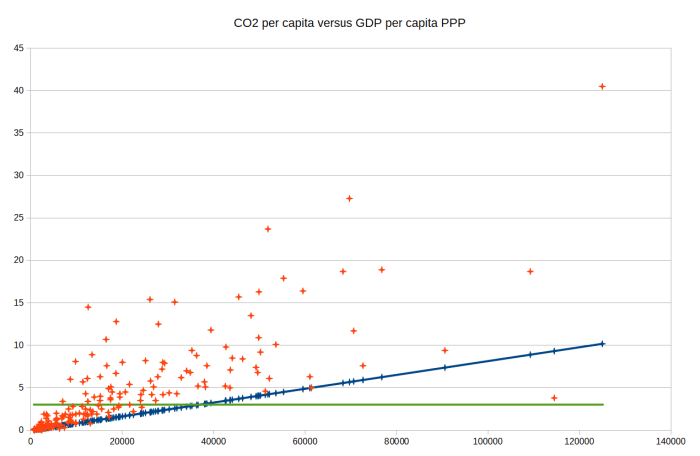
On this graph, the orange dots plot actual GDP per capita (at purchasing power parity) on the X axis against actual CO2 emissions per capita on the Y-axis. The green horizonal line is a CO2 emission target of 3 tonnes per person per year based on reports from the International Panel on Climate Change.

Wedge_full

As you can see, most countries are above the green line. That’s bad. We need the whole world below that green line. The countries that are below the line are largely poor countries, with a handful of middle-income countries mixed in.

But it’s the blue diagonal line that really makes this graph significant, what makes it the Wedge. That line uses Switzerland’s level of efficiency to estimate a frontier of what’s possible. Switzerland’s ratio of GDP to CO2 is the best in the world, among countries where the data actually looks reliable. A handful of other countries do better in the data, but for some (Macau) it’s obviously due to poor counting of indirect emissions and for others (Rwanda, Chad, Burundi) we just don’t have good data at all. I think Switzerland’s efficiency level of $12,000 per ton of CO2 is about as good as can be reasonably expected for most countries over the long run.

Our goal should be to move as far right on the graph as we can (toward higher levels of economic development), but always staying inside this Wedge: Above the green line, our CO2 emissions are too high. Below the blue line may not be technologically feasible (though of course it’s worth a try). We want to aim for the point of the wedge, where GDP is as high as possible but emissions are still below safe targets.

Zooming in on the graph gives a better view of the Wedge.

Wedge_zoomed

The point of the Wedge is about $38,000 per person per year. This is not as rich as the US, but it’s definitely within the range of highly-developed countries. This is about the same standard of living as Italy, Spain, or South Korea. In fact, all three of these countries exceed their targets; the closest I was able to find to a country actually hitting the point of the wedge was Latvia, at $27,300 and 3.5 tonnes per person per year. Uruguay also does quite well at $22,400 and 2.2 tonnes per person per year.

Some countries are within the Wedge; a few, like Uruguay, quite close to the point, and many, like Colombia and Bangladesh, that are below and to the left. For these countries, a “stay the course” policy is the way to go: If they keep up what they are doing, they can continue to experience economic growth without exceeding their emission targets.


But the most important thing about the graph is not actually the Wedge itself: It’s all the countries outside the Wedge, and where they are outside the Wedge.

There are some countries, like Sweden, France, and Switzerland, that are close to the blue line but still outside the Wedge because they are too far to the right. These are countries for whom “degrowth” policies might actually make sense: They are being as efficient in their use of resources as may be technologically feasible, but are simply producing too much output. They need to find a way to scale back their economies without causing social and political collapse. My suggestion, for what it’s worth, is progressive taxation. In addition to carbon taxes (which are a no-brainer), make income taxes so high that they start actually reducing GDP, and do so without fear, since that’s part of the point; then redistribute all the income as evenly as possible so that lower total income comes with much lower inequality and the eradication of poverty. Most of the country will then be no worse off than they were, so social and political unrest seems unlikely. Call it “socialism” if you like, but I’m not suggesting collectivization of industry or the uprising of the proletariat; I just want everyone to adopt the income tax rates the US had in the 1950s.

But most countries are not even close to the blue line; they are well above it. In all these countries, the goal should not be to reduce economic output, but to increase the carbon efficiency of that output. Increased efficiency has no downside (other than the transition cost to implement it): It makes you better off ecologically without making you worse off economically. Bahrain has about the same GDP per capita as Sweden but produces over five times the per-capita carbon emissions. Simply by copying Sweden they could reduce their emissions by almost 19 tonnes per person per year, which is more than the per-capita output of the US (and we’re hardly models of efficiency)—at absolutely no cost in GDP.

Then there are countries like Mongolia, which produces only $12,500 in GDP but 14.5 tonnes of CO2 per person per year. Mongolia is far above and to the left of the point of the Wedge, meaning that they could both increase their GDP and decrease their emissions by adopting the model of more efficient countries. Telling these countries that “degrowth” is the answer is beyond perverse—cut Mongolia’s GDP by 2/3 and you would throw them into poverty without even bringing carbon emissions down to target.

We don’t need to overthrow capitalism or even give up on GDP growth in general. We need to focus on carbon, carbon, carbon: All economic policy from this point forward should be made with CO2 reduction in mind. If that means reducing GDP, we may have to accept that; but often it won’t. Switching to nuclear power and public transit would dramatically reduce emissions but need have no harmful effect on economic output—in fact, the large investment required could pull a country out of recession.

Don’t worry about the Doughnut. Aim for the point of the Wedge.

Is grade inflation a real problem?

Mar 4 JDN 2458182

You can’t spend much time teaching at the university level and not hear someone complain about “grade inflation”. Almost every professor seems to believe in it, and yet they must all be participating in it, if it’s really such a widespread problem.

This could be explained as a collective action problem, a Tragedy of the Commons: If the incentives are always to have the students with the highest grades—perhaps because of administrative pressure, or in order to get better reviews from students—then even if all professors would prefer a harsher grading scheme, no individual professor can afford to deviate from the prevailing norms.

But in fact I think there is a much simpler explanation: Grade inflation doesn’t exist.

In economic growth theory, economists make a sharp distinction between inflation—increase in prices without change in underlying fundamentals—and growth—increase in the real value of output. I contend that there is no such thing as grade inflation—what we are in fact observing is grade growth.
Am I saying that students are actually smarter now than they were 30 years ago?

Yes. That’s exactly what I’m saying.

But don’t take it from me. Take it from the decades of research on the Flynn Effect: IQ scores have been rising worldwide at a rate of about 0.3 IQ points per year for as long as we’ve been keeping good records. Students today are about 10 IQ points smarter than students 30 years ago—a 2018 IQ score of 95 is equivalent to a 1988 score of 105, which is equivalent to a 1958 score of 115. There is reason to think this trend won’t continue indefinitely, since the effect is mainly concentrated at the bottom end of the distribution; but it has continued for quite some time already.

This by itself would probably be enough to explain the observed increase in grades, but there’s more: College students are also a self-selected sample, admitted precisely because they were believed to be the smartest individuals in the application pool. Rising grades at top institutions are easily explained by rising selectivity at top schools: Harvard now accepts 5.6% of applicants. In 1942, Harvard accepted 92% of applicants. The odds of getting in have fallen from 9:1 in favor to 19:1 against. Today, you need a 4.0 GPA, a 36 ACT in every category, glowing letters of recommendation, and hundreds of hours of extracurricular activities (or a family member who donated millions of dollars, of course) to get into Harvard. In the 1940s, you needed a high school diploma and a B average.

In fact, when educational researchers have tried to quantitatively study the phenomenon of “grade inflation”, they usually come back with the result that they simply can’t find it. The US department of education conducted a study in 1995 showing that average university grades had declined since 1965. Given that the Flynn effect raised IQ by almost 10 points during that time, maybe we should be panicking about grade deflation.

It really wouldn’t be hard to make that case: “Back in my day, you could get an A just by knowing basic algebra! Now they want these kids to take partial derivatives?” “We used to just memorize facts to ace the exam; but now teachers keep asking for reasoning and critical thinking?”

More recently, a study in 2013 found that grades rose at the high school level, but fell at the college level, and showed no evidence of losing any informativeness as a signaling mechanism. The only recent study I could find showing genuinely compelling evidence for grade inflation was a 2017 study of UK students estimating that grades are growing about twice as fast as the Flynn effect alone would predict. Most studies don’t even consider the possibility that students are smarter than they used to be—they just take it for granted that any increase in average grades constitutes grade inflation. Many of them don’t even control for the increase in selectivity—here’s one using the fact that Harvard’s average rose from 2.7 to 3.4 from 1960 to 2000 as evidence of “grade inflation” when Harvard’s acceptance rate fell from almost 30% to only 10% during that period.

Indeed, the real mystery is why so many professors believe in grade inflation, when the evidence for it is so astonishingly weak.

I think it’s availability heuristic. Who are professors? They are the cream of the crop. They aced their way through high school, college, and graduate school, then got hired and earned tenure—they were one of a handful of individuals who won a fierce competition with hundreds of competitors at each stage. There are over 320 million people in the US, and only 1.3 million college faculty. This means that college professors represent about the top 0.4% of high-scoring students.

Combine that with the fact that human beings assort positively (we like to spend time with people who are similar to us) and use availability heuristic (we judge how likely something is based on how many times we have seen it).

Thus, when a professor compares to her own experience of college, she is remembering her fellow top-scoring students at elite educational institutions. She is recalling the extreme intellectual demands she had to meet to get where she is today, and erroneously assuming that these are representative of most the population of her generation. She probably went to school at one of a handful of elite institutions, even if she now teaches at a mid-level community college: three quarters of college faculty come from the top one quarter of graduate schools.

And now she compares to the students she has to teach, most of whom would not be able to meet such demands—but of course most people in her generation couldn’t either. She frets for the future of humanity only because not everyone is a genius like her.

Throw in the Curse of Knowledge: The professor doesn’t remember how hard it was to learn what she has learned so far, and so the fact that it seems easy now makes her think it was easy all along. “How can they not know how to take partial derivatives!?” Well, let’s see… were you born knowing how to take partial derivatives?

Giving a student an A for work far inferior to what you’d have done in their place isn’t unfair. Indeed, it would clearly be unfair to do anything less. You have years if not decades of additional education ahead of them, and you are from self-selected elite sample of highly intelligent individuals. Expecting everyone to perform as well as you would is simply setting up most of the population for failure.

There are potential incentives for grade inflation that do concern me: In particular, a lot of international student visas and scholarship programs insist upon maintaining a B or even A- average to continue. Professors are understandably loathe to condemn a student to having to drop out or return to their home country just because they scored 81% instead of 84% on the final exam. If we really intend to make C the average score, then students shouldn’t lose funding or visas just for scoring a B-. Indeed, I have trouble defending any threshold above outright failing—which is to say, a minimum score of D-. If you pass your classes, that should be good enough to keep your funding.

Yet apparently even this isn’t creating too much upward bias, as students who are 10 IQ points smarter are still getting about the same scores as their forebears. We should be celebrating that our population is getting smarter, but instead we’re panicking over “easy grading”.

But kids these days, am I right?

I’m not sure environmentalists understand what the word “consumption” means to economists.

Feb 25 JDN 2458175

Several times now I’ve heard environmentalists repeat variants of this line: “Capitalist economies depend on consumption; therefore capitalism is incompatible with environmental sustainability.”

A recent example comes from this article on QZ arguing that “conscious consumerism” isn’t viable for protecting the environment:

In short, consumption is the backbone of the American economy—which means individual conscious consumerism is basically bound to fail. “70% of GDP in the US is based on household consumption. So all the systems, the market, the institutions, everything is calibrated to maximize consumption,” Brown told me in a later interview. “The whole marketing industry and advertising invents new needs we didn’t know we had.”

Consumption. You keep using that word… I do not think it means what you think it means.

To be clear, let me say that I basically agree that “conscious consumerism” isn’t good enough. There are a few big things you can do to reduce your carbon footprint, like moving to California (or better yet, Scandinavia), becoming vegetarian, driving a hybrid car (or not driving at all), and not flying on airplanes. Aside from that, your consumer choices are not going to have a large impact. There is a huge amount of greenwashing that goes on—products that present themselves as eco-friendly which really aren’t. And these things by themselves are not enough. A 2012 study by the European Roundtable on Sustainable Consumption and Production found little or no difference in long-run carbon footprint between people who claim to be “green consumers” and people who don’t.

Moreover, there is a strong positive correlation between a country’s GDP and its carbon footprint. The list of countries with the highest carbon emissions looks a lot like the list of countries with the highest GDP.

But there is still substantial variation in the ratio of GDP to carbon emissions. Scandinavia does extremely well, at over $5,000 per ton (as does France, thanks to nuclear energy), while most European countries make about $3,000 per ton, the US is at about $2,000 per ton, and the very most carbon-intensive economies like China, the UAE, and South Africa only make about $1,000 per ton. China produces more carbon emissions per capita than Denmark despite having only one-third the standard of living (at purchasing power parity). Emissions also vary a great deal by states within the US; California’s per-capita emissions are comparable to France’s, while Wyoming’s are worse than the UAE’s.

This brings me to my main point, which is that economists don’t mean the same thing by the word “consumption” that environmentalists do. The environmentalist meaning might be closer to common usage: When something is consumed, we think of it as being destroyed, despoiled, degraded. (It’s even an archaic euphemism for tuberculosis.) So I can see why you would think that if our economy is 70% “consumption” that must make capitalism terrible for the environment: An economy that is 70% destruction, despoliation, and degradation does sound pretty bad.

But when economists use the word “consumption”, what we actually mean is private household expenditure. Our economy is 70% “consumption” in the sense that 70% of the dollars spent in GDP are spent by private individuals as opposed to corporations or the government. Of the $19.7 trillion of US GDP, $13.6 trillion was personal consumption expenditures. That’s actually 69%, but it’s okay to round up to 70%. The rest is made up of $3.4 trillion in government spending, $3.3 trillion in private investment, and a loss of $0.6 trillion from our trade deficit.

There’s no particular connection between private household expenditure and destruction, despoliation, or degradation. In fact, the most destructive form of GDP is obviously military spending, which is not counted as “consumption” in the National Income and Product Accounts but rather as “government expenditure”. Military spending is almost pure waste from an ecological perspective; it consumes mind-boggling amounts of fossil fuels in addition to causing death and destruction. The US military produces almost as much total carbon emissions as the entire country of Denmark.

In fact, the vast majority of private household expenditure in highly-developed countries is in the form of services—over $9.2 trillion in the US. The top four categories for expenditure on services in the US are housing/utilities, healthcare, finance, and food service. I can at least see how housing and utilities would be related to ecological impact—concrete and steel are very carbon-intensive, as is electricity if you’re not using nuclear or renewables. But healthcare, finance, and food service? When environmentalists point to the fact that 70% of our economy is consumption as evidence of the fundamental unsustainability of capitalism, this amounts to asserting that the reason we can’t prevent global warming is that there are so many nurses, accountants, and waiters.

Of course, most people don’t quite grasp what economists mean when we use the word “consumption”, so it makes for a nice talking point for environmentalists. You can conjure images of degradation and destruction while citing the respected authority of the National Income and Product Accounts. If you were already left-wing otherwise (as most environmentalists are), you can make it seem as though the problem is capitalism itself, the very structure of an economy built upon “consuming” the Earth.

In reality, there is enormous variation between countries in terms of their carbon efficiency, and in fact the most carbon-efficient nations are all those that have the highest degrees of political and economic freedom—which is to say, social democracies. One can debate whether social democracies like Denmark and Sweden are “truly capitalist”, but they definitely have free-market economies with large private sectors. On a global and historical scale, there’s really not that much difference between Denmark and the United States (compare to the USSR, or China, or Burkina Faso, or Medieval Japan, or Classical Rome). And if the US isn’t capitalist, who is?

My advice? Don’t talk about consumption at all. Talk about carbon emissions. Don’t ignore variation in GDP/carbon ratios: If the world copied China, we’d all have a per-capita income of $15,500 and emissions of 7.6 tons of carbon per person per year; but if the world copied Denmark, we’d all have a per-capita income of $51,000 and emissions of 6.8 tons of carbon per person per year. (Granted, even 6.8 is still too high; the targets I’ve seen say we need to be at about 3.0 by 2030. But Denmark has also been trending downward in emissions, so we could copy them on that too.) Reducing our standard of living wouldn’t save us if it meant being like China, and maintaining it wouldn’t hurt us if it meant being like Denmark.

I definitely agree that focusing on consumer choices isn’t good enough. Focus on policy. Carbon taxes, bans on unconventional extraction (e.g. offshore drilling, fracking), heavy investment in solar and nuclear energy, large reforestation projects, research into soil sequestration and ocean seeding. Demand these things from all politicians of all parties at all levels of government always. Don’t take no for an answer—because millions of people will die if we don’t stop climate change.

But I don’t think nurses, accountants, and waiters are the problem—and it doesn’t hurt for people to become vegetarian and buy hybrid cars.

You know what? Let’s repeal Obamacare. Here’s my replacement.

Feb 18 JDN 2458168

By all reasonable measures, Obamacare has been a success. Healthcare costs are down but coverage rates are up. It reduced both the federal deficit and after-tax income inequality.

But Republicans have hated it the whole time, and in particular the individual mandate provision has always been unpopular. Under the Trump administration, the individual mandate has now been repealed.

By itself, this can only be disastrous. It threatens to undermine all the successes of the entire Obamacare system. Without the individual mandate, covering pre-existing conditions means that people can simply wait to get insurance until they need it—at which point it’s not insurance anymore. The risks stop being shared and end up concentrated on whoever gets sick, then we go back to people going bankrupt because they were unlucky enough to get cancer. The individual mandate was vital to making Obamacare work.

But I do actually understand why the individual mandate is unpopular: Nobody likes being forced into buying anything.

John Roberts ruled that the individual mandate was Constitutional on the grounds that it is economically equivalent to a tax. This is absolutely correct, and I applaud his sound reasoning.

That said, the individual mandate is not in fact psychologically equivalent to a tax.

Psychologically, being forced to specifically buy something or face punishment feels a lot more coercive than simply owing a certain amount of money that the government will use to buy something. Roberts is right; economically, these two things are equivalent. The same real goods get purchased, at the same people’s expense; the accounts balance in the same way. But it feels different.

And it would feel different to me too, if I were required to actually shop for that particular avionic component on that Apache helicopter my taxes paid for, or if I had to write a check for that particular section of Highway 405 that my taxes helped maintain. Yes, I know that I give the government a certain amount of money that they spent on salaries for US military personnel; but I’d find it pretty weird if they required me to actually hand over the money in cash to some specific Marine. (On the other hand, this sort of thing might actually give people a more visceral feel for the benefits of taxes, much as microfinance agencies like to show you the faces of particular people as you give them loans, whether or not those people are actually the ones getting your money.)

There’s another reason it feels different as well: We have framed the individual mandate as a penalty, as a loss. Human beings are loss averse; losing $10 feels about twice as bad as not getting $10. That makes the mandate more unpleasant, hence more unpopular.

What could we do instead? Well, obviously, we could implement a single-payer healthcare system like we already have in Medicare, like they have in Canada and the UK, or like they have in Scandinavia (#ScandinaviaIsBetter). And that’s really what we should do.

But since that doesn’t seem to be on the table right now, here’s my compromise proposal. Okay, yes, let’s repeal Obamacare. No more individual mandate. No fines for not having health insurance.

Here’s what we would do instead: You get a bonus refundable tax credit for having health insurance.

We top off the income tax rate to adjust so that revenue ends up the same.

Say goodbye to the “individual mandate” and welcome the “health care bonus rebate”.

Most of you reading this are economically savvy enough to realize that’s the same thing. If I tax you $100, then refund $100 if you have health insurance, that’s completely equivalent to charging you a fine of $100 if you don’t have health insurance.

But it doesn’t feel the same to most people. A fine feels like a punishment, like a loss. It hurts more than a mere foregone bonus, and it contains an element of disapproval and public shame.

Whereas, we forgo refundable tax credits all the time. You’ve probably forgone dozens of refundable tax credits you could have gotten, either because you didn’t know about them or because you realized they weren’t worth it to you.

Now instead of the government punishing you for such a petty crime as not having health insurance, the government is rewarding you for the responsible civic choice of having health insurance. We have replaced a mean, vindictive government with a friendly, supportive government.

Positive reinforcement is more reliable anyway. (Any child psychologist will tell you that while punishment is largely ineffective and corporal punishment is outright counterproductive, reward systems absolutely do work.) Uptake of health insurance should be at least as good as before, but the policy will be much more popular.

It’s a very simple change to make. It could be done in a single tax bill. Economically, it makes no difference at all. But psychologically—and politically—it could make all the difference in the world.

Stop telling people they need to vote. Tell them they need to cast informed votes.

Feb 11 JDN 2458161

I just spent last week’s post imploring you to defend the norms of democracy. This week, I want to talk about a norm of democracy that I actually think needs an adjustment.

Right now, there is a very strong norm that simply says: VOTE.

“It is our civic duty to vote.” “You are unpatriotic if you don’t vote.” “Voting is a moral obligation.” Etc.

The goal here is laudable: We want people to express the altruistic motivation that will drive them to escape the so-called Downs Paradox and actually go vote to make democracy work.

But the norm is missing something quite important. It’s not actually such a great thing if everyone just goes out and votes, because most people are seriously, disturbingly uninformed about politics.

The norm shouldn’t be that you must vote. The norm should be that you must cast an informed vote.

Best if you vote informed, but if you won’t get informed, then better if you don’t vote at all. Adding random noise or bias toward physical attractiveness and height does not improve electoral outcomes.

How uninformed are voters?

Most voters don’t understand even basic facts about the federal budget, like the fact that Medicare and Social Security spending are more than defense spending, or the fact that federal aid and earmarks are tiny portions of the budget. A couple years ago I had to debunk a meme that was claiming that we spend a vastly larger portion of the budget on defense than we actually do.

It gets worse: Only a quarter of Americans can even name all three branches of government. Almost half couldn’t identify the Bill of Rights. We literally required them to learn this in high school. By law they were supposed to know this.

But of course I’m not one of the ignorant ones, right? In a classic case of Dunning-Kruger Effect, nobody ever thinks they are. When asked to predict if they would pass the civics exam required to obtain citizenship, 89% of voters surveyed predicted they would. When they took it, only 17% actually passed it. (For the record, I took it and got a perfect score. You can try it yourself here.)

More informed voters already tend to be more politically engaged. But they are almost evenly divided between Democrats and Republicans, which means (especially with the way the Electoral College works) that elections are primarily determined by low-information voters. Low-information voters were decisive for Trump in a way that is unprecedented for as far back as we have data on voter knowledge (which, sadly, is not all that far back).

To be fair, more information is no panacea; humans are very good at rationalizing beliefs that they hold for tribal reasons. People who follow political news heavily typically have more distorted views on some political issues, because they only hear one side and they think they know but they don’t. To truly be more informed voters we must seek out information from reliable, nonpartisan sources, and listen to a variety of sources with differing views. Get your ideas about climate change from NPR or the IPCC, not from Huffington Post—and certainly not from Fox News. But still, maybe it’s worth reading National Review or Reason on occasion. Even when they are usually wrong, it is good for you to expose yourself to views from the other side—because sometimes they can be right. (Reason recently published an excellent article on the huge waste of government funds on building stadiums, for example, and National Review made some really good points against the New Mexico proposal to mandate college applications for high school graduates.)

And of course even those of us who are well-informed obviously have lots of other things we don’t know. Given my expertise in economics and my level of political engagement, I probably know more about politics than 99% of American voters; but I still can’t name more than a handful of members of Congress or really any state legislators aside from the ones who ran for my own district. I can’t even off the top of my head recall who heads the Orange County Water District, even though they literally decide whether I get to drink and take a shower. I’m not asking voters to know everything there is to know about politics, as no human being could possibly do such a thing. I’m merely asking that they know enough basic information to make an informed decision about who to vote for.

Moreover, I think this is a unique time in history where changing this norm has really become viable. We are living in a golden age of information access—almost literally anything you could care to know about politics, you could find in a few minutes of Google searching. I didn’t know who ran my water district, but I looked it up, and I do now: apparently Stephen R. Sheldon. I can’t name that many members of Congress, but I don’t vote for that many members of Congress, and I do carefully research each candidate running in my district when it comes time to vote. (In the next California state legislature election, Mimi Walters has got to go—she has consistently failed to stand against Trump, choosing her party over her constituency.)

This means that if you are uninformed about politics and yet still vote, you chose to do that. You aren’t living in a world where it’s extremely expensive or time-consuming to learn about politics. It is spectacularly easy to learn about politics if you actually want to; if you didn’t learn, it was because you chose not to learn. And if even this tiny cost is too much for you, then how about this? If you don’t have time to get informed, you don’t have time to vote.

Voting electronically would also help with this. People could, in the privacy of their own homes, look up information on candidates while their ballots are right there in front of them. While mail-in voter fraud actually does exist (unlike in-person voter fraud, which basically doesn’t), there are safeguards already in widespread use in Internet-based commerce that we could institute on electronic voting to provide sufficient protection. Basically, all we need to do is public-key signing: issue every voter a private key to sign their votes, which are then decrypted at the county office using a database of public keys. If public keys were stolen, that could compromise secret-ballot anonymity, but it would not allow anyone to actually change votes. Voters could come in person to collect their private keys when they register to vote, at their convenience weeks or months before the election. Of course, we’d have to make it user-friendly enough that people who aren’t very good with computers would understand the system. We could always leave open the option of in-person voting for anyone who prefers that.

Of course, establishing this norm would most likely reduce voter turnout, even if it did successfully increase voter knowledge. But we don’t actually need everyone to vote. We need everyone’s interests accurately represented. If you aren’t willing to get informed, then casting your vote isn’t representing your interests anyway, so why bother?

False equivalence is not centrism

False equivalence is not centrism

Feb 4 JDN 2458154

Turning and turning in the widening gyre

The falcon cannot hear the falconer;

Things fall apart; the centre cannot hold;

Mere anarchy is loosed upon the world,

The blood-dimmed tide is loosed, and everywhere

The ceremony of innocence is drowned;

The best lack all conviction, while the worst

Are full of passionate intensity.

~ W.B. Yeats, The Second Coming


Centrism is not very popular these days, but I believe this is because neither its alleged adherents nor its alleged opponents actually have a clear understanding of what centrism is supposed to be. Most of what is called “centrism” in this polarized era (the US is now more politically polarized than it has been in decades) is actually false equivalence.

Most people who express pride in their “centrism” adopt a heuristic which basically amounts to taking the two positions that are most loudly proclaimed in public and averaging them. One side says “Kill all puppies”, the other side says “Don’t kill puppies”, and they proudly and self-righteously declare that the only sensible policy is to kill precisely 50% of the puppies. Anyone who says “the two parties are the same” or “liberals deny science too” is guilty of this false equivalence—and it’s all too common.

But this is not what centrism is supposed to be. A good centrist isn’t someone who looks at their existing Overton Window and chooses the mean value. A good centrist is someone who understands and appreciates Horseshoe Theory. Horseshoe Theory says that the political spectrum is not actually a straight line from left to right; it’s more of a horseshoe shape, where the far-left and the far-right curl down and toward one another. A good centrist is someone who values the top of the horseshoe, more strongly than they value whatever particular policies might move you toward the left or the right edge.

What does the top of the horseshoe represent? Democracy.

A good centrist is someone who really, truly believes in defending democracy.

What the far-left and the far-right have in common is authoritarianism:

For those on either edge of the horseshoe, people who disagree with (the collectivization of all wealth/the superiority of my master race) aren’t simply wrong, they are evil. Persuading them to vote my way is a waste of time. Freedom of speech is dangerous, because it allows them to spread their evil ideas. It would be better to suppress freedom of speech, so that only people who know the truth (read: agree with me) are allowed to speak.

Along similar lines, Slate Star Codex recently published an excellent blog post on how people seem to separate into two very broad political worldviews: There are Mistake Theorists, who think that most of the world’s problems are due to honest ignorance and error; and there are Conflict Theorists, who think that most of the world’s problems are due to the malign influence of evil enemy factions. The far-left and the far-right are overwhelmingly composed of Conflict Theorists. A good centrist is a Mistake Theorist through and through.

Being a good centrist means fighting to defend the institutions that make freedom possible. Here is a whole list of policies that neither the far-left nor the far-right particularly values that we as centrists must:

  1. Voting rights: We must fight against voter suppression and disenfranchisement wherever it occurs. We must stand up to defend the principle “one person, one vote” wherever necessary.
  2. Equality under the law: We must protect the rights of everyone to have equal representation and equal standing as citizens—including, but by no means limited to, women, racial minorities, LGBT people, and people with disabilities.

  3. Election reform: We must find ways to undermine gerrymandering, the Electoral College, and the campaign finance system that allows corporations and wealthy individuals to exert disproportionate influence.

  4. Freedom of speech: We must protect the right of everyone to speak, including those whose views we find abhorrent. Our efforts should be focused most on those who have the least representation in our discourse.

  5. Individual privacy: We must fight against the creeping rise of the surveillance state and the use of extra-legal means of intelligence gathering, particularly in domestic spying. We should be outraged that the House of Representatives voted to extend the NSA’s warrantless wiretap authority after what Edward Snowden revealed about the NSA.

  6. Demilitarization and deincarceration: We must fight to contain or reverse the expansion of military and penal force that has given the United States not only a military larger than the next ten countries combined, but also the world’s highest rate of incarceration.

On some of these issues we might find agreement with the left or (less likely) the right—but even when we don’t, we must press forward. In particular, the goal of equality under the law often aligns with the goal of left-wing social justice—but there are cases where it doesn’t, cases where hatred of White straight men or a craving for vengeance against past injustice drives the left to demand things that would violate this principle. And the atavistic joy of punching Nazis in the face must never overwhelm our sacred commitment to the principles of free speech.

This doesn’t mean we can’t also adopt detailed policy views that align with the left or the right (or both). I for one support single-payer healthcare (left), progressive taxation (left), renewable energy (left), open borders (left), zoning reform (right), reductions in corporate taxes (right), free trade (right, or so I thought?), and a basic income (both—yet strangely we can’t seem to make it happen).

But being a good centrist means that these detailed policy prescriptions are always less important to you than the core principles of democracy itself. When they find out that the rest of the country is against them on something, a leftist or a rightist starts looking for ways to undermine the public will and get the policy they want. A centrist accepts that they have been outvoted and starts looking for ways to persuade the majority that they are mistaken.

Centrism is about defending the guardrails of democracy. False equivalence is not centrism; it is an obstacle to centrism. It prevents us from seeing when one side has clearly damaged those guardrails much more than the other. So let me come out and say it: At this historical juncture, in the United States, the right wing is a far greater threat to the core principles of democracy than the left. This is not to say that the left is inherently incapable of threatening democracy, or never will do so in the future; but it is to say that right here, right now, it’s the right wing we should be worried about. Punching Nazis will never be as threatening to the core of freedom as warrantless wiretaps or the discrediting of the mainstream press.