What is progress? How far have we really come?

JDN 2457534

It is a controversy that has lasted throughout the ages: Is the world getting better? Is it getting worse? Or is it more or less staying the same, changing in ways that don’t really constitute improvements or detriments?

The most obvious and indisputable change in human society over the course of history has been the advancement of technology. At one extreme there are techno-utopians, who believe that technology will solve all the world’s problems and bring about a glorious future; at the other extreme are anarcho-primitivists, who maintain that civilization, technology, and industrialization were all grave mistakes, removing us from our natural state of peace and harmony.

I am not a techno-utopian—I do not believe that technology will solve all our problems—but I am much closer to that end of the scale. Technology has solved a lot of our problems, and will continue to solve a lot more. My aim in this post is to convince you that progress is real, that things really are, on the whole, getting better.

One of the more baffling arguments against progress comes from none other than Jared Diamond, the social scientist most famous for Guns, Germs and Steel (which oddly enough is mainly about horses and goats). About seven months before I was born, Diamond wrote an essay for Discover magazine arguing quite literally that agriculture—and by extension, civilization—was a mistake.

Diamond fortunately avoids the usual argument based solely on modern hunter-gatherers, which is a selection bias if ever I heard one. Instead his main argument seems to be that paleontological evidence shows an overall decrease in health around the same time as agriculture emerged. But that’s still an endogeneity problem, albeit a subtler one. Maybe agriculture emerged as a response to famine and disease. Or maybe they were both triggered by rising populations; higher populations increase disease risk, and are also basically impossible to sustain without agriculture.

I am similarly dubious of the claim that hunter-gatherers are always peaceful and egalitarian. It does seem to be the case that herders are more violent than other cultures, as they tend to form honor cultures that punish all sleights with overwhelming violence. Even after the Industrial Revolution there were herder honor cultures—the Wild West. Yet as Steven Pinker keeps trying to tell people, the death rates due to homicide in all human cultures appear to have steadily declined for thousands of years.

I read an article just a few days ago on the Scientific American blog which included the following claim so astonishingly nonsensical it makes me wonder if the authors can even do arithmetic or read statistical tables correctly:

I keep reminding readers (see Further Reading), the evidence is overwhelming that war is a relatively recent cultural invention. War emerged toward the end of the Paleolithic era, and then only sporadically. A new study by Japanese researchers published in the Royal Society journal Biology Letters corroborates this view.

Six Japanese scholars led by Hisashi Nakao examined the remains of 2,582 hunter-gatherers who lived 12,000 to 2,800 years ago, during Japan’s so-called Jomon Period. The researchers found bashed-in skulls and other marks consistent with violent death on 23 skeletons, for a mortality rate of 0.89 percent.

That is supposed to be evidence that ancient hunter-gatherers were peaceful? The global homicide rate today is 62 homicides per million people per year. Using the worldwide life expectancy of 71 years (which is biasing against modern civilization because our life expectancy is longer), that means that the worldwide lifetime homicide rate is 4,400 homicides per million people, or 0.44%—that’s less than half the homicide rate of these “peaceful” hunter-gatherers. If you compare just against First World countries, the difference is even starker; let’s use the US, which has the highest homicide rate in the First World. Our homicide rate is 38 homicides per million people per year, which at our life expectancy of 79 years is 3,000 homicides per million people, or an overall homicide rate of 0.3%, slightly more than a third of this “peaceful” ancient culture. The most peaceful societies today—notably Japan, where these remains were found—have homicide rates as low as 3 per million people per year, which is a lifetime homicide rate of 0.02%, forty times smaller than their supposedly utopian ancestors. (Yes, all of Japan has fewer total homicides than Chicago. I’m sure it has nothing to do with their extremely strict gun control laws.) Indeed, to get a modern homicide rate as high as these hunter-gatherers, you need to go to a country like Congo, Myanmar, or the Central African Republic. To get a substantially higher homicide rate, you essentially have to be in Latin America. Honduras, the murder capital of the world, has a lifetime homicide rate of about 6.7%.

Again, how did I figure these things out? By reading basic information from publicly-available statistical tables and then doing some simple arithmetic. Apparently these paleoanthropologists couldn’t be bothered to do that, or didn’t know how to do it correctly, before they started proclaiming that human nature is peaceful and civilization is the source of violence. After an oversight as egregious as that, it feels almost petty to note that a sample size of a few thousand people from one particular region and culture isn’t sufficient data to draw such sweeping judgments or speak of “overwhelming” evidence.

Of course, in order to decide whether progress is a real phenomenon, we need a clearer idea of what we mean by progress. It would be presumptuous to use per-capita GDP, though there can be absolutely no doubt that technology and capitalism do in fact raise per-capita GDP. If we measure by inequality, modern society clearly fares much worse (our top 1% share and Gini coefficient may be higher than Classical Rome!), but that is clearly biased in the opposite direction, because the main way we have raised inequality is by raising the ceiling, not lowering the floor. Most of our really good measures (like the Human Development Index) only exist for the last few decades and can barely even be extrapolated back through the 20th century.

How about babies not dying? This is my preferred measure of a society’s value. It seems like something that should be totally uncontroversial: Babies dying is bad. All other things equal, a society is better if fewer babies die.

I suppose it doesn’t immediately follow that all things considered a society is better if fewer babies die; maybe the dying babies could be offset by some greater good. Perhaps a totalitarian society where no babies die is in fact worse than a free society in which a few babies die, or perhaps we should be prepared to accept some small amount of babies dying in order to save adults from poverty, or something like that. But without some really powerful overriding reason, babies not dying probably means your society is doing something right. (And since most ancient societies were in a state of universal poverty and quite frequently tyranny, these exceptions would only strengthen my case.)

Well, get ready for some high-yield truth bombs about infant mortality rates.

It’s hard to get good data for prehistoric cultures, but the best data we have says that infant mortality in ancient hunter-gatherer cultures was about 20-50%, with a best estimate around 30%. This is statistically indistinguishable from early agricultural societies.

Indeed, 30% seems to be the figure humanity had for most of history. Just shy of a third of all babies died for most of history.

In Medieval times, infant mortality was about 30%.

This same rate (fluctuating based on various plagues) persisted into the Enlightenment—Sweden has the best records, and their infant mortality rate in 1750 was about 30%.

The decline in infant mortality began slowly: During the Industrial Era, infant mortality was about 15% in isolated villages, but still as high as 40% in major cities due to high population densities with poor sanitation.

Even as recently as 1900, there were US cities with infant mortality rates as high as 30%, though the overall rate was more like 10%.

Most of the decline was recent and rapid: Just within the US since WW2, infant mortality fell from about 5.5% to 0.7%, though there remains a substantial disparity between White and Black people.

Globally, the infant mortality rate fell from 6.3% to 3.2% within my lifetime, and in Africa today, the region where it is worst, it is about 5.5%—or what it was in the US in the 1940s.

This precipitous decline in babies dying is the main reason ancient societies have such low life expectancies; actually once they reached adulthood they lived to be about 70 years old, not much worse than we do today. So my multiplying everything by 71 actually isn’t too far off even for ancient societies.

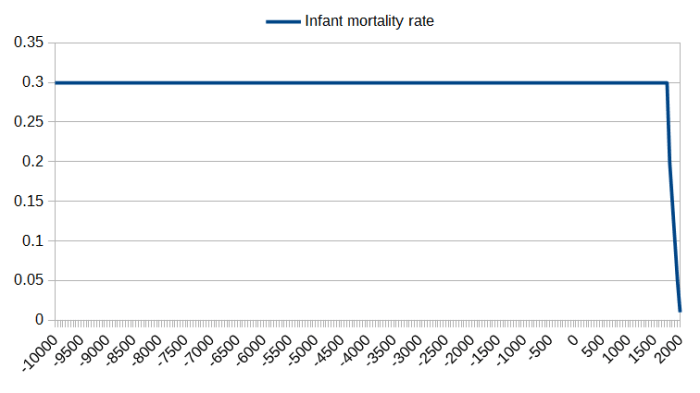
Let me make a graph for you here, of the approximate rate of babies dying over time from 10,000 BC to today:

Infant_mortality.png

Let’s zoom in on the last 250 years, where the data is much more solid:

Infant_mortality_recent.png

I think you may notice something in these graphs. There is quite literally a turning point for humanity, a kink in the curve where we suddenly begin a rapid decline from an otherwise constant mortality rate.

That point occurs around or shortly before 1800—that is, it occurs at industrial capitalism. Adam Smith (not to mention Thomas Jefferson) was writing at just about the point in time when humanity made a sudden and unprecedented shift toward saving the lives of millions of babies.

So now, think about that the next time you are tempted to say that capitalism is an evil system that destroys the world; the evidence points to capitalism quite literally saving babies from dying.

How would it do so? Well, there’s that rising per-capita GDP we previously ignored, for one thing. But more important seems to be the way that industrialization and free markets support technological innovation, and in this case especially medical innovation—antibiotics and vaccines. Our higher rates of literacy and better communication, also a result of raised standard of living and improved technology, surely didn’t hurt. I’m not often in agreement with the Cato Institute, but they’re right about this one: Industrial capitalism is the chief source of human progress.

Billions of babies would have died but we saved them. So yes, I’m going to call that progress. Civilization, and in particular industrialization and free markets, have dramatically improved human life over the last few hundred years.

In a future post I’ll address one of the common retorts to this basically indisputable fact: “You’re making excuses for colonialism and imperialism!” No, I’m not. Saying that modern capitalism is a better system (not least because it saves babies) is not at all the same thing as saying that our ancestors were justified in using murder, slavery, and tyranny to force people into it.

Meanwhile, we’ve been ending world hunger.

JDN 2457303 EDT 19:56

As reported in The Washington Post and Fortune, the World Bank recently released a report showing that for the first time on record—possibly the first time in human history—global extreme poverty has fallen below 10% of the population. Based on a standard of living of $1.90 per day at 2011 purchasing power parity—that’s about $700 per year, a bit less than the average income in Malawi.

The UN World Millennium Development Goal set in 1990 was to cut extreme poverty in half by 2015; in fact we have cut it by more than two-thirds, reducing it from 37% of the world’s population in 1990 to 9.6% today. This is an estimate, based upon models of what’s going on in countries where we don’t have reliable data; ever the cautious scientists, the World Bank prefers to focus on the most recent fully reliable data, which says that we reduced extreme poverty to 12.7% in 2012 and therefore achieved the Millennium Development Goal.

Most of this effect comes from one very big country: China. Over 750 million people in China saw their standard of living rise above the extreme poverty level in the last 30 years.
The slowest reduction in poverty has been in Africa, specifically Sub-Saharan Africa, where extreme poverty has barely budged, from 53% in 1981 to 47% in 2011. But some particular countries in Africa have done better; thanks to good governance—including better free speech protection than the United States, shame on us—Botswana has reduced their extreme poverty rate from over 50% in 1965 to 19% today.

A lot of World Bank officials have been focusing on the fact that there is still much to be done; 10% in extreme poverty is still 10% too many, and even once everyone is above $1.90 per day that still leaves a lot of people at $3 per day and $4 per day which is still pretty darn poor. The project of global development won’t really seem complete until everyone in the world lives above not just the global poverty line, but something more like a First World poverty line, with a home to live in, a doctor to see, a school to attend, clean water, flush toilets, electricity, and probably even a smartphone with Internet access. (If the latter seems extravagant, let me remind you that more people in the world have smartphones than have flush toilets, because #weliveinthefuture.)

Pace the Heritage Foundation, the fact that what we call poverty in America typically includes having a refrigerator, a microwave, and a car doesn’t mean it isn’t actually poverty; it simply means that poverty in the First World isn’t nearly as bad as poverty in the Third World. (After all, over 9% of children in the US live in households with low food security, and 1% live in households with very low food security; hunger in America isn’t as bad as hunger in Malawi, but it’s still hunger.) Maybe it even means we should focus on the Third World, though that argument isn’t as strong as it might appear; to eliminate poverty in the US, all we’d need to do is pass a law that implements a basic income. To eliminate poverty worldwide, we’d need a global project of economic and political reforms to change how hundreds of countries are governed.

Yet, this focus on what we haven’t accomplished (as though we were going to cut funding to the UN Development Program because we’re done now or something) is not only disheartening, it’s unreasonable. We have accomplished something truly spectacular.

We are now on the verge of solving on one of the great problems of human existence, a problem so deep, so ancient, and so fundamental that it’s practically a cliche: We say “end world hunger” in the same breath as “cure cancer” (which doesn’t even make sense) or “conquer death” (which is not as far off as you may think). Yet, in a very real sense, we are on the verge of ending world hunger.

While most people have been focused on other things, from a narcissistic billionaire running for President to the uniquely American tragedy of mass shootings, development economists have been focused on one thing: Conquering global poverty. What this report means is that now, at last, victory is within our grasp.

Development economists are unsung heroes; without their research, their field work, and their advice and pressure to policymakers, we would never have gotten this far. It was development economists who made the UN Millennium Development Goals, and development economists who began to achieve them.

Yet perhaps there is an even more unsung hero in all of this: Capitalism.

I often have a lot of criticisms of capitalism, at least as it operates in the real world; yet it was in the real world that extreme poverty was just brought down below 10%, and it was done primarily by capitalism. I know a lot of people who think that we need to tear down this whole system and replace it with something fundamentally different, but the kind of progress we are making in global development tells me that we need nothing of the sort. We do need to make changes in policy, but they are small changes, simple changes—many of them could be made with the passing of a few simple laws. Capitalism is not fundamentally broken; on the contrary, it is the fundamentals of capitalism that have brought humanity for the first time within arm’s reach of ending world hunger. We need to fix the system at the edges, not throw it away.

Recall that I said most of the poverty reduction occurred in China. What has China been doing lately? They’ve been opening to world trade—that “free trade” stuff I talked about before. They’ve been cutting tariffs. They’ve been privatizing industries. They’ve been letting unprofitable businesses fail so that new ones can rise in their place. They have, in short, been making themselves more capitalist. Building schools, factories, and yes, even sweatshops is what has made China’s rise out of poverty possible. They are still doing many things wrong—not least their authoritarian government, which is now gamifying oppression in truly cyberpunk fashion—but they are doing a few very important things right.

World hunger is on the way out. And I can think of no better reason to celebrate.

What is socialism?

JDN 2457265 EDT 10:47

Last night I was having a political discussion with some friends (as I am wont to do), and it became a little heated, though never uncongenial. A key point of contention was the fact that Bernie Sanders is a socialist, and what exactly that entails.

One of my friends was arguing that this makes him far-left, and thus it is fair when the news media often likes to make a comparison between Sanders on the left and Trump on the right. Donald Trump is actually oddly liberal on some issues, but his attitudes on racial purity, nativism, military unilateralism, and virtually unlimited executive power are literally fascist. Even his “liberal” views are more like the kind of populism that fascists have often used to win support in the past: Don’t you hate being disenfranchised? Give me absolute power and I’ll fix everything for you! Don’t like how our democracy has become corrupt? Don’t worry, I’ll get rid of it! (The democracy, that is.) While he certainly doesn’t align well with the Republican Party platform, I think it’s quite fair to say that Donald Trump is a far-right candidate.

Bernie Sanders, however, is not a far-left candidate. He is a center-left candidate. His views are basically consonant with the Labour Party of the UK and the Social Democratic Party of Germany. He has spoken often about the Scandinavian model (because, well, #Scandinaviaisbetter—Denmark, Sweden, and Norway are some of the happiest places on Earth). When we talk about Bernie Sanders we aren’t talking about following Cuba and the Soviet Union; we’re talking about following Norway and Sweden. As Jon Stewart put it, he isn’t a “crazy-pants cuckoo bird” as some would have you think.

But he’s a socialist, right? Well… sort of—we have to be very clear what that means.

The word “socialism” has been used to mean many things; it has been a cover for genocidal fascism (“National Socialism”) and tyrannical Communism (“Union of Soviet Socialist Republics”). It has become a pejorative thrown at Social Security, Medicare, banking regulations—basically any policy left of Milton Friedman. So apparently it means something between Medicare and the Holocaust.

Social democracy is often classified as a form of socialism—but one can actually make a pretty compelling case that social democracy is not socialism, but in fact a form of capitalism.

If we want a simple, consistent definition of “socialism”, I think I would put it thus: Socialism is a system in which the majority of economic activity is directly controlled by the government. Most, if not all, industries are nationalized; production and distribution are handled by centrally-planned quotas instead of market supply and demand. Under this definition, the USSR, Venezuela, Cuba, and (at least until recently) China are socialist—and under this definition, socialism is a very bad idea. The best-case scenario is inefficiency; the worst-case scenario is mass murder.

Social democracy, the position that Bernie Sanders espouses (and I basically agree wit), is as follows: Social democracy is a system in which markets are taxed and regulated by a democratically-elected government to ensure that they promote general welfare, public goods are provided by the government, and transfer programs are used to reduce poverty and inequality.

Let’s also try to define “capitalism”: Capitalism is a system in which the majority of economic activity is handled by private sector markets.

Under the Scandinavian model, the majority of economic activity is handled by private sector markets, which are in turn regulated and taxed to promote the general welfare—that is, at least on these definitions, Scandinavia is both capitalist and social democratic.

In fact, so is the United States; while our taxes are lower and our regulations weaker, we still have substantial taxes and regulations. We do have transfer programs like WIC, SNAP, and Social Security that attempt to redistribute wealth and reduce poverty.

We could define “socialism” more broadly to mean any government intervention in the economy, in which case Bernie Sander is a socialist and so is… almost everyone else, including most economists.

The majority of the most eminent American economists are in favor of social democracy. I don’t intend this as an argument from authority, but rather to give a sense of the scientific consensus. The consensus in economics is by no means as strong as that in biology or physics (or climatology, ahem), but there is still broad agreement on many issues.

In a survey of 264 members of the American Economics Association [pdf link], 77% opposed government ownership of enterprise (14% mixed feelings, 8% favor) but 71% favored redistribution of wealth in some form (7% mixed feelings, 20% opposed). That’s social democracy is a nutshell. 67% favored public schools (14% mixed feelings, 17% opposed); 75% favored Keynesian monetary policy (12% mixed feelings, 12% opposed); 51% favored Keynesian fiscal policy (19% mixed feelings, 30% opposed). 58% opposed tighter immigration restrictions (16% mixed feelings, 25% opposed). 79% support anti-discrimination laws. 68% favor gun control.

The major departure from left-wing views that the majority of economists make is a near-universal opposition to protectionism, with 86.8% opposed, 7.6% with mixed feelings, and only 5.3% in favor. It seems I am not the only economist to cringe when politicians say they want to “stop sending jobs overseas”, which they do left and right. This view is quite popular; but the evidence says that it is wrong. Protectionism is not the answer; you make your trading partners poorer, they retaliate with their own protections, and you both end up worse off. We need open trade. I’ll save the details on why open trade is so important for a later post.

One issue that economists are very divided on right now is minimum wage; 47.3% favor minimum wage, 38.3% oppose it, and 14.4% have mixed feelings. This division likely reflects the ambiguity of empirical results on the employment effect of minimum wage, which have a wide margin of error but effect sizes that cluster around zero. Economists are also somewhat divided on military aid, with 36.8% in favor, 33% opposed, and 29.9% with mixed feelings. This I attribute more to the fact that military aid, like most military action, can be justified in principle but is typically unjustified in practice. And indeed perhaps “mixed feelings” is the most reasonable view to have on war and its instruments.

Since Bernie Sanders strongly supports raising minimum wage and some of his statements verge on protectionism, I do have to place him to the left of the economic consensus. A lot of economists would probably disagree on the particulars of his tax plans and such. But his core policies are entirely in line with that consensus, and being a social democrat is absolutely part of that. Compare this to the Republicans, who keep trying to out-crazy each other (apparently Scott Walker thinks we should not only build a wall against Mexico, but also against Canada?) and want policies that were abandoned decades ago by mainstream economists (like the gold standard, or a balanced-budget amendment), or simply would never be taken seriously by mainstream economists at all (the aforementioned border wall, eliminating all environmental regulation, or ending all transfer payments and social welfare programs). Even the things they supposedly agree on I’m not sure they do; when economists say they want “deregulation” Republicans seem to think that means “no rules at all” when in fact it’s supposed to mean “simple, transparent rules that can be tightly and fairly enforced”. (I think we need a new term for it, though there is a slogan I like: “Deregulate with a scalpel, not a chainsaw.”) Obama has done a very good job of deregulating in the sense that economists intend, and I think in general most economists view him positively as a leader who made the best of a bad situation.

In any case, the broad consensus of American economists (and I think most economists around the world) is that some form of capitalist social democracy is the best system we have so far. There is dispute about particular policies—how much should the tax rates be, should we tax income, consumption, real estate, capital, etc.; how large should the transfers be; what regulations should be added or removed—but the basic concept of a market economy with a government that taxes, transfers, and regulates is not in serious dispute.

Indeed, social democracy is the economic system of the free world.

Even using the conservative Heritage Foundation’s data, the correlation between tax burden and economic freedom—that’s economic freedom—is small but positive. (I’m excluding missing data, as well as Timor-Leste because it has a “tax burden” larger than its GDP due to weird accounting of its tourism-based economy, and North Korea because they lie to us and they theoretically have “zero taxes” but that’s clearly not true; the Heritage Foundation reports them as 100% taxes, but that’s also clearly not true either.) See for yourself:

Graph: Heritage Foundation Economic Freedom Index and tax burden

Why is this? Do taxes automatically make you more free? No, they make you less free, because you have to pay for things you didn’t choose to buy (which I admit and the Heritage Foundation includes in their index). But taxes are how you manage a free economy. You need to control monetary policy somehow, which means adding and removing money. The way that social democracies do this is by spending on public goods and transfers to add money, and taxing income, consumption, or assets to remove money. Even if you tie your money to the gold standard, you still need to pay for public goods like military and police; and with a fixed money supply that means spending must be matched by taxes.

There are other ways to do this. You could be like Zimbabwe and print as much money as you feel like. You could be like Venezuela, and have government-owned industries form the majority of your economy. Or, actually, you could not do it; you could fail to manage your country’s economy and leave it wallowing in poverty, like Ghana. All of the countries I just listed have lower tax burdens than the United States.

Within the framework of social democracy, there are higher taxes so that spending and transfers can be higher, which means that more public goods are provided and poverty is lower, which means that real equality of opportunity and thus, real economic freedom, are higher. It’s not that raising taxes automatically makes people more free; rather, the kind of policies that make people more free tend to be the kind of social-democratic policies that involve relatively high taxes.

Worldwide, US is 12th in terms of economic freedom and 62nd in terms of tax burden. We currently stand at 24%. That’s quite low for a First World country, but still relatively high by world standards. The highest tax burden is in Eritrea at 50%; the lowest is in Kuwait at an astonishing 0.7% (I don’t even know how that’s possible). Neither is a really wonderful place to live (though Kuwait is better).

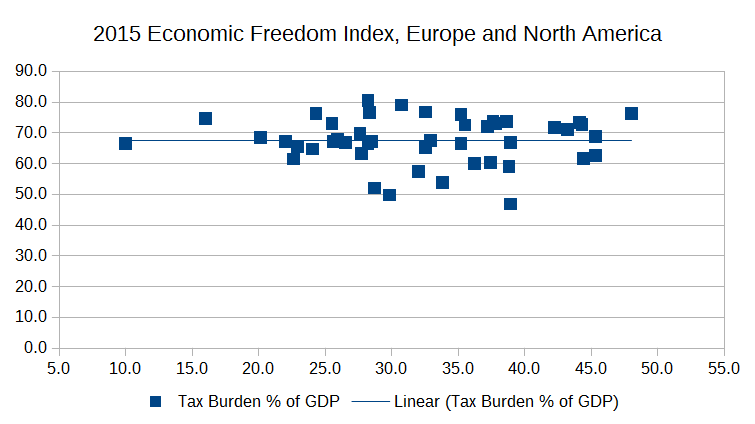
Indeed, if you restrict the sample to North America and Europe, the correlation basically disappears; all the countries are fairly free, all the taxes are fairly high, and within that the two aren’t very much related. (It’s been a long time since I’ve seen a trendline that flat, actually!)

Graph: Heritage Foundation Economic Freedom Index and tax burden, Europe and North America

Switzerland, Canada, and Denmark all have higher economic freedom scores than the United States, as well as higher tax burdens; but on the other hand, Greece, Spain, and Austria have higher tax burdens but lower freedom scores. All of them are variations on social democracy.

Is that socialism? I’m really not sure. Why does it matter, really?

What if you couldn’t own land?

JDN 2457145 EDT 20:49.

Today’s post we’re on the socialism scale somewhere near the The Guess Who, but not quite all the way to John Lennon. I’d like to questions one of the fundamental tenets of modern capitalism, but not the basic concept of private ownership itself:

What if you couldn’t own land?

Many things that you can own were more-or-less straightforwardly created by someone. A car, a computer, a television, a pair of shoes; for today let’s even take for granted intellectual property like books, movies, and songs; at least those things (“things”) were actually made by someone.

But land? We’re talking about chunks of the Earth here. They were here billions of years before us, and in all probability will be here billions of years after we’re gone. There’s no need to incentivize its creation; the vast majority of land was already here and did not need to be created. (I do have to say “the vast majority”, because in places like Japan, Hong Kong, and the Netherlands real estate has become so scarce that people do literally build land out into the sea. But this is something like 0.0001% of the world’s land.)

What we want to incentivize is land development; we want it to be profitable to build buildings and irrigate deserts, and yes, even cut down forests sometimes (though then there should be a carbon tax with credits for forested land to ensure that there isn’t too much incentive). Yet our current property tax system doesn’t do this very well; if you build bigger buildings, you end up paying more property taxes. Yes, you may also make some profit on the buildings—but it’s risky, and you may not get enough benefit to justify the added property taxes.

Moreover, we want to allocate land—we want some way of deciding who is allowed to use what land where and when (and perhaps why). Allowing land to be bought and sold is one way to do that, but it is not the only way.

Indeed, land ownership suffers from a couple of truly glaring flaws as an allocation system:

      1. It creates self-perpetuating inequality. Because land grows in value over time (due to population growth and urbanization, among other things), those who currently own land end up getting an ever-growing quantity of wealth while those who do not own land do not, and very likely end up having to pay ever-growing rents to the landlords. (I like calling them “landlords”; it really drives home the fact that our landholding system is still basically the same as it was under feudalism.) In fact, the recent rise in the share of income that goes to owners of capital rather than workers is almost entirely attributable to the rise in the price of real estate. As that post rightly recognizes, this does nothing to undermine Piketty’s central message of rising inequality due to capital income (pace The Washington Post); it merely tells us to focus on real estate instead of other forms of capital.
      2. It has no non-arbitrary allocation. If we want to decide who owns a car, we can ask questions like, “Who built it? Did someone buy it from them? Did they pay a fair price?”; if we want to decide who owns a book, we can ask questions like, “Who wrote it? Did they sell it to a publisher? What was the royalty rate?” That is, there is a clear original owner, and there is a sense of whether the transfer of ownership can be considered fair. But if we want to decide who owns a chunk of land, basically all we can ask is, “What does the deed say?” The owner is the owner because they are the owner; there’s no sense in which that ownership is fair. We certainly can’t go back to the original creation of the land, because that was due to natural forces gigayears ago. If we keep tracing the ownership backward, we will eventually end up with some guy (almost certainly a man, a White man in fact) with a gun who pointed that gun at other people and said, “This is mine.” This is true of basically all the land in the world (aside from those little bits of Japan and such); it was already there, and the only reason someone got to own it was because they said so and had a bigger gun. And a flag, perhaps: “Do you have a flag?” I suppose, in theory at least, there are a few ways of allocating land which seem less arbitrary: One would be to give everyone an equal amount. But this is practically very difficult: What do you do when the population changes? If you have 2% annual population growth, do you carve off 2% of everybody’s lot each year? Another would be to let people squat land, and automatically own the land that they live on—but again practical difficulties quickly become enormous. In any case, these two methods bear about as much resemblance to our actual allocation of land as a squirrel does to a Tyrannosaurus.

So, what else might we use? The system that makes the most sense to me is that we would own all land as a society. In practical terms this would mean that all land is Federal land, and if you want to use it for something, you need to pay rent to the government. There are many different ways the government could set the rent, but the most sensible might be to charge a flat rate per hectare regardless of where the land is or what it’s being used for, because that would maximize the incentive to develop the land. It would also make the rent fall entirely on the landowner, because the rent would be perfectly inelasticmeaning that you can’t change the quantity you make based on the price, because you aren’t making it; it’s just already sitting there.

Of course, this idea is obviously politically impossible in our current environment—or indeed any foreseeable political environment. I’m just fantasizing here, right?

Well, not quite. There is one thing we could do that would be economically quite similar to government-only land ownership; it’s called a land tax. The idea is incredibly simple: you just collect a flat tax per hectare of land. Economists have known that a land tax is efficient at providing revenue and reducing inequality since at least Adam Smith. So maybe ownership of land isn’t actually foundational to capitalism, after all; maybe we’ve just never fully gotten over feudalism. (I basically agree with Adam Smith, and for doing so I am often called a socialist.) The beautiful thing about a land tax is that it has a tax incidence in which the owners of the land end up bearing the full brunt of the tax.

Tax incidence is something it’s very important to understand; it would be on my list of the top ten economic principles that people should learn. We often have fierce political debates over who will actually write the check: Should employers pay the health insurance premium, or should employees? Will buyers pay sales tax, or sellers? Should we tax corporate profits or personal capital gains?

Please understand that I am not exaggerating when I say that these sorts of questions are totally irrelevant. It simply does not matter who actually writes the check; what matters is who bears the cost. Making the employer pay the health insurance premium doesn’t make the slightest difference if all they’re going to do is cut wages by the exact same amount. You can see the irrelevance of the fact that sellers pay sales tax every time you walk into a store—you always end up paying the price plus the tax, don’t you? (I found that the base price of most items was the same between Long Beach and Ann Arbor, but my total expenditure was always 3% more because of the 9% sales tax versus the 6%.) How do we determine who actually pays the tax? It depends on the elasticity—how easily can you change your behavior in order to avoid the tax? Can you find a different job because the health insurance premiums are too high? No? Then you’re probably paying that premium, even if your employer writes the check. If you can find a new job whenever you want, your employer might have to pay it for you even if you write the check.

The incidence of corporate taxes and taxes on capital gains are even more complicated, because it could affect the behavior of corporations in many different ways; indeed, many economists argue that the corporate tax simply results in higher unemployment or lower wages for workers. I don’t think that’s actually true, but I honestly can’t rule it out completely, precisely because corporate taxes are so complicated. You need to know all sorts of things about the structure of stock markets, and the freedom of trade, and the mobility of immigration… it’s a complete and total mess.

It’s because of tax incidence that a land tax makes so much sense; there’s no way for the landowner to escape it, other than giving up the land entirely. In particular, they can’t charge more for rent without being out-competed (unless landowners are really good at colluding—which might be true for large developers, but not individual landlords). Their elasticity is so low that they’re forced to bear the full cost of the tax.

If the land tax were high enough, it could eliminate the automatic growth in wealth that comes from holding land, and thereby reducing long-run inequality dramatically. The revenue could be used for my other favorite fiscal policy, the basic income—and real estate is a big enough part of our nation’s wealth that it’s actually entirely realistic to fund an $8,000 per person per year basic income entirely on land tax revenue. The total value of US land is about $14 trillion, and an $8,000 basic income for 320 million people would cost about $2.6 trillion; that’s only 19%. You’d actually want to make it a flat tax per hectare, so how much would that be? Well, 60% of US land is privately owned at present (no sense taxing the land the government already owns), and total US land area is about 9 million square kilometers, so to raise $2.5 trillion you’d need a tax of $289,000 per square kilometer, or $2,890 per hectare. If you own a hectare—which is bigger than most single-family lots—you’d only pay $2,890 per year in land tax, well within what most middle-class families could handle. But if you own 290,000 acres like Jeff Bezos, (that’s 117,000 hectares) you’re paying $338 million per year. Since Jeff Bezos has about $38 billion in net wealth, he can actually afford to pay that ($338 million per year is about one-tenth of what Jeff Bezos makes automatically on dividends), though he might consider selling off some of the land to avoid the taxes, which is exactly the sort of incentive we wanted to create.

Indeed, when I contemplate this policy I’m struck by the fact that it has basically no downside—usually in public policy you’re forced to make hard compromises and tradeoffs, but a land tax plus basic income is a system that carries almost no downsides at all. It won’t disincentivize investment, it won’t disincentivize working, it will dramatically reduce inequality, it will save the government a great deal of money on social welfare spending, and best of all it will eliminate poverty immediately and forever. The only people it would hurt at all are extremely rich, and they wouldn’t even be hurt very much, while it would benefit millions of people including some of the most needy.

Why aren’t we doing this already!?

In honor of Pi Day, I for one welcome our new robot overlords

JDN 2457096 EDT 16:08

Despite my preference to use the Julian Date Number system, it has not escaped my attention that this weekend was Pi Day of the Century, 3/14/15. Yesterday morning we had the Moment of Pi: 3/14/15 9:26:53.58979… We arguably got an encore that evening if we allow 9:00 PM instead of 21:00.

Though perhaps it is a stereotype and/or cheesy segue, pi and associated mathematical concepts are often associated with computers and robots. Robots are an increasing part of our lives, from the industrial robots that manufacture our cars to the precision-timed satellites that provide our GPS navigation. When you want to know how to get somewhere, you pull out your pocket thinking machine and ask it to commune with the space robots who will guide you to your destination.

There are obvious upsides to these robots—they are enormously productive, and allow us to produce great quantities of useful goods at astonishingly low prices, including computers themselves, creating a positive feedback loop that has literally lowered the price of a given amount of computing power by a factor of one trillion in the latter half of the 20th century. We now very much live in the early parts of a cyberpunk future, and it is due almost entirely to the power of computer automation.

But if you know your SF you may also remember another major part of cyberpunk futures aside from their amazing technology; they also tend to be dystopias, largely because of their enormous inequality. In the cyberpunk future corporations own everything, governments are virtually irrelevant, and most individuals can barely scrape by—and that sounds all too familiar, doesn’t it? This isn’t just something SF authors made up; there really are a number of ways that computer technology can exacerbate inequality and give more power to corporations.

Why? The reason that seems to get the most attention among economists is skill-biased technological change; that’s weird because it’s almost certainly the least important. The idea is that computers can automate many routine tasks (no one disputes that part) and that routine tasks tend to be the sort of thing that uneducated workers generally do more often than educated ones (already this is looking fishy; think about accountants versus artists). But educated workers are better at using computers and the computers need people to operate them (clearly true). Hence while uneducated workers are substitutes for computers—you can use the computers instead—educated workers are complements for computers—you need programmers and engineers to make the computers work. As computers get cheaper, their substitutes also get cheaper—and thus wages for uneducated workers go down. But their complements get more valuable—and so wages for educated workers go up. Thus, we get more inequality, as high wages get higher and low wages get lower.

Or, to put it more succinctly, robots are taking our jobs. Not all our jobs—actually they’re creating jobs at the top for software programmers and electrical engineers—but a lot of our jobs, like welders and metallurgists and even nurses. As the technology improves more and more jobs will be replaced by automation.

The theory seems plausible enough—and in some form is almost certainly true—but as David Card has pointed out, this fails to explain most of the actual variation in inequality in the US and other countries. Card is one of my favorite economists; he is also famous for completely revolutionizing the economics of minimum wage, showing that prevailing theory that minimum wages must hurt employment simply doesn’t match the empirical data.

If it were just that college education is getting more valuable, we’d see a rise in income for roughly the top 40%, since over 40% of American adults have at least an associate’s degree. But we don’t actually see that; in fact contrary to popular belief we don’t even really see it in the top 1%. The really huge increases in income for the last 40 years have been at the top 0.01%—the top 1% of 1%.

Many of the jobs that are now automated also haven’t seen a fall in income; despite the fact that high-frequency trading algorithms do what stockbrokers do a thousand times better (“better” at making markets more unstable and siphoning wealth from the rest of the economy that is), stockbrokers have seen no such loss in income. Indeed, they simply appropriate the additional income from those computer algorithms—which raises the question why welders couldn’t do the same thing. And indeed, I’ll get to in a moment why that is exactly what we must do, that the robot revolution must also come with a revolution in property rights and income distribution.

No, the real reasons why technology exacerbates inequality are twofold: Patent rents and the winner-takes-all effect.

In an earlier post I already talked about the winner-takes-all effect, so I’ll just briefly summarize it this time around. Under certain competitive conditions, a small fraction of individuals can reap a disproportionate share of the rewards despite being only slightly more productive than those beneath them. This often happens when we have network externalities, in which a product becomes more valuable when more people use it, thus creating a positive feedback loop that makes the products which are already successful wildly so and the products that aren’t successful resigned to obscurity.

Computer technology—more specifically, the Internet—is particularly good at creating such situations. Facebook, Google, and Amazon are all examples of companies that (1) could not exist without Internet technology and (2) depend almost entirely upon network externalities for their business model. They are the winners who take all; thousands of other software companies that were just as good or nearly so are now long forgotten. The winners are not always the same, because the system is unstable; for instance MySpace used to be much more important—and much more profitable—until Facebook came along.

But the fact that a different handful of upper-middle-class individuals can find themselves suddenly and inexplicably thrust into fame and fortune while the rest of us toil in obscurity really isn’t much comfort, now is it? While technically the rise and fall of MySpace can be called “income mobility”, it’s clearly not what we actually mean when we say we want a society with a high level of income mobility. We don’t want a society where the top 10% can by little more than chance find themselves becoming the top 0.01%; we want a society where you don’t have to be in the top 10% to live well in the first place.

Even without network externalities the Internet still nurtures winner-takes-all markets, because digital information can be copied infinitely. When it comes to sandwiches or even cars, each new one is costly to make and costly to transport; it can be more cost-effective to choose the ones that are made near you even if they are of slightly lower quality. But with books (especially e-books), video games, songs, or movies, each individual copy costs nothing to create, so why would you settle for anything but the best? This may well increase the overall quality of the content consumers get—but it also ensures that the creators of that content are in fierce winner-takes-all competition. Hence J.K. Rowling and James Cameron on the one hand, and millions of authors and independent filmmakers barely scraping by on the other. Compare a field like engineering; you probably don’t know a lot of rich and famous engineers (unless you count engineers who became CEOs like Bill Gates and Thomas Edison), but nor is there a large segment of “starving engineers” barely getting by. Though the richest engineers (CEOs excepted) are not nearly as rich as the richest authors, the typical engineer is much better off than the typical author, because engineering is not nearly as winner-takes-all.

But the main topic for today is actually patent rents. These are a greatly underappreciated segment of our economy, and they grow more important all the time. A patent rent is more or less what it sounds like; it’s the extra money you get from owning a patent on something. You can get that money either by literally renting it—charging license fees for other companies to use it—or simply by being the only company who is allowed to manufacture something, letting you sell it at monopoly prices. It’s surprisingly difficult to assess the real value of patent rents—there’s a whole literature on different econometric methods of trying to tackle this—but one thing is clear: Some of the largest, wealthiest corporations in the world are built almost entirely upon patent rents. Drug companies, R&D companies, software companies—even many manufacturing companies like Boeing and GM obtain a substantial portion of their income from patents.

What is a patent? It’s a rule that says you “own” an idea, and anyone else who wants to use it has to pay you for the privilege. The very concept of owning an idea should trouble you—ideas aren’t limited in number, you can easily share them with others. But now think about the fact that most of these patents are owned by corporationsnot by inventors themselves—and you’ll realize that our system of property rights is built around the notion that an abstract entity can own an idea—that one idea can own another.

The rationale behind patents is that they are supposed to provide incentives for innovation—in exchange for investing the time and effort to invent something, you receive a certain amount of time where you get to monopolize that product so you can profit from it. But how long should we give you? And is this really the best way to incentivize innovation?

I contend it is not; when you look at the really important world-changing innovations, very few of them were done for patent rents, and virtually none of them were done by corporations. Jonas Salk was indignant at the suggestion he should patent the polio vaccine; it might have made him a billionaire, but only by letting thousands of children die. (To be fair, here’s a scholar arguing that he probably couldn’t have gotten the patent even if he wanted to—but going on to admit that even then the patent incentive had basically nothing to do with why penicillin and the polio vaccine were invented.)

Who landed on the moon? Hint: It wasn’t Microsoft. Who built the Hubble Space Telescope? Not Sony. The Internet that made Google and Facebook possible was originally invented by DARPA. Even when corporations seem to do useful innovation, it’s usually by profiting from the work of individuals: Edison’s corporation stole most of its good ideas from Nikola Tesla, and by the time the Wright Brothers founded a company their most important work was already done (though at least then you could argue that they did it in order to later become rich, which they ultimately did). Universities and nonprofits brought you the laser, light-emitting diodes, fiber optics, penicillin and the polio vaccine. Governments brought you liquid-fuel rockets, the Internet, GPS, and the microchip. Corporations brought you, uh… Viagra, the Snuggie, and Furbies. Indeed, even Google’s vaunted search algorithms were originally developed by the NSF. I can think of literally zero examples of a world-changing technology that was actually invented by a corporation in order to secure a patent. I’m hesitant to say that none exist, but clearly the vast majority of seminal inventions have been created by governments and universities.

This has always been true throughout history. Rome’s fire departments were notorious for shoddy service—and wholly privately-owned—but their great aqueducts that still stand today were built as government projects. When China invented paper, turned it into money, and defended it with the Great Wall, it was all done on government funding.

The whole idea that patents are necessary for innovation is simply a lie; and even the idea that patents lead to more innovation is quite hard to defend. Imagine if instead of letting Google and Facebook patent their technology all the money they receive in patent rents were instead turned into tax-funded research—frankly is there even any doubt that the results would be better for the future of humanity? Instead of better ad-targeting algorithms we could have had better cancer treatments, or better macroeconomic models, or better spacecraft engines.

When they feel their “intellectual property” (stop and think about that phrase for awhile, and it will begin to seem nonsensical) has been violated, corporations become indignant about “free-riding”; but who is really free-riding here? The people who copy music albums for free—because they cost nothing to copy, or the corporations who make hundreds of billions of dollars selling zero-marginal-cost products using government-invented technology over government-funded infrastructure? (Many of these companies also continue receive tens or hundreds of millions of dollars in subsidies every year.) In the immortal words of Barack Obama, “you didn’t build that!”

Strangely, most economists seem to be supportive of patents, despite the fact that their own neoclassical models point strongly in the opposite direction. There’s no logical connection between the fixed cost of inventing a technology and the monopoly rents that can be extracted from its patent. There is some connection—albeit a very weak one—between the benefits of the technology and its monopoly profits, since people are likely to be willing to pay more for more beneficial products. But most of the really great benefits are either in the form of public goods that are unenforceable even with patents (go ahead, try enforcing on that satellite telescope on everyone who benefits from its astronomical discoveries!) or else apply to people who are so needy they can’t possibly pay you (like anti-malaria drugs in Africa), so that willingness-to-pay link really doesn’t get you very far.

I guess a lot of neoclassical economists still seem to believe that willingness-to-pay is actually a good measure of utility, so maybe that’s what’s going on here; if it were, we could at least say that patents are a second-best solution to incentivizing the most important research.

But even then, why use second-best when you have best? Why not devote more of our society’s resources to governments and universities that have centuries of superior track record in innovation? When this is proposed the deadweight loss of taxation is always brought up, but somehow the deadweight loss of monopoly rents never seems to bother anyone. At least taxes can be designed to minimize deadweight loss—and democratic governments actually have incentives to do that; corporations have no interest whatsoever in minimizing the deadweight loss they create so long as their profit is maximized.

I’m not saying we shouldn’t have corporations at all—they are very good at one thing and one thing only, and that is manufacturing physical goods. Cars and computers should continue to be made by corporations—but their technologies are best invented by government. Will this dramatically reduce the profits of corporations? Of course—but I have difficulty seeing that as anything but a good thing.

Why am I talking so much about patents, when I said the topic was robots? Well, it’s typically because of the way these patents are assigned that robots taking people’s jobs becomes a bad thing. The patent is owned by the company, which is owned by the shareholders; so when the company makes more money by using robots instead of workers, the workers lose.

If when a robot takes your job, you simply received the income produced by the robot as capital income, you’d probably be better off—you get paid more and you also don’t have to work. (Of course, if you define yourself by your career or can’t stand the idea of getting “handouts”, you might still be unhappy losing your job even though you still get paid for it.)

There’s a subtler problem here though; robots could have a comparative advantage without having an absolute advantage—that is, they could produce less than the workers did before, but at a much lower cost. Where it cost $5 million in wages to produce $10 million in products, it might cost only $3 million in robot maintenance to produce $9 million in products. Hence you can’t just say that we should give the extra profits to the workers; in some cases those extra profits only exist because we are no longer paying the workers.

As a society, we still want those transactions to happen, because producing less at lower cost can still make our economy more efficient and more productive than it was before. Those displaced workers can—in theory at least—go on to other jobs where they are needed more.

The problem is that this often doesn’t happen, or it takes such a long time that workers suffer in the meantime. Hence the Luddites; they don’t want to be made obsolete even if it does ultimately make the economy more productive.

But this is where patents become important. The robots were probably invented at a university, but then a corporation took them and patented them, and is now selling them to other corporations at a monopoly price. The manufacturing company that buys the robots now has to spend more in order to use the robots, which drives their profits down unless they stop paying their workers.

If instead those robots were cheap because there were no patents and we were only paying for the manufacturing costs, the workers could be shareholders in the company and the increased efficiency would allow both the employers and the workers to make more money than before.

What if we don’t want to make the workers into shareholders who can keep their shares after they leave the company? There is a real downside here, which is that once you get your shares, why stay at the company? We call that a “golden parachute” when CEOs do it, which they do all the time; but most economists are in favor of stock-based compensation for CEOs, and once again I’m having trouble seeing why it’s okay when rich people do it but not when middle-class people do.

Another alternative would be my favorite policy, the basic income: If everyone knows they can depend on a basic income, losing your job to a robot isn’t such a terrible outcome. If the basic income is designed to grow with the economy, then the increased efficiency also raises everyone’s standard of living, as economic growth is supposed to do—instead of simply increasing the income of the top 0.01% and leaving everyone else where they were. (There is a good reason not to make the basic income track economic growth too closely, namely the business cycle; you don’t want the basic income payments to fall in a recession, because that would make the recession worse. Instead they should be smoothed out over multiple years or designed to follow a nominal GDP target, so that they continue to rise even in a recession.)

We could also combine this with expanded unemployment insurance (explain to me again why you can’t collect unemployment if you weren’t working full-time before being laid off, even if you wanted to be or you’re a full-time student?) and active labor market policies that help people re-train and find new and better jobs. These policies also help people who are displaced for reasons other than robots making their jobs obsolete—obviously there are all sorts of market conditions that can lead to people losing their jobs, and many of these we actually want to happen, because they involve reallocating the resources of our society to more efficient ends.

Why aren’t these sorts of policies on the table? I think it’s largely because we don’t think of it in terms of distributing goods—we think of it in terms of paying for labor. Since the worker is no longer laboring, why pay them?

This sounds reasonable at first, but consider this: Why give that money to the shareholder? What did they do to earn it? All they do is own a piece of the company. They may not have contributed to the goods at all. Honestly, on a pay-for-work basis, we should be paying the robot!

If it bothers you that the worker collects dividends even when he’s not working—why doesn’t it bother you that shareholders do exactly the same thing? By definition, a shareholder is paid according to what they own, not what they do. All this reform would do is make workers into owners.

If you justify the shareholder’s wealth by his past labor, again you can do exactly the same to justify worker shares. (And as I said above, if you’re worried about the moral hazard of workers collecting shares and leaving, you should worry just as much about golden parachutes.)

You can even justify a basic income this way: You paid taxes so that you could live in a society that would protect you from losing your livelihood—and if you’re just starting out, your parents paid those taxes and you will soon enough. Theoretically there could be “welfare queens” who live their whole lives on the basic income, but empirical data shows that very few people actually want to do this, and when given opportunities most people try to find work. Indeed, even those who don’t, rarely seem to be motivated by greed (even though, capitalists tell us, “greed is good”); instead they seem to be de-motivated by learned helplessness after trying and failing for so long. They don’t actually want to sit on the couch all day and collect welfare payments; they simply don’t see how they can compete in the modern economy well enough to actually make a living from work.

One thing is certain: We need to detach income from labor. As a society we need to get over the idea that a human being’s worth is decided by the amount of work they do for corporations. We need to get over the idea that our purpose in life is a job, a career, in which our lives are defined by the work we do that can be neatly monetized. (I admit, I suffer from the same cultural blindness at times, feeling like a failure because I can’t secure the high-paying and prestigious employment I want. I feel this clear sense that my society does not value me because I am not making money, and it damages my ability to value myself.)

As robots do more and more of our work, we will need to redefine the way we live by something else, like play, or creativity, or love, or compassion. We will need to learn to see ourselves as valuable even if nothing we do ever sells for a penny to anyone else.

A basic income can help us do that; it can redefine our sense of what it means to earn money. Instead of the default being that you receive nothing because you are worthless unless you work, the default is that you receive enough to live on because you are a human being of dignity and a citizen. This is already the experience of people who have substantial amounts of capital income; they can fall back on their dividends if they ever can’t or don’t want to find employment. A basic income would turn us all into capital owners, shareholders in the centuries of established capital that has been built by our forebears in the form of roads, schools, factories, research labs, cars, airplanes, satellites, and yes—robots.
Yes, but what about the next 5000 years?

JDN 2456991 PST 1:34.

This week’s post will be a bit different: I have a book to review. It’s called Debt: The First 5000 Years, by David Graeber. The book is long (about 400 pages plus endnotes), but such a compelling read that the hours melt away. “The First 5000 Years” is an incredibly ambitious subtitle, but Graeber actually manages to live up to it quite well; he really does tell us a story that is more or less continuous from 3000 BC to the present.

So who is this David Graeber fellow, anyway? None will be surprised that he is a founding member of Occupy Wall Street—he was in fact the man who coined “We are the 99%”. (As I’ve studied inequality more, I’ve learned he made a mistake; it really should be “We are the 99.99%”.) I had expected him to be a historian, or an economist; but in fact he is an anthropologist. He is looking at debt and its surrounding institutions in terms of a cultural ethnography—he takes a step outside our own cultural assumptions and tries to see them as he might if he were encountering them in a foreign society. This is what gives the book its freshest parts; Graeber recognizes, as few others seem willing to, that our institutions are not the inevitable product of impersonal deterministic forces, but decisions made by human beings.

(On a related note, I was pleasantly surprised to see in one of my economics textbooks yesterday a neoclassical economist acknowledging that the best explanation we have for why Botswana is doing so well—low corruption, low poverty by African standards, high growth—really has to come down to good leadership and good policy. For once they couldn’t remove all human agency and mark it down to grand impersonal ‘market forces’. It’s odd how strong the pressure is to do that, though; I even feel it in myself: Saying that civil rights progressed so much because Martin Luther King was a great leader isn’t very scientific, is it? Well, if that’s what the evidence points to… why not? At what point did ‘scientific’ come to mean ‘human beings are helplessly at the mercy of grand impersonal forces’? Honestly, doesn’t the link between science and technology make matters quite the opposite?)

Graeber provides a new perspective on many things we take for granted: in the introduction there is one particularly compelling passage where he starts talking—with a fellow left-wing activist—about the damage that has been done to the Third World by IMF policy, and she immediately interjects: “But surely one has to pay one’s debts.” The rest of the book is essentially an elaboration on why we say that—and why it is absolutely untrue.

Graeber has also made me think quite a bit differently about Medieval society and in particular Medieval Islam; this was certainly the society in which the writings of Socrates were preserved and algebra was invented, so it couldn’t have been all bad. But in fact, assuming that Graeber’s account is accurate, Muslim societies in the 14th century actually had something approaching the idyllic fair and free market to which all neoclassicists aspire. They did so, however, by rejecting one of the core assumptions of neoclassical economics, and you can probably guess which one: the assumption that human beings are infinite identical psychopaths. Instead, merchants in Medieval Muslim society were held to high moral standards, and their livelihood was largely based upon the reputation they could maintain as upstanding good citizens. Theoretically they couldn’t even lend at interest, though in practice they had workarounds (like payment in installments that total slightly higher than the original price) that amounted to low rates of interest. They did not, however, have anything approaching the levels of interest that we have today in credit cards at 29% or (it still makes me shudder every time I think about it) payday loans at 400%. Paying on installments to a Muslim merchant would make you end up paying about a 2% to 4% rate of interest—which sounds to me almost exactly what it should be, maybe even a bit low because we’re not taking inflation into account. In any case, the moral standards of society kept people from getting too poor or too greedy, and as a result there was little need for enforcement by the state. In spite of myself I have to admit that may not have been possible without the theological enforcement provided by Islam.
Graeber also avoids one of the most common failings of anthropologists, the cultural relativism that makes them unwilling to criticize any cultural practice as immoral even when it obviously is (except usually making exceptions for modern Western capitalist imperialism). While at times I can see he was tempted to go that way, he generally avoids it; several times he goes out of his way to point out how women were sold into slavery in hunter-gatherer tribes and how that contributed to the institutions of chattel slavery that developed once Western powers invaded.

Anthropologists have another common failing that I don’t think he avoids as well, which is a primitivist bent in which anthropologists speak of ancient societies as idyllic and modern societies as horrific. That’s part of why I said ‘if Graber’s account is accurate,’ because I’m honestly not sure it is. I’ll need to look more into the history of Medieval Islam to be sure. Graeber spends a great deal of time talking about how our current monetary system is fundamentally based on threats of violence—but I can tell you that I have honestly never been threatened with violence over money in my entire life. Not by the state, not by individuals, not by corporations. I haven’t even been mugged—and that’s the sort of the thing the state exists to prevent. (Not that I’ve never been threatened with violence—but so far it’s always been either something personal, or, more often, bigotry against LGBT people.) If violence is the foundation of our monetary system, then it’s hiding itself extraordinarily well. Granted, the violence probably pops up more if you’re near the very bottom, but I think I speak for most of the American middle class when I say that I’ve been through a lot of financial troubles, but none of them have involved any guns pointed at my head. And you can’t counter this by saying that we theoretically have laws on the books that allow you to be arrested for financial insolvency—because that’s always been true, in fact it’s less true now than any other point in history, and Graeber himself freely admits this. The important question is how many people actually get violence enforced upon them, and at least within the United States that number seems to be quite small.

Graeber describes the true story of the emergence of money historically, as the result of military conquest—a way to pay soldiers and buy supplies when in an occupied territory where nobody trusts you. He demolishes the (always fishy) argument that money emerged as a way of mediating a barter system: If I catch fish and he makes shoes and I want some shoes but he doesn’t want fish right now, why not just make a deal to pay later? This is of course exactly what they did. Indeed Graeber uses the intentionally provocative word communism to describe the way that resources are typically distributed within families and small villages—because it basically is “from each according to his ability, to each according to his need”. (I would probably use the less-charged word “community”, but I have to admit that those come from the same Latin root.) He also describes something I’ve tried to explain many times to neoclassical economists to no avail: There is equally a communism of the rich, a solidarity of deal-making and collusion that undermines the competitive market that is supposed to keep the rich in check. Graeber points out that wine, women and feasting have been common parts of deals between villages throughout history—and yet are still common parts of top-level business deals in modern capitalism. Even as we claim to be atomistic rational agents we still fall back on the community norms that guided our ancestors.

Another one of my favorite lines in the book is on this very subject: “Why, if I took a free-market economic theorist out to an expensive dinner, would that economist feel somewhat diminished—uncomfortably in my debt—until he had been able to return the favor? Why, if he were feeling competitive with me, would he be inclined to take me someplace even more expensive?” That doesn’t make any sense at all under the theory of neoclassical rational agents (an infinite identical psychopath would just enjoy the dinner—free dinner!—and might never speak to you again), but it makes perfect sense under the cultural norms of community in which gifts form bonds and generosity is a measure of moral character. I also got thinking about how introducing money directly into such exchanges can change them dramatically: For instance, suppose I took my professor out to a nice dinner with drinks in order to thank him for writing me recommendation letters. This seems entirely appropriate, right? But now suppose I just paid him $30 for writing the letters. All the sudden it seems downright corrupt. But the dinner check said $30 on it! My bank account debit is the same! He might go out and buy a dinner with it! What’s the difference? I think the difference is that the dinner forms a relationship that ties the two of us together as individuals, while the cash creates a market transaction between two interchangeable economic agents. By giving my professor cash I would effectively be saying that we are infinite identical psychopaths.

While Graeber doesn’t get into it, a similar argument also applies to gift-giving on holidays and birthdays. There seriously is—I kid you not—a neoclassical economist who argues that Christmas is economically inefficient and should be abolished in favor of cash transfers. He wrote a book about it. He literally does not understand the concept of gift-giving as a way of sharing experiences and solidifying relationships. This man must be such a joy to have around! I can imagine it now: “Will you play catch with me, Daddy?” “Daddy has to work, but don’t worry dear, I hired a minor league catcher to play with you. Won’t that be much more efficient?”

This sort of thing is what makes Debt such a compelling read, and Graeber does make some good points and presents a wealth of historical information. So now it’s time to talk about what’s wrong with the book, the things Graeber gets wrong.

First of all, he’s clearly quite ignorant about the state-of-the-art in economics, and I’m not even talking about the sort of cutting-edge cognitive economics experiments I want to be doing. (When I read what Molly Crockett has been working on lately in the neuroscience of moral judgments, I began to wonder if I should apply to University College London after all.)

No, I mean Graeber is ignorant of really basic stuff, like the nature of government debt—almost nothing of what I said in that post is controversial among serious economists; the equations certainly aren’t, though some of the interpretation and application might be. (One particularly likely sticking point called “Ricardian equivalence” is something I hope to get into in a future post. You already know the refrain: Ricardian equivalence only happens if you live in a world of infinite identical psychopaths.) Graeber has internalized the Republican talking points about how this is money our grandchildren will owe to China; it’s nothing of the sort, and most of it we “owe” to ourselves. In a particularly baffling passage Graeber talks about how there are no protections for creditors of the US government, when creditors of the US government have literally never suffered a single late payment in the last 200 years. There are literally no creditors in the world who are more protected from default—and only a few others that reach the same level, such as creditors to the Bank of England.

In an equally-bizarre aside he also says in one endnote that “mainstream economists” favor the use of the gold standard and are suspicious of fiat money; exactly the opposite is the case. Mainstream economists—even the neoclassicists with whom I have my quarrels—are in almost total agreement that a fiat monetary system managed by a central bank is the only way to have a stable money supply. The gold standard is the pet project of a bunch of cranks and quacks like Peter Schiff. Like most quacks, the are quite vocal; but they are by no means supported by academic research or respected by top policymakers. (I suppose the latter could change if enough Tea Party Republicans get into office, but so far even that hasn’t happened and Janet Yellen continues to manage our fiat money supply.) In fact, it’s basically a consensus among economists that the gold standard caused the Great Depression—that in addition to some triggering event (my money is on Minsky-style debt deflation—and so is Krugman’s), the inability of the money supply to adjust was the reason why the world economy remained in such terrible shape for such a long period. The gold standard has not been a mainstream position among economists since roughly the mid-1980s—before I was born.

He makes this really bizarre argument about how because Korea, Japan, Taiwan, and West Germany are major holders of US Treasury bonds and became so under US occupation—which is indisputably true—that means that their development was really just some kind of smokescreen to sell more Treasury bonds. First of all, we’ve never had trouble selling Treasury bonds; people are literally accepting negative interest rates in order to have them right now. More importantly, Korea, Japan, Taiwan, and West Germany—those exact four countries, in that order—are the greatest economic success stories in the history of the human race. West Germany was rebuilt literally from rubble to become once again a world power. The Asian Tigers were even more impressive, raised from the most abject Third World poverty to full First World high-tech economy status in a few generations. If this is what happens when you buy Treasury bonds, we should all buy as many Treasury bonds as we possibly can. And while that seems intuitively ridiculous, I have to admit, China’s meteoric rise also came with an enormous investment in Treasury bonds. Maybe the secret to economic development isn’t physical capital or exports or institutions; nope, it’s buying Treasury bonds. (I don’t actually believe this, but the correlation is there, and it totally undermines Graeber’s argument that buying Treasury bonds makes you some kind of debt peon.)

Speaking of correlations, Graeber is absolutely terrible at econometrics; he doesn’t even seem to grasp the most basic concepts. On page 366 he shows this graph of the US defense budget and the US federal debt side by side in order to argue that the military is the primary reason for our national debt. First of all, he doesn’t even correct for inflation—so most of the exponential rise in the two curves is simply the purchasing power of the dollar declining over time. Second, he doesn’t account for GDP growth, which is most of what’s left after you account for inflation. He has two nonstationary time-series with obvious exponential trends and doesn’t even formally correlate them, let alone actually perform the proper econometrics to show that they are cointegrated. I actually think they probably are cointegrated, and that a large portion of national debt is driven by military spending, but Graeber’s graph doesn’t even begin to make that argument. You could just as well graph the number of murders and the number of cheesecakes sold, each on an annual basis; both of them would rise exponentially with population, thus proving that cheesecakes cause murder (or murders cause cheesecakes?).

And then where Graeber really loses me is when he develops his theory of how modern capitalism and the monetary and debt system that go with it are fundamentally corrupt to the core and must be abolished and replaced with something totally new. First of all, he never tells us what that new thing is supposed to be. You’d think in 400 pages he could at least give us some idea, but no; nothing. He apparently wants us to do “not capitalism”, which is an infinite space of possible systems, some of which might well be better, but none of which can actually be implemented without more specific ideas. Many have declared that Occupy has failed—I am convinced that those who say this appreciate neither how long it takes social movements to make change, nor how effective Occupy has already been at changing our discourse, so that Capital in the Twenty-First Century can be a bestseller and the President of the United States can mention income inequality and economic mobility in his speeches—but insofar as Occupy has failed to achieve its goals, it seems to me that this is because it was never clear just what Occupy’s goals were to begin with. Now that I’ve read Graeber’s work, I understand why: He wanted it that way. He didn’t want to go through the hard work (which is also risky: you could be wrong) of actually specifying what this new economic system would look like; instead he’d prefer to find flaws in the current system and then wait for someone else to figure out how to fix them. That has always been the easy part; any human system comes with flaws. The hard part is actually coming up with a better system—and Graeber doesn’t seem willing to even try.

I don’t know exactly how accurate Graeber’s historical account is, but it seems to check out, and even make sense of some things that were otherwise baffling about the sketchy account of the past I had previously learned. Why were African tribes so willing to sell their people into slavery? Well, because they didn’t think of it as their people—they were selling captives from other tribes taken in war, which is something they had done since time immemorial in the form of slaves for slaves rather than slaves for goods. Indeed, it appears that trade itself emerged originally as what Graeber calls a “human economy”, in which human beings are literally traded as a fungible commodity—but always humans for humans. When money was introduced, people continued selling other people, but now it was for goods—and apparently most of the people sold were young women. So much of the Bible makes more sense that way: Why would Job be all right with getting new kids after losing his old ones? Kids are fungible! Why would people sell their daughters for goats? We always sell women! How quickly do we flirt with the unconscionable, when first we say that all is fungible.

One of Graeber’s central points is that debt came long before money—you owed people apples or hours of labor long before you ever paid anybody in gold. Money only emerged when debt became impossible to enforce, usually because trade was occurring between soldiers and the villages they had just conquered, so nobody was going to trust anyone to pay anyone back. Immediate spot trades were the only way to ensure that trades were fair in the absence of trust or community. In other words, the first use of gold as money was really using it as collateral. All of this makes a good deal of sense, and I’m willing to believe that’s where money originally came from.

But then Graeber tries to use this horrific and violent origin of money—in war, rape, and slavery, literally some of the worst things human beings have ever done to one another—as an argument for why money itself is somehow corrupt and capitalism with it. This is nothing short of a genetic fallacy: I could agree completely that money had this terrible origin, and yet still say that money is a good thing and worth preserving. (Indeed, I’m rather strongly inclined to say exactly that.) The fact that it was born of violence does not mean that it is violence; we too were born of violence, literally millions of years of rape and murder. It is astronomically unlikely that any one of us does not have a murderer somewhere in our ancestry. (Supposedly I’m descended from Julius Caesar, hence my last name Julius—not sure I really believe that—but if so, there you go, a murderer and tyrant.) Are we therefore all irredeemably corrupt? No. Where you come from does not decide what you are or where you are going.

In fact, I could even turn the argument around: Perhaps money was born of violence because it is the only alternative to violence; without money we’d still be trading our daughters away because we had no other way of trading. I don’t think I believe that either; but it should show you how fragile an argument from origin really is.

This is why the whole book gives this strange feeling of non sequitur; all this history is very interesting and enlightening, but what does it have to do with our modern problems? Oh. Nothing, that’s what. The connection you saw doesn’t make any sense, so maybe there’s just no connection at all. Well all right then. This was an interesting little experience.

This is a shame, because I do think there are important things to be said about the nature of money culturally, philosophically, morally—but Graeber never gets around to saying them, seeming to think that merely pointing out money’s violent origins is a sufficient indictment. It’s worth talking about the fact that money is something we made, something we can redistribute or unmake if we choose. I had such high expectations after I read that little interchange about the IMF: Yes! Finally, someone gets it! No, you don’t have to repay debts if that means millions of people will suffer! But then he never really goes back to that. The closest he veers toward an actual policy recommendation is at the very end of the book, a short section entitled “Perhaps the world really does owe you a living” in which he very briefly suggests—doesn’t even argue for, just suggests—that perhaps people do deserve a certain basic standard of living even if they aren’t working. He could have filled 50 pages arguing the ins and outs of a basic income with graphs and charts and citations of experimental data—but no, he just spends a few paragraphs proposing the idea and then ends the book. (I guess I’ll have to write that chapter myself; I think it would go well in The End of Economics, which I hope to get back to writing in a few months—while I also hope to finally publish my already-written book The Mathematics of Tears and Joy.)

If you want to learn about the history of money and debt over the last 5000 years, this is a good book to do so—and that is, after all, what the title said it would be. But if you’re looking for advice on how to improve our current economic system for the benefit of all humanity, you’ll need to look elsewhere.

And so in the grand economic tradition of reducing complex systems into a single numeric utility value, I rate Debt: The First 5000 Years a 3 out of 5.

What just happened in that election?

JDN 2456970 PST 11:12.

My head is still spinning from the election results on Tuesday. Republicans gained a net of 12 seats to secure their majority in the House. Even worse, Republicans gained at least 7 seats in the Senate (note that each Senate seat should count for 4.35 House seats because there are 100 Senators and 435 Representatives) and may gain two more depending on how runoffs go. This gives them a majority in both houses of Congress. So people like Republicans then? Maybe they’re fed up with Obama and dissatisfied with his handling of the economy (even though it has actually been spectacular given what he had to work with).
But then when we look at actual ballot proposals, the ones that passed were mostly liberal issues. California passed proposition 47, which will reduce sentences for minor drug and theft crimes and substantially reduce our incidence of incarceration. (There’s no sign of releasing current prisoners, unfortunately; but at least we won’t be adding as many new ones.) Marijuana was legalized—fully legalized, for all purposes—in Alaska, Oregon, and DC, further reducing incarceration. At last, the US may finally stop being the incarceration capitol of the world! We currently hold the title in both per-capita and total incarceration, so there can be no dispute. (Technically the Seychelles has a higher per-capita rate, but come on, they don’t count as a real country; they have a population smaller than Ann Arbor—or for that matter the annual throughput of Riker’s Island.)

The proposals to allow wolf hunting in Michigan failed, for which many wolves would thank you if they could. Minimum wages were raised in five states, four of which are Republican-leaning states. The most extreme minimum wage hike was in San Francisco, where the minimum wage is going to be raised as high as $18 over the next four years. So people basically agree with Democrats on policy, but decided to hand the Senate over to Republicans.

I think the best explanation for what happened is the voting demographics. When we have a Senate election, we aren’t sampling randomly from the American population; we’re pulling from specific states, and specific populations within those states. Geography played a huge role in these election results. So did age; the voting population was much older on average than the general population, because most young people simply didn’t vote. I know some of these young people, who tell me things like “I’m not voting because I won’t be part of that system!” Apparently their level of understanding of social change approaches that of the Lonely Island song “I Threw it on the Ground”. Not voting isn’t rebellion, it’s surrender. (I’m not sure who said that first, but it’s clearly right.) Rebellion would be voting for a radical third-party candidate, or running as one yourself. Rebellion would be leading rallies to gather support—that is, votes—for that candidate. Alternatively, you could say that rebellion is too risky and simply aim for reform, in which case you’d vote for Democrats as I did.

Your failure to vote did not help change that system. On the contrary, it was because of your surrender that we got two houses of Congress controlled by Republicans who have veered so far to the right they are bordering on fascism and feudalism. It is strange living in a society where the “mainstream” has become so extremist. You end up feeling like a radical far-left Marxist when in fact you agree—as I do—with the core policies of FDR or even Eisenhower. You have been told that the right is capitalism and the left is socialism; this is wrong. The left is capitalism; the right is feudalism. When I tell you I want a basic income funded by a progressive income tax, I am agreeing with Milton Friedman.

This must be how it feels to be a secularist in an Islamist theocracy like Iran. Now that Colorado has elected a state legislator who is so extreme that he literally has performed exorcisms to make people not gay or transgender (his name is apparently Gordon Klingenschmitt), I fear we’re dangerously on the verge of a theocracy of our own.

Of course, I shouldn’t just blame the people who didn’t vote; I should also blame the people who did vote, and voted for candidates who are completely insane. Even though it’s just a state legislature, tens of thousands of people voted for that guy in Colorado; tens of thousands of Americans were okay with the fact that he thinks gay and transgender people have demons inside us that need to be removed by exorcism. Even in Iran theocracy is astonishingly popular. People are voting for these candidates, and we must find out why and change their minds. We must show them that the people they are voting for are not going to make good decisions that benefit America, they are going to make selfish decisions that benefit themselves or their corporate cronies, or even just outright bad decisions that hurt everyone. As an example of the latter (which is arguably worse), there is literally no benefit to discrimination against women or racial minorities or LGBT people. It’s just absolute pure deadweight loss that causes massive harm without any benefit at all. It’s deeply, deeply irrational, and one of the central projects of cognitive economics must be figuring out what makes people discriminate and figuring out how to make them stop.

To be fair, some of the candidates that were elected are not so extreme. Tom Cotton of Arkansas (whose name is almost offensively down-homey rural American; I don’t think I could name a character that in a novel without people thinking it was satire) supported the state minimum wage increase and is sponsoring a bill that would ban abortions after 20 weeks, which is actually pretty reasonable, rather than at conception, which is absurd.

Thom Tillis of North Carolina is your standard old rich White male corporate stooge, but I don’t see anything in his platform that is particularly terrifying. David Perdue of Georgia is the same; he’s one of those business owners who thinks he knows how to run the economy because he can own a business while it makes money. (Even if he did have something to do with the profitability of the business—which is not entirely clear—that’s still like a fighter pilot saying he’s a great aerospace engineer.) Cory Gardner is similar (not old, but rich White male corporate stooge), but he’s scary simply because he came from the Colorado state legislature, where they just installed that exorcist guy.

Thad Cochran of Mississippi was re-elected, so he was already there; he generally votes along whatever lines the Republican leadership asks him to, so he is not so much a villain as a henchman. Shelley Moore Capito of West Virginia also seems to basically vote whatever the party says.

Joni Ernst of Iowa is an interesting character; despite being a woman, she basically agrees with all the standard Republican positions, including those that are obviously oppressive of women. She voted for an abortion ban at conception, which is totally different from what Cotton wants. She even takes the bizarre confederalist view of Paul Ryan that a federal minimum wage is “big government” but a state minimum wage is just fine. The one exception is that she supports reform of sexual harassment policy in the military, probably because she experienced it herself.

But I’m supposed to be an economist, so what do I think is going to happen to the economy? (Of course, don’t forget, the economy is made of people. One of the best things that can ever happen to an economy is the empowerment of women, racial minorities, and LGBT people, all of which are now in jeopardy under a Republican Congress.)

The best-case scenario is “not much”; the obstructionism continues, and despite an utterly useless government the market repairs itself as it will always do eventually. Job growth will continue at its slow but steady pace, GDP will get back to potential trend. Inequality will continue to increase as it has been doing for about 30 years now. In a couple years there will be another election and hopefully Republicans will lose their majority.

The worst-case scenario is “Republicans get what they want”. The budget will finally be balanced—by cutting education, infrastructure, and social services. Then they’ll unbalance it again by cutting taxes on the rich and starting a couple more wars, because that kind of government spending doesn’t count. (They are weaponized Keynesians all.) They’ll restrict immigration even though immigration is what the First World needs right now (not to mention the fact that the people coming here need it even more). They’ll impose draconian regulations on abortion, they’ll stop or reverse the legalization of marijuana and same-sex marriage.

Democrats must not cave in to demands for “compromise” and “bipartisanship”. If the Republicans truly believed in those things, they wouldn’t have cost the economy $24 billion and downgraded the credit rating of the US government by their ridiculous ploy to shut down the government. They wouldn’t have refused to deal until the sequester forced nonsensical budget cuts. They wouldn’t make it a central part of their platform to undermine or repeal the universal healthcare system that they invented just so that Democrats can’t take credit for it. They have become so committed to winning political arguments at any cost that they are willing to do real harm to America and its people in order to do it. They are overcome by the tribal paradigm, and we all suffer for it.

No, the Republicans in Congress today are like 3-year-olds who throw a tantrum when they don’t get everything exactly their way. You can’t negotiate with these people, you can’t compromise with them. I wish you could, I really do. I’ve heard of days long gone when Congress actually accomplished things, but I have only vague recollections, for I was young in the Clinton era. (I do remember times under Bush II when Congress did things, but they were mostly bad things.) Maybe if we’re firm enough or persuasive enough some of them will even come around. But the worst thing Democrats could do right now is start caving to Republican demands thinking that it will restore unity to our government—because that unity would come only at the price of destroying people’s lives.

Unfortunately I fear that Democrats will appease Republicans in this way, because they’ve been doing that so far. In the campaign, hardly any of the Democrats mentioned Obama’s astonishing economic record or the numerous benefits of Obamacare—which by the way is quite popular among its users, at least more so than getting rid of it entirely (most people want to fix it, not eliminate it). Most of the Democratic candidates barely ran a campaign deserving of the name.

To be clear: Do not succumb to the tribal paradigm yourself. Do not think that everyone who votes Republican is a bad person—the vast majority are good people who were misled. Do not even assume that every Republican politician is evil; a few obviously are (see also Dick Cheney), but most are actually not so much evil as blinded by the ideology of their tribe. I believe that Paul Ryan and Rand Paul think that what they do is in the best interests of America; the problem is not their intentions but their results and their unwillingness to learn from those results. We do need to find ways to overcome partisanship and restore unity and compromise—but we must not simply bow to their demands in order to do that.

Democrats: Do not give in. Stand up for your principles. Every time you give in to their obstructionism, you are incentivizing that obstructionism. And maybe next election you could actually talk about the good things your party does for people—or the bad things their party does—instead of running away from your own party and apologizing for everything?