Free trade is not the problem. Billionaires are the problem.

JDN 2457468

One thing that really stuck out to me about the analysis of the outcome of the Michigan primary elections was that people kept talking about trade; when Bernie Sanders, a center-left social democrat, and Donald Trump, a far-right populist nationalist (and maybe even crypto-fascist) are the winners, something strange is at work. The one common element that the two victors seemed to have was their opposition to free trade agreements. And while people give many reasons to support Trump, many quite baffling, his staunch protectionism is one of the stronger voices. While Sanders is not as staunchly protectionist, he definitely has opposed many free-trade agreements.

Most of the American middle class feels as though they are running in place, working as hard as they can to stay where they are and never moving forward. The income statistics back them up on this; as you can see in this graph from FRED, real median household income in the US is actually lower than it was a decade ago; it never really did recover from the Second Depression:

US_median_household_income

As I talk to people about why they think this is, one of the biggest reasons they always give is some variant of “We keep sending our jobs to China.” There is this deep-seated intuition most Americans seem to have that the degradation of the middle class is the result of trade globalization. Bernie Sanders speaks about ending this by changes in tax policy and stronger labor regulations (which actually makes some sense); Donald Trump speaks of ending this by keeping out all those dirty foreigners (which appeals to the worst in us); but ultimately, they both are working from the narrative that free trade is the problem.

But free trade is not the problem. Like almost all economists, I support free trade. Free trade agreements might be part of the problem—but that’s because a lot of free trade agreements aren’t really about free trade. Many trade agreements, especially the infamous TRIPS accord, were primarily about restricting trade—specifically on “intellectual property” goods like patented drugs and copyrighted books. They were about expanding the monopoly power of corporations over their products so that the monopoly applied not just to the United States, but indeed to the whole world. This is the opposite of free trade and everything that it stands for. The TPP was a mixed bag, with some genuinely free-trade provisions (removing tariffs on imported cars) and some awful anti-trade provisions (making patents on drugs even stronger).

Every product we buy as an import is another product we sell as an export. This is not quite true, as the US does run a trade deficit; but our trade deficit is small compared to our overall volume of trade (which is ludicrously huge). Total US exports for 2014, the last full year we’ve fully tabulated, were $3.306 trillion—roughly the entire budget of the federal government. Total US imports for 2014 were $3.578 trillion. This makes our trade deficit $272 billion, which is 7.6% of our imports, or about 1.5% of our GDP of $18.148 trillion. So to be more precise, every 100 products we buy as imports are 92 products we sell as exports.

If we stopped making all these imports, what would happen? Well, for one thing, millions of people in China would lose their jobs and fall back into poverty. But even if you’re just looking at the US specifically, there’s no reason to think that domestic production would increase nearly as much as the volume of trade was reduced, because the whole point of trade is that it’s more efficient than domestic production alone. It is actually generous to think that by switching to autarky we’d have even half the domestic production that we’re currently buying in imports. And then of course countries we export to would retaliate, and we’d lose all those exports. The net effect of cutting ourselves off from world trade would be a loss of about $1.5 trillion in GDP—average income would drop by 8%.

Now, to be fair, there are winners and losers. Offshoring of manufacturing does destroy the manufacturing jobs that are offshored; but at least when done properly, it also creates new jobs by improved efficiency. These two effects are about the same size, so the overall effect is a small decline in the overall number of US manufacturing jobs. It’s not nearly large enough to account for the collapsing middle class.

Globalization may be one contributor to rising inequality, as may changes in technology that make some workers (software programmers) wildly more productive as they make other workers (cashiers, machinists, and soon truck drivers) obsolete. But those of us who have looked carefully at the causes of rising income inequality know that this is at best a small part of what’s really going on.

The real cause is what Bernie Sanders is always on about: The 1%. Gains in income in the US for the last few decades (roughly as long as I’ve been alive) have been concentrated in a very small minority of the population—in fact, even 1% may be too coarse. Most of the income gains have actually gone to more like the top 0.5% or top 0.25%, and the most spectacular increases in income have all been concentrated in the top 0.01%.

The story that we’ve been told—I dare say sold—by the mainstream media (which is, lets face it, owned by a handful of corporations) is that new technology has made it so that anyone who works hard (or at least anyone who is talented and works hard and gets a bit lucky) can succeed or even excel in this new tech-driven economy.

I just gave up on a piece of drivel called Bold that was seriously trying to argue that anyone with a brilliant idea can become a billionaire if they just try hard enough. (It also seemed positively gleeful about the possibility of a cyberpunk dystopia in which corporations use mass surveillance on their customers and competitors—yes, seriously, this was portrayed as a good thing.) If you must read it, please, don’t give these people any more money. Find it in a library, or find a free ebook version, or something. Instead you should give money to the people who wrote the book I switched to, Raw Deal, whose authors actually understand what’s going on here (though I maintain that the book should in fact be called Uber Capitalism).

When you look at where all the money from the tech-driven “new economy” is going, it’s not to the people who actually make things run. A typical wage for a web developer is about $35 per hour, and that’s relatively good as far as entry-level tech jobs. A typical wage for a social media intern is about $11 per hour, which is probably less than what the minimum wage ought to be. The “sharing economy” doesn’t produce outstandingly high incomes for workers, just outstandingly high income risk because you aren’t given a full-time salary. Uber has claimed that its drivers earn $90,000 per year, but in fact their real take-home pay is about $25 per hour. A typical employee at Airbnb makes $28 per hour. If you do manage to find full-time hours at those rates, you can make a middle-class salary; but that’s a big “if”. “Sharing economy”? Robert Reich has aptly renamed it the “share the crumbs economy”.

So where’s all this money going? CEOs. The CEO of Uber has net wealth of $8 billion. The CEO of Airbnb has net wealth of $3.3 billion. But they are paupers compared to the true giants of the tech industry: Larry Page of Google has $36 billion. Jeff Bezos of Amazon has $49 billion. And of course who can forget Bill Gates, founder of Microsoft, and his mind-boggling $77 billion.

Can we seriously believe that this is because their ideas were so brilliant, or because they are so talented and skilled? Uber’s “brilliant” idea is just to monetize carpooling and automate linking people up. Airbnb’s “revolutionary” concept is an app to advertise your bed-and-breakfast. At least Google invented some very impressive search algorithms, Amazon created one of the most competitive product markets in the world, and Microsoft democratized business computing. Of course, none of these would be possible without the invention of the Internet by government and university projects.

As for what these CEOs do that is so skilled? At this point they basically don’t do… anything. Any real work they did was in the past, and now it’s all delegated to other people; they just rake in money because they own things. They can manage if they want, but most of them have figured out that the best CEOs do very little while CEOS who micromanage typically fail. While I can see some argument for the idea that working hard in the past could merit you owning capital in the future, I have a very hard time seeing how being very good at programming and marketing makes you deserve to have so much money you could buy a new Ferrari every day for the rest of your life.

That’s the heuristic I like to tell people, to help them see the absolutely enormous difference between a millionaire and a billionaire: A millionaire is someone who can buy a Ferrari. A billionaire is someone who can buy a new Ferrari every day for the rest of their life. A high double-digit billionaire like Bezos or Gates could buy a new Ferrari every hour for the rest of their life. (Do the math; a Ferrari is about $250,000. Remember that they get a return on capital typically between 5% and 15% per year. With $1 billion, you get $50 to $150 million just in interest and dividends every year, and $100 million is enough to buy 365 Ferraris. As long as you don’t have several very bad years in a row on your stocks, you can keep doing this more or less forever—and that’s with only $1 billion.)

Immigration and globalization are not what is killing the American middle class. Corporatization is what’s killing the American middle class. Specifically, the use of regulatory capture to enforce monopoly power and thereby appropriate almost all the gains of new technologies into into the hands of a few dozen billionaires. Typically this is achieved through intellectual property, since corporate-owned patents basically just are monopolistic regulatory capture.

Since 1984, US real GDP per capita rose from $28,416 to $46,405 (in 2005 dollars). In that same time period, real median household income only rose from $48,664 to $53,657 (in 2014 dollars). That means that the total amount of income per person in the US rose by 49 log points (63%), while the amount of income that a typical family received only rose 10 log points (10%). If median income had risen at the same rate as per-capita GDP (and if inequality remained constant, it would), it would now be over $79,000, instead of $53,657. That is, a typical family would have $25,000 more than they actually do. The poverty line for a family of 4 is $24,300; so if you’re a family of 4 or less, the billionaires owe you a poverty line. You should have three times the poverty line, and in fact you have only two—because they took the rest.

And let me be very clear: I mean took. I mean stole, in a very real sense. This is not wealth that they created by their brilliance and hard work. This is wealth that they expropriated by exploiting people and manipulating the system in their favor. There is no way that the top 1% deserves to have as much wealth as the bottom 95% combined. They may be talented; they may work hard; but they are not that talented, and they do not work that hard. You speak of “confiscation of wealth” and you mean income taxes? No, this is the confiscation of our nation’s wealth.

Those of us who voted for Bernie Sanders voted for someone who is trying to stop it.

Those of you who voted for Donald Trump? Congratulations on supporting someone who epitomizes it.

We do not benefit from economic injustice.

JDN 2457461

Recently I think I figured out why so many middle-class White Americans express so much guilt about global injustice: A lot of people seem to think that we actually benefit from it. Thus, they feel caught between a rock and a hard place; conquering injustice would mean undermining their own already precarious standard of living, while leaving it in place is unconscionable.

The compromise, is apparently to feel really, really guilty about it, constantly tell people to “check their privilege” in this bizarre form of trendy autoflagellation, and then… never really get around to doing anything about the injustice.

(I guess that’s better than the conservative interpretation, which seems to be that since we benefit from this, we should keep doing it, and make sure we elect big, strong leaders who will make that happen.)

So let me tell you in no uncertain words: You do not benefit from this.

If anyone does—and as I’ll get to in a moment, that is not even necessarily true—then it is the billionaires who own the multinational corporations that orchestrate these abuses. Billionaires and billionaires only stand to gain from the exploitation of workers in the US, China, and everywhere else.

How do I know this with such certainty? Allow me to explain.

First of all, it is a common perception that prices of goods would be unattainably high if they were not produced on the backs of sweatshop workers. This perception is mistaken. The primary effect of the exploitation is simply to raise the profits of the corporation; there is a secondary effect of raising the price a moderate amount; and even this would be overwhelmed by the long-run dynamic effect of the increased consumer spending if workers were paid fairly.

Let’s take an iPad, for example. The price of iPads varies around the world in a combination of purchasing power parity and outright price discrimination; but the top model almost never sells for less than $500. The raw material expenditure involved in producing one is about $370—and the labor expenditure? Just $11. Not $110; $11. If it had been $110, the price could still be kept under $500 and turn a profit; it would simply be much smaller. That is, even if prices are really so elastic that Americans would refuse to buy an iPad at any more than $500 that would still mean Apple could still afford to raise the wages they pay (or rather, their subcontractors pay) workers by an order of magnitude. A worker who currently works 50 hours a week for $10 per day could now make $10 per hour. And the price would not have to change; Apple would simply lose profit, which is why they don’t do this. In the absence of pressure to the contrary, corporations will do whatever they can to maximize profits.

Now, in fact, the price probably would go up, because Apple fans are among the most inelastic technology consumers in the world. But suppose it went up to $600, which would mean a 1:1 absorption of these higher labor expenditures into price. Does that really sound like “Americans could never afford this”? A few people right on the edge might decide they couldn’t buy it at that price, but it wouldn’t be very many—indeed, like any well-managed monopoly, Apple knows to stop raising the price at the point where they start losing more revenue than they gain.

Similarly, half the price of an iPhone is pure profit for Apple, and only 2% goes into labor. Once again, wages could be raised by an order of magnitude and the price would not need to change.

Apple is a particularly obvious example, but it’s quite simple to see why exploitative labor cannot be the source of improved economic efficiency. Paying workers less does not make them do better work. Treating people more harshly does not improve their performance. Quite the opposite: People work much harder when they are treated well. In addition, at the levels of income we’re talking about, small improvements in wages would result in substantial improvements in worker health, further improving performance. Finally, substitution effect dominates income effect at low incomes. At very high incomes, income effect can dominate substitution effect, so higher wages might result in less work—but it is precisely when we’re talking about poor people that it makes the least sense to say they would work less if you paid them more and treated them better.

At most, paying higher wages can redistribute existing wealth, if we assume that the total amount of wealth does not increase. So it’s theoretically possible that paying higher wages to sweatshop workers would result in them getting some of the stuff that we currently have (essentially by a price mechanism where the things we want get more expensive, but our own wages don’t go up). But in fact our wages are most likely too low as well—wages in the US have become unlinked from productivity, around the time of Reagan—so there’s reason to think that a more just system would improve our standard of living also. Where would all the extra wealth come from? Well, there’s an awful lot of room at the top.

The top 1% in the US own 35% of net wealth, about as much as the bottom 95%. The 400 billionaires of the Forbes list have more wealth than the entire African-American population combined. (We’re double-counting Oprah—but that’s it, she’s the only African-American billionaire in the US.) So even assuming that the total amount of wealth remains constant (which is too conservative, as I’ll get to in a moment), improving global labor standards wouldn’t need to pull any wealth from the middle class; it could get plenty just from the top 0.01%.

In surveys, most Americans are willing to pay more for goods in order to improve labor standards—and the amounts that people are willing to pay, while they may seem small (on the order of 10% to 20% more), are in fact clearly enough that they could substantially increase the wages of sweatshop workers. The biggest problem is that corporations are so good at covering their tracks that it’s difficult to know whether you are really supporting higher labor standards. The multiple layers of international subcontractors make things even more complicated; the people who directly decide the wages are not the people who ultimately profit from them, because subcontractors are competitive while the multinationals that control them are monopsonists.

But for now I’m not going to deal with the thorny question of how we can actually regulate multinational corporations to stop them from using sweatshops. Right now, I just really want to get everyone on the same page and be absolutely clear about cui bono. If there is a benefit at all, it’s not going to you and me.

Why do I keep saying “if”? As so many people will ask me: “Isn’t it obvious that if one person gets less money, someone else must get more?” If you’ve been following my blog at all, you know that the answer is no.

On a single transaction, with everything else held constant, that is true. But we’re not talking about a single transaction. We’re talking about a system of global markets. Indeed, we’re not really talking about money at all; we’re talking about wealth.

By paying their workers so little that those workers can barely survive, corporations are making it impossible for those workers to go out and buy things of their own. Since the costs of higher wages are concentrated in one corporation while the benefits of higher wages are spread out across society, there is a Tragedy of the Commons where each corporation acting in its own self-interest undermines the consumer base that would have benefited all corporations (not to mention people who don’t own corporations). It does depend on some parameters we haven’t measured very precisely, but under a wide range of plausible values, it works out that literally everyone is worse off under this system than they would have been under a system of fair wages.

This is not simply theoretical. We have empirical data about what happened when companies (in the US at least) stopped using an even more extreme form of labor exploitation: slavery.

Because we were on the classical gold standard, GDP growth in the US in the 19th century was extremely erratic, jumping up and down as high as 10 lp and as low as -5 lp. But if you try to smooth out this roller-coaster business cycle, you can see that our growth rate did not appear tobe slowed by the ending of slavery:

US_GDP_growth_1800s


Looking at the level of real per capita GDP (on a log scale) shows a continuous growth trend as if nothing had changed at all:

US_GDP_per_capita_1800s

In fact, if you average the growth rates (in log points, averaging makes sense) from 1800 to 1860 as antebellum and from 1865 to 1900 as postbellum, you find that the antebellum growth rate averaged 1.04 lp, while the postbellum growth rate averaged 1.77 lp. Over a period of 50 years, that’s the difference between growing by a factor of 1.7 and growing by a factor of 2.4. Of course, there were a lot of other factors involved besides the end of slavery—but at the very least it seems clear that ending slavery did not reduce economic growth, which it would have if slavery were actually an efficient economic system.

This is a different question from whether slaveowners were irrational in continuing to own slaves. Purely on the basis of individual profit, it was most likely rational to own slaves. But the broader effects on the economic system as a whole were strongly negative. I think that part of why the debate on whether slavery is economically inefficient has never been settled is a confusion between these two questions. One side says “Slavery damaged overall economic growth.” The other says “But owning slaves produced a rate of return for investors as high as manufacturing!” Yeah, those… aren’t answering the same question. They are in fact probably both true. Something can be highly profitable for individuals while still being tremendously damaging to society.

I don’t mean to imply that sweatshops are as bad as slavery; they are not. (Though there is still slavery in the world, and some sweatshops tread a fine line.) What I’m saying is that showing that sweatshops are profitable (no doubt there) or even that they are better than most of the alternatives for their workers (probably true in most cases) does not show that they are economically efficient. Sweatshops are beneficent exploitationthey make workers better off, but in an obviously unjust way. And they only make workers better off compared to the current alternatives; if they were replaced with industries paying fair wages, workers would obviously be much better off still.

And my point is, so would we. While the prices of goods would increase slightly in the short run, in the long run the increased consumer spending by people in Third World countries—which soon would cease to be Third World countries, as happened in Korea and Japan—would result in additional trade with us that would raise our standard of living, not lower it. The only people it is even plausible to think would be harmed are the billionaires who own our multinational corporations; and yet even they might stand to benefit from the improved efficiency of the global economy.

No, you do not benefit from sweatshops. So stop feeling guilty, stop worrying so much about “checking your privilege”—and let’s get out there and do something about it.

Bet five dollars for maximum performance

JDN 2457433

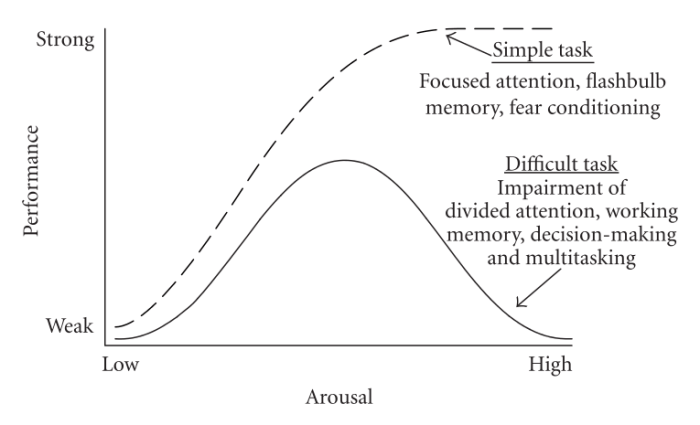
One of the more surprising findings from the study of human behavior under stress is the Yerkes-Dodson curve:

OriginalYerkesDodson
This curve shows how well humans perform at a given task, as a function of how high the stakes are on whether or not they do it properly.

For simple tasks, it says what most people intuitively expect—and what neoclassical economists appear to believe: As the stakes rise, the more highly incentivized you are to do it, and the better you do it.

But for complex tasks, it says something quite different: While increased stakes do raise performance to a point—with nothing at stake at all, people hardly work at all—it is possible to become too incentivized. Formally we say the curve is not monotonic; it has a local maximum.

This is one of many reasons why it’s ridiculous to say that top CEOs should make tens of millions of dollars a year on the rise and fall of their company’s stock price (as a great many economists do in fact say). Even if I believed that stock prices accurately reflect the company’s viability (they do not), and believed that the CEO has a great deal to do with the company’s success, it would still be a case of overincentivizing. When a million dollars rides on a decision, that decision is going to be worse than if the stakes had only been $100. With this in mind, it’s really not surprising that higher CEO pay is correlated with worse company performance. Stock options are terrible motivators, but do offer a subtle way of making wages adjust to the business cycle.

The reason for this is that as the stakes get higher, we become stressed, and that stress response inhibits our ability to use higher cognitive functions. The sympathetic nervous system evolved to make us very good at fighting or running away in the face of danger, which works well should you ever be attacked by a tiger. It did not evolve to make us good at complex tasks under high stakes, the sort of skill we’d need when calculating the trajectory of an errant spacecraft or disarming a nuclear warhead.

To be fair, most of us never have to worry about piloting errant spacecraft or disarming nuclear warheads—indeed, you’re about as likely to get attacked by a tiger even in today’s world. (The rate of tiger attacks in the US is just under 2 per year, and the rate of manned space launches in the US was about 5 per year until the Space Shuttle was terminated.)

There are certain professions, such as pilots and surgeons, where performing complex tasks under life-or-death pressure is commonplace, but only a small fraction of people take such professions for precisely that reason. And if you’ve ever wondered why we use checklists for pilots and there is discussion of also using checklists for surgeons, this is why—checklists convert a single complex task into many simple tasks, allowing high performance even at extreme stakes.

But we do have to do a fair number of quite complex tasks with stakes that are, if not urgent life-or-death scenarios, then at least actions that affect our long-term life prospects substantially. In my tutoring business I encounter one in particular quite frequently: Standardized tests.

Tests like the SAT, ACT, GRE, LSAT, GMAT, and other assorted acronyms are not literally life-or-death, but they often feel that way to students because they really do have a powerful impact on where you’ll end up in life. Will you get into a good college? Will you get into grad school? Will you get the job you want? Even subtle deviations from the path of optimal academic success can make it much harder to achieve career success in the future.

Of course, these are hardly the only examples. Many jobs require us to complete tasks properly on tight deadlines, or else risk being fired. Working in academia infamously requires publishing in journals in time to rise up the tenure track, or else falling off the track entirely. (This incentivizes the production of huge numbers of papers, whether they’re worth writing or not; yes, the number of papers published goes down after tenure, but is that a bad thing? What we need to know is whether the number of good papers goes down. My suspicion is that most if not all of the reduction in publications is due to not publishing things that weren’t worth publishing.)

So if you are faced with this sort of task, what can you do? If you realize that you are faced with a high-stakes complex task, you know your performance will be bad—which only makes your stress worse!

My advice is to pretend you’re betting five dollars on the outcome.

Ignore all other stakes, and pretend you’re betting five dollars. $5.00 USD. Do it right and you get a Lincoln; do it wrong and you lose one.
What this does is ensures that you care enough—you don’t want to lose $5 for no reason—but not too much—if you do lose $5, you don’t feel like your life is ending. We want to put you near that peak of the Yerkes-Dodson curve.

The great irony here is that you most want to do this when it is most untrue. If you actually do have a task for which you’ve bet $5 and nothing else rides on it, you don’t need this technique, and any technique to improve your performance is not particularly worthwhile. It’s when you have a standardized test to pass that you really want to use this—and part of me even hopes that people know to do this whenever they have nuclear warheads to disarm. It is precisely when the stakes are highest that you must put those stakes out of your mind.

Why five dollars? Well, the exact amount is arbitrary, but this is at least about the right order of magnitude for most First World individuals. If you really want to get precise, I think the optimal stakes level for maximum performance is something like 100 microQALY per task, and assuming logarithmic utility of wealth, $5 at the US median household income of $53,600 is approximately 100 microQALY. If you have a particularly low or high income, feel free to adjust accordingly. Literally you should be prepared to bet about an hour of your life; but we are not accustomed to thinking that way, so use $5. (I think most people, if asked outright, would radically overestimate what an hour of life is worth to them. “I wouldn’t give up an hour of my life for $1,000!” Then why do you work at $20 an hour?)

It’s a simple heuristic, easy to remember, and sometimes effective. Give it a try.

The possibilities of a global basic income

JDN 2457401

This post is sort of a Patreon Readers’ Choice; it had a tied score with the previous post. If ties keep happening, I may need to devise some new scheme, lest I end up writing so many Readers’ Choice posts I don’t have time for my own topics (I suppose there are worse fates).

The idea of a global basic income is one I have alluded to many times, but never directly focused on.

As I wrote this I realized it’s actually two posts. I have good news and bad news.
First, the good news.

A national basic income is a remarkably simple, easy policy to make: When the tax code comes around for revision that year, you get Congress to vote in a very large refundable credit, disbursed monthly, that goes to everyone—that is a basic income. To avoid ballooning the budget deficit, you would also want to eliminate a bunch of other deductions and credits, and might want to raise the tax rates as well—but these are all things that we have done before many times. Different administrations almost always add some deductions and remove others, raise some rates and lower others. By this simple intervention, we could end poverty in America immediately and forever. The most difficult part of this whole process is convincing a majority of both houses of Congress to support it. (And even that may not be as difficult as it seems, for a basic income is one of the few economic policies that appeals to both Democrats, Libertarians, and even some Republicans.)

Similar routine policy changes could be applied in other First World countries. A basic income could be established by a vote of Parliament in the UK, a vote of the Senate and National Assembly in France, a vote of the Riksdag in Sweden, et cetera; indeed, Switzerland is already planning a referendum on the subject this year. The benefits of a national basic income policy are huge, the costs are manageable, the implementation is trivial. Indeed, the hardest thing to understand about all of this is why we haven’t done it already.

But the benefits of a national basic income are of course limited to the nation(s) in which it is applied. If Switzerland votes in its proposal to provide $30,000 per person per year (that’s at purchasing power parity, but it’s almost irrelevant whether I use nominal or PPP figures, because Swiss prices are so close to US prices), that will help a lot of people in Switzerland—but it won’t do much for people in Germany or Italy, let alone people in Ghana or Nicaragua. It could do a little bit for other countries, if the increased income for the poor and lower-middle class results in increased imports to Switzerland. But Switzerland especially is a very small player in global trade. A US basic income is more likely to have global effects, because the US by itself accounts for 9% of the world’s exports and 13% of the world’s imports. Some nations, particularly in Latin America, depend almost entirely upon the US to buy their exports.

But even so, national basic incomes in the entire First World would not solve the problem of global poverty. To do that, we would need a global basic income, one that applies to every human being on Earth.

The first question to ask is whether this is feasible at all. Do we even have enough economic output in the world to do this? If we tried would we simply trigger a global economic collapse?

Well,if you divide all the world’s income, adjusted for purchasing power, evenly across all the world’s population, the result is about $15,000 per person per year. This is about the standard of living of the average (by which I mean median) person in Lebanon, Brazil, or Botswana. It’s a little better than the standard of living in China, South Africa, or Peru. This is about half of what the middle class of the First World are accustomed to, but it is clearly enough to not only survive, but actually make some kind of decent living. I think most people would be reasonably happy with this amount of income, if it were stable and secure—and by construction, the majority of the world’s population would be better off if all incomes were equalized in this way.

Of course, we can’t actually do that. All the means we have for redistributing income to that degree would require sacrificing economic efficiency in various ways. It is as if we were carrying water in buckets with holes in the bottom; the amount we give at the end is a lot less than the amount we took at the start.

Indeed, the efficiency costs of redistribution rise quite dramatically as the amount redistributed increases.

I have yet to see a convincing argument for why we could not simply tax the top 1% at a 90% marginal rate and use all of that income for public goods without any significant loss in economic efficiency—this is after all more or less what we did here in the United States in the 1960s, when we had a top marginal rate over 90% and yet per capita GDP growth was considerably higher than it is today. A great many economists seem quite convinced that taxing top incomes in this way would create some grave disincentive against innovation and productivity, yet any time anything like this has been tried such disincentives have conspicuously failed to emerge. (Why, it’s almost as if the rich aren’t that much smarter and more hard-working than we are!)

I am quite sure, on the other hand, that if we literally set up the tax system so that all income gets collected by the government and then doled out to everyone evenly, this would be economically disastrous. Under that system, your income is basically independent of the work you do. You could work your entire life to create a brilliant invention that adds $10 billion to the world economy, and your income would rise by… 0.01%, the proportion that your invention added to the world economy. Or you could not do that, indeed do nothing at all, be a complete drain upon society, and your income would be about $1.50 less each year. It’s not hard to understand why a lot of people might work considerably less hard in such circumstances; if you are paid exactly the same whether you are an entrepreneur, a software engineer, a neurosurgeon, a teacher, a garbage collector, a janitor, a waiter, or even simply a couch potato, it’s hard to justify spending a lot of time and effort acquiring advanced skills and doing hard work. I’m sure there are some people, particularly in creative professions such as art, music, and writing—and indeed, science—who would continue to work, but even so the garbage would not get picked up, the hamburgers would never get served, and the power lines would never get fixed. The result would be that trying to give everyone the same income would dramatically reduce the real income available to distribute, so that we all ended up with say $5,000 per year or even $1,000 per year instead of $15,000.

Indeed, absolute equality is worse than the system of income distribution under Soviet Communism, which still provided at least some incentives to work—albeit often not to work in the most productive or efficient way.

So let’s suppose that we only have the income of the top 1% to work with. It need not be literally that we take income only from the top 1%; we could spread the tax burden wider than that, and there may even be good reasons to do so. But I think this gives us a good back-of-the-envelope estimate of how much money we would realistically have to work with in funding a global basic income. It’s actually surprisingly hard to find good figures on the global income share of the top 1%; there’s one figure going around which is not simply wrong it’s ridiculous, claiming that the income threshold for the top 1% worldwide is only $34,000. Why is it ridiculous? Because the United States comprises 4.5% of the world’s population, and half of Americans make more money than that. This means that we already have at least 2% of the world’s population making at least that much, in the United States alone. Add in people from Europe, Japan, etc. and you easily find that this must be the income of about the top 5%, maybe even only the top 10%, worldwide. Exactly where it lies depends on the precise income distributions of various countries.

But here’s what I do know; the global Gini coefficient is about 0.40, and the US Gini coefficient is about 0.45; thus, roughly speaking, income inequality on a global scale recapitulates income inequality in the US. The top 1% in the US receive about 20% of the income. So let’s say that the top 1% worldwide probably also receive somewhere around 20% of the income. We were only using it to estimate the funds available for a basic income anyway.

This would mean that our basic income could be about $3,000 per person per year at purchasing power parity. That probably doesn’t sound like a lot, and I suppose it isn’t; but the UN poverty threshold is $2 per person per day, which is $730 per person per day. Thus, our basic income is over four times what it would take to eliminate global poverty by the UN threshold.

Now in fact I think that this threshold is probably too low; but is it four times too low? We are accustomed to such a high standard of living in the First World that it’s easy to forget that people manage to survive on far, far less than we have. I think in fact our problem here is not so much poverty per se as it is inequality and financial insecurity. We live in a state of “insecure affluence”; we have a great deal (think for a moment about your shelter, transportation, computer, television, running water, reliable electricity, abundant food—and if you are reading this you probably have all these things), but we constantly fear that we may lose it at any moment, and not without reason. (My family actually lost the house I grew up in as a result of predatory banking and the financial crisis.) We are taught all our lives that the only way to protect this abundance is by means of a hyper-competitive, winner-takes-allcutthroat capitalist economy that never lets us ever become comfortable in appreciating that abundance, for it could be taken from us at any time.

I think the apotheosis of what it is to live in insecure affluence is renting an apartment in LA or New York—you must have a great deal going for you to be able to live in the city at all, but you are a renter, an interloper; the apartment, like so much of your existence, is never fully secure, never fully yours. Perhaps the icing on the cake is if you’re doing it for grad school (as I was a year ago), this bizarre system in which we live near poverty for several years not in spite but because of the fact that we are so hard-working, intelligent and educated. (And it never ceases to baffle me that economists who lived through that can still believe in the Life-Cycle Spending Hypothesis.)

Being below the poverty line in a First World country is a kind of poverty, but it’s a very different kind than being below the poverty line in a Third World country. (I think we need a new term to distinguish it, and maybe “insecure affluence” or “economic insecurity” is the right one.) A national basic income could be set considerably higher than the global basic income (since we’re giving it to far fewer people), so we might actually be able to set $15,000 nationally—but to do that worldwide would use up literally all the money in the world.

Raising the minimum income worldwide to $3,000 per person per year would transform the lives of billions of people. It would, in a very real sense, end poverty, worldwide, immediately and forever.

And that’s the good news. Stay tuned for the bad news.

Why does nobody want to become a teacher?

JDN 2457366

The United States is currently suffering a large and growing shortage of qualified teachers, particularly in grades K-12. In some particular areas, this shortage is extremely acute; high schools are not able to teach some courses because there is simply no one qualified to teach them. Science and math teachers are in particularly high demand, because these programs are being expanded even as the people qualified to teach them are shifting over to working at the college level or in the private sector.

Other countries are also suffering severe teacher shortages, including the UK and several other countries in the EU.
The problem is projected to get worse: Enrollments in teacher training are rapidly declining. Meanwhile, because somewhere along the way people got convinced that the problem with education is that our teachers aren’t smart enough (this is completely, totally wrong by the way), standards for becoming a teacher are becoming ever more stringent, narrowing the pool even more.

This is a very serious problem, because education—often called “human capital investment” in economic jargon—is one of the most important investments any society can make. Indeed, it may be the most important, the one factor of production that is absolutely indispensable. If you run out of one raw material, you can make products out of something else. Manual labor can be replaced by machines. If you don’t have enough machines, you can build more. But if you find yourself without anyone who knows how to read and do arithmetic, how are you going to replace that? If we imagine a scenario like being trapped on a desert island or colonizing Mars where we have to start from scratch and we are only allowed to have one factor of production, education is the one we would want to have. (I guess if it’s Mars you do need a certain bare minimum of physical capital, like a spacesuit.)

The teacher shortage is most acute in high-poverty areas, where educational outcomes are terrible. Indeed, the most important cause of the failings of the US education system has always been poverty.

Why are teachers in poor schools so underqualified? Because their working conditions are terrible. Turnover is extremely high because teachers are underpaid, the schools are undersupplied, and their administrators do not support them.

Why are there so many teachers not qualified to teach their subjects? Because people who are qualified can find better jobs in other places. Jobs just as rewarding, that make just as large a contribution to society, which are more pleasant, offer more autonomy, and pay a lot better.

If you are an expert in physics, you could become a physicist and make a median income of $106,000.

If you are an expert in economics, you could become an economist and make a median income of $92,000.

If you are an expert in biology, you could become a biochemist and make a median income of $81,000.

Or, instead of all those things, you could become a high school teacher and make a median income of $55,000. Gee, I wonder which one you’re going to do?

Keep that in mind if it sounds ridiculous to you to pay teachers $100,000 salaries.

Even in wealthy schools, teachers are miserable; I have this on direct testimony from my father, who has taught high school in Ann Arbor for almost 20 years now. There are a lot of teachers who believe in making a difference through education, but quickly become burnt out and leave for better working conditions.

I know in my own case that I’m not planning on teaching high school, even though I know I’d be very good at it and I’ve always found teaching very rewarding. I’d actually be qualified to teach several subjects, from mathematics to social studies and even including physics and Latin. Any public school would be thrilled to have me—but probably not thrilled enough to pay me as much as I’d get from a university, international institution, or policy think-tank. So it’s hard for me to justify the career decision of going into public education.

The absolute highest-paid teacher in the Ann Arbor Public Schools is paid $109,000 gross—and Ann Arbor is one of the highest-paying school systems in the nation, and not coincidentally also one of the best. Most of the professors at the University of Michigan are paid over $100,000 gross and some are paid over $300,000. (As a public school, the University of Michigan releases all its salaries.)

So, you’re living in Ann Arbor… you have a graduate degree… you want to work in education; you could either start at $40,000 and maybe work your way up to $100,000 by teaching high school, or you could start at $100,000 and maybe work your way up to $300,000 by teaching college. (Admittedly, to teach in college you generally also need to do research work and probably get a PhD; so it’s not quite an equal comparison. But the most-qualified educators would be good at either job.)

Economics, along with most science and math fields, pays particularly well outside education. This senior economist position at the World Bank pays at grade GG, which is a minimum starting net salary of $102,000.
How can we solve our teacher shortage? It’s really quite simple: Offer higher salaries for teachers. If you want the best-qualified people in your classrooms, you must pay salaries that attract the best-qualified people. If you pay substandard salaries, you’re going to attract substandard talent. “Those who can, do; those who can’t, teach” isn’t a law of nature; it’s a result of public policy decisions to keep teachers systematically underpaid.

Most of the time when people say “It’s just ECON 101”, they don’t actually understand economics very well and likely have not actually taken ECON 101. But this really basically is a question of ECON 101: Supply and demand. If you have a shortage of something, not enough people willing to produce it compared to the number of people who want to buy it, you must raise the price.

Would that be expensive? Yes it would. Doubling the salary of every teacher would raise total spending on education by about 75%, because teacher compensation is about three-quarters of education spending. This would raise US K-12 education spending from about $600 billion per year to more like $1.05 trillion per year, an additional $450 billion per year in public spending, or a little less than $1,500 per American per year. That is not a small amount of money; indeed, it’s about three times what we’d need to end world hunger. And this is actually an underestimate, since we also hope to hire more teachers and should also improve facilities while we’re at it. So a truly comprehensive educational reform project could very well double our total spending on K-12 education to $1.2 trillion.

And if you want to go up there on a podium and actually tell people, “It would be nice to improve our educational system, but we simply can’t afford to do it without raising taxes unreasonably high!” then that is absolutely a reasonable argument to make. There are always tradeoffs in life. At some point, maybe it really isn’t worth spending an extra million dollars to educate one more child. (Is it worth an extra million dollars to educate two more children? Based on net present value of earnings, yes. And frankly I don’t think net present value of earnings even gets close to assessing the true value of an education; it’s a very weak lower bound.)

But I am sick and tired of people saying “Education is our highest priority!” and then refusing to actually spend the money it would take to improve our educational system. This is not a question of “finding solutions”; we know what to do. Raise teacher salaries. Improve schools. Buy new textbooks. People just aren’t willing to actually pony up the cash to do it. They want an easy way out, some simple way of making education better that somehow won’t cost anything. But we’ve been searching for that for awhile now—don’t you think we’d have found it by now?

Means, medians, and inequality denial

JDN 2457324 EDT 21:45

You may have noticed a couple of big changes in the blog today. The first is that I’ve retitled it “Human Economics” to emphasize the positive, and the second is that I’ve moved it to my domain http://patrickjuli.us which is a lot shorter and easier to type. I’ll be making two bite-sized posts a week, just as I have been piloting for the last few weeks.

Earlier today I was dismayed to see a friend link to this graph by the American Enterprise Institute (a well-known Libertarian think-tank):

middleclass1

Look! The “above $100,000” is the only increasing category! That means standard of living in the US is increasing! There’s no inequality problem!

The AEI has an agenda to sell you, which is that the free market is amazing and requires absolutely no intervention, and government is just a bunch of big bad meanies who want to take your hard-earned money and give it away to lazy people. They chose very carefully what data to use for this plot in order to make it look like inequality isn’t increasing.

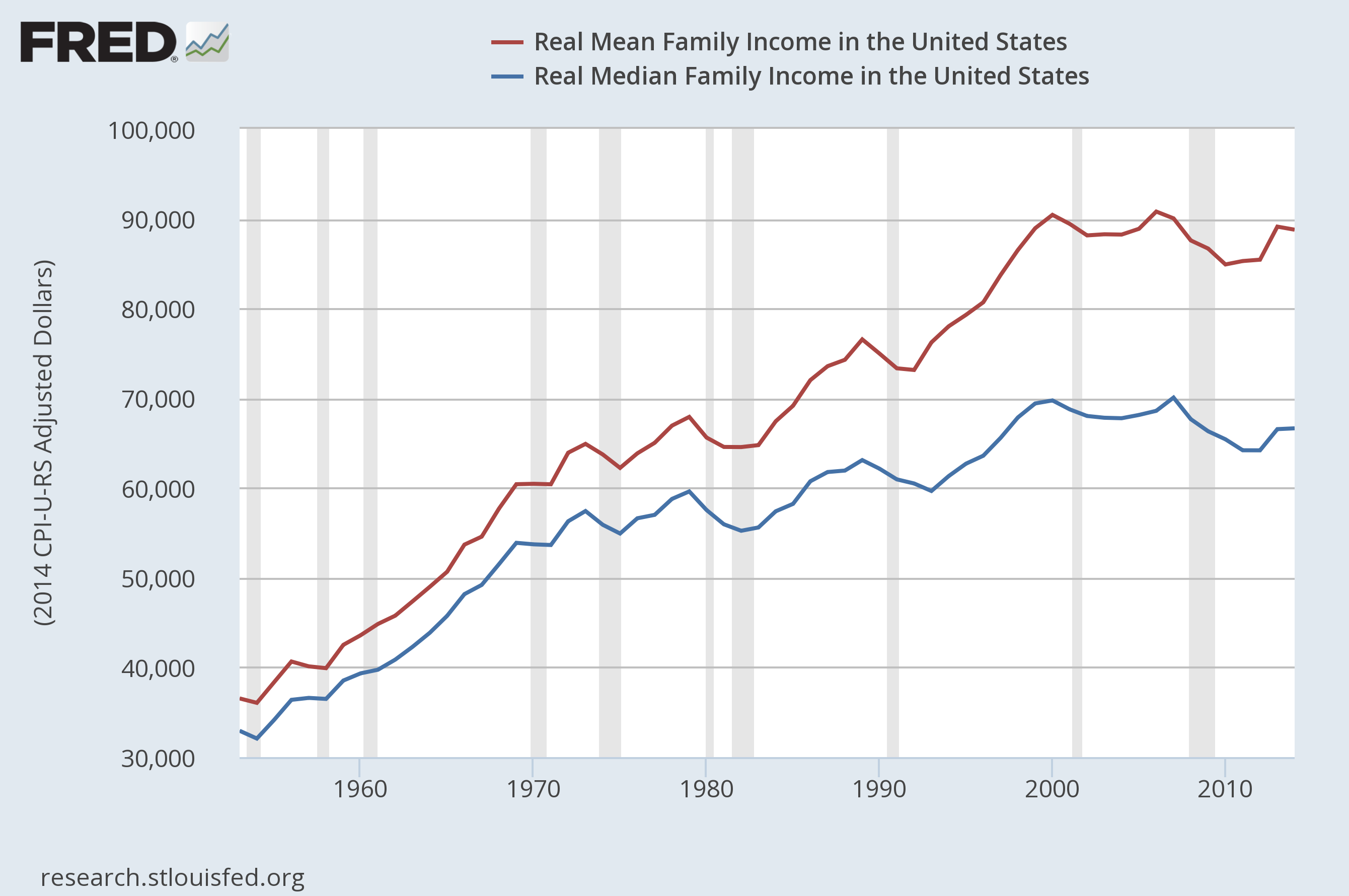
Here’s a more impartial way of looking at the situation, the most obvious, pre-theoretical way of looking at inequality: What has happened to mean income versus median income?

As a refresher from intro statistics, the mean is what you get by adding up the total money and dividing by the number of people; the median is what a person in the exact middle has. So for example if there are three people in a room, one makes $20,000, the second makes $50,000, and the third is Bill Gates making $10,000,000,000, then the mean income is $3,333,333,356 but the median income is $50,000. In a distribution similar to the power-law distribution that incomes generally fall into, the mean is usually higher than the median, and how much higher is a measure of how much inequality there is. (In my example, the mean is much higher, because there’s huge inequality with Bill Gates in the room.) This confuses people, because when people say “the average”, they usually intend the mean; but when they say “the average person”, they usually intend the median. The average person in my three-person example makes $50,000, but the average income is $3.3 billion.

So if we look at mean income versus median income in the US over time, this is what we see:

median_mean

In 1953, mean household income was $36,535 and median household income was $32,932. Mean income was therefore 10.9% higher than median income.

In 2013, mean household income was $88,765 and median income was $66,632. Mean household income was therefore 33.2% higher than median income.

That, my dear readers, is a substantial increase in inequality. To be fair, it’s also a substantial increase in standard of living; these figures are already adjusted for inflation, so the average family really did see their standard of living roughly double during that period.

But this also isn’t the whole story.

First, notice that real median household income is actually about 5% lower now than it was in 2007. Real mean household income is also lower than its peak in 2006, but only by about 2%. This is why in a real sense we are still in the Second Depression; income for most people has not retained its pre-recession peak.

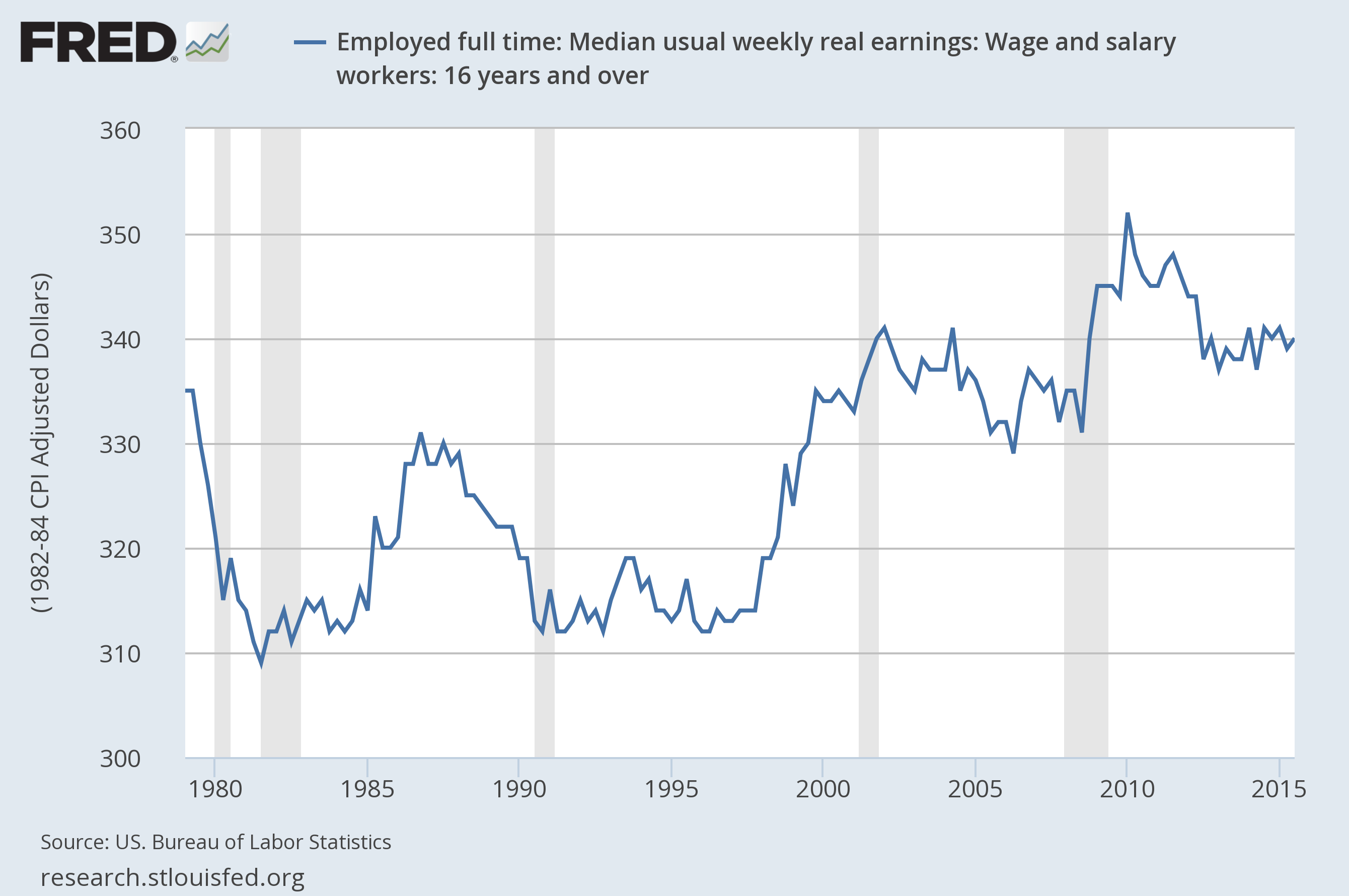
Furthermore, real median earnings for full-time employees have not meaningfully increased over the last 35 years; in 1982 dollars, they were $335 in 1979 and they are $340 now:

median_earnings

At first I thought this was because people were working more hours, but that doesn’t seem to be true; average weekly hours of work have fallen from 38.2 to 33.6:

weekly_hours

The main reason seems to be actually that women are entering the workforce, so more households have multiple full-time incomes; while only 43% of women were in the labor force in 1970, almost 57% are now.

women_labor_force

I must confess to a certain confusion on this point, however, as the difference doesn’t seem to be reflected in any of the measures of personal income. Median personal income was about 41% of median family income in 1974, and now it’s about 43%. I’m not sure exactly what’s going on here.

personal_household

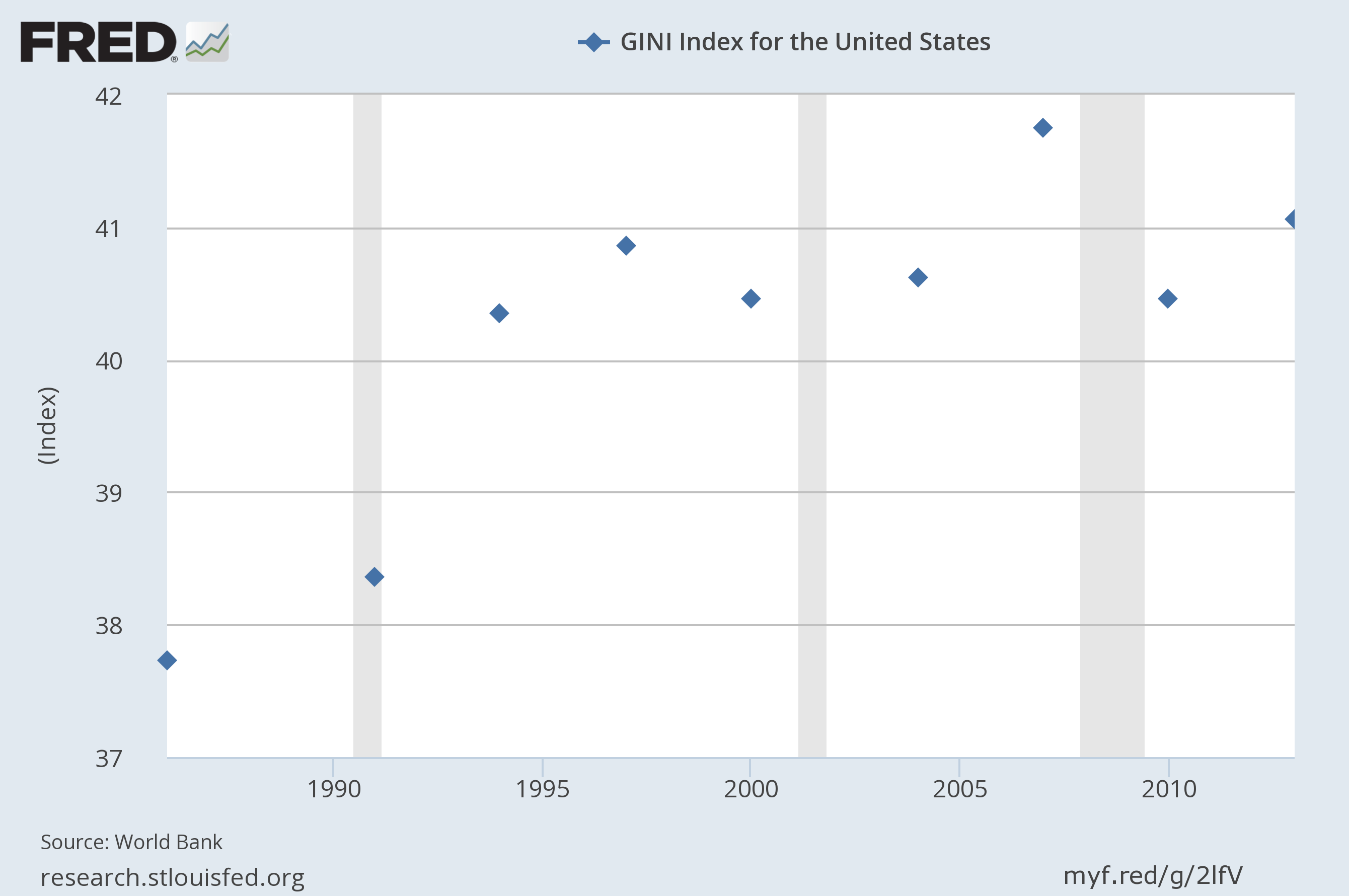
The Gini index, a standard measure of income inequality, is only collected every few years, yet shows a clear rising trend from 37% in 1986 to 41% in 2013:

GINI

But perhaps the best way to really grasp our rising inequality is to look at the actual proportions of income received by each portion of the population.

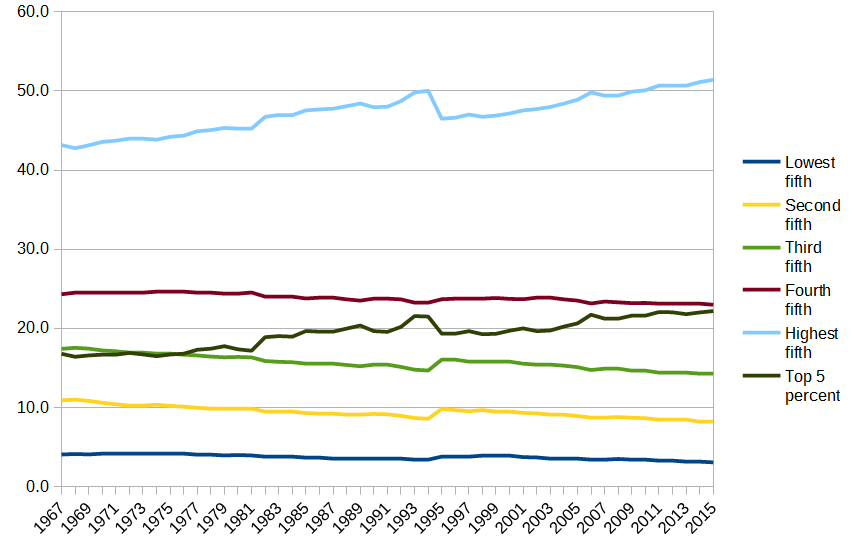
This is what it looks like if you use US Census data, broken down by groups of 20% and the top 5%; notice how since 1977 the top 5% have taken in more than the 40%-60% bracket, and they are poised to soon take in more than the 60%-80% bracket as well:

income_quintiles

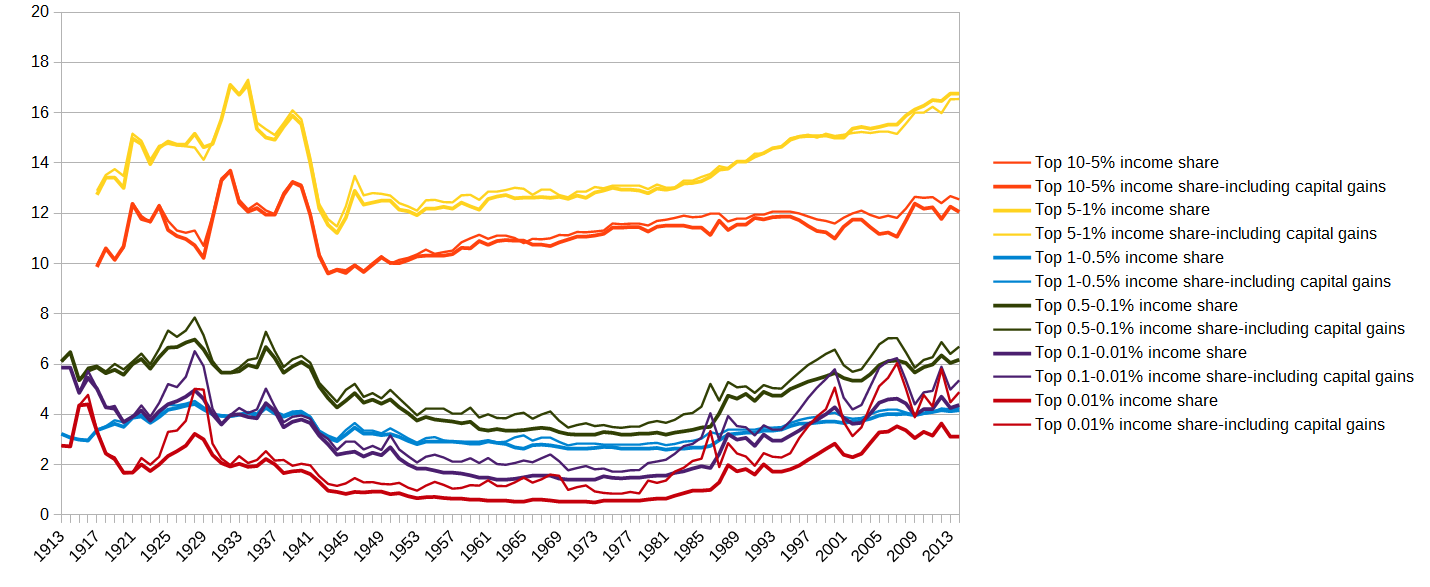
The result is even more striking if you use the World Top Incomes Database. You can watch the share of income rise for the top 10%, 5%, 1%, 0.1%, and 0.01%:

top_income_shares

But in fact it’s even worse than it sounds. What I’ve just drawn double-counts a lot of things; it includes the top 0.01% in the top 0.1%, which is in turn included in the top 1%, and so on. If you exclude these, so that we’re only looking at the people in the top 10% but not the top 5%, the people in the top 5% but not the top 1%, and so on, something even more disturbing happens:

top_income_shares_adjusted

While the top 10% does see some gains, the top 5% gains faster, and the gains accrue even faster as you go up the chain.

Since 1970, the top 10%-5% share grew 10%. The top 0.01% share grew 389%.

Year

Top 10-5% share

Top 10-5% share incl. cap. gains

Top 5-1% share

Top 5-1% share incl cap. gains

Top 1-0.5% share

Top 1-0.5% share incl. cap. gains

Top 0.5-0.1% share

Top 0.5-0.1% share incl. cap. gains

Top 0.1-0.01% share

Top 0.1-0.01% share incl. cap. gains

Top 0.01% share

Top 0.01% share incl. cap. gains

1970

11.13

10.96

12.58

12.64

2.65

2.77

3.22

3.48

1.41

1.78

0.53

1

2014

12.56

12.06

16.78

16.55

4.17

4.28

6.18

6.7

4.38

5.36

3.12

4.89

Relative gain

12.8%

10.0%

33.4%

30.9%

57.4%

54.5%

91.9%

92.5%

210.6%

201.1%

488.7%

389.0%

To be clear, these are relative gains in shares. Including capital gains, the share of income received by the top 10%-5% grew from 10.96% to 12.06%, a moderate increase. The share of income received by the top 0.01% grew from 1.00% to 4.89%, a huge increase. (Yes, the top 0.01% now receive almost 5% of the income, making them on average almost 500 times richer than the rest of us.)

The pie has been getting bigger, which is a good thing. But the rich are getting an ever-larger piece of that pie, and the piece the very rich get is expanding at an alarming rate.

It’s certainly a reasonable question what is causing this rise in inequality, and what can or should be done about it. By people like the AEI try to pretend it doesn’t even exist, and that’s not economic policy analysis; that’s just plain denial.

What’s wrong with academic publishing?

JDN 2457257 EDT 14:23.

I just finished expanding my master’s thesis into a research paper that is, I hope, suitable for publication in an economics journal. As part of this process I’ve been looking into the process of submitting articles for publication in academic journals… and I’ve found has been disgusting and horrifying. It is astonishingly bad, and my biggest question is why researchers put up with it.

Thus, the subject of this post is what’s wrong with the system—and what we might do instead.

Before I get into it, let me say that I don’t actually disagree with “publish or perish” in principle—as SMBC points out, it’s a lot like “do your job or get fired”. Researchers should publish in peer-reviewed journals; that’s a big part of what doing research means. The problem is how most peer-reviewed journals are currently operated.

First of all, in case you didn’t know, most scientific journals are owned by for-profit corporations. The largest corporation Elsevier, owns The Lancet and all of ScienceDirect, and has net income of over 1 billion Euros a year. Then there’s Springer and Wiley-Blackwell; between the three of them, these publishers account for over 40% of all scientific publications. These for-profit publishers retain the full copyright to most of the papers they publish, and tightly control access with paywalls; the cost to get through these paywalls is generally thousands of dollars a year for individuals and millions of dollars a year for universities. Their monopoly power is so great it “makes Rupert Murdoch look like a socialist.”

For-profit journals do often offer an “open-access” option in which you basically buy back your own copyright, but the price is high—the most common I’ve seen are $1800 or $3000 per paper—and very few researchers do this, for obvious financial reasons. In fact I think for a full-time tenured faculty researcher it’s probably worth it, given the alternatives. (Then again, full-time tenured faculty are becoming an endangered species lately; what might be worth it in the long run can still be very difficult for a cash-strapped adjunct to afford.) Open-access means people can actually read your paper and potentially cite your paper. Closed-access means it may languish in obscurity.

And of course it isn’t just about the benefits for the individual researcher. The scientific community as a whole depends upon the free flow of information; the reason we publish in the first place is that we want people to read papers, discuss them, replicate them, challenge them. Publication isn’t the finish line; it’s at best a checkpoint. Actually one thing that does seem to be wrong with “publish or perish” is that there is so much pressure for publication that we publish too many pointless papers and nobody has time to read the genuinely important ones.

These prices might be justifiable if the for-profit corporations actually did anything. But in fact they are basically just aggregators. They don’t do the peer-review, they farm it out to other academic researchers. They don’t even pay those other researchers; they just expect them to do it. (And they do! Like I said, why do they put up with this?) They don’t pay the authors who have their work published (on the contrary, they often charge submission fees—about $100 seems to be typical—simply to look at them). It’s been called “the world’s worst restaurant”, where you pay to get in, bring your own ingredients and recipes, cook your own food, serve other people’s food while they serve yours, and then have to pay again if you actually want to be allowed to eat.

They pay for the printing of paper copies of the journal, which basically no one reads; and they pay for the electronic servers that host the digital copies that everyone actually reads. They also provide some basic copyediting services (copyediting APA style is a job people advertise on Craigslist—so you can guess how much they must be paying).

And even supposing that they actually provided some valuable and expensive service, the fact would remain that we are making for-profit corporations the gatekeepers of the scientific community. Entities that exist only to make money for their owners are given direct control over the future of human knowledge. If you look at Cracked’s “reasons why we can’t trust science anymore”, all of them have to do with the for-profit publishing system. p-hacking might still happen in a better system, but publishers that really had the best interests of science in mind would be more motivated to fight it than publishers that are simply trying to raise revenue by getting people to buy access to their papers.

Then there’s the fact that most journals do not allow authors to submit to multiple journals at once, yet take 30 to 90 days to respond and only publish a fraction of what is submitted—it’s almost impossible to find good figures on acceptance rates (which is itself a major problem!), but the highest figures I’ve seen are 30% acceptance, a more typical figure seems to be 10%, and some top journals go as low as 3%. In the worst-case scenario you are locked into a journal for 90 days with only a 3% chance of it actually publishing your work. At that rate publishing an article could take years.

Is open-access the solution? Yes… well, part of it, anyway.

There are a large number of open-access journals, some of which do not charge submission fees, but very few of them are prestigious, and many are outright predatory. Predatory journals charge exorbitant fees, often after accepting papers for publication; many do little or no real peer review. There are almost seven hundred known predatory open-access journals; over one hundred have even been caught publishing hoax papers. These predatory journals are corrupting the process of science.

There are a few reputable open-access journals, such as BMC Biology and PLOSOne. Though not actually a journal, ArXiv serves a similar role. These will be part of the solution, most definitely. Yet even legitimate open-access journals often charge each author over $1000 to publish an article. There is a small but significant positive correlation between publication fees and journal impact factor.

We need to found more open-access journals which are funded by either governments or universities, so that neither author nor reader ever pays a cent. Science is a public good and should be funded as such. Even if copyright makes sense for other forms of content (I’m not so sure about that), it most certainly does not make sense for scientific knowledge, which by its very nature is only doing its job if it is shared with the world.

These journals should be specifically structured to be method-sensitive but results-blind. (It’s a very good thing that medical trials are usually registered before they are completed, so that publication is assured even if the results are negative—the same should be done with other sciences. Unfortunately, even in medicine there is significant publication bias.) If you could sum up the scientific method in one phrase, it might just be that: Method-sensitive but results-blind. If you think you know what you’re going to find beforehand, you may not be doing science. If you are certain what you’re going to find beforehand, you’re definitely not doing science.

The process should still be highly selective, but it should be possible—indeed, expected—to submit to multiple journals at once. If journals want to start paying their authors to entice them to publish in that journal rather than take another offer, that’s fine with me. Researchers are the ones who produce the content; if anyone is getting paid for it, it should be us.

This is not some wild and fanciful idea; it’s already the way that book publishing works. Very few literary agents or book publishers would ever have the audacity to say you can’t submit your work elsewhere; those that try are rapidly outcompeted as authors stop submitting to them. It’s fundamentally unreasonable to expect anyone to hang all their hopes on a particular buyer months in advance—and that is what you are, publishers, you are buyers. You are not sellers, you did not create this content.

But new journals face a fundamental problem: Good researchers will naturally want to publish in journals that are prestigious—that is, journals that are already prestigious. When all of the prestige is in journals that are closed-access and owned by for-profit companies, the best research goes there, and the prestige becomes self-reinforcing. Journals are prestigious because they are prestigious; welcome to tautology club.

Somehow we need to get good researchers to start boycotting for-profit journals and start investing in high-quality open-access journals. If Elsevier and Springer can’t get good researchers to submit to them, they’ll change their ways or wither and die. Research should be funded and published by governments and nonprofit institutions, not by for-profit corporations.

This may in fact highlight a much deeper problem in academia, the very concept of “prestige”. I have no doubt that Harvard is a good university, better university than most; but is it actually the best as it is in most people’s minds? Might Stanford or UC Berkeley be better, or University College London, or even the University of Michigan? How would we tell? Are the students better? Even if they are, might that just be because all the better students went to the schools that had better reputations? Controlling for the quality of the student, more prestigious universities are almost uncorrelated with better outcomes. Those who get accepted to Ivies but attend other schools do just as well in life as those who actually attend Ivies. (Good news for me, getting into Columbia but going to Michigan.) Yet once a university acquires such a high reputation, it can be very difficult for it to lose that reputation, and even more difficult for others to catch up.

Prestige is inherently zero-sum; for me to get more prestige you must lose some. For one university or research journal to rise in rankings, another must fall. Aside from simply feeding on other prestige, the prestige of a university is largely based upon the students it rejects—its “selectivity” score. What does it say about our society that we value educational institutions based upon the number of people they exclude?

Zero-sum ranking is always easier to do than nonzero-sum absolute scoring. Actually that’s a mathematical theorem, and one of the few good arguments against range voting (still not nearly good enough, in my opinion); if you have a list of scores you can always turn them into ranks (potentially with ties); but from a list of ranks there is no way to turn them back into scores.

Yet ultimately it is absolute scores that must drive humanity’s progress. If life were simply a matter of ranking, then progress would be by definition impossible. No matter what we do, there will always be top-ranked and bottom-ranked people.

There is simply no way mathematically for more than 1% of human beings to be in the top 1% of the income distribution. (If you’re curious where exactly that lies today, I highly recommend this interactive chart by the New York Times.) But we could raise the standard of living for the majority of people to a level that only the top 1% once had—and in fact, within the First World we have already done this. We could in fact raise the standard of living for everyone in the First World to a level that only the top 1%—or less—had as recently as the 16th century, by the simple change of implementing a basic income.

There is no way for more than 0.14% of people to have an IQ above 145, because IQ is defined to have a mean of 100 and a standard deviation of 15, regardless of how intelligent people are. People could get dramatically smarter over timeand in fact have—and yet it would still be the case that by definition, only 0.14% can be above 145.

Similarly, there is no way for much more than 1% of people to go to the top 1% of colleges. There is no way for more than 1% of people to be in the highest 1% of their class. But we could increase the number of college degrees (which we have); we could dramatically increase literacy rates (which we have).

We need to find a way to think of science in the same way. I wouldn’t suggest simply using number of papers published or even number of drugs invented; both of those are skyrocketing, but I can’t say that most of the increase is actually meaningful. I don’t have a good idea of what an absolute scale for scientific quality would look like, even at an aggregate level; and it is likely to be much harder still to make one that applies on an individual level.

But I think that ultimately this is the only way, the only escape from the darkness of cutthroat competition. We must stop thinking in terms of zero-sum rankings and start thinking in terms of nonzero-sum absolute scales.