So what can we actually do about sweatshops?

JDN 2457489

(The topic of this post was chosen by a vote of my Patreons.) There seem to be two major camps on most political issues: One camp says “This is not a problem, stop worrying about it.” The other says “This is a huge problem, it must be fixed right away, and here’s the easy solution.” Typically neither of these things is true, and the correct answer is actually “This is a huge problem, well worth fixing—but we need to do a lot of work to figure out exactly how.”

Sweatshop labor is a very good example of this phenomenon.

Camp A is represented here by the American Enterprise Institute, which even goes as far as to defend child labor on the grounds that “we used to do it before”. (Note that we also used to do slavery before. Also protectionism, but of course AEI doesn’t think that was good. Who needs logical consistency when you have ideological purity?) The College Conservative uses ECON 101 to defend sweatshops, perhaps not realizing that economics courses continue past ECON 101.

Camp B is represented here by Buycott, telling us to buy “made in the USA” products and boycott all companies that use sweatshops. Other commonly listed strategies include buying used clothes (I mean, there may be some ecological benefits to this, but clearly not all clothes can be used clothes) and “buy union-made” which is next to impossible for most products. Also in this camp is LaborVoices, a Silicon Valley tech company that seems convinced they can somehow solve the problem of sweatshops by means of smartphone apps, because apparently Silicon Valley people believe that smartphones are magical and not, say, one type of product that performs services similar to many other pre-existing products but somewhat more efficiently. (This would also explain how Uber can say with a straight face that they are “revolutionary” when all they actually do is mediate unlicensed taxi services, and Airbnb is “innovative” because it makes it slightly more convenient to rent out rooms in your home.)

Of course I am in that third camp, people who realize that sweatshops—and exploitative labor practices in general—are a serious problem, but a very complex and challenging one that does not have any easy, obvious solutions.

One thing we absolutely cannot do is return to protectionism or get American consumers to only buy from American companies (a sort of “soft protectionism” by social construction). This would not only be inefficient for us—it would be devastating for people in Third World countries. Sweatshops typically provide substantially better living conditions than the alternatives available to their workers.

Yet this does not mean that sweatshops are morally acceptable or should simply be left alone, contrary to the assertions of many economists—most famously Benjamin Powell. Anyone who doubts this must immediately read “Wrongful Beneficence” by Chris Meyers; the mere fact that an act benefits someone –or even everyone—does not prove that the act was morally acceptable. If someone is starving to death and you offer them bread in exchange for doing whatever you want them to do for the next year, you are benefiting them, surely—but what you are doing is morally wrong. And this is basically what sweatshops are; they provide survival in exchange for exploitation.

It can be remarkably difficult to even tell which companies are using sweatshops—and this is by design. While in response to public pressure corporations often try to create the image of improving their labor standards, they seem quite averse to actually improving labor standards, and even more averse to establishing systems of enforcement to make those labor standards followed consistently. Almost no sweatshops are directly owned by the retailers whose products they make; instead there is a chain of outsourced vendors and distributors, a chain that creates diffusion of responsibility and plausible deniability. When international labor organizations do get the chance to investigate the labor conditions of factories operated by multinational corporations, they invariably find that regulations are more honored in the breach than the observance.

So, what would a long-run solution to sweatshops look like? In a word: Development. The only sustainable solution to oppressive labor conditions is a world where everyone is healthy enough, educated enough, and provided with enough resources that their productivity is at a First World level; furthermore it is a world where workers have enough bargaining power that they are actually paid according to that productivity. (The US has lately been finding out what happens if you do the former but not the latter—the result is that you generate an enormous amount of wealth, but it all ends up in the hands of the top 0.1%. Yet it is quite possible to do the latter, as Denmark has figured out, #ScandinaviaIsBetter.)

To achieve this, we need more factories in Third World countries, not fewer—more investment, not less. We need to buy more of China’s exports, hire more factory workers in Bangladesh.

But it’s not enough to provide incentives to build factories—we must also provide incentives to give workers at those factories more bargaining power.

To see how we can pull this off, I offer a case study of a (qualified) success: Nike.

In the 1990s, Nike’s subcontractors had some of the worst labor conditions in the shoe industry. Today, they actually have some of the best. How did that happen?

It began with people noticing a problem—activists and investigative journalists documented the abuses in Nike’s factories. They drew public attention, which undermined Nike’s efforts at mass advertising (which was basically their entire business model—their shoes aren’t actually especially good). They tried to clean up their image with obviously biased reports, which triggered a backlash. Finally Nike decides to actually do something about the problem, and actually becomes a founding member of the Fair Labor Association. They establish new labor standards, and they audit regularly to ensure that those standards are being complied with. Today they publish an annual corporate social responsibility report that actually appears to be quite transparent and accurate, showing both the substantial improvements that have been made and the remaining problems. Activist campaigns turned Nike around almost completely.

In short, consumer pressure led to private regulation. Many development economists are increasingly convinced that this is what we need—we must put pressure on corporations to regulate themselves.

The pressure is a key part of this process; Willem Buiter wasn’t wrong when he quipped that “self-regulation stands in relation to regulation the way self-importance stands in relation to importance and self-righteousness to righteousness.” For any regulation to work, it must have an enforcement mechanism; for private regulation to work, that enforcement mechanism comes from the consumers.

Yet even this is not enough, because there are too many incentives for corporations to lie and cheat if they only have to be responsive to consumers. It’s unreasonable to expect every consumer to take the time—let alone have the expertise—to perform extensive research on the supply chain of every corporation they buy a product from. I also think it’s unreasonable to expect most people to engage in community organizing or shareholder activism as Green America suggests, though it certainly wouldn’t hurt if some did. But there are just too many corporations to keep track of! Like it or not, we live in a globalized capitalist economy where you almost certainly buy from a hundred different corporations over the course of a year.

Instead we need governments to step up—and the obvious choice is the government of the United States, which remains the world’s economic and military hegemon. We should be pressuring our legislators to make new regulations on international trade that will raise labor standards around the globe.

Note that this undermines the most basic argument corporations use against improving their labor standards: “If we raise wages, we won’t be able to compete.” Not if we force everyone to raise wages, around the globe. “If it’s cheaper to build a factory in Indonesia, why shouldn’t we?” It won’t be cheaper, unless Indonesia actually has a real comparative advantage in producing that product. You won’t be able to artificially hold down your expenses by exploiting your workers—you’ll have to actually be more efficient in order to be more profitable, which is how capitalism is supposed to work.

There’s another argument we often hear that is more legitimate, which is that raising wages would also force corporations to raise prices. But as I discussed in a previous post on this subject, the amount by which prices would need to rise is remarkably small, and nowhere near large enough to justify panic about dangerous global inflation. Paying 10% or even 20% more for our products is well worth it to reduce the corruption and exploitation that abuses millions of people—a remarkable number of them children—around the globe. Also, it doesn’t take a mathematical savant to realize that if increasing wages by a factor of 10 only increases prices by 20%, workers will in fact be better off.

Where would all that extra money come from? Now we come to the real reason why corporations don’t want to raise their labor standards: It would come from profits. Right now profits are extraordinarily large, much larger than they have any right to be in a fair market. It was recently estimated that 74% of billionaire wealth comes from economic rent—that is to say, from deception, exploitation, and market manipulation, rather than actual productivity. (There’s a lot of uncertainty in this estimate; the true figure is probably somewhere between 50% and 90%—it’s almost certainly a majority, and could be the vast majority.) In fact, I really shouldn’t say “money”, which we can just print; what we really want to know is where the extra wealth would come from to give that money value. But by paying workers more, improving their standard of living, and creating more consumer demand, we would in fact dramatically increase the amount of real wealth in the world.

So, we need regulations to improve global labor standards. But we must first be clear: What should these regulations say?

First, we must rule out protectionist regulations that would give unfair advantages to companies that produce locally. These would only result in economic inefficiency at best, and trade wars throwing millions back into poverty at worst. (Some advantage makes sense to internalize the externalities of shipping, but really that should be created by a carbon tax, not by trade tariffs. It’s a lot more expensive and carbon-intensive to ship from Detroit to LA than from Detroit to Windsor, but the latter is the “international” trade.)

Second, we should not naively assume that every country should have the same minimum wage. (I am similarly skeptical of Hillary Clinton’s proposal to include people with severe mental or physical disabilities in the US federal minimum wage; I too am concerned about people with disabilities being exploited, but the fact is many people with severe disabilities really aren’t as productive, and it makes sense for wages to reflect that.) If we’re going to have minimum wages at all—basic income and wage subsidies both make a good deal more sense than a hard price floor; see also my earlier post on minimum wage—they should reflect the productivity and prices of the region. I applaud California and New York for adopting $15 minimum wages, but I’d be a bit skeptical of doing the same in Mississippi, and adamantly opposed to doing so in Bangladesh.

It may not even be reasonable to expect all countries to have the same safety standards; workers who are less skilled and in more dire poverty may rationally be willing to accept more risk to remain employed, rather than laid off because their employer could not afford to meet safety standards and still pay them a sufficient wage. For some safety standards this is ridiculous; making sufficiently many exits with doors that swing outward and maintaining smoke detectors are not expensive things to do. (And yet factories in Bangladesh often fail to meet such basic requirements, which kills hundreds of workers each year.) But other safety standards may be justifiably relaxed; OSHA compliance in the US costs about $70 billion per year, about $200 per person, which many countries simply couldn’t afford. (On the other hand, OSHA saves thousands of lives, does not increase unemployment, and may actually benefit employers when compared with the high cost of private injury lawsuits.) We should have expert economists perform careful cost-benefit analyses of proposed safety regulations to determine which ones are cost-effective at protecting workers and which ones are too expensive to be viable.

While we’re at it, these regulations should include environmental standards, or a global carbon tax that’s used to fund climate change mitigation efforts around the world. Here there isn’t much excuse for not being strict; pollution and environmental degradation harms the poor the most. Yes, we do need to consider the benefits of production that is polluting; but we have plenty of profit incentives for that already. Right now the balance is clearly tipped far too much in favor of more pollution than the optimum rather than less. Even relatively heavy-handed policies like total bans on offshore drilling and mountaintop removal might be in order; in general I’d prefer to tax rather than ban, but these activities are so enormously damaging that if the choice is between a ban and doing nothing, I’ll take the ban. (I’m less convinced of this with regard to fracking; yes, earthquakes and polluted groundwater are bad—but are they Saudi Arabia bad? Because buying more oil from Saudi Arabia is our leading alternative.)

It should go without saying (but unfortunately it doesn’t seem to) that our regulations must include an absolute zero-tolerance policy for forced labor. If we find out that a company is employing forced labor, they should have to not only free every single enslaved worker, but pay each one a million dollars (PPP 2005 chained CPI of course). If they can’t do that and they go bankrupt, good riddance; remind me to play them the world’s saddest song on the world’s tiniest violin. Of course, first we need to find out, which brings me to the most important point.

Above all, these regulations must be enforced. We could start with enforceable multilateral trade agreements, where tariff reductions are tied to human rights and labor standards. This is something the President of the United States could do, right now, as an addendum to the Trans-Pacific Partnership. (What he should have done is made the TPP contingent on this, but it’s too late for that.) Future trade agreements should include these as a matter of course.If countries want to reap the benefits of free trade, they must be held accountable for sharing those benefits equitably with their people.

But ultimately we should not depend upon multilateral agreements between nations—we need truly international standards with global enforcement. We should empower the International Labor Organization to enact sanctions and inspections (right now it mostly enacts suggestions which are promptly and dutifully ignored), and possibly even to arrest executives for trial at the International Criminal Court. We should double if not triple or quadruple their funding—and if member nations will not pay this voluntarily, we should make them—the United Nations should be empowered to collect taxes in support of global development, which should be progressive with per-capita GDP. Coercion, you say? National sovereignty, you say? Millions of starving little girls is my reply.

Right now, the ability of multinational corporations to move between countries to find the ones that let them pay the least have created a race to the floor; it’s time for us to raise that floor.

What can you yourself do, assuming you’re not a head of state? (If you are, I’m honored. Also, any openings on your staff?) Well, you can vote—and you can use that vote to put pressure on your legislators to support these kinds of polices. There are also some other direct actions you can take that I discussed in a previous post; but mainly what we need is policy. Consumer pressure and philanthropy are good, and by all means, don’t stop; but to really achieve global justice we will need nothing short of global governance.

What can we do to make the world a better place?

JDN 2457475

There are an awful lot of big problems in the world: war, poverty, oppression, disease, terrorism, crime… I could go on for awhile, but I think you get the idea. Solving or even mitigating these huge global problems could improve or even save the lives of millions of people.

But precisely because these problems are so big, they can also make us feel powerless. What can one person, or even a hundred people, do against problems on this scale?

The answer is quite simple: Do your share.

No one person can solve any of these problems—not even someone like Bill Gates, though he for one at least can have a significant impact on poverty and disease because he is so spectacularly mind-bogglingly rich; the Gates Foundation has a huge impact because it has as much wealth as the annual budget of the NIH.

But all of us together can have an enormous impact. This post today is about helping you see just how cheap and easy it would be to end world hunger and cure poverty-related diseases, if we simply got enough people to contribute.

The Against Malaria Foundation releases annual reports for all their regular donors. I recently got a report that my donations personally account for 1/100,000 of their total assets. That’s terrible. The global population is 7 billion people; in the First World alone it’s over 1 billion. I am the 0.01%, at least when it comes to donations to the Against Malaria Foundation.

I’ve given them only $850. Their total assets are only $80 million. They shouldn’t have $80 million—they should have $80 billion. So, please, if you do nothing else as a result of this post, go make a donation to the Against Malaria Foundation. I am entirely serious; if you think you might forget or change your mind, do it right now. Even a dollar would be worth it. If everyone in the First World gave $1, they would get 12 times as much as they currently have.

GiveWell is an excellent source for other places you should donate; they rate charities around the world for their cost-effectiveness in the only way worth doing: Lives saved per dollar donated. They don’t just naively look at what percentage goes to administrative costs; they look at how everything is being spent and how many children have their diseases cured.

Until the end of April, UNICEF is offering an astonishing five times matching funds—meaning that if you donate $10, a full $50 goes to UNICEF projects. I have really mixed feelings about donors that offer matching funds (So what you’re saying is, you won’t give if we don’t?), but when they are being offered, use them.

All those charities are focused on immediate poverty reduction; if you’re looking for somewhere to give that fights Existential Risk, I highly recommend the Union of Concerned Scientists—one of the few Existential Risk organizations that uses evidence-based projections and recognizes that nuclear weapons and climate change are the threats we need to worry about.

And let’s not be too anthropocentrist; there are a lot of other sentient beings on this planet, and Animal Charity Evaluator can help you find which charities will best improve the lives of other animals.

I’ve just listed a whole bunch of ways you can give money—and that probably is the best thing for you to give; your time is probably most efficiently used working in your own profession whatever that may be—but there are other ways you can contribute as well.

One simple but important change you can make, if you haven’t already, is to become vegetarian. Even aside from the horrific treatment of animals in industrial farming, you don’t have to believe that animals deserve rights to understand that meat is murder. Meat production is a larger contributor to global greenhouse gas emissions than transportation, so everyone becoming vegetarian would have a larger impact against climate change than taking literally every car and truck in the world off the road. Since the world population is less than 10 billion, meat is 18% of greenhouse emissions and the IPCC projects that climate change will kill between 10 and 100 million people over the next century, every 500 to 5000 new vegetarians saves a life.

You can move your money from a bank to a credit union, as even the worst credit unions are generally better than the best for-profit banks, and the worst for-profit banks are very, very bad. The actual transition can be fairly inconvenient, but a good credit union will provide you with all the same services, and most credit unions link their networks and have online banking, so for example I can still deposit and withdraw from my University of Michigan Credit Union account while in California.

Another thing you can do is reduce your consumption of sweatshop products in favor of products manufactured under fair labor standards. This is harder than it sounds; it can be very difficult to tell what a company’s true labor conditions are like, as the worst companies work very hard to hide them (now, if they worked half as hard to improve them… it reminds me of how many students seem willing to do twice as much work to cheat as they would to simply learn the material in the first place).

You should not simply stop buying products that say “Made in China”; in fact, this could be counterproductive. We want products to be made in China; we need products to be made in China. What we have to do is improve labor standards in China, so that products made in China are like products made in Japan or Korea—skilled workers with high-paying jobs in high-tech factories. Presumably it doesn’t bother you when something says “Made in Switzerland” or “Made in the UK”, because you know their labor standards are at least as high as our own; that’s where I’d like to get with “Made in China”.

The simplest way to do this is of course to buy Fair Trade products, particularly coffee and chocolate. But most products are not available Fair Trade (there are no Fair Trade computers, and only loose analogues for clothing and shoes).

Moreover, we must not let the perfect be the enemy of the good; companies that have done terrible things in the past may still be the best companies to support, because there are no alternatives that are any better. In order to incentivize improvement, we must buy from the least of all evils for awhile until the new competitive pressure makes non-evil corporations viable. With this in mind, the Fair Labor Association may not be wrong to endorse companies like Adidas and Apple, even though they surely have substantial room to improve. Similarly, few companies on the Ethisphere list are spotless, but they probably are genuinely better than their competitors. (Well, those that have competitors; Hasbro is on there. Name a well-known board game, and odds are it’s made by a Hasbro subsidiary: they own Parker Brothers, Milton Bradley, and Wizards of the Coast. Wikipedia has their own category, Hasbro subsidiaries. Maybe they’ve been trying to tell us something with all those versions of Monopoly?)

I’m not very happy with the current state of labor standards reporting (much less labor standards enforcement), so I don’t want to recommend any of these sources too highly. But if you are considering buying from one of three companies and only one of them is endorsed by the Fair Labor Association, it couldn’t hurt to buy from that one instead of the others.

Buying from ethical companies will generally be more expensive—but rarely prohibitively so, and this is part of how we use price signals to incentivize better behavior. For about a year, BP gasoline was clearly cheaper than other gasoline, because nobody wanted to buy from BP and they were forced to sell at a discount after the Deepwater Horizon disaster. Their profits tanked as a result. That’s the kind of outcome we want—preferably for a longer period of time.

I suppose you could also save money by buying cheaper products and then donate the difference, and in the short run this would actually be most cost-effective for global utility; but (1) nobody really does that; people who buy Fair Trade also tend to donate more, maybe just because they are more generous in general, and (2) in the long run what we actually want is more ethical businesses, not a system where businesses exploit everyone and then we rely upon private charity to compensate us for our exploitation. For similar reasons, philanthropy is a stopgap—and a much-needed one—but not a solution.

Of course, you can vote. And don’t just vote in the big name elections like President of the United States. Your personal impact may actually be larger from voting in legislatures and even local elections and ballot proposals. Certainly your probability of being a deciding vote is far larger, though this is compensated by the smaller effect of the resulting policies. Most US states have a website where you can look up any upcoming ballots you’ll be eligible to vote on, so you can plan out your decisions well in advance.

You may even want to consider running for office at the local level, though I realize this is a very large commitment. But most local officials run uncontested, which means there is no real democracy at work there at all.

Finally, you can contribute in some small way to making the world a better place simply by spreading the word, as I hope I’m doing right now.

Free trade is not the problem. Billionaires are the problem.

JDN 2457468

One thing that really stuck out to me about the analysis of the outcome of the Michigan primary elections was that people kept talking about trade; when Bernie Sanders, a center-left social democrat, and Donald Trump, a far-right populist nationalist (and maybe even crypto-fascist) are the winners, something strange is at work. The one common element that the two victors seemed to have was their opposition to free trade agreements. And while people give many reasons to support Trump, many quite baffling, his staunch protectionism is one of the stronger voices. While Sanders is not as staunchly protectionist, he definitely has opposed many free-trade agreements.

Most of the American middle class feels as though they are running in place, working as hard as they can to stay where they are and never moving forward. The income statistics back them up on this; as you can see in this graph from FRED, real median household income in the US is actually lower than it was a decade ago; it never really did recover from the Second Depression:

US_median_household_income

As I talk to people about why they think this is, one of the biggest reasons they always give is some variant of “We keep sending our jobs to China.” There is this deep-seated intuition most Americans seem to have that the degradation of the middle class is the result of trade globalization. Bernie Sanders speaks about ending this by changes in tax policy and stronger labor regulations (which actually makes some sense); Donald Trump speaks of ending this by keeping out all those dirty foreigners (which appeals to the worst in us); but ultimately, they both are working from the narrative that free trade is the problem.

But free trade is not the problem. Like almost all economists, I support free trade. Free trade agreements might be part of the problem—but that’s because a lot of free trade agreements aren’t really about free trade. Many trade agreements, especially the infamous TRIPS accord, were primarily about restricting trade—specifically on “intellectual property” goods like patented drugs and copyrighted books. They were about expanding the monopoly power of corporations over their products so that the monopoly applied not just to the United States, but indeed to the whole world. This is the opposite of free trade and everything that it stands for. The TPP was a mixed bag, with some genuinely free-trade provisions (removing tariffs on imported cars) and some awful anti-trade provisions (making patents on drugs even stronger).

Every product we buy as an import is another product we sell as an export. This is not quite true, as the US does run a trade deficit; but our trade deficit is small compared to our overall volume of trade (which is ludicrously huge). Total US exports for 2014, the last full year we’ve fully tabulated, were $3.306 trillion—roughly the entire budget of the federal government. Total US imports for 2014 were $3.578 trillion. This makes our trade deficit $272 billion, which is 7.6% of our imports, or about 1.5% of our GDP of $18.148 trillion. So to be more precise, every 100 products we buy as imports are 92 products we sell as exports.

If we stopped making all these imports, what would happen? Well, for one thing, millions of people in China would lose their jobs and fall back into poverty. But even if you’re just looking at the US specifically, there’s no reason to think that domestic production would increase nearly as much as the volume of trade was reduced, because the whole point of trade is that it’s more efficient than domestic production alone. It is actually generous to think that by switching to autarky we’d have even half the domestic production that we’re currently buying in imports. And then of course countries we export to would retaliate, and we’d lose all those exports. The net effect of cutting ourselves off from world trade would be a loss of about $1.5 trillion in GDP—average income would drop by 8%.

Now, to be fair, there are winners and losers. Offshoring of manufacturing does destroy the manufacturing jobs that are offshored; but at least when done properly, it also creates new jobs by improved efficiency. These two effects are about the same size, so the overall effect is a small decline in the overall number of US manufacturing jobs. It’s not nearly large enough to account for the collapsing middle class.

Globalization may be one contributor to rising inequality, as may changes in technology that make some workers (software programmers) wildly more productive as they make other workers (cashiers, machinists, and soon truck drivers) obsolete. But those of us who have looked carefully at the causes of rising income inequality know that this is at best a small part of what’s really going on.

The real cause is what Bernie Sanders is always on about: The 1%. Gains in income in the US for the last few decades (roughly as long as I’ve been alive) have been concentrated in a very small minority of the population—in fact, even 1% may be too coarse. Most of the income gains have actually gone to more like the top 0.5% or top 0.25%, and the most spectacular increases in income have all been concentrated in the top 0.01%.

The story that we’ve been told—I dare say sold—by the mainstream media (which is, lets face it, owned by a handful of corporations) is that new technology has made it so that anyone who works hard (or at least anyone who is talented and works hard and gets a bit lucky) can succeed or even excel in this new tech-driven economy.

I just gave up on a piece of drivel called Bold that was seriously trying to argue that anyone with a brilliant idea can become a billionaire if they just try hard enough. (It also seemed positively gleeful about the possibility of a cyberpunk dystopia in which corporations use mass surveillance on their customers and competitors—yes, seriously, this was portrayed as a good thing.) If you must read it, please, don’t give these people any more money. Find it in a library, or find a free ebook version, or something. Instead you should give money to the people who wrote the book I switched to, Raw Deal, whose authors actually understand what’s going on here (though I maintain that the book should in fact be called Uber Capitalism).

When you look at where all the money from the tech-driven “new economy” is going, it’s not to the people who actually make things run. A typical wage for a web developer is about $35 per hour, and that’s relatively good as far as entry-level tech jobs. A typical wage for a social media intern is about $11 per hour, which is probably less than what the minimum wage ought to be. The “sharing economy” doesn’t produce outstandingly high incomes for workers, just outstandingly high income risk because you aren’t given a full-time salary. Uber has claimed that its drivers earn $90,000 per year, but in fact their real take-home pay is about $25 per hour. A typical employee at Airbnb makes $28 per hour. If you do manage to find full-time hours at those rates, you can make a middle-class salary; but that’s a big “if”. “Sharing economy”? Robert Reich has aptly renamed it the “share the crumbs economy”.

So where’s all this money going? CEOs. The CEO of Uber has net wealth of $8 billion. The CEO of Airbnb has net wealth of $3.3 billion. But they are paupers compared to the true giants of the tech industry: Larry Page of Google has $36 billion. Jeff Bezos of Amazon has $49 billion. And of course who can forget Bill Gates, founder of Microsoft, and his mind-boggling $77 billion.

Can we seriously believe that this is because their ideas were so brilliant, or because they are so talented and skilled? Uber’s “brilliant” idea is just to monetize carpooling and automate linking people up. Airbnb’s “revolutionary” concept is an app to advertise your bed-and-breakfast. At least Google invented some very impressive search algorithms, Amazon created one of the most competitive product markets in the world, and Microsoft democratized business computing. Of course, none of these would be possible without the invention of the Internet by government and university projects.

As for what these CEOs do that is so skilled? At this point they basically don’t do… anything. Any real work they did was in the past, and now it’s all delegated to other people; they just rake in money because they own things. They can manage if they want, but most of them have figured out that the best CEOs do very little while CEOS who micromanage typically fail. While I can see some argument for the idea that working hard in the past could merit you owning capital in the future, I have a very hard time seeing how being very good at programming and marketing makes you deserve to have so much money you could buy a new Ferrari every day for the rest of your life.

That’s the heuristic I like to tell people, to help them see the absolutely enormous difference between a millionaire and a billionaire: A millionaire is someone who can buy a Ferrari. A billionaire is someone who can buy a new Ferrari every day for the rest of their life. A high double-digit billionaire like Bezos or Gates could buy a new Ferrari every hour for the rest of their life. (Do the math; a Ferrari is about $250,000. Remember that they get a return on capital typically between 5% and 15% per year. With $1 billion, you get $50 to $150 million just in interest and dividends every year, and $100 million is enough to buy 365 Ferraris. As long as you don’t have several very bad years in a row on your stocks, you can keep doing this more or less forever—and that’s with only $1 billion.)

Immigration and globalization are not what is killing the American middle class. Corporatization is what’s killing the American middle class. Specifically, the use of regulatory capture to enforce monopoly power and thereby appropriate almost all the gains of new technologies into into the hands of a few dozen billionaires. Typically this is achieved through intellectual property, since corporate-owned patents basically just are monopolistic regulatory capture.

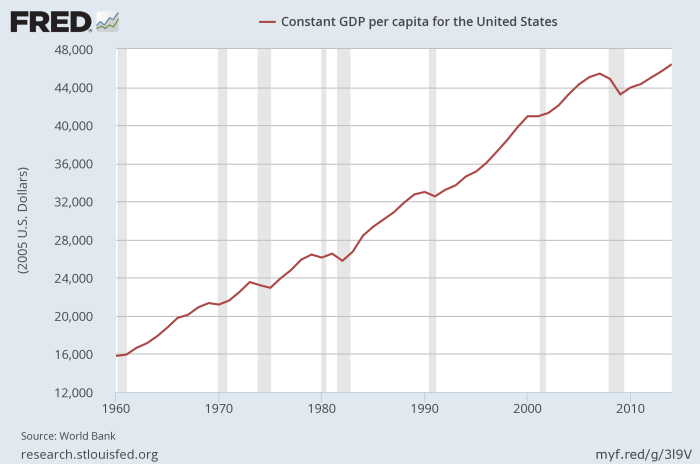
Since 1984, US real GDP per capita rose from $28,416 to $46,405 (in 2005 dollars). In that same time period, real median household income only rose from $48,664 to $53,657 (in 2014 dollars). That means that the total amount of income per person in the US rose by 49 log points (63%), while the amount of income that a typical family received only rose 10 log points (10%). If median income had risen at the same rate as per-capita GDP (and if inequality remained constant, it would), it would now be over $79,000, instead of $53,657. That is, a typical family would have $25,000 more than they actually do. The poverty line for a family of 4 is $24,300; so if you’re a family of 4 or less, the billionaires owe you a poverty line. You should have three times the poverty line, and in fact you have only two—because they took the rest.

And let me be very clear: I mean took. I mean stole, in a very real sense. This is not wealth that they created by their brilliance and hard work. This is wealth that they expropriated by exploiting people and manipulating the system in their favor. There is no way that the top 1% deserves to have as much wealth as the bottom 95% combined. They may be talented; they may work hard; but they are not that talented, and they do not work that hard. You speak of “confiscation of wealth” and you mean income taxes? No, this is the confiscation of our nation’s wealth.

Those of us who voted for Bernie Sanders voted for someone who is trying to stop it.

Those of you who voted for Donald Trump? Congratulations on supporting someone who epitomizes it.

We do not benefit from economic injustice.

JDN 2457461

Recently I think I figured out why so many middle-class White Americans express so much guilt about global injustice: A lot of people seem to think that we actually benefit from it. Thus, they feel caught between a rock and a hard place; conquering injustice would mean undermining their own already precarious standard of living, while leaving it in place is unconscionable.

The compromise, is apparently to feel really, really guilty about it, constantly tell people to “check their privilege” in this bizarre form of trendy autoflagellation, and then… never really get around to doing anything about the injustice.

(I guess that’s better than the conservative interpretation, which seems to be that since we benefit from this, we should keep doing it, and make sure we elect big, strong leaders who will make that happen.)

So let me tell you in no uncertain words: You do not benefit from this.

If anyone does—and as I’ll get to in a moment, that is not even necessarily true—then it is the billionaires who own the multinational corporations that orchestrate these abuses. Billionaires and billionaires only stand to gain from the exploitation of workers in the US, China, and everywhere else.

How do I know this with such certainty? Allow me to explain.

First of all, it is a common perception that prices of goods would be unattainably high if they were not produced on the backs of sweatshop workers. This perception is mistaken. The primary effect of the exploitation is simply to raise the profits of the corporation; there is a secondary effect of raising the price a moderate amount; and even this would be overwhelmed by the long-run dynamic effect of the increased consumer spending if workers were paid fairly.

Let’s take an iPad, for example. The price of iPads varies around the world in a combination of purchasing power parity and outright price discrimination; but the top model almost never sells for less than $500. The raw material expenditure involved in producing one is about $370—and the labor expenditure? Just $11. Not $110; $11. If it had been $110, the price could still be kept under $500 and turn a profit; it would simply be much smaller. That is, even if prices are really so elastic that Americans would refuse to buy an iPad at any more than $500 that would still mean Apple could still afford to raise the wages they pay (or rather, their subcontractors pay) workers by an order of magnitude. A worker who currently works 50 hours a week for $10 per day could now make $10 per hour. And the price would not have to change; Apple would simply lose profit, which is why they don’t do this. In the absence of pressure to the contrary, corporations will do whatever they can to maximize profits.

Now, in fact, the price probably would go up, because Apple fans are among the most inelastic technology consumers in the world. But suppose it went up to $600, which would mean a 1:1 absorption of these higher labor expenditures into price. Does that really sound like “Americans could never afford this”? A few people right on the edge might decide they couldn’t buy it at that price, but it wouldn’t be very many—indeed, like any well-managed monopoly, Apple knows to stop raising the price at the point where they start losing more revenue than they gain.

Similarly, half the price of an iPhone is pure profit for Apple, and only 2% goes into labor. Once again, wages could be raised by an order of magnitude and the price would not need to change.

Apple is a particularly obvious example, but it’s quite simple to see why exploitative labor cannot be the source of improved economic efficiency. Paying workers less does not make them do better work. Treating people more harshly does not improve their performance. Quite the opposite: People work much harder when they are treated well. In addition, at the levels of income we’re talking about, small improvements in wages would result in substantial improvements in worker health, further improving performance. Finally, substitution effect dominates income effect at low incomes. At very high incomes, income effect can dominate substitution effect, so higher wages might result in less work—but it is precisely when we’re talking about poor people that it makes the least sense to say they would work less if you paid them more and treated them better.

At most, paying higher wages can redistribute existing wealth, if we assume that the total amount of wealth does not increase. So it’s theoretically possible that paying higher wages to sweatshop workers would result in them getting some of the stuff that we currently have (essentially by a price mechanism where the things we want get more expensive, but our own wages don’t go up). But in fact our wages are most likely too low as well—wages in the US have become unlinked from productivity, around the time of Reagan—so there’s reason to think that a more just system would improve our standard of living also. Where would all the extra wealth come from? Well, there’s an awful lot of room at the top.

The top 1% in the US own 35% of net wealth, about as much as the bottom 95%. The 400 billionaires of the Forbes list have more wealth than the entire African-American population combined. (We’re double-counting Oprah—but that’s it, she’s the only African-American billionaire in the US.) So even assuming that the total amount of wealth remains constant (which is too conservative, as I’ll get to in a moment), improving global labor standards wouldn’t need to pull any wealth from the middle class; it could get plenty just from the top 0.01%.

In surveys, most Americans are willing to pay more for goods in order to improve labor standards—and the amounts that people are willing to pay, while they may seem small (on the order of 10% to 20% more), are in fact clearly enough that they could substantially increase the wages of sweatshop workers. The biggest problem is that corporations are so good at covering their tracks that it’s difficult to know whether you are really supporting higher labor standards. The multiple layers of international subcontractors make things even more complicated; the people who directly decide the wages are not the people who ultimately profit from them, because subcontractors are competitive while the multinationals that control them are monopsonists.

But for now I’m not going to deal with the thorny question of how we can actually regulate multinational corporations to stop them from using sweatshops. Right now, I just really want to get everyone on the same page and be absolutely clear about cui bono. If there is a benefit at all, it’s not going to you and me.

Why do I keep saying “if”? As so many people will ask me: “Isn’t it obvious that if one person gets less money, someone else must get more?” If you’ve been following my blog at all, you know that the answer is no.

On a single transaction, with everything else held constant, that is true. But we’re not talking about a single transaction. We’re talking about a system of global markets. Indeed, we’re not really talking about money at all; we’re talking about wealth.

By paying their workers so little that those workers can barely survive, corporations are making it impossible for those workers to go out and buy things of their own. Since the costs of higher wages are concentrated in one corporation while the benefits of higher wages are spread out across society, there is a Tragedy of the Commons where each corporation acting in its own self-interest undermines the consumer base that would have benefited all corporations (not to mention people who don’t own corporations). It does depend on some parameters we haven’t measured very precisely, but under a wide range of plausible values, it works out that literally everyone is worse off under this system than they would have been under a system of fair wages.

This is not simply theoretical. We have empirical data about what happened when companies (in the US at least) stopped using an even more extreme form of labor exploitation: slavery.

Because we were on the classical gold standard, GDP growth in the US in the 19th century was extremely erratic, jumping up and down as high as 10 lp and as low as -5 lp. But if you try to smooth out this roller-coaster business cycle, you can see that our growth rate did not appear tobe slowed by the ending of slavery:

US_GDP_growth_1800s


Looking at the level of real per capita GDP (on a log scale) shows a continuous growth trend as if nothing had changed at all:

US_GDP_per_capita_1800s

In fact, if you average the growth rates (in log points, averaging makes sense) from 1800 to 1860 as antebellum and from 1865 to 1900 as postbellum, you find that the antebellum growth rate averaged 1.04 lp, while the postbellum growth rate averaged 1.77 lp. Over a period of 50 years, that’s the difference between growing by a factor of 1.7 and growing by a factor of 2.4. Of course, there were a lot of other factors involved besides the end of slavery—but at the very least it seems clear that ending slavery did not reduce economic growth, which it would have if slavery were actually an efficient economic system.

This is a different question from whether slaveowners were irrational in continuing to own slaves. Purely on the basis of individual profit, it was most likely rational to own slaves. But the broader effects on the economic system as a whole were strongly negative. I think that part of why the debate on whether slavery is economically inefficient has never been settled is a confusion between these two questions. One side says “Slavery damaged overall economic growth.” The other says “But owning slaves produced a rate of return for investors as high as manufacturing!” Yeah, those… aren’t answering the same question. They are in fact probably both true. Something can be highly profitable for individuals while still being tremendously damaging to society.

I don’t mean to imply that sweatshops are as bad as slavery; they are not. (Though there is still slavery in the world, and some sweatshops tread a fine line.) What I’m saying is that showing that sweatshops are profitable (no doubt there) or even that they are better than most of the alternatives for their workers (probably true in most cases) does not show that they are economically efficient. Sweatshops are beneficent exploitationthey make workers better off, but in an obviously unjust way. And they only make workers better off compared to the current alternatives; if they were replaced with industries paying fair wages, workers would obviously be much better off still.

And my point is, so would we. While the prices of goods would increase slightly in the short run, in the long run the increased consumer spending by people in Third World countries—which soon would cease to be Third World countries, as happened in Korea and Japan—would result in additional trade with us that would raise our standard of living, not lower it. The only people it is even plausible to think would be harmed are the billionaires who own our multinational corporations; and yet even they might stand to benefit from the improved efficiency of the global economy.

No, you do not benefit from sweatshops. So stop feeling guilty, stop worrying so much about “checking your privilege”—and let’s get out there and do something about it.

Is America uniquely… mean?

JDN 2457454

I read this article yesterday which I found both very resonant and very disturbing: At least among First World countries, the United States really does seem uniquely, for lack of a better word, mean.

The formal psychological terminology is social dominance orientation; the political science term is authoritarianism. In economics, we notice the difference due to its effect on income inequality. But all of these concepts are capturing part of a deeper underlying reality that in the age of Trump I am finding increasingly hard to deny. The best predictor of support for Trump is authoritarianism.

Of course I’ve already talked about our enormous military budget; but then Tennessee had to make their official state rifle a 50-caliber weapon capable of destroying light tanks. There is something especially dominant, aggressive, and violent about American culture.

We are certainly not unique in the world as a whole—actually I think the amount of social dominance orientation, authoritarianism, and inequality in the US is fairly similar to the world average. We are unique in our gun ownership, but our military spending proportional to GDP is not particularly high by world standards—we’re just an extremely rich country. But in all these respects we are a unique outlier among First World countries; in many ways we resemble a rich authoritarian petrostate like Qatar rather than a European social democracy like France or the UK. (At least we’re not Saudi Arabia?)

More than other First World cultures, Americans believe in hierarchy; they believe that someone should be on top and other people should be on the bottom. More than that, they believe that people “like us” should be on top and people “not like us” should be on the bottom, however that is defined—often in terms of race or religion, but not necessarily.

Indeed, one of the things I find most baffling about this is that it is often more important to people that others be held down than that they themselves be lifted up. This is the only way I can make sense of the fact that people who have watched their wages be drained into the pockets of billionaires for a generation can think that the most important things to do right now are block out illegal immigrants and deport Muslims.

It seems to be that people become convinced that their own status, whatever it may be, is deserved: If they are rich, it is obviously because they are so brilliant and hard-working (something Trump clearly believes about himself, being a textbook example of Narcissistic Personality Disorder); if they are poor, it is obviously because they are so incompetent and lazy. Thus, being lifted up doesn’t make sense; why would you give me things I don’t deserve?

But then when they see people who are different from them, they know automatically that those people must be by definition inferior, as all who are Not of Our Tribe are by definition inferior. And therefore, any of them who are rich gained their position through corruption or injustice, and all of them who are poor deserve their fate for being so inferior. Thus, it is most vital to ensure that these Not of Our Tribe are held down from reaching high positions they so obviously do not deserve.

I’m fairly sure that most of this happens at a very deep unconscious level; it calls upon ancient evolutionary instincts to love our own tribe, to serve the alpha male, to fear and hate those of other tribes. These instincts may well have served us 200,000 years ago (then again, they may just have been the best our brains could manage at the time); but they are becoming a dangerous liability today.

As E.O. Wilson put it: “The real problem of humanity is the following: we have paleolithic emotions; medieval institutions; and god-like technology.”

Yet this cannot be a complete explanation, for there is variation in these attitudes. A purely instinctual theory should say that all human cultures have this to an essentially equal degree; but I started this post by pointing out that the United States appears to have a particularly large amount relative to Europe.

So, there must be something in the cultures or institutions of different nations that makes them either enhance or suppress this instinctual tribalism. There must be something that Europe is doing right, the US is doing wrong, and Saudi Arabia is doing very, very wrong.
Well, the obvious one that sticks out at me is religion. It seems fairly obvious to me that Sweden is less religious than the US, which is less religious than Saudi Arabia.

Data does back me up on this. Religiosity isn’t easy to measure, but we have methods of doing so. If we ask people in various countries if religion is very important in their lives, the percentage of people who say yes gives us an indication of how religious that country is.

In Saudi Arabia, 93% say yes. In the United States, 65% say yes. In Sweden, only 17% say yes.

Religiosity tends to be highest in the poorest countries, but the US is an outlier, far too rich for our religion (or too religious for our wealth).

Religiosity also tends to be highest in countries with high inequality—this time, the US fits right in.

The link between religion and inequality is quite clear. It’s harder to say which way the causation runs. Perhaps high inequality makes people cling more to religion as a comfort, and getting rid of religion would only mean taking that comfort away. Or, perhaps religion actually makes people believe more in social dominance, and thus is part of what keeps that high inequality in place. It could also be a feedback loop, in which higher inequality leads to higher religiosity which leads to higher inequality.

That said, I think we actually have some evidence that causality runs from religion to inequality, rather than the other way around. The secularization of France took place around the same time as the French Revolution that overthrew the existing economic system and replaced it with one that had substantially less inequality. Iran’s government became substantially more based on religion in the latter half of the 20th century, and their inequality soared thereafter.

Above all, Donald Trump dominates the evangelical vote, which makes absolutely no sense if religion is a comfort against inequality—but perfect sense if religion solidifies the tendency of people to think in terms of hierarchy and authoritarianism.

This also makes sense in terms of the content of religion, especially Abrahamaic religion; read the Bible and the Qur’an, and you will see that their primary goal seems to be to convince you that some people, namely people who believe in this book, are just better than other people, and we should be in charge because God says so. (And you wouldn’t try to argue with God, would you?) They really make no particular effort to convince you that God actually exists; they spend all their argumentative effort on what God wants you to do and who God wants you to put in charge—and for some strange reason it always seems to be the same guys who are writing down “God’s words” in the book! What a coincidence!

If religion is indeed the problem, or a large part of the problem, what can we do about it? That’s the most difficult part. We’ve been making absolutely conclusive rational arguments against religion since literally 300 years before Jesus was even born (there has never been a time in human history in which it was rational for an educated person to believe in Christianity or Islam, for the religions did not come into existence until well after the arguments to refute them were well-known!), and the empirical evidence against theism has only gotten stronger ever since; so that clearly isn’t enough.

I think what we really need to do at this point is confront the moral monopoly that religion has asserted for itself. The “Moral Majority” was neither, but its name still sort of makes sense to us because we so strongly associate being moral with being religious. We use terms like “Christian” and “generous” almost interchangeably. And whenever you get into a debate about religion, shortly after you have thoroughly demolished any shred of empirical credibility religion still had left, you can basically guarantee that the response will be: “But without God, how can you know right from wrong?”

What is perhaps most baffling about this concept of morality so commonplace in our culture is that not only is the command of a higher authority that rewards and punishes you not the highest level of moral development—it is literally the lowest. Of the six stages of moral thinking Kohlberg documented in children, the reward and punishment orientation exemplified by the Bible and the Qur’an is the very first. I think many of these people really truly haven’t gotten past level 1, which is why when you start trying to explain how you base your moral judgments on universal principles of justice and consequences (level 6) they don’t seem to have any idea what you’re talking about.

Perhaps this is a task for our education system (philosophy classes in middle school?), perhaps we need something more drastic than that, or perhaps it is enough that we keep speaking about it in public. But somehow we need to break up the monopoly that religion has on moral concepts, so that people no longer feel ashamed to say that something is morally wrong without being able to cite a particular passage from a particular book from the Iron Age. Perhaps once we can finally make people realize that morality does not depend on religion, we can finally free them from the grip of religion—and therefore from the grip of authoritarianism and social dominance.

If this is right, then the reason America is so mean is that we are so Christian—and people need to realize that this is not a paradoxical statement.

Do we always want to internalize externalities?

JDN 2457437

I often talk about the importance of externalitiesa full discussion in this earlier post, and one of their important implications, the tragedy of the commons, in another. Briefly, externalities are consequences of actions incurred upon people who did not perform those actions. Anything I do affecting you that you had no say in, is an externality.

Usually I’m talking about how we want to internalize externalities, meaning that we set up a system of incentives to make it so that the consequences fall upon the people who chose the actions instead of anyone else. If you pollute a river, you should have to pay to clean it up. If you assault someone, you should serve jail time as punishment. If you invent a new technology, you should be rewarded for it. These are all attempts to internalize externalities.

But today I’m going to push back a little, and ask whether we really always want to internalize externalities. If you think carefully, it’s not hard to come up with scenarios where it actually seems fairer to leave the externality in place, or perhaps reduce it somewhat without eliminating it.

For example, suppose indeed that someone invents a great new technology. To be specific, let’s think about Jonas Salk, inventing the polio vaccine. This vaccine saved the lives of thousands of people and saved millions more from pain and suffering. Its value to society is enormous, and of course Salk deserved to be rewarded for it.

But we did not actually fully internalize the externality. If we had, every family whose child was saved from polio would have had to pay Jonas Salk an amount equal to what they saved on medical treatments as a result, or even an amount somehow equal to the value of their child’s life (imagine how offended people would get if you asked that on a survey!). Those millions of people spared from suffering would need to each pay, at minimum, thousands of dollars to Jonas Salk, making him of course a billionaire.

And indeed this is more or less what would have happened, if he had been willing and able to enforce a patent on the vaccine. The inability of some to pay for the vaccine at its monopoly prices would add some deadweight loss, but even that could be removed if Salk Industries had found a way to offer targeted price vouchers that let them precisely price-discriminate so that every single customer paid exactly what they could afford to pay. If that had happened, we would have fully internalized the externality and therefore maximized economic efficiency.

But doesn’t that sound awful? Doesn’t it sound much worse than what we actually did, where Jonas Salk received a great deal of funding and support from governments and universities, and lived out his life comfortably upper-middle class as a tenured university professor?

Now, perhaps he should have been awarded a Nobel Prize—I take that back, there’s no “perhaps” about it, he definitely should have been awarded a Nobel Prize in Medicine, it’s absurd that he did not—which means that I at least do feel the externality should have been internalized a bit more than it was. But a Nobel Prize is only 10 million SEK, about $1.1 million. That’s about enough to be independently wealthy and live comfortably for the rest of your life; but it’s a small fraction of the roughly $7 billion he could have gotten if he had patented the vaccine. Yet while the possible world in which he wins a Nobel is better than this one, I’m fairly well convinced that the possible world in which he patents the vaccine and becomes a billionaire is considerably worse.

Internalizing externalities makes sense if your goal is to maximize total surplus (a concept I explain further in the linked post), but total surplus is actually a terrible measure of human welfare.

Total surplus counts every dollar of willingness-to-pay exactly the same across different people, regardless of whether they live on $400 per year or $4 billion.

It also takes no account whatsoever of how wealth is distributed. Suppose a new technology adds $10 billion in wealth to the world. As far as total surplus, it makes no difference whether that $10 billion is spread evenly across the entire planet, distributed among a city of a million people, concentrated in a small town of 2,000, or even held entirely in the bank account of a single man.

Particularly a propos of the Salk example, total surplus makes no distinction between these two scenarios: a perfectly-competitive market where everything is sold at a fair price, and a perfectly price-discriminating monopoly, where everything is sold at the very highest possible price each person would be willing to pay.

This is a perfectly-competitive market, where the benefits are more or less equally (in this case exactly equally, but that need not be true in real life) between sellers and buyers:

elastic_supply_competitive_labeled

This is a perfectly price-discriminating monopoly, where the benefits accrue entirely to the corporation selling the good:

elastic_supply_price_discrimination

In the former case, the company profits, consumers are better off, everyone is happy. In the latter case, the company reaps all the benefits and everyone else is left exactly as they were. In real terms those are obviously very different outcomes—the former being what we want, the latter being the cyberpunk dystopia we seem to be hurtling mercilessly toward. But in terms of total surplus, and therefore the kind of “efficiency” that is maximize by internalizing all externalities, they are indistinguishable.

In fact (as I hope to publish a paper about at some point), the way willingness-to-pay works, it weights rich people more. Redistributing goods from the poor to the rich will typically increase total surplus.

Here’s an example. Suppose there is a cake, which is sufficiently delicious that it offers 2 milliQALY in utility to whoever consumes it (this is a truly fabulous cake). Suppose there are two people to whom we might give this cake: Richie, who has $10 million in annual income, and Hungry, who has only $1,000 in annual income. How much will each of them be willing to pay?

Well, assuming logarithmic marginal utility of wealth (which is itself probably biasing slightly in favor of the rich), 1 milliQALY is about $1 to Hungry, so Hungry will be willing to pay $2 for the cake. To Richie, however, 1 milliQALY is about $10,000; so he will be willing to pay a whopping $20,000 for this cake.

What this means is that the cake will almost certainly be sold to Richie; and if we proposed a policy to redistribute the cake from Richie to Hungry, economists would emerge to tell us that we have just reduced total surplus by $19,998 and thereby committed a great sin against economic efficiency. They will cajole us into returning the cake to Richie and thus raising total surplus by $19,998 once more.

This despite the fact that I stipulated that the cake is worth just as much in real terms to Hungry as it is to Richie; the difference is due to their wildly differing marginal utility of wealth.

Indeed, it gets worse, because even if we suppose that the cake is worth much more in real utility to Hungry—because he is in fact hungry—it can still easily turn out that Richie’s willingness-to-pay is substantially higher. Suppose that Hungry actually gets 20 milliQALY out of eating the cake, while Richie still only gets 2 milliQALY. Hungry’s willingness-to-pay is now $20, but Richie is still going to end up with the cake.

Now, if your thought is, “Why would Richie pay $20,000, when he can go to another store and get another cake that’s just as good for $20?” Well, he wouldn’t—but in the sense we mean for total surplus, willingness-to-pay isn’t just what you’d actually be willing to pay given the actual prices of the goods, but the absolute maximum price you’d be willing to pay to get that good under any circumstances. It is instead the marginal utility of the good divided by your marginal utility of wealth. In this sense the cake is “worth” $20,000 to Richie, and “worth” substantially less to Hungry—but not because it’s actually worth less in real terms, but simply because Richie has so much more money.

Even economists often equate these two, implicitly assuming that we are spending our money up to the point where our marginal willingness-to-pay is the actual price we choose to pay; but in general our willingness-to-pay is higher than the price if we are willing to buy the good at all. The consumer surplus we get from goods is in fact equal to the difference between willingness-to-pay and actual price paid, summed up over all the goods we have purchased.

Internalizing all externalities would definitely maximize total surplus—but would it actually maximize happiness? Probably not.

If you asked most people what their marginal utility of wealth is, they’d have no idea what you’re talking about. But most people do actually have an intuitive sense that a dollar is worth more to a homeless person than it is to a millionaire, and that’s really all we mean by diminishing marginal utility of wealth.

I think the reason we’re uncomfortable with the idea of Jonas Salk getting $7 billion from selling the polio vaccine, rather than the same number of people getting the polio vaccine and Jonas Salk only getting the $1.1 million from a Nobel Prize, is that we intuitively grasp that after that $1.1 million makes him independently wealthy, the rest of the money is just going to sit in some stock account and continue making even more money, while if we’d let the families keep it they would have put it to much better use raising their children who are now protected from polio. We do want to reward Salk for his great accomplishment, but we don’t see why we should keep throwing cash at him when it could obviously be spent in better ways.

And indeed I think this intuition is correct; great accomplishments—which is to say, large positive externalities—should be rewarded, but not in direct proportion. Maybe there should be some threshold above which we say, “You know what? You’re rich enough now; we can stop giving you money.” Or maybe it should simply damp down very quickly, so that a contribution which is worth $10 billion to the world pays only slightly more than one that is worth $100 million, but a contribution that is worth $100,000 pays considerably more than one which is only worth $10,000.

What it ultimately comes down to is that if we make all the benefits incur to the person who did it, there aren’t any benefits anymore. The whole point of Jonas Salk inventing the polio vaccine (or Einstein discovering relativity, or Darwin figuring out natural selection, or any great achievement) is that it will benefit the rest of humanity, preferably on to future generations. If you managed to fully internalize that externality, this would no longer be true; Salk and Einstein and Darwin would have become fabulously wealthy, and then somehow we’d all have to continue paying into their estates or something an amount equal to the benefits we received from their discoveries. (Every time you use your GPS, pay a royalty to the Einsteins. Every time you take a pill, pay a royalty to the Darwins.) At some point we’d probably get fed up and decide we’re no better off with them than without them—which is exactly by construction how we should feel if the externality were fully internalized.

Internalizing negative externalities is much less problematic—it’s your mess, clean it up. We don’t want other people to be harmed by your actions, and if we can pull that off that’s fantastic. (In reality, we usually can’t fully internalize negative externalities, but we can at least try.)

But maybe internalizing positive externalities really isn’t so great after all.

Why Millennials feel “entitled”

JDN 2457064

I’m sure you’ve already heard this plenty of times before, but just in case here are a few particularly notable examples: “Millennials are entitled.” “Millennials are narcissistic.” “Millennials expect instant gratification.

Fortunately there are some more nuanced takes as well: One survey shows that we are perceived as “entitled” and “self-centered” but also “hardworking” and “tolerant”. This article convincingly argues that Baby Boomers show at least as much ‘entitlement’ as we do. Another article points out that young people have been called these sorts of names for decades—though actually the proper figure is centuries.

Though some of the ‘defenses’ leave a lot to be desired: “OK, admittedly, people do live at home. But that’s only because we really like our parents. And why shouldn’t we?” Uh, no, that’s not it. Nor is it that we’re holding off on getting married. The reason we live with our parents is that we have no money and can’t pay for our own housing. And why aren’t we getting married? Because we can’t afford to pay for a wedding, much less buy a home and start raising kids. (Since the time I drafted this for Patreon and it went live, yet another article hand-wringing over why we’re not getting married was publishedin Scientific American, of all places.)

Are we not buying cars because we don’t like cars? No, we’re not buying cars because we can’t afford to pay for them.

The defining attributes of the Millennial generation are that we are young (by definition) and broke (with very few exceptions). We’re not uniquely narcissistic or even tolerant; younger generations always have these qualities.

But there may be some kernel of truth here, which is that we were promised a lot more than we got.

Educational attainment in the United States is the highest it has ever been. Take a look at this graph from the US Department of Education:

Percentage of 25- to 29-year-olds who completed a bachelor’s or higher degree, by race/ethnicity: Selected years, 1990–2014

education_attainment_race

More young people of every demographic except American Indians now have college degrees (and those figures fluctuate a lot because of small samples—whether my high school had an achievement gap for American Indians depended upon how I self-identified on the form, because there were only two others and I was tied for the highest GPA).

Even the IQ of Millennials is higher than that of our parents’ generation, which is higher than their parents’ generation; (measured) intelligence rises over time in what is called the Flynn Effect. IQ tests have to be adjusted to be harder by about 3 points every 10 years because otherwise the average score would stop being 100.

As your level of education increases, your income tends to go up and your unemployment tends to go down. In 2014, while people with doctorates or professional degrees had about 2% unemployment and made a median income of $1590 per week, people without even high school diplomas had about 9% unemployment and made a median income of only $490 per week. The Bureau of Labor Statistics has a nice little bar chart of these differences:

education_employment_earnings

Now the difference is not quite as stark. With the most recent data, the unemployment rate is 6.7% for people without a high school diploma and 2.5% for people with a bachelor’s degree or higher.

But that’s for the population as a whole. What about the population of people 18 to 35, those of us commonly known as Millennials?

Well, first of all, our unemployment rate overall is much higher. With the most recent data, unemployment among people ages 20-24 is a whopping 9.4%. For ages 25 to 34 it gets better, 5.3%; but it’s still much worse than unemployment at ages 35-44 (4.0%), 45-54 (3.6%), or 55+ (3.2%). Overall, unemployment among Millennials is about 6.7% while unemployment among Baby Boomers is about 3.2%, half as much. (Gen X is in between, but a lot closer to the Boomers at around 3.8%.)

It was hard to find data specifically breaking it down by both age and education at the same time, but the hunt was worth it.

Among people age 20-24 not in school:

Without a high school diploma, 328,000 are unemployed, out of 1,501,000 in the labor force. That’s an unemployment rate of 21.9%. Not a typo, that’s 21.9%.

With only a high school diploma, 752,000 are unemployed, out of 5,498,000 in the labor force. That’s an unemployment rate of 13.7%.

With some college but no bachelor’s degree, 281,000 are unemployed, out of 3,620,000 in the labor force. That’s an unemployment rate of 7.7%.

With a bachelor’s degree, 90,000 are unemployed, out of 2,313,000 in the labor force. That’s an unemployment rate of 3.9%.

What this means is that someone 24 or under needs to have a bachelor’s degree in order to have the same overall unemployment rate that people from Gen X have in general, and even with a bachelor’s degree, people under 24 still have a higher unemployment rate than what Baby Boomers simply have by default. If someone under 24 doesn’t even have a high school diploma, forget it; their unemployment rate is comparable to the population unemployment rate at the trough of the Great Depression.

In other words, we need to have college degrees just to match the general population older than us, of whom only 20% have a college degree; and there is absolutely nothing a Millennial can do in terms of education to ever have the tiny unemployment rate (about 1.5%) of Baby Boomers with professional degrees. (Be born White, be in perfect health, have a professional degree, have rich parents, and live in a city with very high employment, and you just might be able to pull it off.)

So, why do Millennials feel like a college degree should “entitle” us to a job?

Because it does for everyone else.

Why do we feel “entitled” to a higher standard of living than the one we have?
Take a look at this graph of GDP per capita in the US:

US_GDP_per_capita

You may notice a rather sudden dip in 2009, around the time most Millennials graduated from college and entered the labor force. On the next graph, I’ve added a curve approximating what it would look like if the previous trend had continued:

US_GDP_per_capita_trend

(There’s a lot on this graph for wonks like me. You can see how the unit-root hypothesis seemed to fail in the previous four recessions, where economic output rose back up to potential; but it clearly held in this recession, and there was a permanent loss of output. It also failed in the recession before that. So what’s the deal? Why do we recover from some recessions and take a permanent blow from others?)

If the Great Recession hadn’t happened, instead of per-capita GDP being about $46,000 in 2005 dollars, it would instead be closer to $51,000 in 2005 dollars. In today’s money, that means our current $56,000 would be instead closer to $62,000. If we had simply stayed on the growth trajectory we were promised, we’d be almost 10 log points richer (11% for the uninitiated).

So, why do Millennials feel “entitled” to things we don’t have? In a word, macroeconomics.

People anchored their expectations of what the world would be like on forecasts. The forecasts said that the skies were clear and economic growth would continue apace; so naturally we assumed that this was true. When the floor fell out from under our economy, only a few brilliant and/or lucky economists saw it coming; even people who were paying quite close attention were blindsided. We were raised in a world where economic growth promised rising standard of living and steady employment for the rest of our lives. And then the storm hit, and we were thrown into a world of poverty and unemployment—and especially poverty and unemployment for us.

We are angry about how we had been promised more than we were given, angry about how the distribution of what wealth we do have gets ever more unequal. We are angry that our parents’ generation promised what they could not deliver, and angry that it was their own blind worship of the corrupt banking system that allowed the crash to happen.

And because we are angry and demand a fairer share, they have the audacity to call us “narcissistic”.

How Reagan ruined America

JDN 2457408

Or maybe it’s Ford?

The title is intentionally hyperbolic; despite the best efforts of Reagan and his ilk, America does yet survive. Indeed, as Obama aptly pointed out in his recent State of the Union, we appear to be on an upward trajectory once more. And as you’ll see in a moment, many of the turning points actually seem to be Gerald Ford, though it was under Reagan that the trends really gained steam.

But I think it’s quite remarkable just how much damage Reaganomics did to the economy and society of the United States. It’s actually a turning point in all sorts of different economic policy measures; things were going well from the 1940s to the 1970s, and then suddenly in the 1980s they take a turn for the worse.

The clearest example is inequality. From the World Top Incomes Database, here’s the graph I featured on my Patreon page of income shares in the United States:

top_income_shares_pretty.png

Inequality was really bad during the Roaring Twenties (no surprise to anyone who has read The Great Gatsby), then after the turmoil of the Great Depression, the New Deal, and World War 2, inequality was reduced to a much lower level.

During this period, what I like to call the Golden Age of American Capitalism:

Instead of almost 50% in the 1920s, the top 10% now received about 33%.

Instead of over 20% in the 1920s, the top 1% now received about 10%.

Instead of almost 5% in the 1920s, the top 0.01% now received about 1%.

This pattern continued to hold, remarkably stable, until 1980. Then, it completely unraveled. Income shares of the top brackets rose, and continued to rise, ever since (fluctuating with the stock market of course). Now, we’re basically back right where we were in the 1920s; the top 10% gets 50%, the top 1% gets 20%, and the top 0.01% gets 4%.

Not coincidentally, we see the same pattern if we look at the ratio of CEO pay to average worker pay, as shown here in a graph from the Economic Policy Institute:

Snapshot_CEO_pay_main

Up until 1980, the ratio in pay between CEOs and their average workers was steady around 20 to 1. From that point forward, it began to rise—and rise, and rise. It continued to rise under every Presidential administration, and actually hit its peak in 2000, under Bill Clinton, at an astonishing 411 to 1 ratio. In the 2000s it fell to about 250 to 1 (hurray?), and has slightly declined since then to about 230 to 1.

By either measure, we can see a clear turning point in US inequality—it was low and stable, until Reagan came along, when it began to explode.

Part of this no doubt is the sudden shift in tax rates. The top marginal tax rates on income were over 90% from WW2 to the 1960s; then JFK reduced them to 70%, which is probably close to the revenue-maximizing rate. There they stayed, until—you know the refrain—along came Reagan, and by the end of his administration he had dropped the top marginal rate to 28%. It then was brought back up to about 35%, where it has basically remained, sometimes getting as high as 40%.

US_income_tax_rates

Another striking example is the ratio between worker productivity and wages. The Economic Policy Institute has a very detailed analysis of this, but I think their graph by itself is quite striking:

productivity_wages

Starting around the 1970s, and then rapidly accelerating from the 1980s onward, we see a decoupling of productivity from wages. Productivity has continued to rise at more or less the same rate, but wages flatten out completely, even falling for part of the period.

For those who still somehow think Republicans are fiscally conservative, take a look at this graph of the US national debt:

US_federal_debt

We were at a comfortable 30-40% of GDP range, actually slowly decreasing—until Reagan. We got back on track to reduce the debt during the mid-1990s—under Bill Clinton—and then went back to raising it again once George W. Bush got in office. It ballooned as a result of the Great Recession, and for the past few years Obama has been trying to bring it back under control.

Of course, national debt is not nearly as bad as most people imagine it to be. If Reagan had only raised the national debt in order to stop unemployment, that would have been fine—but he did not.

Unemployment had never been above 10% since World War 2 (and in fact reached below 4% in the 1960s!) and yet all the sudden hit almost 11%, shortly after Reagan:
US_unemployment
Let’s look at that graph a little closer. Right now the Federal Reserve uses 5% as their target unemployment rate, the supposed “natural rate of unemployment” (a lot of economists use this notion, despite there being almost no empirical support for it whatsoever). If I draw red lines at 5% unemployment and at 1981, the year Reagan took office, look at what happens.

US_unemployment_annotated

For most of the period before 1981, we spent most of our time below the 5% line, jumping above it during recessions and then coming back down; for most of the period after 1981, we spent most of our time above the 5% line, even during economic booms.

I’ve drawn another line (green) where the most natural break appears, and it actually seems to be the Ford administration; so maybe I can’t just blame Reagan. But something happened in the last quarter of the 20th century that dramatically changed the shape of unemployment in America.

Inflation is at least ambiguous; it was pretty bad in the 1940s and 1950s, and then settled down in the 1960s for awhile before picking up in the 1970s, and actually hit its worst just before Reagan took office:

US_inflation

Then there’s GDP growth.

US_GDP_growth

After World War 2, our growth rate was quite volatile, rising as high as 8% (!) in some years, but sometimes falling to zero or slightly negative. Rates over 6% were common during booms. On average GDP growth was quite good, around 4% per year.

In 1981—the year Reagan took office—we had the worst growth rate in postwar history, an awful -1.9%. Coming out of that recession we had very high growth of about 7%, but then settled into the new normal: More stable growth rates, yes, but also much lower. Never again did our growth rate exceed 4%, and on average it was more like 2%. In 2009, Reagan’s record recession was broken with the Great Recession, a drop of almost 3% in a single year.

GDP per capita tells a similar story, of volatile but fast growth before Reagan followed by stable but slow growth thereafter:

US_GDP_per_capita

Of course, it wouldn’t be fair to blame Reagan for all of this. A lot of things have happened in the late 20th century, after all. In particular, the OPEC oil crisis is probably responsible for many of these 1970s shocks, and when Nixon moved us at last off the Bretton Woods gold standard, it was probably the right decision, but done at a moment of crisis instead of as the result of careful planning.

Also, while the classical gold standard was terrible, the Bretton Woods system actually had some things to recommend it. It required strict capital controls and currency exchange regulations, but the period of highest economic growth and lowest inequality in the United States—the period I’m calling the Golden Age of American Capitalism—was in fact the same period as the Bretton Woods system.

Some of these trends started before Reagan, and all of them continued in his absence—many of them worsening as much or more under Clinton. Reagan took office during a terrible recession, and either contributed to the recovery or at least did not prevent it.

The President only has very limited control over the economy in any case; he can set a policy agenda, but Congress must actually implement it, and policy can take years to show its true effects. Yet given Reagan’s agenda of cutting top tax rates, crushing unions, and generally giving large corporations whatever they want, I think he bears at least some responsibility for turning our economy in this very bad direction.

The possibilities of a global basic income

JDN 2457401

This post is sort of a Patreon Readers’ Choice; it had a tied score with the previous post. If ties keep happening, I may need to devise some new scheme, lest I end up writing so many Readers’ Choice posts I don’t have time for my own topics (I suppose there are worse fates).

The idea of a global basic income is one I have alluded to many times, but never directly focused on.

As I wrote this I realized it’s actually two posts. I have good news and bad news.
First, the good news.

A national basic income is a remarkably simple, easy policy to make: When the tax code comes around for revision that year, you get Congress to vote in a very large refundable credit, disbursed monthly, that goes to everyone—that is a basic income. To avoid ballooning the budget deficit, you would also want to eliminate a bunch of other deductions and credits, and might want to raise the tax rates as well—but these are all things that we have done before many times. Different administrations almost always add some deductions and remove others, raise some rates and lower others. By this simple intervention, we could end poverty in America immediately and forever. The most difficult part of this whole process is convincing a majority of both houses of Congress to support it. (And even that may not be as difficult as it seems, for a basic income is one of the few economic policies that appeals to both Democrats, Libertarians, and even some Republicans.)

Similar routine policy changes could be applied in other First World countries. A basic income could be established by a vote of Parliament in the UK, a vote of the Senate and National Assembly in France, a vote of the Riksdag in Sweden, et cetera; indeed, Switzerland is already planning a referendum on the subject this year. The benefits of a national basic income policy are huge, the costs are manageable, the implementation is trivial. Indeed, the hardest thing to understand about all of this is why we haven’t done it already.

But the benefits of a national basic income are of course limited to the nation(s) in which it is applied. If Switzerland votes in its proposal to provide $30,000 per person per year (that’s at purchasing power parity, but it’s almost irrelevant whether I use nominal or PPP figures, because Swiss prices are so close to US prices), that will help a lot of people in Switzerland—but it won’t do much for people in Germany or Italy, let alone people in Ghana or Nicaragua. It could do a little bit for other countries, if the increased income for the poor and lower-middle class results in increased imports to Switzerland. But Switzerland especially is a very small player in global trade. A US basic income is more likely to have global effects, because the US by itself accounts for 9% of the world’s exports and 13% of the world’s imports. Some nations, particularly in Latin America, depend almost entirely upon the US to buy their exports.

But even so, national basic incomes in the entire First World would not solve the problem of global poverty. To do that, we would need a global basic income, one that applies to every human being on Earth.

The first question to ask is whether this is feasible at all. Do we even have enough economic output in the world to do this? If we tried would we simply trigger a global economic collapse?

Well,if you divide all the world’s income, adjusted for purchasing power, evenly across all the world’s population, the result is about $15,000 per person per year. This is about the standard of living of the average (by which I mean median) person in Lebanon, Brazil, or Botswana. It’s a little better than the standard of living in China, South Africa, or Peru. This is about half of what the middle class of the First World are accustomed to, but it is clearly enough to not only survive, but actually make some kind of decent living. I think most people would be reasonably happy with this amount of income, if it were stable and secure—and by construction, the majority of the world’s population would be better off if all incomes were equalized in this way.

Of course, we can’t actually do that. All the means we have for redistributing income to that degree would require sacrificing economic efficiency in various ways. It is as if we were carrying water in buckets with holes in the bottom; the amount we give at the end is a lot less than the amount we took at the start.

Indeed, the efficiency costs of redistribution rise quite dramatically as the amount redistributed increases.

I have yet to see a convincing argument for why we could not simply tax the top 1% at a 90% marginal rate and use all of that income for public goods without any significant loss in economic efficiency—this is after all more or less what we did here in the United States in the 1960s, when we had a top marginal rate over 90% and yet per capita GDP growth was considerably higher than it is today. A great many economists seem quite convinced that taxing top incomes in this way would create some grave disincentive against innovation and productivity, yet any time anything like this has been tried such disincentives have conspicuously failed to emerge. (Why, it’s almost as if the rich aren’t that much smarter and more hard-working than we are!)

I am quite sure, on the other hand, that if we literally set up the tax system so that all income gets collected by the government and then doled out to everyone evenly, this would be economically disastrous. Under that system, your income is basically independent of the work you do. You could work your entire life to create a brilliant invention that adds $10 billion to the world economy, and your income would rise by… 0.01%, the proportion that your invention added to the world economy. Or you could not do that, indeed do nothing at all, be a complete drain upon society, and your income would be about $1.50 less each year. It’s not hard to understand why a lot of people might work considerably less hard in such circumstances; if you are paid exactly the same whether you are an entrepreneur, a software engineer, a neurosurgeon, a teacher, a garbage collector, a janitor, a waiter, or even simply a couch potato, it’s hard to justify spending a lot of time and effort acquiring advanced skills and doing hard work. I’m sure there are some people, particularly in creative professions such as art, music, and writing—and indeed, science—who would continue to work, but even so the garbage would not get picked up, the hamburgers would never get served, and the power lines would never get fixed. The result would be that trying to give everyone the same income would dramatically reduce the real income available to distribute, so that we all ended up with say $5,000 per year or even $1,000 per year instead of $15,000.

Indeed, absolute equality is worse than the system of income distribution under Soviet Communism, which still provided at least some incentives to work—albeit often not to work in the most productive or efficient way.

So let’s suppose that we only have the income of the top 1% to work with. It need not be literally that we take income only from the top 1%; we could spread the tax burden wider than that, and there may even be good reasons to do so. But I think this gives us a good back-of-the-envelope estimate of how much money we would realistically have to work with in funding a global basic income. It’s actually surprisingly hard to find good figures on the global income share of the top 1%; there’s one figure going around which is not simply wrong it’s ridiculous, claiming that the income threshold for the top 1% worldwide is only $34,000. Why is it ridiculous? Because the United States comprises 4.5% of the world’s population, and half of Americans make more money than that. This means that we already have at least 2% of the world’s population making at least that much, in the United States alone. Add in people from Europe, Japan, etc. and you easily find that this must be the income of about the top 5%, maybe even only the top 10%, worldwide. Exactly where it lies depends on the precise income distributions of various countries.

But here’s what I do know; the global Gini coefficient is about 0.40, and the US Gini coefficient is about 0.45; thus, roughly speaking, income inequality on a global scale recapitulates income inequality in the US. The top 1% in the US receive about 20% of the income. So let’s say that the top 1% worldwide probably also receive somewhere around 20% of the income. We were only using it to estimate the funds available for a basic income anyway.

This would mean that our basic income could be about $3,000 per person per year at purchasing power parity. That probably doesn’t sound like a lot, and I suppose it isn’t; but the UN poverty threshold is $2 per person per day, which is $730 per person per day. Thus, our basic income is over four times what it would take to eliminate global poverty by the UN threshold.

Now in fact I think that this threshold is probably too low; but is it four times too low? We are accustomed to such a high standard of living in the First World that it’s easy to forget that people manage to survive on far, far less than we have. I think in fact our problem here is not so much poverty per se as it is inequality and financial insecurity. We live in a state of “insecure affluence”; we have a great deal (think for a moment about your shelter, transportation, computer, television, running water, reliable electricity, abundant food—and if you are reading this you probably have all these things), but we constantly fear that we may lose it at any moment, and not without reason. (My family actually lost the house I grew up in as a result of predatory banking and the financial crisis.) We are taught all our lives that the only way to protect this abundance is by means of a hyper-competitive, winner-takes-allcutthroat capitalist economy that never lets us ever become comfortable in appreciating that abundance, for it could be taken from us at any time.

I think the apotheosis of what it is to live in insecure affluence is renting an apartment in LA or New York—you must have a great deal going for you to be able to live in the city at all, but you are a renter, an interloper; the apartment, like so much of your existence, is never fully secure, never fully yours. Perhaps the icing on the cake is if you’re doing it for grad school (as I was a year ago), this bizarre system in which we live near poverty for several years not in spite but because of the fact that we are so hard-working, intelligent and educated. (And it never ceases to baffle me that economists who lived through that can still believe in the Life-Cycle Spending Hypothesis.)

Being below the poverty line in a First World country is a kind of poverty, but it’s a very different kind than being below the poverty line in a Third World country. (I think we need a new term to distinguish it, and maybe “insecure affluence” or “economic insecurity” is the right one.) A national basic income could be set considerably higher than the global basic income (since we’re giving it to far fewer people), so we might actually be able to set $15,000 nationally—but to do that worldwide would use up literally all the money in the world.

Raising the minimum income worldwide to $3,000 per person per year would transform the lives of billions of people. It would, in a very real sense, end poverty, worldwide, immediately and forever.

And that’s the good news. Stay tuned for the bad news.

What would an interplanetary economy look like?

JDN 2457397

Today’s post is the second Reader’s Choice topic, chosen by a vote of my Patreons.

Remember, you too can vote on future topics if you pledge at least $10 per month.

Actually, there was a tie between two topics; since I was in an SF mood today, I decided to do this one as the official Reader’s Choice post. The second, “The challenges and possibilities of a global basic income”, I’ll do as a later post. (If I don’t get around to that before the next vote, you can of course always vote for it again.)

Will we ever colonize outer space? Many people thought we’d be there by now.

In Blade Runner, released in 1982, Roy was built and deployed to the outer colonies in 2015, which you may remember as the year that just ended.

Predictions of the future are often wrong, but predictions from the 20th century of the 21st century seem to be consistently overoptimistic about technology. In a past Idiot Free Zone post, I hypothesize that this is due to the confusion between exponential and logistic growth.

Paul Krugman is also a big fan of SF (it is actually about as likely that I’d run into Krugman at Worldcon as at an economics conference), and he wrote a paper on the possibility of interstellar trade way back in 1978. I think he’s kind of satirizing economic theorists actually; he uses sophisticated mathematics to address a problem that doesn’t exist in the real world—just like they do.

I think we will eventually at least reach the point of interplanetary colonization, if not actually interstellar. To begin, let me emphasize that vital distinction. Mars is currently about 60 million kilometers away at its closest approach. The core of the Alpha Centauri system is 4.24 light-years away, which is about 40 trillion kilometers. The distance from Ann Arbor to Toledo is about 84 kilometers. Thus, the difficulty of going to Alpha Centauri is about as much higher than that of going to Mars as the difficulty of going to Mars is compared to going from Ann Arbor to Toledo—each a factor of 700,000 times the distance.

With current technology, we can send robots to Mars (how cool is that? We did get some of the future we were promised). A typical trip takes about half a year. It costs us about $2.5 billion to do that, though India somehow managed to at least make Mars orbit for $75 million. Even if we use the $2.5 billion figure, that still means our current economic output the US and Europe alone could support hundreds of missions per year if we were willing to pay for it. (Devote the entire US military budget to NASA and we could land a new robot on Mars every day.) Interplanetary travel is most definitely feasible.

Interstellar travel on the other hand, is still far out of reach. In principle we are limited by the speed of light; in fact, it’s a good deal worse than that. The fastest we have ever gotten a spacecraft leaving the Solar System is about 60,000 km/h; at that speed it would take almost one billion hours to get to Alpha Centauri, which is over 100,000 years. We will need substantial breakthroughs in spacecraft propulsion before we can even consider sending anything to even the nearest stars. (I wouldn’t give up hope completely, however; in 1901 someone could just as well have criticized H.G. Wells’ The First Men in the Moon on the grounds that no one will ever invent a propulsion system powerful enough to reach the moon.)

By the time we manage interstellar travel, our technology will be so much more advanced it’s hard to even imagine what things will be like. But interplanetary travel we could probably do right now.

So let’s suppose we do in fact establish colonies on other planets—most likely Mars and Mercury, as well as several moons of Jupiter and Saturn. What would our economy look like once we did?

For a decidedly Game of Thrones take on this situation, see The Expanse. Their scientific accuracy is quite good (although they still have sound in space!); so far, their economic accuracy seems pretty good as well, but so far I haven’t seen enough yet to be sure.
One thing I think The Expanse does get right is that asteroid mining is a vital part of the interplanetary trade network. The thing that’s currently keeping us from colonizing other planets is a lack of economic incentives to bear the enormous cost of space travel. Asteroid mining is one thing that might actually provide those incentives, if we can leap just a few more technological hurdles in terms of mining robots and spacecraft propulsion.

Many asteroids contain metals such as silver, gold and platinum at concentrations 20 times as great as anything found on the surface of the Earth. The amount of iron and nickel they contain is even larger; we could supply the entire iron production of the Earth (3.2 billion tonnes) with a single asteroid, 16 Psyche, for the next million years. That one asteroid over 2e19 kg of nearly pure iron-nickel, which is 200 quadrillion tonnes. Many asteroids also contain large concentrations of other useful and rare metals, such as lithium and neodymium.

It is unlikely we would actually try to colonize asteroids (they do in The Expanse, but I’m not sure I buy it). None are large enough to support an atmosphere (kind of by definition), so we’d have to build space stations large enough for permanent habitation. With such ludicrous amounts of iron all around us, that might be possible; but would it be cost-effective? I think it’s more likely that we would have temporary habitats, able to support people for several months or maybe a few years, and people would basically do “tours of duty” working in the asteroids, and then return home. This is similar to how we use space stations right now; you can live there for a long time—the standing record is over a year—but nobody lives their whole life there. It might be a sort of “seasonal” work, where the seasons are decided by large-scale orbital mechanics rather than local planetary axial tilt. (We might have to start doing “seasonal adjustments” to statistics based on this!) Provided that the workers are paid a substantial portion of the spoils—by no means a certainty, as we all know from sweatshops around the world—this work could easily be lucrative enough that you become a millionaire after a tour or two and then retire.

But they might well return home to Mars, since the orbital transfer from the asteroid belt to Mars is considerably easier (it has what we call a lower “delta-v”) than the same transfer all the way back to Earth, and the launch and landing are even easier still. Mars does support an atmosphere—currently very thin and not breathable, but that could change with terraforming. It is also large enough to spread out with room for many homes, greenhouses, power plants, etc., and has enough gravity to at least keep human bodies as a basic level of functioning without too much additional support. (Mars’ gravity is about 40% that of Earth’s.)

Of course, most of the products we make are going to be used on Earth—most of everything is going to be used on Earth, probably for centuries to come. It’s possible that we’ll end up like the British Empire did where the colonies are more populous than the source, but it will take a long time for that to happen. (Moreover, the primary reason—cheap, fertile agricultural land—will not apply unless we happen upon a habitable planet or get very good at terraforming.) This means we will need to ship something from Mars to Earth. But since the delta-v is exceptionally high, we’ll want to ship as little as possible. I think this means that we will do most of the refinement and even manufacturing on Mars, and then ship prefabricated components to Earth. Any process that removes mass will be done on Mars, to minimize the amount of mass that needs to make the trip to Earth.

And what will Earth provide in return? As we import this huge quantity of metal (or metal components), what will we export in return?
Well, one possibility is that we won’t—at first, we (by which I mean “our corporations”) will simply retain ownership of the entire supply chain and do all the accounting as though production were being done entirely on Earth. We won’t think of it as “trade”, just as corporations engaging in a series of prospecting and mining ventures. At least at first.

Yet this will become increasingly unwieldy, just as it became unwieldy for the British Empire to retain control of all its colonies and collect their taxes for the Crown. Communication between Mars, Earth, and the asteroid belt will be relatively fast—a few hours delay at worst—but travel will be very slow and very expensive. Local institutions will form and assert themselves, and may eventually topple the corporate managers, expropriate their assets, and create new governments. The corporations could see the rebellion coming a year in advance from the transmissions, and still be powerless to stop it because the ships will take too long to arrive.

Once new local governments form, we will start thinking of it as “trade”. So what will we be trading? To some extent people on Mars might simply accept Earth currency (perhaps US Dollars, or Euros, or as I like to imagine some unified currency, perhaps the Atlantic Union Dollar); but only if they can then use that Earth currency to buy things they actually need. What will they actually need?

Food, for one. Some amount of food production will be done on Mars by necessity—you can’t survive if you depend entirely on imported food to survive. But it will be expensive, and most likely nutrient-dense but tasteless and monotonous genetically-engineered vegetable products. People will get tired of eating bricks of processed Aresoy(TM) for the 17,000th time and will crave real food; Earth will respond by selling them frozen steaks at $12,000 per kilogram. Probably only luxury foods will be imported, actually; why spend $11,900 for a hamburger when you can spend $12,000 for filet mignon? Nominal income on Mars will be huge—millionaires will be ubiquitous. At purchasing power parity, it may not be so impressive, once you account for the ridiculous cost of food and housing. It’ll be like living in Silicon Valley—on steroids.

Water, perhaps. This one is not as obvious as it may seem. While Earth does have the largest concentration of liquid water (except for a couple of moons of the gas giants), there is plenty of ice in them thar asteroids. It will most likely be cheaper (albeit not cheap) to obtain water by capturing and melting down asteroid ice than to ship it all the way from Earth.

But I think the most important Earth export will beculture. The main products that Martians will want to buy from us will be books, movies, songs, video games, hologram simulations. They will be blueprints, patents, 3D printer schematics. Those who travel to Mars will be bold, adventurous, many of them loners and misfits—but deep down they will still sometimes long for the comforts of the books they read as children, the songs they listened to as teenagers. The beautiful thing about selling culture is that it can be transported almost for free—just add it to the radio transmissions you were already sending. Mars will also produce its own culture, of course, but the much smaller population and constant struggle for survival will mean that most of the cultural flow will be outward from Earth to the colonies rather than the reverse. The Internet won’t work normally between Earth and Mars due to the time delay, but there will be something like it, a local MarsNet that caches material from the Internet on a delay of a few hours and then shares it with the colony. You won’t download webpages in real time, you’ll request them a day in advance. You won’t send instant messages, but sending email will be hardly any different. (Instead of Nigerian princes we’ll start getting scam spam about Martian mining entrepreneurs.) Whoever owns this communication monopoly will become fantastically rich, perhaps even more so than the mining companies themselves—because the mining companies have overhead.

Overall, the increased availability of previously-scarce metals like gold, lithium, and neodymium will make new technologies possible and also widely available, including battery technologies that might finally allow Earth to wean itself off of carbon emissions. (Unfortunately, our current means of spacecraft launch are all very carbon-intensive. We will need to invent nuclear engines that don’t leave fallout so that we can launch with them from the ground.) Like all trade, the mutual imports and exports between Earth and Mars will benefit both societies.

But unless we change course dramatically as a society, interplanetary trade will make one problem even worse, and that is inequality. I am having trouble foreseeing an interplanetary trade system that doesn’t involve making the middlemen who own the shipping and networking companies rich even beyond the wildest dreams of today’s plutocrats. We will witness the birth of humanity’s first trillionaires, individual men (and let’s face it, probably men, unless we figure out gender equality too) who own as much as not just entire countries, but as entire large First World countries. The GDP of France today is $2.8 trillion per year; the CEO of Aresoy or MarsNet could well make more than that on dividends. Of course, that provides him a great incentive to start the project now—but what will it mean for our societies when one person can buy a spaceship as casually as we would buy a cup of coffee?