What does correlation have to do with causation?

JDN 2457345

I’ve been thinking of expanding the topics of this blog into some basic statistics and econometrics. It has been said that there are “Lies, damn lies, and statistics”; but in fact it’s almost the opposite—there are truths, whole truths, and statistics. Almost everything in the world that we know—not merely guess, or suppose, or intuit, or believe, but actually know, with a quantifiable level of certainty—is done by means of statistics. All sciences are based on them, from physics (when they say the Higgs discovery is a “5-sigma event”, that’s a statistic) to psychology, ecology to economics. Far from being something we cannot trust, they are in a sense the only thing we can trust.

The reason it sometimes feels like we cannot trust statistics is that most people do not understand statistics very well; this creates opportunities for both accidental confusion and willful distortion. My hope is therefore to provide you with some of the basic statistical knowledge you need to combat the worst distortions and correct the worst confusions.

I wasn’t quite sure where to start on this quest, but I suppose I have to start somewhere. I figured I may as well start with an adage about statistics that I hear commonly abused: “Correlation does not imply causation.”

Taken at its original meaning, this is definitely true. Unfortunately, it can be easily abused or misunderstood.

In its original meaning, the formal sense of the word “imply” meaning logical implication, to “imply” something is an extremely strong statement. It means that you logically entail that result, that if the antecedent is true, the consequent must be true, on pain of logical contradiction. Logical implication is for most practical purposes synonymous with mathematical proof. (Unfortunately, it’s not quite synonymous, because of things like Gödel’s incompleteness theorems and Löb’s theorem.)

And indeed, correlation does not logically entail causation; it’s quite possible to have correlations without any causal connection whatsoever, simply by chance. One of my former professors liked to brag that from 1990 to 2010 whether or not she ate breakfast had a statistically significant positive correlation with that day’s closing price for the Dow Jones Industrial Average.

How is this possible? Did my professor actually somehow influence the stock market by eating breakfast? Of course not; if she could do that, she’d be a billionaire by now. And obviously the Dow’s price at 17:00 couldn’t influence whether she ate breakfast at 09:00. Could there be some common cause driving both of them, like the weather? I guess it’s possible; maybe in good weather she gets up earlier and people are in better moods so they buy more stocks. But the most likely reason for this correlation is much simpler than that: She tried a whole bunch of different combinations until she found two things that correlated. At the usual significance level of 0.05, on average you need to try about 20 combinations of totally unrelated things before two of them will show up as correlated. (My guess is she used a number of different stock indexes and varied the starting and ending year. That’s a way to generate a surprisingly large number of degrees of freedom without it seeming like you’re doing anything particularly nefarious.)

But how do we know they aren’t actually causally related? Well, I suppose we don’t. Especially if the universe is ultimately deterministic and nonlocal (as I’ve become increasingly convinced by the results of recent quantum experiments), any two data sets could be causally related somehow. But the point is they don’t have to be; you can pick any randomly-generated datasets, pair them up in 20 different ways, and odds are, one of those ways will show a statistically significant correlation.

All of that is true, and important to understand. Finding a correlation between eating grapefruit and getting breast cancer, or between liking bitter foods and being a psychopath, does not necessarily mean that there is any real causal link between the two. If we can replicate these results in a bunch of other studies, that would suggest that the link is real; but typically, such findings cannot be replicated. There is something deeply wrong with the way science journalists operate; they like to publish the new and exciting findings, which 9 times out of 10 turn out to be completely wrong. They never want to talk about the really important and fascinating things that we know are true because we’ve been confirming them over hundreds of different experiments, because that’s “old news”. The journalistic desire to be new and first fundamentally contradicts the scientific requirement of being replicated and confirmed.

So, yes, it’s quite possible to have a correlation that tells you absolutely nothing about causation.

But this is exceptional. In most cases, correlation actually tells you quite a bit about causation.

And this is why I don’t like the adage; “imply” has a very different meaning in common speech, meaning merely to suggest or evoke. Almost everything you say implies all sorts of things in this broader sense, some more strongly than others, even though it may logically entail none of them.

Correlation does in fact suggest causation. Like any suggestion, it can be overridden. If we know that 20 different combinations were tried until one finally yielded a correlation, we have reason to distrust that correlation. If we find a correlation between A and B but there is no logical way they can be connected, we infer that it is simply an odd coincidence.

But when we encounter any given correlation, there are three other scenarios which are far more likely than mere coincidence: A causes B, B causes A, or some other factor C causes A and B. These are also not mutually exclusive; they can all be true to some extent, and in many cases are.

A great deal of work in science, and particularly in economics, is based upon using correlation to infer causation, and has to be—because there is simply no alternative means of approaching the problem.

Yes, sometimes you can do randomized controlled experiments, and some really important new findings in behavioral economics and development economics have been made this way. Indeed, much of the work that I hope to do over the course of my career is based on randomized controlled experiments, because they truly are the foundation of scientific knowledge. But sometimes, that’s just not an option.

Let’s consider an example: In my master’s thesis I found a strong correlation between the level of corruption in a country (as estimated by the World Bank) and the proportion of that country’s income which goes to the top 0.01% of the population. Countries that have higher levels of corruption also tend to have a larger proportion of income that accrues to the top 0.01%. That correlation is a fact; it’s there. There’s no denying it. But where does it come from? That’s the real question.

Could it be pure coincidence? Well, maybe; but when it keeps showing up in several different models with different variables included, that becomes unlikely. A single p < 0.05 will happen about 1 in 20 times by chance; but five in a row should happen less than 1 in 1 million times (assuming they’re independent, which, to be fair, they usually aren’t).

Could it be some artifact of the measurement methods? It’s possible. In particular, I was concerned about the possibility of Halo Effect, in which people tend to assume that something which is better (or worse) in one way is automatically better (or worse) in other ways as well. People might think of their country as more corrupt simply because it has higher inequality, even if there is no real connection. But it would have taken a very large halo bias to explain this effect.

So, does corruption cause income inequality? It’s not hard to see how that might happen: More corrupt individuals could bribe leaders or exploit loopholes to make themselves extremely rich, and thereby increase inequality.

Does inequality cause corruption? This also makes some sense, since it’s a lot easier to bribe leaders and manipulate regulations when you have a lot of money to work with in the first place.

Does something else cause both corruption and inequality? Also quite plausible. Maybe some general cultural factors are involved, or certain economic policies lead to both corruption and inequality. I did try to control for such things, but I obviously couldn’t include all possible variables.

So, which way does the causation run? Unfortunately, I don’t know. I tried some clever statistical techniques to try to figure this out; in particular, I looked at which tends to come first—the corruption or the inequality—and whether they could be used to predict each other, a method called Granger causality. Those results were inconclusive, however. I could neither verify nor exclude a causal connection in either direction. But is there a causal connection? I think so. It’s too robust to just be coincidence. I simply don’t know whether A causes B, B causes A, or C causes A and B.

Imagine trying to do this same study as a randomized controlled experiment. Are we supposed to create two societies and flip a coin to decide which one we make more corrupt? Or which one we give more income inequality? Perhaps you could do some sort of experiment with a proxy for corruption (cheating on a test or something like that), and then have unequal payoffs in the experiment—but that is very far removed from how corruption actually works in the real world, and worse, it’s prohibitively expensive to make really life-altering income inequality within an experimental context. Sure, we can give one participant $1 and the other $1,000; but we can’t give one participant $10,000 and the other $10 million, and it’s the latter that we’re really talking about when we deal with real-world income inequality. I’m not opposed to doing such an experiment, but it can only tell us so much. At some point you need to actually test the validity of your theory in the real world, and for that we need to use statistical correlations.

Or think about macroeconomics; how exactly are you supposed to test a theory of the business cycle experimentally? I guess theoretically you could subject an entire country to a new monetary policy selected at random, but the consequences of being put into the wrong experimental group would be disastrous. Moreover, nobody is going to accept a random monetary policy democratically, so you’d have to introduce it against the will of the population, by some sort of tyranny or at least technocracy. Even if this is theoretically possible, it’s mind-bogglingly unethical.

Now, you might be thinking: But we do change real-world policies, right? Couldn’t we use those changes as a sort of “experiment”? Yes, absolutely; that’s called a quasi-experiment or a natural experiment. They are tremendously useful. But since they are not truly randomized, they aren’t quite experiments. Ultimately, everything you get out of a quasi-experiment is based on statistical correlations.

Thus, abuse of the adage “Correlation does not imply causation” can lead to ignoring whole subfields of science, because there is no realistic way of running experiments in those subfields. Sometimes, statistics are all we have to work with.

This is why I like to say it a little differently:

Correlation does not prove causation. But correlation definitely can suggest causation.

Just give people money!

JDN 2457332 EDT 17:02.

Today is the Fifth of November, on which a bunch of people who liked a Hollywood movie start posting images in support of a fanatical religious terrorist in his plot to destroy democracy in the United Kingdom a few centuries ago. It’s really weird, but I’m not particularly interested in that.

Instead I’d like to talk about the solution to poverty, which we’ve known for a long time—in fact, it’s completely obvious—and yet have somehow failed to carry out. Many people doubt that it even works, not based on the empirical evidence, but because it just feels like it can’t be right, like it’s so obvious that surely it was tried and didn’t work and that’s why we moved on to other things. When you first tell a kindergartner that there are poor people in the world, that child will very likely ask: “Why don’t we just give them some money?”

Why not indeed?

Formally this is called a “direct cash transfer”, and it comes in many different variants, but basically they run along a continuum from unconditional—we just give it to everybody, no questions asked—to more and more conditional—you have to be below a certain income, or above a certain age, or have kids, or show up at our work program, or take a drug test, etc. The EU has a nice little fact sheet about the different types of cash transfer programs in use.

Actually, I’d argue that at the very far extreme is government salaries—the government will pay you $40,000 per year, provided that you teach high school every weekday. We don’t really think of that as a “conditional cash transfer” because it involves you providing a useful service (and is therefore more like an ordinary, private-sector salary), but many of the conditions imposed on cash transfers actually have this sort of character—we want people to do things that we think are useful to society, in order to justify us giving them the money. It really seems to be a continuum, from just giving money to everyone, to giving money to some people based on them doing certain things, to specifically hiring people to do something.

Social programs in different countries can be found at different places on this continuum. In the United States, our programs are extremely conditional, and also the total amount we give out is relatively small. In Europe, programs are not as conditional—though still conditional—and they give out more. And sure enough, after-tax poverty in Europe is considerably lower, even though before-tax poverty is about the same.

In fact, the most common way to make transfers conditional is to make them “in-kind”; instead of giving you money, we give you something—healthcare, housing, food. Sometimes this makes sense; actually I think for healthcare it makes the most sense, because price signals don’t work in a market as urgent and inelastic as healthcare (that is, you don’t shop around for an emergency room—in fact, people don’t even really shop around for a family doctor). But often it’s simply a condition we impose for political reasons; we don’t want those “lazy freeloaders” to do anything else with the money that we wouldn’t like, such as buying alcohol or gambling. Even poor people in India buy into this sort of reasoning. Nevermind that they generally don’t do that, or that they could just shift away spending they would otherwise be making (warning: technical economics paper within) to do those things anyway—it’s the principle of the thing.

Direct cash transfers not only work—they work about as well as the best things we’ve tried. Spending on cash transfers is about as cost-effective as spending on medical aid and malaria nets.

Other than in experiments (the largest of which I’m aware of was a town in Canada, unless you count Alaska’s Permanent Fund Dividend, which is unconditional but quite small), we have never really tried implementing a fully unconditional cash transfer system. “Too expensive” is usually the complaint, and it would indeed be relatively expensive (probably greater than all of what we currently spend on Social Security and Medicare, which are two of our biggest government budget items). Implementing a program with a cost on the order of $2 trillion per year is surely not something to be done lightly. But it would have one quite substantial benefit: It would eliminate poverty in the United States immediately and forever.

This is why I really like the “abolish poverty” movement; we must recognize that at our current level of economic development, poverty is no longer a natural state, a complex problem to solve. It is a policy decision that we are making. We are saying, as a society, that we would rather continue to have poverty than spend that $2 trillion per year, about 12% of our $17.4 trillion GDP. We are saying that we’d rather have people who are homeless and starving than lose 12 cents of every dollar we make. (To be fair, if we include the dynamic economic impact of this tax-and-transfer system it might actually turn out to be more than that; but it could in fact be less—the increased spending would boost the economy, just as the increased taxes would restrain it—and seems very unlikely to be more than 20% of GDP.)

For most of human history—and in most countries today—that is not the case. India could not abolish poverty immediately by a single tax policy; nor could China. Probably not Brazil either. Maybe Greece could do it, but then again maybe not. But Germany could; the United Kingdom could; France could; and we could in the United States. We have enough wealth now that with a moderate increase in government spending we could create an economic floor below which no person could fall. It is incumbent upon us at the very least to justify why we don’t.

I have heard it said that poverty is not a natural condition, but the result of human action. Even Nelson Mandela endorsed this view. This is false, actually. In general, poverty is the natural condition of all life forms on Earth (and probably all life forms in the universe). Natural selection evolves us toward fitting as many gene-packages into the environment as possible, not toward maximizing the happiness of the sentient beings those gene-packages may happen to be. To a first approximation, all life forms suffer in poverty.

We live at a unique time in human history; for no more than the last century—and perhaps not even that—we have actually had so much wealth that we could eliminate poverty by choice. For hundreds of thousands of years human beings toiled in poverty because there was no such choice. Perhaps good policy in Greece could end poverty today, but it couldn’t have during the reign of Pericles. Good policy in Italy could end poverty now, but not when Caesar was emperor. Good policy in the United Kingdom could easily end poverty immediately, but even under Queen Victoria that wasn’t feasible.

Maybe that’s why we aren’t doing it? Our cultural memory was forged in a time decades or centuries ago, before we had this much wealth to work with. We speak of “end world hunger” in the same breath as “cure cancer” or “conquer death”, a great dream that has always been impossible and perhaps still is—but in fact we should speak of it in the same breath as “split the atom” and “land on the Moon”, seminal achievements that our civilization is now capable of thanks to economic and technological revolution.

Capitalism also seems to have a certain momentum to it; once you implement a market economy that maximizes wealth by harnessing self-interest, people seem to forget that we are fundamentally altruistic beings. I may never forget that economist who sent me an email with “altruism” in scare quotes, as though it was foolish (or at best imprecise) to say that human beings care about one another. But in fact we are the most altruistic species on Earth, without question, in a sense so formal and scientific it can literally be measured quantitatively.

There are real advantages to harnessing self-interest—not least, I know my own interests considerably better than I know yours, no matter who you are—and that is part of how we have achieved this great level of wealth (though personally I think science, democracy, and the empowerment of women are the far greater causes of our prosperity). But we must not let it forget us why we wanted to have wealth in the first place: Not to concentrate power in a handful of individuals who will pass it on to their heirs; not to “maximize work incentives”; not to give us the fanciest technological gadgets. The reason we wanted to have wealth was so that we could finally free ourselves from the endless toil that was our lot by birth and that of all other beings—to let us finally live, instead of merely survive. There is a peak to Maslow’s pyramid, and we could stand there now, together; but we must find the will to give up that 12 cents of every dollar.

Means, medians, and inequality denial

JDN 2457324 EDT 21:45

You may have noticed a couple of big changes in the blog today. The first is that I’ve retitled it “Human Economics” to emphasize the positive, and the second is that I’ve moved it to my domain http://patrickjuli.us which is a lot shorter and easier to type. I’ll be making two bite-sized posts a week, just as I have been piloting for the last few weeks.

Earlier today I was dismayed to see a friend link to this graph by the American Enterprise Institute (a well-known Libertarian think-tank):

middleclass1

Look! The “above $100,000” is the only increasing category! That means standard of living in the US is increasing! There’s no inequality problem!

The AEI has an agenda to sell you, which is that the free market is amazing and requires absolutely no intervention, and government is just a bunch of big bad meanies who want to take your hard-earned money and give it away to lazy people. They chose very carefully what data to use for this plot in order to make it look like inequality isn’t increasing.

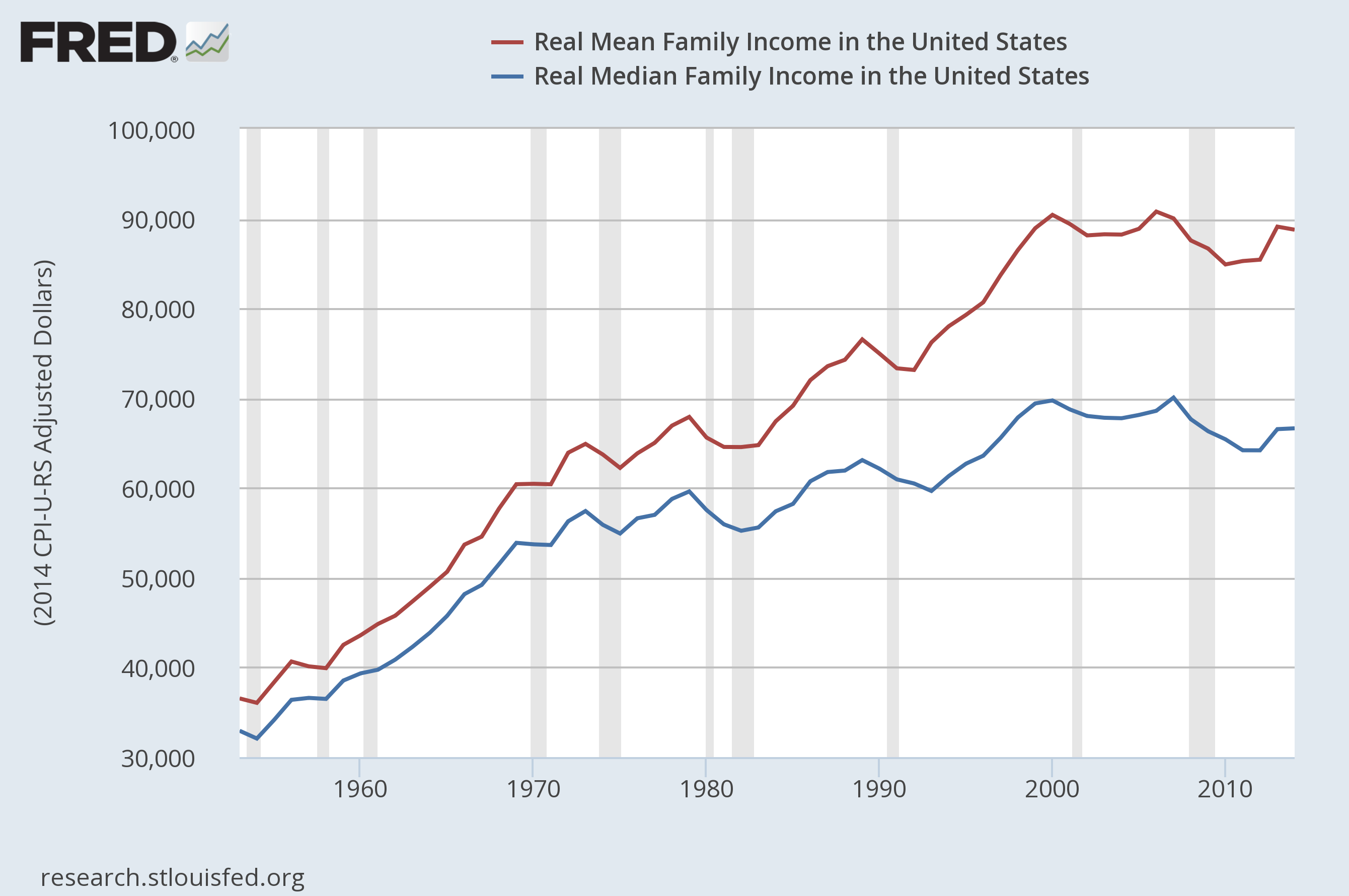
Here’s a more impartial way of looking at the situation, the most obvious, pre-theoretical way of looking at inequality: What has happened to mean income versus median income?

As a refresher from intro statistics, the mean is what you get by adding up the total money and dividing by the number of people; the median is what a person in the exact middle has. So for example if there are three people in a room, one makes $20,000, the second makes $50,000, and the third is Bill Gates making $10,000,000,000, then the mean income is $3,333,333,356 but the median income is $50,000. In a distribution similar to the power-law distribution that incomes generally fall into, the mean is usually higher than the median, and how much higher is a measure of how much inequality there is. (In my example, the mean is much higher, because there’s huge inequality with Bill Gates in the room.) This confuses people, because when people say “the average”, they usually intend the mean; but when they say “the average person”, they usually intend the median. The average person in my three-person example makes $50,000, but the average income is $3.3 billion.

So if we look at mean income versus median income in the US over time, this is what we see:

median_mean

In 1953, mean household income was $36,535 and median household income was $32,932. Mean income was therefore 10.9% higher than median income.

In 2013, mean household income was $88,765 and median income was $66,632. Mean household income was therefore 33.2% higher than median income.

That, my dear readers, is a substantial increase in inequality. To be fair, it’s also a substantial increase in standard of living; these figures are already adjusted for inflation, so the average family really did see their standard of living roughly double during that period.

But this also isn’t the whole story.

First, notice that real median household income is actually about 5% lower now than it was in 2007. Real mean household income is also lower than its peak in 2006, but only by about 2%. This is why in a real sense we are still in the Second Depression; income for most people has not retained its pre-recession peak.

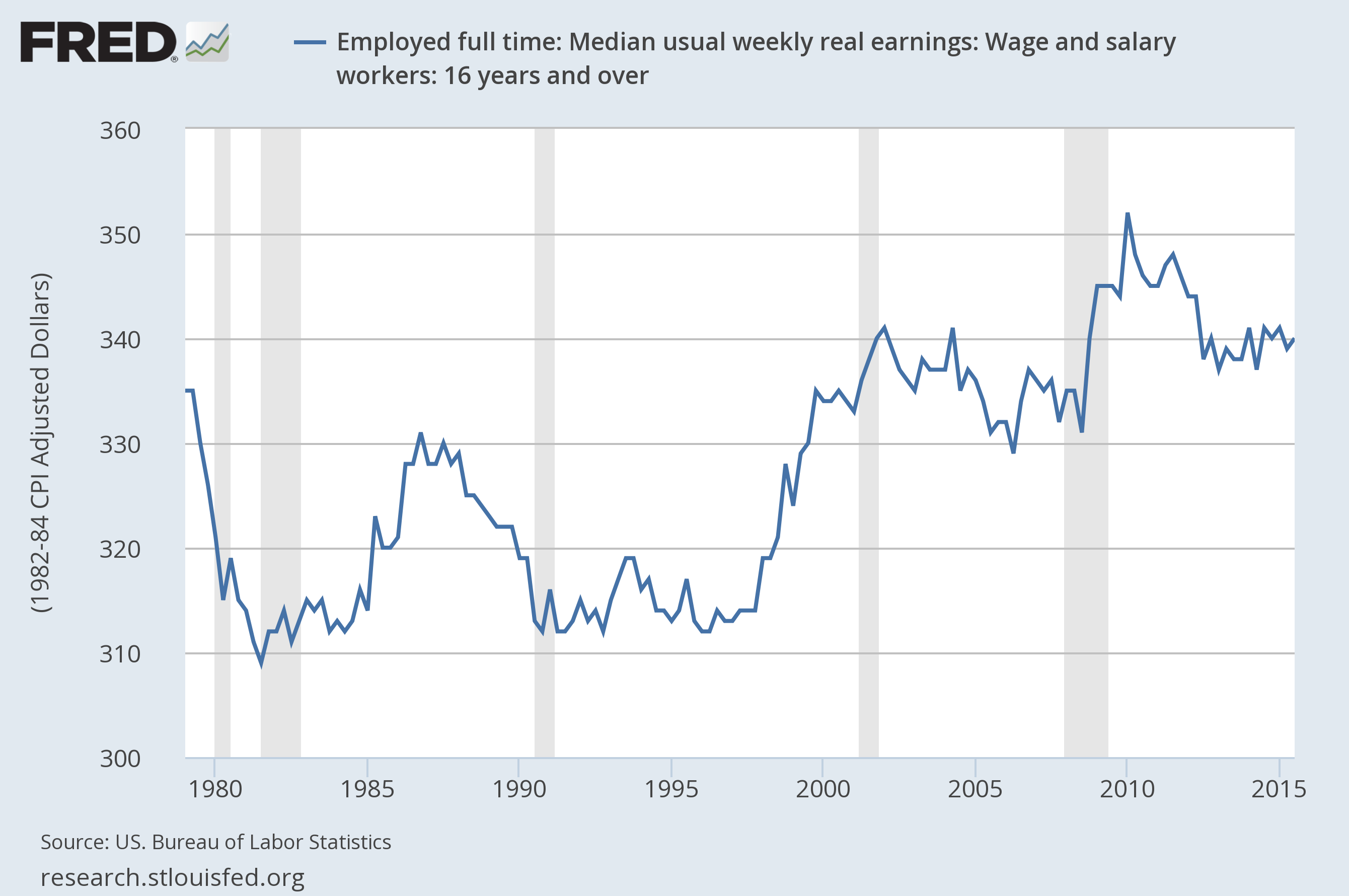
Furthermore, real median earnings for full-time employees have not meaningfully increased over the last 35 years; in 1982 dollars, they were $335 in 1979 and they are $340 now:

median_earnings

At first I thought this was because people were working more hours, but that doesn’t seem to be true; average weekly hours of work have fallen from 38.2 to 33.6:

weekly_hours

The main reason seems to be actually that women are entering the workforce, so more households have multiple full-time incomes; while only 43% of women were in the labor force in 1970, almost 57% are now.

women_labor_force

I must confess to a certain confusion on this point, however, as the difference doesn’t seem to be reflected in any of the measures of personal income. Median personal income was about 41% of median family income in 1974, and now it’s about 43%. I’m not sure exactly what’s going on here.

personal_household

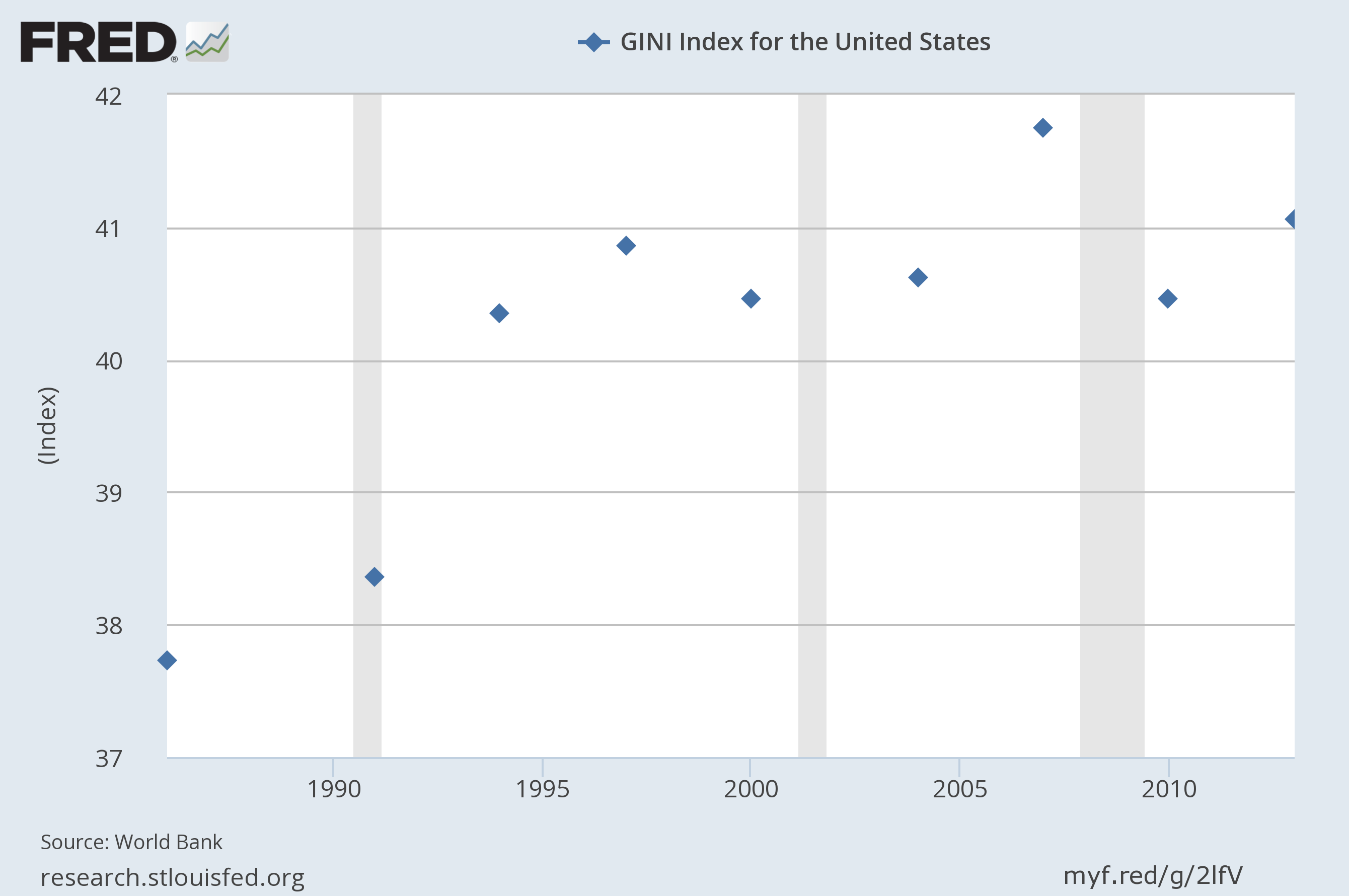
The Gini index, a standard measure of income inequality, is only collected every few years, yet shows a clear rising trend from 37% in 1986 to 41% in 2013:

GINI

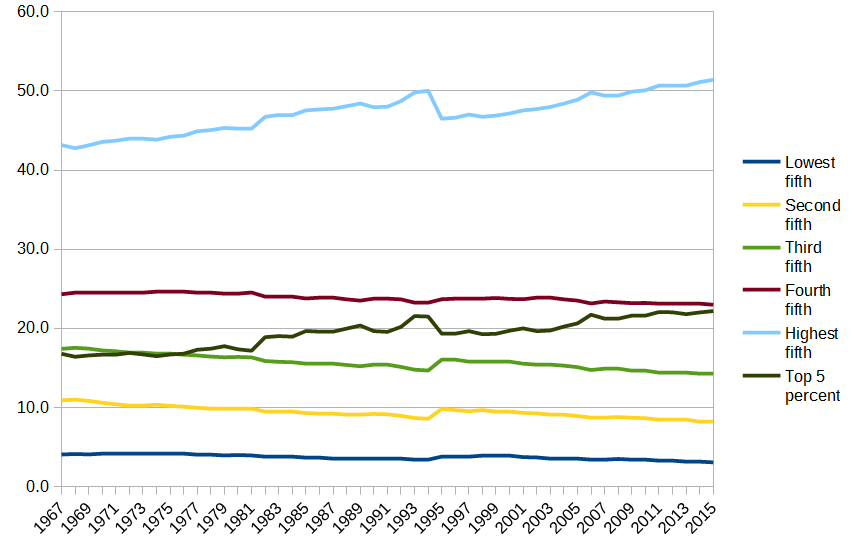
But perhaps the best way to really grasp our rising inequality is to look at the actual proportions of income received by each portion of the population.

This is what it looks like if you use US Census data, broken down by groups of 20% and the top 5%; notice how since 1977 the top 5% have taken in more than the 40%-60% bracket, and they are poised to soon take in more than the 60%-80% bracket as well:

income_quintiles

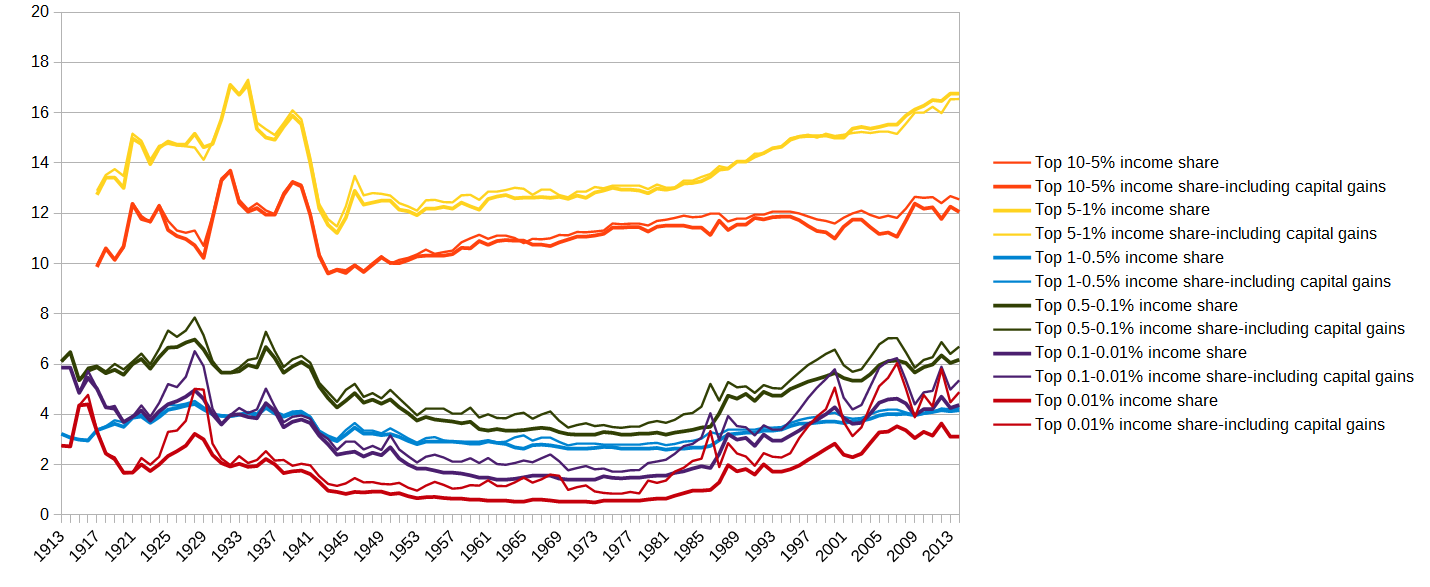
The result is even more striking if you use the World Top Incomes Database. You can watch the share of income rise for the top 10%, 5%, 1%, 0.1%, and 0.01%:

top_income_shares

But in fact it’s even worse than it sounds. What I’ve just drawn double-counts a lot of things; it includes the top 0.01% in the top 0.1%, which is in turn included in the top 1%, and so on. If you exclude these, so that we’re only looking at the people in the top 10% but not the top 5%, the people in the top 5% but not the top 1%, and so on, something even more disturbing happens:

top_income_shares_adjusted

While the top 10% does see some gains, the top 5% gains faster, and the gains accrue even faster as you go up the chain.

Since 1970, the top 10%-5% share grew 10%. The top 0.01% share grew 389%.

Year

Top 10-5% share

Top 10-5% share incl. cap. gains

Top 5-1% share

Top 5-1% share incl cap. gains

Top 1-0.5% share

Top 1-0.5% share incl. cap. gains

Top 0.5-0.1% share

Top 0.5-0.1% share incl. cap. gains

Top 0.1-0.01% share

Top 0.1-0.01% share incl. cap. gains

Top 0.01% share

Top 0.01% share incl. cap. gains

1970

11.13

10.96

12.58

12.64

2.65

2.77

3.22

3.48

1.41

1.78

0.53

1

2014

12.56

12.06

16.78

16.55

4.17

4.28

6.18

6.7

4.38

5.36

3.12

4.89

Relative gain

12.8%

10.0%

33.4%

30.9%

57.4%

54.5%

91.9%

92.5%

210.6%

201.1%

488.7%

389.0%

To be clear, these are relative gains in shares. Including capital gains, the share of income received by the top 10%-5% grew from 10.96% to 12.06%, a moderate increase. The share of income received by the top 0.01% grew from 1.00% to 4.89%, a huge increase. (Yes, the top 0.01% now receive almost 5% of the income, making them on average almost 500 times richer than the rest of us.)

The pie has been getting bigger, which is a good thing. But the rich are getting an ever-larger piece of that pie, and the piece the very rich get is expanding at an alarming rate.

It’s certainly a reasonable question what is causing this rise in inequality, and what can or should be done about it. By people like the AEI try to pretend it doesn’t even exist, and that’s not economic policy analysis; that’s just plain denial.

Meanwhile, we’ve been ending world hunger.

JDN 2457303 EDT 19:56

As reported in The Washington Post and Fortune, the World Bank recently released a report showing that for the first time on record—possibly the first time in human history—global extreme poverty has fallen below 10% of the population. Based on a standard of living of $1.90 per day at 2011 purchasing power parity—that’s about $700 per year, a bit less than the average income in Malawi.

The UN World Millennium Development Goal set in 1990 was to cut extreme poverty in half by 2015; in fact we have cut it by more than two-thirds, reducing it from 37% of the world’s population in 1990 to 9.6% today. This is an estimate, based upon models of what’s going on in countries where we don’t have reliable data; ever the cautious scientists, the World Bank prefers to focus on the most recent fully reliable data, which says that we reduced extreme poverty to 12.7% in 2012 and therefore achieved the Millennium Development Goal.

Most of this effect comes from one very big country: China. Over 750 million people in China saw their standard of living rise above the extreme poverty level in the last 30 years.
The slowest reduction in poverty has been in Africa, specifically Sub-Saharan Africa, where extreme poverty has barely budged, from 53% in 1981 to 47% in 2011. But some particular countries in Africa have done better; thanks to good governance—including better free speech protection than the United States, shame on us—Botswana has reduced their extreme poverty rate from over 50% in 1965 to 19% today.

A lot of World Bank officials have been focusing on the fact that there is still much to be done; 10% in extreme poverty is still 10% too many, and even once everyone is above $1.90 per day that still leaves a lot of people at $3 per day and $4 per day which is still pretty darn poor. The project of global development won’t really seem complete until everyone in the world lives above not just the global poverty line, but something more like a First World poverty line, with a home to live in, a doctor to see, a school to attend, clean water, flush toilets, electricity, and probably even a smartphone with Internet access. (If the latter seems extravagant, let me remind you that more people in the world have smartphones than have flush toilets, because #weliveinthefuture.)

Pace the Heritage Foundation, the fact that what we call poverty in America typically includes having a refrigerator, a microwave, and a car doesn’t mean it isn’t actually poverty; it simply means that poverty in the First World isn’t nearly as bad as poverty in the Third World. (After all, over 9% of children in the US live in households with low food security, and 1% live in households with very low food security; hunger in America isn’t as bad as hunger in Malawi, but it’s still hunger.) Maybe it even means we should focus on the Third World, though that argument isn’t as strong as it might appear; to eliminate poverty in the US, all we’d need to do is pass a law that implements a basic income. To eliminate poverty worldwide, we’d need a global project of economic and political reforms to change how hundreds of countries are governed.

Yet, this focus on what we haven’t accomplished (as though we were going to cut funding to the UN Development Program because we’re done now or something) is not only disheartening, it’s unreasonable. We have accomplished something truly spectacular.

We are now on the verge of solving on one of the great problems of human existence, a problem so deep, so ancient, and so fundamental that it’s practically a cliche: We say “end world hunger” in the same breath as “cure cancer” (which doesn’t even make sense) or “conquer death” (which is not as far off as you may think). Yet, in a very real sense, we are on the verge of ending world hunger.

While most people have been focused on other things, from a narcissistic billionaire running for President to the uniquely American tragedy of mass shootings, development economists have been focused on one thing: Conquering global poverty. What this report means is that now, at last, victory is within our grasp.

Development economists are unsung heroes; without their research, their field work, and their advice and pressure to policymakers, we would never have gotten this far. It was development economists who made the UN Millennium Development Goals, and development economists who began to achieve them.

Yet perhaps there is an even more unsung hero in all of this: Capitalism.

I often have a lot of criticisms of capitalism, at least as it operates in the real world; yet it was in the real world that extreme poverty was just brought down below 10%, and it was done primarily by capitalism. I know a lot of people who think that we need to tear down this whole system and replace it with something fundamentally different, but the kind of progress we are making in global development tells me that we need nothing of the sort. We do need to make changes in policy, but they are small changes, simple changes—many of them could be made with the passing of a few simple laws. Capitalism is not fundamentally broken; on the contrary, it is the fundamentals of capitalism that have brought humanity for the first time within arm’s reach of ending world hunger. We need to fix the system at the edges, not throw it away.

Recall that I said most of the poverty reduction occurred in China. What has China been doing lately? They’ve been opening to world trade—that “free trade” stuff I talked about before. They’ve been cutting tariffs. They’ve been privatizing industries. They’ve been letting unprofitable businesses fail so that new ones can rise in their place. They have, in short, been making themselves more capitalist. Building schools, factories, and yes, even sweatshops is what has made China’s rise out of poverty possible. They are still doing many things wrong—not least their authoritarian government, which is now gamifying oppression in truly cyberpunk fashion—but they are doing a few very important things right.

World hunger is on the way out. And I can think of no better reason to celebrate.

The Warren Rule is a good start

JDN 2457243 EDT 10:40.

As far back as 2010, Elizabeth Warren proposed a simple regulation on the reporting of CEO compensation that was then built into Dodd-Frank—but the SEC has resisted actually applying that rule for five years; only now will it actually take effect (and by “now” I mean over the next two years). For simplicity I’ll refer to that rule as the Warren Rule, though I don’t see a lot of other people doing that (most people don’t give it a name at all).

Two things are important to understand about this rule, which both undercut its effectiveness and make all the right-wing whinging about it that much more ridiculous.

1. It doesn’t actually place any limits on CEO compensation or employee salaries; it merely requires corporations to consistently report the ratio between them. Specifically, the rule says that every publicly-traded corporation must report the ratio between the “total compensation” of their CEO and the median salary (with benefits) of their employees; wisely, it includes foreign workers (with a few minor exceptions—lobbyists fought for more but fortunately Warren stood firm), so corporations can’t simply outsource everything but management to make it look like they pay their employees more. Unfortunately, it does not include contractors, which is awful; expect to see corporations working even harder to outsource their work to “contractors” who are actually employees without benefits (not that they weren’t already). The greatest victory here will be for economists, who now will have more reliable data on CEO compensation; and for consumers, who will now find it more salient just how overpaid America’s CEOs really are.

2. While it does wisely cover “total compensation”, that isn’t actually all the money that CEOs receive for owning and operating corporations. It includes salaries, bonuses, benefits, and newly granted stock options—it does not include the value of stock options previously exercised or dividends received from stock the CEO already owns.

TIME screwed this up; they took at face value when Larry Page reported a $1 “total compensation”, which technically is true by how “total compensation” is defined; he received a $1 token salary and no new stock awards. But Larry Page has net wealth of over $38 billion; about half of that is Google stock, so even if we ignore all others, on Google’s PE ratio of about 25, Larry Page received at least $700 million in Google retained earnings alone. (In my personal favorite unit of wealth, Page receives about 3 romneys a year in retained earnings.) No, TIME, he is not the lowest-paid CEO in the world; he has simply structured his income so that it comes entirely from owning shares instead of receiving a salary. Most top CEOs do this, so be wary when it says a Fortune 500 CEO received only $2 million, and completely ignore it when it says a CEO received only $1. Probably in the former case and definitely in the latter, their real money is coming from somewhere else.

Of course, the complaints about how this is an unreasonable demand on businesses are totally absurd. Most of them keep track of all this data anyway; it’s simply a matter of porting it from one spreadsheet to another. (I also love the argument that only “idiosyncratic investors” will care; yeah, what sort of idiot would care about income inequality or be concerned how much of their investment money is going directly to line a single person’s pockets?) They aren’t complaining because it will be a large increase in bureaucracy or a serious hardship on their businesses; they’re complaining because they think it might work. Corporations are afraid that if they have to publicly admit how overpaid their CEOs are, they might actually be pressured to pay them less. I hope they’re right.

CEO pay is set in a very strange way; instead of being based on an estimate of how much they are adding to the company, a CEO’s pay is typically set as a certain margin above what the average CEO is receiving. But then as the process iterates and everyone tries to be above average, pay keeps rising, more or less indefinitely. Anyone with a basic understanding of statistics could have seen this coming, but somehow thousands of corporations didn’t—or else simply didn’t care.

Most people around the world want the CEO-to-employee pay ratio to be dramatically lower than it is. Indeed, unrealistically lower, in my view. Most countries say only 6 to 1, while Scandinavia says only 2 to 1. I want you to think about that for a moment; if the average employee at a corporation makes $50,000, people in Scandinavia think the CEO should only make $100,000, and people elsewhere think the CEO should only make $300,000? I’m honestly not sure what would happen to our economy if we made such a rule. There would be very little incentive to want to become a CEO; why bear all that fierce competition and get blamed for everything to make only twice as much as you would as an average employee?

On the other hand, most CEOs don’t actually do all that much; CEO pay is basically uncorrelated with company performance. Maybe it would be better if they weren’t paid very much, or even if we didn’t have them at all. But under our current system, capping CEO pay also caps the pay of basically everyone else; the CEO is almost always the highest-paid individual in any corporation.

I guess that’s really the problem. We need to find ways to change the overall attitude of our society that higher authority necessarily comes with higher pay; that isn’t a rational assessment of marginal productivity, it’s a recapitulation of our primate instincts for a mating hierarchy. He’s the alpha male, of course he gets all the bananas.

The president of a university should make next to nothing compared to the top scientists at that university, because the president is a useless figurehead and scientists are the foundation of universities—and human knowledge in general. Scientists are actually the one example I can think of where one individual trulycan be one million times as productive as another—though even then I don’t think that justifies paying them one million times as much.

Most corporations should be structured so that managers make moderate incomes and the highest incomes go to engineers and designers, the people who have the highest skills and do the most important work. A car company without managers seems like an interesting experiment in employee ownership. A car company without engineers seems like an oxymoron.

Finally, people who work in finance should make very low incomes, because they don’t actually do very much. Bank tellers are probably paid about what they should be; stock traders and hedge fund managers should be paid like bank tellers. (Or rather, there shouldn’t be stock traders and hedge funds as we know them; this is all pure waste. A really efficient financial system would be extremely simple, because finance actually is very simple—people who have money loan it to people who need it, and in return receive more money later. Everything else is just elaborations on that, and most of these elaborations are really designed to obscure, confuse, and manipulate.)

Oddly enough, the place where we do this best is the nation as a whole; the President of the United States would be astonishingly low-paid if we thought of him as a CEO. Only about $450,000 including expense accounts, for a “corporation” with revenue of nearly $3 trillion? (Suppose instead we gave the President 1% of tax revenue; that would be $30 billion per year. Think about how absurdly wealthy our leaders would be if we gave them stock options, and be glad that we don’t do that.)

But placing a hard cap at 2 or even 6 strikes me as unreasonable. Even during the 1950s the ratio was about 20 to 1, and it’s been rising ever since. I like Robert Reich’s proposal of a sliding scale of corporate taxes; I also wouldn’t mind a hard cap at a higher figure, like 50 or 100. Currently the average CEO makes about 350 times as much as the average employee, so even a cap of 100 would substantially reduce inequality.
A pay ratio cap could actually be a better alternative to a minimum wage, because it can adapt to market conditions. If the economy is really so bad that you must cut the pay of most of your workers, well, you’d better cut your own pay as well. If things are going well and you can afford to raise your own pay, your workers should get a share too. We never need to set some arbitrary amount as the minimum you are allowed to pay someone—but if you want to pay your employees that little, you won’t be paid very much yourself.

The biggest reason to support the Warren Rule, however, is awareness. Most people simply have no idea of how much CEOs are actually paid. When asked to estimate the ratio between CEO and employee pay, most people around the world underestimate by a full order of magnitude.

Here are some graphs from a sampling of First World countries. I used data from this paper in Perspectives on Psychological Sciencethe fact that it’s published in a psychology journal tells you a lot about the academic turf wars involved in cognitive economics.

The first shows the absolute amount of average worker pay (not adjusted for purchasing power) in each country. Notice how the US is actually near the bottom, despite having one of the strongest overall economies and not particularly high purchasing power:

worker_pay

The second shows the absolute amount of average CEO pay in each country; I probably don’t even need to mention how the US is completely out of proportion with every other country.

CEO_pay

And finally, the ratio of the two. One of these things is not like the other ones…

CEO_worker_ratio

So obviously the ratio in the US is far too high. But notice how even in Poland, the ratio is still 28 to 1. In order to drop to the 6 to 1 ratio that most people seem to think would be ideal, we would need to dramatically reform even the most equal nations in the world. Denmark and Norway should particularly think about whether they really believe that 2 to 1 is the proper ratio, since they are currently some of the most equal (not to mention happiest) nations in the world, but their current ratios are still 48 and 58 respectively. You can sustain a ratio that high and still have universal prosperity; every adult citizen in Norway is a millionaire in local currency. (Adjusting for purchasing power, it’s not quite as impressive; instead the guaranteed wealth of a Norwegian citizen is “only” about $100,000.)

Most of the world’s population simply has no grasp of how extreme economic inequality has become. Putting the numbers right there in people’s faces should help with this, though if the figures only need to be reported to investors that probably won’t make much difference. But hey, it’s a start.

Nature via Nurture

JDN 2457222 EDT 16:33.

One of the most common “deep questions” human beings have asked ourselves over the centuries is also one of the most misguided, the question of “nature versus nurture”: Is it genetics or environment that makes us what we are?

Humans are probably the single entity in the universe for which this question makes least sense. Artificial constructs have no prior existence, so they are “all nurture”, made what we choose to make them. Most other organisms on Earth behave accordingly to fixed instinctual programming, acting out a specific series of responses that have been honed over millions of years, doing only one thing, but doing it exceedingly well. They are in this sense “all nature”. As the saying goes, the fox knows many things, but the hedgehog knows one very big thing. Most organisms on Earth are in this sense hedgehogs, but we Homo sapiens are the ultimate foxes. (Ironically, hedgehogs are not actually “hedgehogs” in this sense: Being mammals, they have an advanced brain capable of flexibly responding to environmental circumstances. Foxes are a good deal more intelligent still, however.)

But human beings are by far the most flexible, adaptable organism on Earth. We live on literally every continent; despite being savannah apes we even live deep underwater and in outer space. Unlike most other species, we do not fit into a well-defined ecological niche; instead, we carve our own. This certainly has downsides; human beings are ourselves a mass extinction event.

Does this mean, therefore, that we are tabula rasa, blank slates upon which anything can be written?

Hardly. We’re more like word processors. Staring (as I of course presently am) at the blinking cursor of a word processor on a computer screen, seeing that wide, open space where a virtual infinity of possible texts could be written, depending entirely upon a sequence of miniscule key vibrations, you could be forgiven for thinking that you are looking at a blank slate. But in fact you are looking at the pinnacle of thousands of years of technological advancement, a machine so advanced, so precisely engineered, that its individual components are one ten-thousandth the width of a human hair (Intel just announced that we can now do even better than that). At peak performance, it is capable of over 100 billion calculations per second. Its random-access memory stores as much information as all the books on a stacks floor of the Hatcher Graduate Library, and its hard drive stores as much as all the books in the US Library of Congress. (Of course, both libraries contain digital media as well, exceeding anything my humble hard drive could hold by a factor of a thousand.)

All of this, simply to process text? Of course not; word processing is an afterthought for a processor that is specifically designed for dealing with high-resolution 3D images. (Of course, nowadays even a low-end netbook that is designed only for word processing and web browsing can typically handle a billion calculations per second.) But there the analogy with humans is quite accurate as well: Written language is about 10,000 years old, while the human visual mind is at least 100,000. We were 3D image analyzers long before we were word processors. This may be why we say “a picture is worth a thousand words”; we process each with about as much effort, even though the image necessarily contains thousands of times as many bits.

Why is the computer capable of so many different things? Why is the human mind capable of so many more? Not because they are simple and impinged upon by their environments, but because they are complex and precision-engineered to nonlinearly amplify tiny inputs into vast outputs—but only certain tiny inputs.

That is, it is because of our nature that we are capable of being nurtured. It is precisely the millions of years of genetic programming that have optimized the human brain that allow us to learn and adapt so flexibly to new environments and form a vast multitude of languages and cultures. It is precisely the genetically-programmed humanity we all share that makes our environmentally-acquired diversity possible.

In fact, causality also runs the other direction. Indeed, when I said other organisms were “all nature” that wasn’t right either; for even tightly-programmed instincts are evolved through millions of years of environmental pressure. Human beings have even been involved in cultural interactions long enough that it has begun to affect our genetic evolution; the reason I can digest lactose is that my ancestors about 10,000 years ago raised goats. We have our nature because of our ancestors’ nurture.

And then of course there’s the fact that we need a certain minimum level of environmental enrichment even to develop normally; a genetically-normal human raised into a deficient environment will suffer a kind of mental atrophy, as when children raised feral lose their ability to speak.

Thus, the question “nature or nurture?” seems a bit beside the point: We are extremely flexible and responsive to our environment, because of innate genetic hardware and software, which requires a certain environment to express itself, and which arose because of thousands of years of culture and millions of years of the struggle for survival—we are nurture because nature because nurture.

But perhaps we didn’t actually mean to ask about human traits in general; perhaps we meant to ask about some specific trait, like spatial intelligence, or eye color, or gender identity. This at least can be structured as a coherent question: How heritable is the trait? What proportion of the variance in this population is caused by genetic variation? Heritability analysis is a well-established methodology in behavioral genetics.
Yet, that isn’t the same question at all. For while height is extremely heritable within a given population (usually about 80%), human height worldwide has been increasing dramatically over time due to environmental influences and can actually be used as a measure of a nation’s economic development. (Look at what happened to the height of men in Japan.) How heritable is height? You have to be very careful what you mean.

Meanwhile, the heritability of neurofibromatosis is actually quite low—as many people acquire the disease by new mutations as inherit it from their parents—but we know for a fact it is a genetic disorder, because we can point to the specific genes that mutate to cause the disease.

Heritability also depends on the population under consideration; speaking English is more heritable within the United States than it is across the world as a whole, because there are a larger proportion of non-native English speakers in other countries. In general, a more diverse environment will lead to lower heritability, because there are simply more environmental influences that could affect the trait.

As children get older, their behavior gets more heritablea result which probably seems completely baffling, until you understand what heritability really means. Your genes become a more important factor in your behavior as you grow up, because you become separated from the environment of your birth and immersed into the general environment of your whole society. Lower environmental diversity means higher heritability, by definition. There’s also an effect of choosing your own environment; people who are intelligent and conscientious are likely to choose to go to college, where they will be further trained in knowledge and self-control. This latter effect is called niche-picking.

This is why saying something like “intelligence is 80% genetic” is basically meaningless, and “intelligence is 80% heritable” isn’t much better until you specify the reference population. The heritability of intelligence depends very much on what you mean by “intelligence” and what population you’re looking at for heritability. But even if you do find a high heritability (as we do for, say, Spearman’s g within the United States), this doesn’t mean that intelligence is fixed at birth; it simply means that parents with high intelligence are likely to have children with high intelligence. In evolutionary terms that’s all that matters—natural selection doesn’t care where you got your traits, only that you have them and pass them to your offspring—but many people do care, and IQ being heritable because rich, educated parents raise rich, educated children is very different from IQ being heritable because innately intelligent parents give birth to innately intelligent children. If genetic variation is systematically related to environmental variation, you can measure a high heritability even though the genes are not directly causing the outcome.

We do use twin studies to try to sort this out, but because identical twins raised apart are exceedingly rare, two very serious problems emerge: One, there usually isn’t a large enough sample size to say anything useful; and more importantly, this is actually an inaccurate measure in terms of natural selection. The evolutionary pressure is based on the correlation with the genes—it actually doesn’t matter whether the genes are directly causal. All that matters is that organisms with allele X survive and organisms with allele Y do not. Usually that’s because allele X does something useful, but even if it’s simply because people with allele X happen to mostly come from a culture that makes better guns, that will work just as well.

We can see this quite directly: White skin spread across the world not because it was useful (it’s actually terrible in any latitude other than subarctic), but because the cultures that conquered the world happened to be comprised mostly of people with White skin. In the 15th century you’d find a very high heritability of “using gunpowder weapons”, and there was definitely a selection pressure in favor of that trait—but it obviously doesn’t take special genes to use a gun.

The kind of heritability you get from twin studies is answering a totally different, nonsensical question, something like: “If we reassigned all offspring to parents randomly, how much of the variation in this trait in the new population would be correlated with genetic variation?” And honestly, I think the only reason people think that this is the question to ask is precisely because even biologists don’t fully grasp the way that nature and nurture are fundamentally entwined. They are trying to answer the intuitive question, “How much of this trait is genetic?” rather than the biologically meaningful “How strongly could a selection pressure for this trait evolve this gene?”

And if right now you’re thinking, “I don’t care how strongly a selection pressure for the trait could evolve some particular gene”, that’s fine; there are plenty of meaningful scientific questions that I don’t find particularly interesting and are probably not particularly important. (I hesitate to provide a rigid ranking, but I think it’s safe to say that “How does consciousness arise?” is a more important question than “Why are male platypuses venomous?” and “How can poverty be eradicated?” is a more important question than “How did the aircraft manufacturing duopoly emerge?”) But that’s really the most meaningful question we can construct from the ill-formed question “How much of this trait is genetic?” The next step is to think about why you thought that you were asking something important.

What did you really mean to ask?

For a bald question like, “Is being gay genetic?” there is no meaningful answer. We could try to reformulate it as a meaningful biological question, like “What is the heritability of homosexual behavior among males in the United States?” or “Can we find genetic markers strongly linked to self-identification as ‘gay’?” but I don’t think those are the questions we really meant to ask. I think actually the question we meant to ask was more fundamental than that: Is it legitimate to discriminate against gay people? And here the answer is unequivocal: No, it isn’t. It is a grave mistake to think that this moral question has anything to do with genetics; discrimination is wrong even against traits that are totally environmental (like religion, for example), and there are morally legitimate actions to take based entirely on a person’s genes (the obvious examples all coming from medicine—you don’t treat someone for cystic fibrosis if they don’t actually have it).

Similarly, when we ask the question “Is intelligence genetic?” I don’t think most people are actually interested in the heritability of spatial working memory among young American males. I think the real question they want to ask is about equality of opportunity, and what it would look like if we had it. If success were entirely determined by intelligence and intelligence were entirely determined by genetics, then even a society with equality of opportunity would show significant inequality inherited across generations. Thus, inherited inequality is not necessarily evidence against equality of opportunity. But this is in fact a deeply disingenuous argument, used by people like Charles Murray to excuse systemic racism, sexism, and concentration of wealth.

We didn’t have to say that inherited inequality is necessarily or undeniably evidence against equality of opportunity—merely that it is, in fact, evidence of inequality of opportunity. Moreover, it is far from the only evidence against equality of opportunity; we also can observe the fact that college-educated Black people are no more likely to be employed than White people who didn’t even finish high school, for example, or the fact that otherwise identical resumes with predominantly Black names (like “Jamal”) are less likely to receive callbacks compared to predominantly White names (like “Greg”). We can observe that the same is true for resumes with obviously female names (like “Sarah”) versus obviously male names (like “David”), even when the hiring is done by social scientists. We can directly observe that one-third of the 400 richest Americans inherited their wealth (and if you look closer into the other two-thirds, all of them had some very unusual opportunities, usually due to their family connections—“self-made” is invariably a great exaggeration). The evidence for inequality of opportunity in our society is legion, regardless of how genetics and intelligence are related. In fact, I think that the high observed heritability of intelligence is largely due to the fact that educational opportunities are distributed in a genetically-biased fashion, but I could be wrong about that; maybe there really is a large genetic influence on human intelligence. Even so, that does not justify widespread and directly-measured discrimination. It does not justify a handful of billionaires luxuriating in almost unimaginable wealth as millions of people languish in poverty. Intelligence can be as heritable as you like and it is still wrong for Donald Trump to have billions of dollars while millions of children starve.

This is what I think we need to do when people try to bring up a “nature versus nurture” question. We can certainly talk about the real complexity of the relationship between genetics and environment, which I think are best summarized as “nature via nurture”; but in fact usually we should think about why we are asking that question, and try to find the real question we actually meant to ask.

What if you couldn’t own land?

JDN 2457145 EDT 20:49.

Today’s post we’re on the socialism scale somewhere near the The Guess Who, but not quite all the way to John Lennon. I’d like to questions one of the fundamental tenets of modern capitalism, but not the basic concept of private ownership itself:

What if you couldn’t own land?

Many things that you can own were more-or-less straightforwardly created by someone. A car, a computer, a television, a pair of shoes; for today let’s even take for granted intellectual property like books, movies, and songs; at least those things (“things”) were actually made by someone.

But land? We’re talking about chunks of the Earth here. They were here billions of years before us, and in all probability will be here billions of years after we’re gone. There’s no need to incentivize its creation; the vast majority of land was already here and did not need to be created. (I do have to say “the vast majority”, because in places like Japan, Hong Kong, and the Netherlands real estate has become so scarce that people do literally build land out into the sea. But this is something like 0.0001% of the world’s land.)

What we want to incentivize is land development; we want it to be profitable to build buildings and irrigate deserts, and yes, even cut down forests sometimes (though then there should be a carbon tax with credits for forested land to ensure that there isn’t too much incentive). Yet our current property tax system doesn’t do this very well; if you build bigger buildings, you end up paying more property taxes. Yes, you may also make some profit on the buildings—but it’s risky, and you may not get enough benefit to justify the added property taxes.

Moreover, we want to allocate land—we want some way of deciding who is allowed to use what land where and when (and perhaps why). Allowing land to be bought and sold is one way to do that, but it is not the only way.

Indeed, land ownership suffers from a couple of truly glaring flaws as an allocation system:

      1. It creates self-perpetuating inequality. Because land grows in value over time (due to population growth and urbanization, among other things), those who currently own land end up getting an ever-growing quantity of wealth while those who do not own land do not, and very likely end up having to pay ever-growing rents to the landlords. (I like calling them “landlords”; it really drives home the fact that our landholding system is still basically the same as it was under feudalism.) In fact, the recent rise in the share of income that goes to owners of capital rather than workers is almost entirely attributable to the rise in the price of real estate. As that post rightly recognizes, this does nothing to undermine Piketty’s central message of rising inequality due to capital income (pace The Washington Post); it merely tells us to focus on real estate instead of other forms of capital.
      2. It has no non-arbitrary allocation. If we want to decide who owns a car, we can ask questions like, “Who built it? Did someone buy it from them? Did they pay a fair price?”; if we want to decide who owns a book, we can ask questions like, “Who wrote it? Did they sell it to a publisher? What was the royalty rate?” That is, there is a clear original owner, and there is a sense of whether the transfer of ownership can be considered fair. But if we want to decide who owns a chunk of land, basically all we can ask is, “What does the deed say?” The owner is the owner because they are the owner; there’s no sense in which that ownership is fair. We certainly can’t go back to the original creation of the land, because that was due to natural forces gigayears ago. If we keep tracing the ownership backward, we will eventually end up with some guy (almost certainly a man, a White man in fact) with a gun who pointed that gun at other people and said, “This is mine.” This is true of basically all the land in the world (aside from those little bits of Japan and such); it was already there, and the only reason someone got to own it was because they said so and had a bigger gun. And a flag, perhaps: “Do you have a flag?” I suppose, in theory at least, there are a few ways of allocating land which seem less arbitrary: One would be to give everyone an equal amount. But this is practically very difficult: What do you do when the population changes? If you have 2% annual population growth, do you carve off 2% of everybody’s lot each year? Another would be to let people squat land, and automatically own the land that they live on—but again practical difficulties quickly become enormous. In any case, these two methods bear about as much resemblance to our actual allocation of land as a squirrel does to a Tyrannosaurus.

So, what else might we use? The system that makes the most sense to me is that we would own all land as a society. In practical terms this would mean that all land is Federal land, and if you want to use it for something, you need to pay rent to the government. There are many different ways the government could set the rent, but the most sensible might be to charge a flat rate per hectare regardless of where the land is or what it’s being used for, because that would maximize the incentive to develop the land. It would also make the rent fall entirely on the landowner, because the rent would be perfectly inelasticmeaning that you can’t change the quantity you make based on the price, because you aren’t making it; it’s just already sitting there.

Of course, this idea is obviously politically impossible in our current environment—or indeed any foreseeable political environment. I’m just fantasizing here, right?

Well, not quite. There is one thing we could do that would be economically quite similar to government-only land ownership; it’s called a land tax. The idea is incredibly simple: you just collect a flat tax per hectare of land. Economists have known that a land tax is efficient at providing revenue and reducing inequality since at least Adam Smith. So maybe ownership of land isn’t actually foundational to capitalism, after all; maybe we’ve just never fully gotten over feudalism. (I basically agree with Adam Smith, and for doing so I am often called a socialist.) The beautiful thing about a land tax is that it has a tax incidence in which the owners of the land end up bearing the full brunt of the tax.

Tax incidence is something it’s very important to understand; it would be on my list of the top ten economic principles that people should learn. We often have fierce political debates over who will actually write the check: Should employers pay the health insurance premium, or should employees? Will buyers pay sales tax, or sellers? Should we tax corporate profits or personal capital gains?

Please understand that I am not exaggerating when I say that these sorts of questions are totally irrelevant. It simply does not matter who actually writes the check; what matters is who bears the cost. Making the employer pay the health insurance premium doesn’t make the slightest difference if all they’re going to do is cut wages by the exact same amount. You can see the irrelevance of the fact that sellers pay sales tax every time you walk into a store—you always end up paying the price plus the tax, don’t you? (I found that the base price of most items was the same between Long Beach and Ann Arbor, but my total expenditure was always 3% more because of the 9% sales tax versus the 6%.) How do we determine who actually pays the tax? It depends on the elasticity—how easily can you change your behavior in order to avoid the tax? Can you find a different job because the health insurance premiums are too high? No? Then you’re probably paying that premium, even if your employer writes the check. If you can find a new job whenever you want, your employer might have to pay it for you even if you write the check.

The incidence of corporate taxes and taxes on capital gains are even more complicated, because it could affect the behavior of corporations in many different ways; indeed, many economists argue that the corporate tax simply results in higher unemployment or lower wages for workers. I don’t think that’s actually true, but I honestly can’t rule it out completely, precisely because corporate taxes are so complicated. You need to know all sorts of things about the structure of stock markets, and the freedom of trade, and the mobility of immigration… it’s a complete and total mess.

It’s because of tax incidence that a land tax makes so much sense; there’s no way for the landowner to escape it, other than giving up the land entirely. In particular, they can’t charge more for rent without being out-competed (unless landowners are really good at colluding—which might be true for large developers, but not individual landlords). Their elasticity is so low that they’re forced to bear the full cost of the tax.

If the land tax were high enough, it could eliminate the automatic growth in wealth that comes from holding land, and thereby reducing long-run inequality dramatically. The revenue could be used for my other favorite fiscal policy, the basic income—and real estate is a big enough part of our nation’s wealth that it’s actually entirely realistic to fund an $8,000 per person per year basic income entirely on land tax revenue. The total value of US land is about $14 trillion, and an $8,000 basic income for 320 million people would cost about $2.6 trillion; that’s only 19%. You’d actually want to make it a flat tax per hectare, so how much would that be? Well, 60% of US land is privately owned at present (no sense taxing the land the government already owns), and total US land area is about 9 million square kilometers, so to raise $2.5 trillion you’d need a tax of $289,000 per square kilometer, or $2,890 per hectare. If you own a hectare—which is bigger than most single-family lots—you’d only pay $2,890 per year in land tax, well within what most middle-class families could handle. But if you own 290,000 acres like Jeff Bezos, (that’s 117,000 hectares) you’re paying $338 million per year. Since Jeff Bezos has about $38 billion in net wealth, he can actually afford to pay that ($338 million per year is about one-tenth of what Jeff Bezos makes automatically on dividends), though he might consider selling off some of the land to avoid the taxes, which is exactly the sort of incentive we wanted to create.

Indeed, when I contemplate this policy I’m struck by the fact that it has basically no downside—usually in public policy you’re forced to make hard compromises and tradeoffs, but a land tax plus basic income is a system that carries almost no downsides at all. It won’t disincentivize investment, it won’t disincentivize working, it will dramatically reduce inequality, it will save the government a great deal of money on social welfare spending, and best of all it will eliminate poverty immediately and forever. The only people it would hurt at all are extremely rich, and they wouldn’t even be hurt very much, while it would benefit millions of people including some of the most needy.

Why aren’t we doing this already!?

Beware the false balance

JDN 2457046 PST 13:47.

I am now back in Long Beach, hence the return to Pacific Time. Today’s post is a little less economic than most, though it’s certainly still within the purview of social science and public policy. It concerns a question that many academic researchers and in general reasonable, thoughtful people have to deal with: How do we remain unbiased and nonpartisan?

This would not be so difficult if the world were as the most devoted “centrists” would have you believe, and it were actually the case that both sides have their good points and bad points, and both sides have their scandals, and both sides make mistakes or even lie, so you should never take the side of the Democrats or the Republicans but always present both views equally.

Sadly, this is not at all the world in which we live. While Democrats are far from perfect—they are human beings after all, not to mention politicians—Republicans have become completely detached from reality. As Stephen Colbert has said, “Reality has a liberal bias.” You know it’s bad when our detractors call us the reality-based community. Treating both sides as equal isn’t being unbiased—it’s committing a balance fallacy.

Don’t believe me? Here is a list of objective, scientific facts that the Republican Party (and particularly its craziest subset, the Tea Party) has officially taken political stances against:

  1. Global warming is a real problem, and largely caused by human activity. (The Republican majority in the Senate voted down a resolution acknowledging this.)
  2. Human beings share a common ancestor with chimpanzees. (48% of Republicans think that we were created in our present form.)
  3. Animals evolve over time due to natural selection. (Only 43% of Republicans believe this.)
  4. The Earth is approximately 4.5 billion years old. (Marco Rubio said he thinks maybe the Earth was made in seven days a few thousand years ago.)
  5. Hydraulic fracturing can trigger earthquakes.(Republican in Congress are trying to nullify local regulations on fracking because they insist it is so safe we don’t even need to keep track.)
  6. Income inequality in the United States is the worst it has been in decades and continues to rise. (Mitt Romney said that the concern about income inequality is just “envy”.)
  7. Progressive taxation reduces inequality without adversely affecting economic growth. (Here’s a Republican former New York Senator saying that the President “should be ashamed” for raising taxes on—you guessed it—”job creators”.)
  8. Moderate increases in the minimum wage do not yield significant losses in employment. (Republicans consistently vote against even small increases in the minimum wage, and Democrats consistently vote in favor.)
  9. The United States government has no reason to ever default on its debt. (John Boehner, now Speaker of the House, once said that “America is broke” and if we don’t stop spending we’ll never be able to pay the national debt.)
  10. Human embryos are not in any way sentient, and fetuses are not sentient until at least 17 weeks of gestation, probably more like 30 weeks. (Yet if I am to read it in a way that would make moral sense, “Life begins at conception”—which several Republicans explicitly endorsed at the National Right to Life Convention—would have to imply that even zygotes are sentient beings. If you really just meant “alive”, then that would equally well apply to plants or even bacteria. Sentience is the morally relevant category.)

And that’s not even counting the Republican Party’s association with Christianity and all of the objectively wrong scientific claims that necessarily entails—like the existence of an afterlife and the intervention of supernatural forces. Most Democrats also self-identify as Christian, though rarely with quite the same fervor (the last major Democrat I can think of who was a devout Christian was Jimmy Carter), probably because most Americans self-identify as Christian and are hesitant to elect an atheist President (despite the fact that 93% of the National Academy of Sciences is comprised of atheists and the higher your IQ the more likely you are to be an atheist; we wouldn’t want to elect someone who agrees with smart people, now would we?).

It’s true, there are some other crazy ideas out there with a left-wing slant, like the anti-vaccination movement that has wrought epidemic measles upon us, the anti-GMO crowd that rejects basic scientific facts about genetics, and the 9/11 “truth” movement that refuses to believe that Al Qaeda actually caused the attacks. There are in fact far-left Marxists out there who want to tear down the whole capitalist system by glorious revolution and replace it with… er… something (they’re never quite clear on that last point). But none of these things are the official positions of standing members of Congress.

The craziest belief by a standing Democrat I can think of is Dennis Kucinich’s belief that he saw an alien spacecraft. And to be perfectly honest, alien spacecraft are about a thousand times more plausible than Christianity in general, let alone Creationism. There almost certainly are alien spacecraft somewhere in the universe—just most likely so far away we’ll need FTL to encounter them. Moreover, this is not Kucinich’s official position as a member of Congress and it’s not something he has ever made policy based upon.

Indeed, if you’re willing to include the craziest individuals with no real political power who identify with a particular side of the political spectrum, then we should include on the right-wing side people like the Bundy militia in Nevada, neo-Nazis in Detroit, and the dozens of KKK chapters across the US. Not to mention this pastor who wants to murder all gay people in the world (because he truly believes what Leviticus 20:13 actually and clearly says).

If you get to include Marxists on the left, then we get to include Nazis on the right. Or, we could be reasonable and say that only the official positions of elected officials or mainstream pundits actually count, in which case Democrats have views that are basically accurate and reasonable while the majority of Republicans have views that are still completely objectively wrong.

There’s no balance here. For every Democrat who is wrong, there is a Republicans who is totally delusional. For every Democrat who distorts the truth, there is a Republican who blatantly lies about basic facts. Not to mention that for every Democrat who has had an ill-advised illicit affair there is a Republican who has committed war crimes.

Actually war crimes are something a fair number of Democrats have done as well, but the difference still stands out in high relief: Barack Obama has ordered double-tap drone strikes that are in violation of the Geneva Convention, but George W. Bush orchestrated a worldwide mass torture campaign and launched pointless wars that slaughtered hundreds of thousands of people. Bill Clinton ordered some questionable CIA operations, but George H.W. Bush was the director of the CIA.

I wish we had two parties that were equally reasonable. I wish there were two—or three, or four—proposals on the table in each discussion, all of which had merits and flaws worth considering. Maybe if we somehow manage to get the Green Party a significant seat in power, or the Social Democrat party, we can actually achieve that goal. But that is not where we are right now. Right now, we have the Democrats, who have some good ideas and some bad ideas; and then we have the Republicans, who are completely out of their minds.

There is an important concept in political science called the Overton window; it is the range of political ideas that are considered “reasonable” or “mainstream” within a society. Things near the middle of the Overton window are considered sensible, even “nonpartisan” ideas, while things near the edges are “partisan” or “political”, and things near but outside the window are seen as “extreme” and “radical”. Things far outside the window are seen as “absurd” or even “unthinkable”.

Right now, our Overton window is in the wrong place. Things like Paul Ryan’s plan to privatize Social Security and Medicare are seen as reasonable when they should be considered extreme. Progressive income taxes of the kind we had in the 1960s are seen as extreme when they should be considered reasonable. Cutting WIC and SNAP with nothing to replace them and letting people literally starve to death are considered at most partisan, when they should be outright unthinkable. Opposition to basic scientific facts like climate change and evolution is considered a mainstream political position—when in terms of empirical evidence Creationism should be more intellectually embarrassing than being a 9/11 truther or thinking you saw an alien spacecraft. And perhaps worst of all, military tactics like double-tap strikes that are literally war crimes are considered “liberal”, while the “conservative” position involves torture, worldwide surveillance and carpet bombing—if not outright full-scale nuclear devastation.

I want to restore reasonable conversation to our political system, I really do. But that really isn’t possible when half the politicians are totally delusional. We have but one choice: We must vote them out.

I say this particularly to people who say “Why bother? Both parties are the same.” No, they are not the same. They are deeply, deeply different, for all the reasons I just outlined above. And if you can’t bring yourself to vote for a Democrat, at least vote for someone! A Green, or a Social Democrat, or even a Libertarian or a Socialist if you must. It is only by the apathy of reasonable people that this insanity can propagate in the first place.

How is the economy doing?

JDN 2457033 EST 12:22.

Whenever you introduce yourself to someone as an economist, you will typically be asked a single question: “How is the economy doing?” I’ve already experienced this myself, and I don’t have very many dinner parties under my belt.

It’s an odd question, for a couple of reasons: First, I didn’t say I was a macroeconomic forecaster. That’s a very small branch of economics—even a small branch of macroeconomics. Second, it is widely recognized among economists that our forecasters just aren’t very good at what they do. But it is the sort of thing that pops into people’s minds when they hear the word “economist”, so we get asked it a lot.

Why are our forecasts so bad? Some argue that the task is just inherently too difficult due to the chaotic system involved; but they used to say that about weather forecasts, and yet with satellites and computer models our forecasts are now far more accurate than they were 20 years ago. Others have argued that “politics always dominates over economics”, as though politics were somehow a fundamentally separate thing, forever exogenous, a parameter in our models that cannot be predicted. I have a number of economic aphorisms I’m trying to popularize; the one for this occasion is: “Nothing is exogenous.” (Maybe fundamental constants of physics? But actually many physicists think that those constants can be derived from even more fundamental laws.) My most common is “It’s the externalities, stupid.”; next is “It’s not the incentives, it’s the opportunities.”; and the last is “Human beings are 90% rational. But woe betide that other 10%.” In fact, it’s not quite true that all our macroeconomic forecasters are bad; a few, such as Krugman, are actually quite good. The Klein Award is given each year to the best macroeconomic forecasters, and the same names pop up too often for it to be completely random. (Sadly, one of the most common is Citigroup, meaning that our banksters know perfectly well what they’re doing when they destroy our economy—they just don’t care.) So in fact I think our failures of forecasting are not inevitable or permanent.

And of course that’s not what I do at all. I am a cognitive economist; I study how economic systems behave when they are run by actual human beings, rather than by infinite identical psychopaths. I’m particularly interested in what I call the tribal paradigm, the way that people identify with groups and act in the interests of those groups, how much solidarity people feel for each other and why, and what role ideology plays in that identification. I’m hoping to one day formally model solidarity and make directly testable predictions about things like charitable donations, immigration policies and disaster responses.

I do have a more macroeconomic bent than most other cognitive economists; I’m not just interested in how human irrationality affects individuals or corporations, I’m also interested in how it affects society as a whole. But unlike most macroeconomists I care more about inequality than unemployment, and hardly at all about inflation. Unless you start getting 40% inflation per year, inflation really isn’t that harmful—and can you imagine what 40% unemployment would be like? (Also, while 100% inflation is awful, 100% unemployment would be no economy at all.) If we’re going to have a “misery index“, it should weight unemployment at least 10 times as much as inflation—and it should also include terms for poverty and inequality. Frankly maybe we should just use poverty, since I’d be prepared to accept just about any level of inflation, unemployment, or even inequality if it meant eliminating poverty. This is of course is yet another reason why a basic income is so great! An anti-poverty measure can really only be called a failure if it doesn’t actually reduce poverty; the only way that could happen with a basic income is if it somehow completely destabilized the economy, which is extremely unlikely as long as the basic income isn’t something ridiculous like $100,000 per year.

I could probably talk about my master’s thesis; the econometric models are relatively arcane, but the basic idea of correlating the income concentration of the top 1% of 1% and the level of corruption is something most people can grasp easily enough.

Of course, that wouldn’t be much of an answer to “How is the economy doing?”; usually my answer is to repeat what I’ve last read from mainstream macroeconomic forecasts, which is usually rather banal—but maybe that’s the idea? Most small talk is pretty banal I suppose (I never was very good at that sort of thing). It sounds a bit like this: No, we’re not on the verge of horrible inflation—actually inflation is currently too low. (At this point someone will probably bring up the gold standard, and I’ll have to explain that the gold standard is an unequivocally terrible idea on so, so many levels. The gold standard caused the Great Depression.) Unemployment is gradually improving, and actually job growth is looking pretty good right now; but wages are still stagnant, which is probably what’s holding down inflation. We could have prevented the Second Depression entirely, but we didn’t because Republicans are terrible at managing the economy—all of the 10 most recent recessions and almost 80% of the recessions in the last century were under Republican presidents. Instead the Democrats did their best to implement basic principles of Keynesian macroeconomics despite Republican intransigence, and we muddled through. In another year or two we will actually be back at an unemployment rate of 5%, which the Federal Reserve considers “full employment”. That’s already problematic—what about that other 5%?—but there’s another problem as well: Much of our reduction in unemployment has come not from more people being employed but instead by more people dropping out of the labor force. Our labor force participation rate is the lowest it’s been since 1978, and is still trending downward. Most of these people aren’t getting jobs; they’re giving up. At best we may hope that they are people like me, who gave up on finding work in order to invest in their own education, and will return to the labor force more knowledgeable and productive one day—and indeed, college participation rates are also rising rapidly. And no, that doesn’t mean we’re becoming “overeducated”; investment in education, so-called “human capital”, is literally the single most important factor in long-term economic output, by far. Education is why we’re not still in the Stone Age. Physical capital can be replaced, and educated people will do so efficiently. But all the physical capital in the world will do you no good if nobody knows how to use it. When everyone in the world is a millionaire with two PhDs and all our work is done by robots, maybe then you can say we’re “overeducated”—and maybe then you’d still be wrong. Being “too educated” is like being “too rich” or “too happy”.

That’s usually enough to placate my interlocutor. I should probably count my blessings, for I imagine that the first confrontation you get at a dinner party if you say you are a biologist involves a Creationist demanding that you “prove evolution”. I like to think that some mathematical biologists—yes, that’s a thing—take their request literally and set out to mathematically prove that if allele distributions in a population change according to a stochastic trend then the alleles with highest expected fitness have, on average, the highest fitness—which is what we really mean by “survival of the fittest”. The more formal, the better; the goal is to glaze some Creationist eyes. Of course that’s a tautology—but so is literally anything that you can actually prove. Cosmologists probably get similar demands to “prove the Big Bang”, which sounds about as annoying. I may have to deal with gold bugs, but I’ll take them over Creationists any day.

What do other scientists get? When I tell people I am a cognitive scientist (as a cognitive economist I am sort of both an economist and a cognitive scientist after all), they usually just respond with something like “Wow, you must be really smart.”; which I suppose is true enough, but always strikes me as an odd response. I think they just didn’t know enough about the field to even generate a reasonable-sounding question, whereas with economists they always have “How is the economy doing?” handy. Political scientists probably get “Who is going to win the election?” for the same reason. People have opinions about economics, but they don’t have opinions about cognitive science—or rather, they don’t think they do. Actually most people have an opinion about cognitive science that is totally and utterly ridiculous, more on a par with Creationists than gold bugs: That is, most people believe in a soul that survives after death. This is rather like believing that after your computer has been smashed to pieces and ground back into the sand from whence it came, all the files you had on it are still out there somewhere, waiting to be retrieved. No, they’re long gone—and likewise your memories and your personality will be long gone once your brain has rotted away. Yes, we have a soul, but it’s made of lots of tiny robots; when the tiny robots stop working the soul is no more. Everything you are is a result of the functioning of your brain. This does not mean that your feelings are not real or do not matter; they are just as real and important as you thought they were. What it means is that when a person’s brain is destroyed, that person is destroyed, permanently and irrevocably. This is terrifying and difficult to accept; but it is also most definitely true. It is as solid a fact as any in modern science. Many people see a conflict between evolution and religion; but the Pope has long since rendered that one inert. No, the real conflict, the basic fact that undermines everything religion is based upon, is not in biology but in cognitive science. It is indeed the Basic Fact of Cognitive Science: We are our brains, no more and no less. (But I suppose it wouldn’t be polite to bring that up at dinner parties.)

The “You must be really smart.” response is probably what happens to physicists and mathematicians. Quantum mechanics confuses basically everyone, so few dare go near it. The truly bold might try to bring up Schrodinger’s Cat, but are unlikely to understand the explanation of why it doesn’t work. General relativity requires thinking in tensors and four-dimensional spaces—perhaps they’ll be asked the question “What’s inside a black hole?”, which of course no physicist can really answer; the best answer may actually be, “What do you mean, inside?” And if a mathematician tries to explain their work in lay terms, it usually comes off as either incomprehensible or ridiculous: Stokes’ Theorem would be either “the integral of a differential form over the boundary of some orientable manifold is equal to the integral of its exterior derivative over the whole manifold” or else something like “The swirliness added up inside an object is equal to the swirliness added up around the edges.”

Economists, however, always seem to get this one: “How is the economy doing?”

Right now, the answer is this: “It’s still pretty bad, but it’s getting a lot better. Hopefully the new Congress won’t screw that up.”

Why immigration is good

JDN 2456977 PST 12:31.

The big topic in policy news today is immigration. After years of getting nothing done on the issue, Obama has finally decided to bypass Congress and reform our immigration system by executive order. Republicans are threatening to impeach him if he does. His decision to go forward without Congressional approval may have something to do with the fact that Republicans just took control of both houses of Congress. Naturally, Fox News is predicting economic disaster due to the expansion of the welfare state. (When is that not true?) A more legitimate critique comes from the New York Times, who point out how this sudden shift demonstrates a number of serious problems in our political system and how it is financed.

So let’s talk about immigration, and why it is almost always a good thing for a society and its economy. There are a couple of downsides, but they are far outweighed by the upsides.

I’ll start with the obvious: Immigration is good for the immigrants. That’s why they’re doing it. Uprooting yourself from your home and moving thousands of miles isn’t easy under the best circumstances (like I when I moved from Michigan to California for grad school); now imagine doing it when you are in crushing poverty and you have to learn a whole new language and culture once you arrive. People are only willing to do this when the stakes are high. The most extreme example is of course the children refugees from Latin America, who are finally getting some of the asylum they so greatly deserve, but even the “ordinary” immigrants coming from Mexico are leaving a society racked with poverty, endemic with corruption, and bathed in violence—most recently erupting in riots that have set fire to government buildings. These people are desperate; they are crossing our border despite the fences and guns because they feel they have no other choice. As a fundamental question of human rights, it is not clear to me that we even have the right to turn these people away. Forget the effect on our economy; forget the rate of assimilation; what right do we have to say to these people that their suffering should go on because they were born on the wrong side of an arbitrary line?

There are wealthier immigrants—many of them here, in fact, for grad schoolwhose circumstances are not so desperate; but hardly anyone even considers turning them away, because we want their money and their skills in our society. Americans who fear brain drain have it all backwards; the United States is where the brains drain to. This trend may be reversing more recently as our right-wing economic policy pulls funding away from education and science, but it would likely only reach the point where we export as many intelligent people as we import; we’re not talking about creating a deficit here, only reducing our world-dominating surplus. And anyway I’m not so concerned about those people; yes, the world needs them, but they don’t need much help from the world.

My concern is for our tired, our poor, our huddled masses yearning to breathe free. These are the people we are thinking about turning away—and these are the people who most desperately need us to take them in. That alone should be enough reason to open our borders, but apparently it isn’t for most people, so let’s talk about some of the ways that America stands to gain from such a decision.

First of all, immigration increases economic growth. Immigrants don’t just take in money; they also spend it back out, which further increases output and creates jobs. Immigrants are more likely than native citizens to be entrepreneurs, perhaps because taking the chance to start a business isn’t so scary after you’ve already taken the chance to travel thousands of miles to a new country. Our farming system is highly dependent upon cheap immigrant labor (that’s a little disturbing, but if as far as the US economy, we get cheap food by hiring immigrants on farms). On average, immigrants are younger than our current population, so they are more likely to work and less likely to retire, which has helped save the US from the economic malaise that afflicts nations like Japan where the aging population is straining the retirement system. More open immigration wouldn’t just increase the number of immigrants coming here to do these things; it would also make the immigrants who are already here more productive by opening up opportunities for education and entrepreneurship. Immigration could speed the recovery from the Second Depression and maybe even revitalize our dying Rust Belt cities.

Now, what about the downsides? By increasing the supply of labor faster than they increase the demand for labor, immigrants could reduce wages. There is some evidence that immigrants reduce wages, particularly for low-skill workers. This effect is rather small, however; in many studies it’s not even statistically significant (PDF link). A 10% increase in low-skill immigrants leads to about a 3% decrease in low-skill wages (PDF link). The total economy grows, but wages decrease at the bottom, so there is a net redistribution of wealth upward.

Immigration is one of the ways that globalization increases within-nation inequality even as it decreases between-nation inequality; you move the poor people to rich countries, and they become less poor than they were, but still poorer than most of the people in those rich countries, which increases the inequality there. On average the world becomes better off, but it can seem bad for the rich countries, especially the people in rich countries who were already relatively poor. Because they distribute wealth by birthright, national borders actually create something analogous to the privilege of feudal lords, albeit to a much larger segment of the population. (Much larger: Here’s a right-wing site trying to argue that the median American is in the top 1% of income by world standards; neat trick, because Americans comprise 4% of the world population—so our top half makes up 2% of the world’s population by themselves. Yet somehow apparently that 2% of the population is the top 1%? Also, the US isn’t the only rich country; have you heard of, say, Europe?)

There’s also a lot of variation in the literature as to the size—or even direction—of the effect of immigration on low-skill wages. But since the theory makes sense and the preponderance of the evidence is toward a moderate reduction in wages for low-skill native workers, let’s assume that this is indeed the case.

First of all I have to go back to my original point: These immigrants are getting higher wages than they would have in the countries they left. (That part is usually even true of the high-skill immigrants.) So if you’re worried about low wages for low-skill workers, why are you only worried about that for workers who were born on this side of the fence? There’s something deeply nationalistic—if not outright racist—inherent in the complaint that Americans will have lower pay or lose their jobs when Mexicans come here. Don’t Mexicans also deserve jobs and higher pay?

Aside from that, do we really want to preserve higher wages at the cost of economic efficiency? Are high wages an end in themselves? It seems to me that what we’re really concerned about is welfare—we want the people of our society to live better lives. High wages are one way to do that, but not the only way; a basic income could reverse that upward redistribution of wealth, taking the economic benefits of the immigration that normally accrue toward the top and giving them to the bottom. As I already talked about in an earlier post, a basic income is a lot more efficient than trying to mess around with wages. Markets are very powerful; we shouldn’t always accept what they do, but we should also be careful when we interfere with them. If the market is trying to drive certain wages down, that means that there is more desire to do that kind of work then there is work of that kind that needs done. The wage change creates a market incentive for people to switch to more productive kinds of work. We should also be working to create opportunities to make that switch—funding free education, for instance—because an incentive without an opportunity is a bit like pointing a gun at someone’s head and ordering them to give birth to a unicorn.

So on the one hand we have the increase in local inequality and the potential reduction in low-skill wages; those are basically the only downsides. On the other hand, we have increases in short-term and long-term economic growth, lower global inequality, more spending, more jobs, a younger population with less strain on the retirement system, more entrepreneurship, and above all, the enormous lifelong benefits to the immigrants themselves that motivated them to move in the first place. It seems pretty obvious to me: we can enact policies to reduce the downsides, but above all we must open our borders.