How much should we save?

JDN 2457215 EDT 15:43.

One of the most basic questions in macroeconomics has oddly enough received very little attention: How much should we save? What is the optimal level of saving?

At the microeconomic level, how much you should save basically depends on what you think your income will be in the future. If you have more income now than you think you’ll have later, you should save now to spend later. If you have less income now than you think you’ll have later, you should spend now and dissave—save negatively, otherwise known as borrowing—and pay it back later. The life-cycle hypothesis says that people save when they are young in order to retire when they are old—in its strongest form, it says that we keep our level of spending constant across our lifetime at a value equal to our average income. The strongest form is utterly ridiculous and disproven by even the most basic empirical evidence, so usually the hypothesis is studied in a weaker form that basically just says that people save when they are young and spend when they are old—and even that runs into some serious problems.

The biggest problem, I think, is that the interest rate you receive on savings is always vastly less than the interest rate you pay on borrowing, which in turn is related to the fact that people are credit-constrainedthey generally would like to borrow more than they actually can. It also has a lot to do with the fact that our financial system is an oligopoly; banks make more profits if they can pay savers less and charge borrowers more, and by colluding with each other they can control enough of the market that no major competitors can seriously undercut them. (There is some competition, however, particularly from credit unions—and if you compare these two credit card offers from University of Michigan Credit Union at 8.99%/12.99% and Bank of America at 12.99%/22.99% respectively, you can see the oligopoly in action as the tiny competitor charges you a much fairer price than the oligopoly beast. 9% means doubling in just under eight years, 13% means doubling in a little over five years, and 23% means doubling in three years.) Another very big problem with the life-cycle theory is that human beings are astonishingly bad at predicting the future, and thus our expectations about our future income can vary wildly from the actual future income we end up receiving. People who are wise enough to know that they do not know generally save more than they think they’ll need, which is called precautionary saving. Combine that with our limited capacity for self-control, and I’m honestly not sure the life-cycle hypothesis is doing any work for us at all.

But okay, let’s suppose we had a theory of optimal individual saving. That would still leave open a much larger question, namely optimal aggregate saving. The amount of saving that is best for each individual may not be best for society as a whole, and it becomes a difficult policy challenge to provide incentives to make people save the amount that is best for society.

Or it would be, if we had the faintest idea what the optimal amount of saving for society is. There’s a very simple rule-of-thumb that a lot of economists use, often called the golden rule (not to be confused with the actual Golden Rule, though I guess the idea is that a social optimum is a moral optimum), which is that we should save exactly the same amount as the share of capital in income. If capital receives one third of income (This figure of one third has been called a “law”, but as with most “laws” in economics it’s really more like the Pirate Code; labor’s share of income varies across countries and years. I doubt you’ll be surprised to learn that it is falling around the world, meaning more income is going to capital owners and less is going to workers.), then one third of income should be saved to make more capital for next year.

When you hear that, you should be thinking: “Wait. Saved to make more capital? You mean invested to make more capital.” And this is the great sleight of hand in the neoclassical theory of economic growth: Saving and investment are made to be the same by definition. It’s called the savings-investment identity. As I talked about in an earlier post, the model seems to be that there is only one kind of good in the world, and you either use it up or save it to make more.

But of course that’s not actually how the world works; there are different kinds of goods, and if people stop buying tennis shoes that doesn’t automatically lead to more factories built to make tennis shoes—indeed, quite the opposite.If people reduce their spending, the products they no longer buy will now accumulate on shelves and the businesses that make those products will start downsizing their production. If people increase their spending, the products they now buy will fly off the shelves and the businesses that make them will expand their production to keep up.

In order to make the savings-investment identity true by definition, the definition of investment has to be changed. Inventory accumulation, products building up on shelves, is counted as “investment” when of course it is nothing of the sort. Inventory accumulation is a bad sign for an economy; indeed the time when we see the most inventory accumulation is right at the beginning of a recession.

As a result of this bizarre definition of “investment” and its equation with saving, we get the famous Paradox of Thrift, which does indeed sound paradoxical in its usual formulation: “A global increase in marginal propensity to save can result in a reduction in aggregate saving.” But if you strip out the jargon, it makes a lot more sense: “If people suddenly stop spending money, companies will stop investing, and the economy will grind to a halt.” There’s still a bit of feeling of paradox from the fact that we tried to save more money and ended up with less money, but that isn’t too hard to understand once you consider that if everyone else stops spending, where are you going to get your money from?

So what if something like this happens, we all try to save more and end up having no money? The government could print a bunch of money and give it to people to spend, and then we’d have money, right? Right. Exactly right, in fact. You now understand monetary policy better than most policymakers. Like a basic income, for many people it seems too simple to be true; but in a nutshell, that is Keynesian monetary policy. When spending falls and the economy slows down as a result, the government should respond by expanding the money supply so that people start spending again. In practice they usually expand the money supply by a really bizarre roundabout way, buying and selling bonds in open market operations in order to change the interest rate that banks charge each other for loans of reserves, the Fed funds rate, in the hopes that banks will change their actual lending interest rates and more people will be able to borrow, thus, ultimately, increasing the money supply (because, remember, banks don’t have the money they lend you—they create it).

We could actually just print some money and give it to people (or rather, change a bunch of numbers in an IRS database), but this is very unpopular, particularly among people like Ron Paul and other gold-bug Republicans who don’t understand how monetary policy works. So instead we try to obscure the printing of money behind a bizarre chain of activities, opening many more opportunities for failure: Chiefly, we can hit the zero lower bound where interest rates are zero and can’t go any lower (or can they?), or banks can be too stingy and decide not to lend, or people can be too risk-averse and decide not to borrow; and that’s not even to mention the redistribution of wealth that happens when all the money you print is given to banks. When that happens we turn to “unconventional monetary policy”, which basically just means that we get a little bit more honest about the fact that we’re printing money. (Even then you get articles like this one insisting that quantitative easing isn’t really printing money.)

I don’t know, maybe there’s actually some legitimate reason to do it this way—I do have to admit that when governments start openly printing money it often doesn’t end well. But really the question is why you’re printing money, whom you’re giving it to, and above all how much you are printing. Weimar Germany printed money to pay off odious war debts (because it totally makes sense to force a newly-established democratic government to pay the debts incurred by belligerent actions of the monarchy they replaced; surely one must repay one’s debts). Hungary printed money to pay for rebuilding after the devastation of World War 2. Zimbabwe printed money to pay for a war (I’m sensing a pattern here) and compensate for failed land reform policies. In all three cases the amount of money they printed was literally billions of times their original money supply. Yes, billions. They found their inflation cascading out of control and instead of stopping the printing, they printed even more. The United States has so far printed only about three times our original monetary base, still only about a third of our total money supply. (Monetary base is the part that the Federal reserve controls; the rest is created by banks. Typically 90% of our money is not monetary base.) Moreover, we did it for the right reasons—in response to deflation and depression. That is why, as Matthew O’Brien of The Atlantic put it so well, the US can never be Weimar.

I was supposed to be talking about saving and investment; why am I talking about money supply? Because investment is driven by the money supply. It’s not driven by saving, it’s driven by lending.

Now, part of the underlying theory was that lending and saving are supposed to be tied together, with money lent coming out of money saved; this is true if you assume that things are in a nice tidy equilibrium. But we never are, and frankly I’m not sure we’d want to be. In order to reach that equilibrium, we’d either need to have full-reserve banking, or banks would have to otherwise have their lending constrained by insufficient reserves; either way, we’d need to have a constant money supply. Any dollar that could be lent, would have to be lent, and the whole debt market would have to be entirely constrained by the availability of savings. You wouldn’t get denied for a loan because your credit rating is too low; you’d get denied for a loan because the bank would literally not have enough money available to lend you. Banking would have to be perfectly competitive, so if one bank can’t do it, no bank can. Interest rates would have to precisely match the supply and demand of money in the same way that prices are supposed to precisely match the supply and demand of products (and I think we all know how well that works out). This is why it’s such a big problem that most macroeconomic models literally do not include a financial sector. They simply assume that the financial sector is operating at such perfect efficiency that money in equals money out always and everywhere.

So, recognizing that saving and investment are in fact not equal, we now have two separate questions: What is the optimal rate of saving, and what is the optimal rate of investment? For saving, I think the question is almost meaningless; individuals should save according to their future income (since they’re so bad at predicting it, we might want to encourage people to save extra, as in programs like Save More Tomorrow), but the aggregate level of saving isn’t an important question. The important question is the aggregate level of investment, and for that, I think there are two ways of looking at it.

The first way is to go back to that original neoclassical growth model and realize it makes a lot more sense when the s term we called “saving” actually is a funny way of writing “investment”; in that case, perhaps we should indeed invest the same proportion of income as the income that goes to capital. An interesting, if draconian, way to do so would be to actually require this—all and only capital income may be used for business investment. Labor income must be used for other things, and capital income can’t be used for anything else. The days of yachts bought on stock options would be over forever—though so would the days of striking it rich by putting your paycheck into a tech stock. Due to the extreme restrictions on individual freedom, I don’t think we should actually do such a thing; but it’s an interesting thought that might lead to an actual policy worth considering.

But a second way that might actually be better—since even though the model makes more sense this way, it still has a number of serious flaws—is to think about what we might actually do in order to increase or decrease investment, and then consider the costs and benefits of each of those policies. The simplest case to analyze is if the government invests directly—and since the most important investments like infrastructure, education, and basic research are usually done this way, it’s definitely a useful example. How is the government going to fund this investment in, say, a nuclear fusion project? They have four basic ways: Cut spending somewhere else, raise taxes, print money, or issue debt. If you cut spending, the question is whether the spending you cut is more or less important than the investment you’re making. If you raise taxes, the question is whether the harm done by the tax (which is generally of two flavors; first there’s the direct effect of taking someone’s money so they can’t use it now, and second there’s the distortions created in the market that may make it less efficient) is outweighed by the new project. If you print money or issue debt, it’s a subtler question, since you are no longer pulling from any individual person or project but rather from the economy as a whole. Actually, if your economy has unused capacity as in a depression, you aren’t pulling from anywhere—you’re simply adding new value basically from thin air, which is why deficit spending in depressions is such a good idea. (More precisely, you’re putting resources to use that were otherwise going to lay fallow—to go back to my earlier example, the tennis shoes will no longer rest on the shelves.) But if you do not have sufficient unused capacity, you will get crowding-out; new debt will raise interest rates and make other investments more expensive, while printing money will cause inflation and make everything more expensive. So you need to weigh that cost against the benefit of your new investment and decide whether it’s worth it.

This second way is of course a lot more complicated, a lot messier, a lot more controversial. It would be a lot easier if we could just say: “The target investment rate should be 33% of GDP.” But even then the question would remain as to which investments to fund, and which consumption to pull from. The abstraction of simply dividing the economy into “consumption” versus “investment” leaves out matters of the utmost importance; Paul Allen’s 400-foot yacht and food stamps for children are both “consumption”, but taxing the former to pay for the latter seems not only justified but outright obligatory. The Bridge to Nowhere and the Humane Genome Project are both “investment”, but I think we all know which one had a higher return for human society. The neoclassical model basically assumes that the optimal choices for consumption and investment are decided automatically (automagically?) by the inscrutable churnings of the free market, but clearly that simply isn’t true.

In fact, it’s not always clear what exactly constitutes “consumption” versus “investment”, and the particulars of answering that question may distract us from answering the questions that actually matter. Is a refrigerator investment because it’s a machine you buy that sticks around and does useful things for you? Or is it consumption because consumers buy it and you use it for food? Is a car an investment because it’s vital to getting a job? Or is it consumption because you enjoy driving it? Someone could probably argue that the appreciation on Paul Allen’s yacht makes it an investment, for instance. Feeding children really is an investment, in their so-called “human capital” that will make them more productive for the rest of their lives. Part of the money that went to the Humane Genome Project surely paid some graduate student who then spent part of his paycheck on a keg of beer, which would make it consumption. And so on. The important question really isn’t “is this consumption or investment?” but “Is this worth doing?” And thus, the best answer to the question, “How much should we save?” may be: “Who cares?”

What are we celebrating today?

JDN 2457208 EDT 13:35 (July 4, 2015)

As all my American readers will know (and unsurprisingly 79% of my reader trackbacks come from the United States), today is Independence Day. I’m curious how my British readers feel about this day (and the United Kingdom is my second-largest source of reader trackbacks); we are in a sense celebrating the fact that we’re no longer ruled by you.

Every nation has some notion of patriotism; in the simplest sense we could say that patriotism is simply nationalism, yet another reflection of our innate tribal nature. As Obama said when asked about American exceptionalism, the British also believe in British exceptionalism. If that is all we are dealing with, then there is no particular reason to celebrate; Saudi Arabia or China could celebrate just as well (and very likely does). Independence Day then becomes something parochial, something that is at best a reflection of local community and culture, and at worst a reaffirmation of nationalistic divisiveness.

But in fact I think we are celebrating something more than that. The United States of America is not just any country. It is not just a richer Brazil or a more militaristic United Kingdom. There really is something exceptional about the United States, and it really did begin on July 4, 1776.

In fact we should probably celebrate June 21, 1789 and December 15, 1791, the ratification of the Constitution and the Bill of Rights respectively. But neither of these would have been possible without that Declaration of Independence on July 4, 1776. (In fact, even that date isn’t as clear-cut as commonly imagined.)

What makes the United States unique?

From the dawn of civilization around 5000 BC up to the mid-18th century AD, there were basically two ways to found a nation. The most common was to grow the nation organically, formulate an ethnic identity over untold generations and then make up an appealing backstory later. The second way, and not entirely mutually exclusive, was for a particular leader, usually a psychopathic king, to gather a superior army, conquer territory, and annex the people there, making them part of his nation whether they wanted it or not. Variations on these two themes were what happened in Rome, in Greece, in India, in China; they were done by the Sumerians, by the Egyptians, by the Aztecs, by the Maya. All the ancient civilizations have founding myths that are distorted so far from the real history that the real history has become basically unknowable. All the more recent powers were formed by warlords and usually ruled with iron fists.

The United States of America started with a war, make no mistake; and George Washington really was more a charismatic warlord than he ever was a competent statesman. But Washington was not a psychopath, and refused to rule with an iron fist. Instead he was instrumental in establishing a fundamentally new approach to the building of nations.
This is literally what happened—myths have grown around it, but it itself documented history. Washington and his compatriots gathered a group of some of the most intelligent and wise individuals they could find, sat them down in a room, and tasked them with answering the basic question: “What is the best possible country?” They argued and debated, considering absolutely the most cutting-edge economics (The Wealth of Nations was released in 1776) and political philosophy (Thomas Paine’s Common Sense also came out in 1776). And then, when they had reached some kind of consensus on what the best sort of country would be—they created that country. They were conscious of building a new tradition, of being the founders of the first nation built as part of the Enlightenment. Previously nations were built from immemorial tradition or the whims of warlords—the United States of America was the first nation in the world that was built on principle.

It would not be the last; in fact, with a terrible interlude that we call Napoleon, France would soon become the second nation of the Enlightenment. A slower process of reform would eventually bring the United Kingdom itself to a similar state (though the UK is still a monarchy and has no formal constitution, only an ever-growing mountain of common law). As the centuries passed and the United States became more and more powerful, its system of government attained global influence, with now almost every nation in the world nominally a “democracy” and about half actually recognizable as such. We now see it as unexceptional to have a democratically-elected government bound by a constitution, and even think of the United States as a relatively poor example compared to, say, Sweden or Norway (because #Scandinaviaisbetter), and this assessment is not entirely wrong; but it’s important to keep in mind that this was not always the case, and on July 4, 1776 the Founding Fathers truly were building something fundamentally new.

Of course, the Founding Fathers were not the demigods they are often imagined to be; Washington himself was a slaveholder, and not just any slaveholder, but in fact almost a billionaire in today’s terms—the wealthiest man in America by far and actually a rival to the King of England. Thomas Jefferson somehow managed to read Thomas Paine and write “all men are created equal” without thinking that this obligated him to release his own slaves. Benjamin Franklin was a misogynist and womanizer. James Madison’s concept of formalizing armed rebellion bordered on insanity (and ultimately resulted in our worst amendment, the Second). The system that they built disenfranchised women, enshrined the slavery of Black people into law, and consisted of dozens of awkward compromises (like the Senate) that would prove disastrous in the future. The Founding Fathers were human beings with human flaws and human hypocrisy, and they did many things wrong.

But they also did one thing very, very right: They created a new model for how nations should be built. In a very real sense they redefined what it means to be a nation. That is what we celebrate on Independence Day.

1200px-Flag_of_the_United_States.svg

Externalities

JDN 2457202 EDT 17:52.

The 1992 Bill Clinton campaign had a slogan, “It’s the economy, stupid.”: A snowclone I’ve used on occasion is “it’s the externalities, stupid.” (Though I’m actually not all that fond of calling people ‘stupid’; though occasionally true is it never polite and rarely useful.) Externalities are one of the most important concepts in economics, and yet one that even all too many economists frequently neglect.

Fortunately for this one, I really don’t need much math; the concept isn’t even that complicated, which makes it all the more mysterious how frequently it is ignored. An externality is simply an effect that an action has upon those who were not involved in choosing to perform that action.

All sorts of actions have externalities; indeed, much rarer are actions that don’t. An obvious example is that punching someone in the face has the externality of injuring that person. Pollution is an important externality of many forms of production, because the people harmed by pollution are typically not the same people who were responsible for creating it. Traffic jams are created because every car on the road causes a congestion externality on all the other cars.

All the aforementioned are negative externalities, but there are also positive externalities. When one individual becomes educated, they tend to improve the overall economic viability of the place in which they live. Building infrastructure benefits whole communities. New scientific discoveries enhance the well-being of all humanity.

Externalities are a fundamental problem for the functioning of markets. In the absence of externalities—if each person’s actions only affected that one person and nobody else—then rational self-interest would be optimal and anything else would make no sense. In arguing that rationality is equivalent to self-interest, generations of economists have been, tacitly or explicitly, assuming that there are no such things as externalities.

This is a necessary assumption to show that self-interest would lead to something I discussed in an earlier post: Pareto-efficiency, in which the only way to make one person better off is to make someone else worse off. As I already talked about in that other post, Pareto-efficiency is wildly overrated; a wide variety of Pareto-efficient systems would be intolerable to actually live in. But in the presence of externalities, markets can’t even guarantee Pareto-efficiency, because it’s possible to have everyone acting in their rational self-interest cause harm to everyone at once.

This is called a tragedy of the commons; the basic idea is really quite simple. Suppose that when I burn a gallon of gasoline, that makes me gain 5 milliQALY by driving my car, but then makes everyone lose 1 milliQALY in increased pollution. On net, I gain 4 milliQALY, so if I am rational and self-interested I would do that. But now suppose that there are 10 people all given the same choice. If we all make that same choice, each of us will gain 1 milliQALY—and then lose 10 milliQALY. We would all have been better off if none of us had done it, even though it made sense to each of us at the time. Burning a gallon of gasoline to drive my car is beneficial to me, more so than the release of carbon dioxide into the atmosphere is harmful; but as a result of millions of people burning gasoline, the carbon dioxide in the atmosphere is destabilizing our planet’s climate. We’d all be better off if we could find some way to burn less gasoline.

In order for rational self-interest to be optimal, externalities have to somehow be removed from the system. Otherwise, there are actions we can take that benefit ourselves but harm other people—and thus, we would all be better off if we acted to some degree altruistically. (When I say things like this, most non-economists think I am saying something trivial and obvious, while most economists insist that I am making an assertion that is radical if not outright absurd.)

But of course a world without externalities is a world of complete isolation; it’s a world where everyone lives on their own deserted island and there is no way of communicating or interacting with any other human being in the world. The only reasonable question about this world is whether we would die first or go completely insane first; clearly those are the two things that would happen. Human beings are fundamentally social animals—I would argue that we are in fact more social even than eusocial animals like ants and bees. (Ants and bees are only altruistic toward their own kin; humans are altruistic to groups of millions of people we’ve never even met.) Humans without social interaction are like flowers without sunlight.

Indeed, externalities are so common that if markets only worked in their absence, markets would make no sense at all. Fortunately this isn’t true; there are some ways that markets can be adjusted to deal with at least some kinds of externalities.

One of the most well-known is the Coase theorem; this is odd because it is by far the worst solution. The Coase theorem basically says that if you can assign and enforce well-defined property rights and there is absolutely no cost in making any transaction, markets will automatically work out all externalities. The basic idea is that if someone is about to perform an action that would harm you, you can instead pay them not to do it. Then, the harm to you will be prevented and they will incur an additional benefit.

In the above example, we could all agree to pay $30 (which let’s say is worth 1 milliQALY) to each person who doesn’t burn a gallon of gasoline that would pollute our air. Then, if I were thinking about burning some gasoline, I wouldn’t want to do it, because I’d lose the $300 in payments, which costs me 10 milliQALY, while the benefits of burning the gasoline are only 5 milliQALY. We all reason the same way, and the result is that nobody burns gasoline and actually the money exchanged all balances out so we end up where we were before. The result is that we are all better off.

The first thought you probably have is: How do I pay everyone who doesn’t hurt me? How do I even find all those people? How do I ensure that they follow through and actually don’t hurt me? These are the problems of transaction costs and contract enforcement that are usually presented as the problem with the Coase theorem, and they certainly are very serious problems. You end up needing some sort of government simply to enforce all those contracts, and even then there’s the question of how we can possibly locate everyone who has ever polluted our air or our water.

But in fact there’s an even more fundamental problem: This is extortion. We are almost always in the condition of being able to harm other people, and a system in which the reason people don’t hurt each other is because they’re constantly paying each other not to is a system in which the most intimidating psychopath is the wealthiest person in the world. That system is in fact Pareto-efficient (the psychopath does quite well for himself indeed); but it’s exactly the sort of Pareto-efficient system that isn’t worth pursuing.

Another response to externalities is simply to accept them, which isn’t as awful as it sounds. There are many kinds of externalities that really aren’t that bad, and anything we might do to prevent them is likely to make the cure worse than the disease. Think about the externality of people standing in front of you in line, or the externality of people buying the last cereal box off the shelf before you can get there. The externality of taking the job you applied for may hurt at the time, but in the long run that’s how we maintain a thriving and competitive labor market. In fact, even the externality of ‘gentrifying’ your neighborhood so you can no longer afford it is not nearly as bad as most people seem to think—indeed, the much larger problem seems to be the poor neighborhoods that don’t have rising incomes, remaining poor for generations. (It also makes no sense to call this “gentrifying”; the only landed gentry we have in America is the landowners who claim a ludicrous proportion of our wealth, not the middle-class people who buy cheap homes and move in. If you really want to talk about a gentry, you should be thinking Waltons and Kochs—or Bushs and Clintons.) These sorts of minor externalities that are better left alone are sometimes characterized as pecuniary externalities because they usually are linked to prices, but I think that really misses the point; it’s quite possible for an externality to be entirely price-related and do enormous damage (read: the entire financial system) and to have little or nothing to do with prices and still be not that bad (like standing in line as I mentioned above).

But obviously we can’t leave all externalities alone in this way. We can’t just let people rob and murder one another arbitrarily, or ignore the destruction of the world’s climate that threatens hundreds of millions of lives. We can’t stand back and let forests burn and rivers run dry when we could easily have saved them.

The much more reasonable and realistic response to externalities is what we call government—there are rules you have to follow in society and punishments you face if you don’t. We can avoid most of the transaction problems involved in figuring out who polluted our water by simply making strict rules about polluting water in general. We can prevent people from stealing each other’s things or murdering each other by police who will investigate and punish such crimes.

This is why regulation—and a government strong enough to enforce that regulation—is necessary for the functioning of a society. This dichotomy we have been sold about “regulations versus the market” is totally nonsensical; the market depends upon regulations. This doesn’t justify any particular regulation—and indeed, an awful lot of regulations are astonshingly bad. But some sort of regulatory system is necessary for a market to function at all, and the question has never been whether we will have regulations but which regulations we will have. People who argue that all regulations must go and the market would somehow work on its own are either deeply ignorant of economics or operating from an ulterior motive; some truly horrendous policies have been made by arguing that “less government is always better” when the truth is nothing of the sort.

In fact, there is one real-world method I can think of that actually comes reasonably close to eliminating all externalities—and it is called social democracy. By involving everyone—democracy—in a system that regulates the economy—socialism—we can, in a sense, involve everyone in every transaction, and thus make it impossible to have externalities. In practice it’s never that simple, of course; but the basic concept of involving our whole society in making the rules that our society will follow is sound—and in fact I can think of no reasonable alternative.

We have to institute some sort of regulatory system, but then we need to decide what the regulations will be and who will control them. If we want to instead vest power in a technocratic elite, how do you decide whom to include in that elite? How do we ensure that the technocrats are actually better for the general population if there is no way for that general population to have a say in their election? By involving as many people as we can in the decision-making process, we make it much less likely that one person’s selfish action will harm many others. Indeed, this is probably why democracy prevents famine and genocide—which are, after all, rather extreme examples of negative externalities.

What does it mean to “own” an idea?

JDN 2457195 EDT 11:29.

For a long time I’ve been suspicious of intellectual property as current formulated, but I’m never quite sure what to replace it with. I recently finished reading a surprisingly compelling little book called Against Intellectual Monopoly, which offered some more direct empirical support for many of my more philosophical concerns. (Fitting their opposition to copyright law, the authors, Michele Boldrin and David Levine, offer the full text of the book for free online.)

Boldrin and Levine argue that they are not in fact opposed to intellectual property, but intellectual monopoly. I think this is a bit of a silly distinction myself, and in fact muddles the issue a little because most of what we currently call “intellectual property” is in fact what they call “intellectual monopoly”.

The problems with intellectual property are well-documented within, but I think it’s worth repeating at least the basic form of the argument. Intellectual property is supposed to incentivize innovation by rewarding innovators for their investment, and thereby increase the total amount of innovation.

This requires three conditions to hold: First, the intellectual property must actually reward the innovators. Second, innovation must be increased when innovators seek rewards. And third, the costs of implementing the policy must be exceeded by the benefits provided by it.

As it turns out, none of those three conditions to hold. For intellectual property to make sense, they would all need to hold; and in fact none do.

First—and worst—of all, intellectual property does not actually reward innovators. It instead rewards those who manipulate the intellectual property system. Intellectual property is why Thomas Edison was wealthy and Nikola Tesla was poor. Intellectual property is why we keep getting new versions of the same pills for erectile dysfunction instead of an AIDS vaccine. Intellectual property is how we get patent troll corporations, submarine patents, and Samsung owing Apple $1 billion for making its smartphones the wrong shape. Intellectual property is how Worlds.com is proposing to sue an entire genre of video games.

Second, the best innovators are not motivated by individual rewards. This has always been true; the people who really contribute the most to the world in knowledge or creativity are those who do it out of an insatiable curiosity, or a direct desire to improve the world. People who are motivated primarily by profit only innovate as a last resort, instead preferring to manipulate laws, undermine competitors, or simply mass-produce safe, popular products.

I can think of no more vivid an example here than Hollywood. Why is it that every single new movie that comes out is basically a more expensive rehash of the exact same 5 movies that have been coming out for the last 50 years? Because big corporations don’t innovate. It’s too risky to try to make a movie that’s fundamentally new and different, because, odds are, that new movie would fail. It’s much safer to make an endless series of superhero movies and keep coming out with yet another movie about a heroic dog. It’s not even that these movies are bad—they’re often pretty good, and when done well (like Avengers) they can be quite enjoyable. But thousands of original screenplays are submitted to Hollywood every year, and virtually none of them are actually made into films. It’s impossible to know what great works of film we might have seen on the big screen if not for the stranglehold of media companies.

This is not how Hollywood began; it started out wildly innovative and new. But did you ever know why it started in Los Angeles and not somewhere else? It was to evade patent laws. Thomas Edison, the greatest patent troll in history, held a stranglehold on motion picture technology on the East Coast, so filmmakers fled to California to get as far away from there as possible, during a time when Federal enforcement was much more lax. The innovation that created Los Angeles as we know it not only was not incentivized by intellectual property protection—it was only possible in its absence.

And then of course there is the third condition, that the benefits be worth the costs—but it’s trivially obvious that this is not the case, since the benefits are in fact basically zero. We divert billions of dollars from consumers to huge corporations, monopolize the world’s ideas, create a system of surveillance and enforcement that makes basically everyone a criminal (I’ll admit it; I have pirated music, software, and most recently the film My Neighbor Totoro, and I often copy video games I own on CD or DVD to digital images so I don’t need the CD or DVD every time to play—which should be fair use but has been enforced as copyright violation). When everyone is a criminal, enforcement becomes capricious, a means of control that can be used and abused by those in power.

Intellectual property even allows corporations to undermine our more basic sense of property ownership—they can prevent us from making use of our own goods as we choose. They can punish us for modifying the software in our computers, our video game systems—or even our cars. They can install software on our computers that compromises our security in order to protect their copyright. This is a point that Boldrin and Levine repeat several times; in place of what we call “intellectual property” (and they call “intellectual monopoly”), they offer a system which would protect our ordinary property rights, our rights to do what we choose with the goods that we purchase—goods that include books, computers, and DVDs.

That brings me to where I think their argument is weakest—their policy proposal. Basically the policy they propose is that we eliminate all intellectual property rights (except trademarks, which they rightly point out are really more about honesty than they are about property—trademark violation typically amounts to fraudulently claiming that your product was made by someone it wasn’t), and then do nothing else. The only property rights would be ordinary property rights, which would know apply in full to products such as books and DVDs. When you buy a DVD, you would have the right to do whatever you please with it, up to and including copying it a hundred times and selling the copies. You bought the DVD, you bought the blank discs, you bought the burner; so (goes their argument), why shouldn’t you be able to do what you want with them?

For patents, I think their argument is basically correct. I’ve tried to make lists of the greatest innovations in science in technology, and virtually none of them were in any way supported by patents. We needn’t go as far back as fire, writing, and the wheel; think about penicillin, the smallpox vaccine, electricity, digital computing, superconductors, lasers, the Internet. Airplanes might seem like they were invented under patent, but in fact the Wright brothers made a relatively small contribution and most of the really important development in aircraft was done by the military. Important medicines are almost always funded by the NIH, while private pharmaceutical companies give us Viagra at best and Vioxx at worst. Private companies have an incentive to skew their trials in various ways, ranging from simply questionable (p-value hacking) to the outright fraudulent (tampering with data). We know they do, because meta-analyses have found clear biases in the literature. The NIH has much less incentive to bias results in this way, and as a result more of the drugs released will be safe and effective. Boldrin and Levine recommend that all drug trials be funded by the NIH instead of drug companies, and I couldn’t agree more. What basis would drug companies have for complaining? We’re giving them something they previously had to pay for. But of course they will complain, because now their drugs will be subject to unbiased scrutiny. Moreover, it undercuts much of the argument for their patent; without the initial cost of large-scale drug trials, it’s harder to see why they need patents to make a profit.

Major innovations have been the product of individuals working out of curiosity, or random chance, or university laboratories, or government research projects; but they are rarely motivated by patents and they are almost never created by corporations. Corporations do invent incremental advancements, but many of these they keep as trade secrets, or go ahead and share, knowing that reverse-engineering takes time and investment. The great innovations of the computer industry (like high-level programming languages, personal computers, Ethernet, USB ports, and windowed operating systems) were all invented before software could be patented—and since then, what have we really gotten? In fact, it can be reasonably argued that patents reduce innovation; most innovations are built on previous innovations, and patents hinder that process of assimilation and synthesis. Patent pools can mitigate this effect, but only for oligopolistic insiders, which almost by definition are less innovative than disruptive outsiders.

And of course, patents on software and biological systems should be invalidated yesterday. If we must have patents, they should be restricted only to entities that cannot self-replicate, which means no animals, no plants, no DNA, nothing alive, no software, and for good measure, no grey goo nanobots. (It also makes sense at a basic level: How can you stop people from copying it, when it can copy itself?)

It’s when we get to copyright that I’m not so convinced. I certainly agree that the current copyright system suffers from deep problems. When your photos can be taken without your permission and turned into works of art but you can’t make a copy of a video game onto your hard drive to play it more conveniently, clearly something is wrong with our copyright system. I also agree that there is something fundamentally problematic about saying that one “owns” a text in such a way that they can decide what others do with it. When you read my work, copies of the information I convey to you are stored inside your brain; do I now own a piece of your brain? If you print out my blog post on a piece of paper and then photocopy it, how can I own something you made with your paper on your printer?

I release all my blog posts under a “by-sa” copyleft, “attribution-share-alike”, which requires that my work be shared without copyright protection and properly attributed to me. You are however free to sell them, modify them, or use them however you like, given those constraints. I think that something like this may be the best system for protecting authors against plagiarism without unduly restricting the rights of readers to copy, modify, and otherwise use the content they buy. Applied to software, the Free Software Foundation basically agrees.

Boldrin and Levine do not, however; they think that even copyleft is too much, because it imposes restrictions upon buyers. They do agree that plagiarism should be illegal (because it is fraudulent), but they disagree with the “share-alike” part, the requirement that content be licensed according to what the author demands. As far as they are concerned, you bought the book, and you can do whatever you damn well please with it. In practice there probably isn’t a whole lot of difference between these two views, since in the absence of copyright there isn’t nearly as much need for copyleft. I don’t really need to require you to impose a free license if you can’t impose any license at all. (When I say “free” I mean libre, not gratis; free as in speech, not as in beerRed Hat Linux is free software you pay for, and Zynga games are horrifically predatory proprietary software you get for free.)

One major difference is that under copyleft we could impose requirements to release information under certain circumstances—I have in mind particularly scientific research papers and associated data. To maximize the availability of knowledge and facilitate peer review, it could be a condition of publication for scientific research that the paper and data be made publicly available under a free license—already this is how research done directly for the government works (at least the stuff that isn’t classified). But under a strict system of physical property only this sort of licensing would be a violation of the publishers’ property rights to do as they please with their servers and hard drives.

But there are legitimate concerns to be had even about simply moving to a copyleft system. I am a fiction author, and I submit books for publication. (This is not hypothetical; I actually do this.) Under the current system, I own the copyright to those books, and if the publisher decides to use them (thus far, only JukePop Serials, a small online publisher, has ever done so), they must secure my permission, presumably by means of a royalty contract. They can’t simply take whatever manuscripts they like and publish them. But if I submitted under a copyleft, they absolutely could. As long as my name were on the cover, they wouldn’t have to pay me a dime. (Charles Darwin certainly didn’t get a dime from Ray Comfort’s edition of The Origin of Species—yes, that is a thing.)

Now the question becomes, would they? There might be a competitive equilbrium where publishers are honest and do in fact pay their authors. If they fail to do so, authors are likely to stop submitting to that publisher once it acquires its shady reputation. If we can reach the equilibrium where authors get paid, that’s almost certainly better than today; the only people I can see it hurting are major publishing houses like Pearson PLC and superstar authors like J.K. Rowling; and even then it wouldn’t hurt them all that much. (Rowling might only be a millionaire instead of a billionaire, and Pearson PLC might see its net income drop from over $500 million to say $10 million.) The average author would most likely benefit, because publishers would have more incentive to invest in their midlist when they can’t crank out hundreds of millions of dollars from their superstars. Books would proliferate at bargain prices, and we could all double the size of our libraries. The net effect on the book market would be to reduce the winner-takes-all effect, which can only be a good thing.

But that isn’t the only possibility. The incentive to steal authors’ work when they submit it could instead create an equilibrium where hardly anyone publishes fiction anymore; and that world is surely worse than the one we live in today. We would want to think about how we can ensure that authors are adequately paid for their work in a copyleft system. Maybe some can make their money from speaking tours and book signings, but I’m not confident that enough can.

I do have one idea, similar to what Thomas Pogge came up with in his “public goods system”, though he primarily intended that to apply to medicine. The basic concept is that there would be a fund, either gathered from donations or supported by taxes, that supports artists. (Actually we already have the National Endowment for the Arts, but it isn’t nearly big enough.) This support would be doled out based on some metric of the artists’ popularity or artistic importance. The details of that are quite tricky, but I think one could arrange some sort of voting system where people use range voting to decide how much to give to each author, musician, painter, or filmmaker. Potentially even research funding could be set this way, with people voting to decide how important they think a particular project is—though I fear that people may be too ignorant to accurately gauge the important of certain lines of research, as when Sarah Palin mocked studies of “fruit flies in Paris”, otherwise known as literally the foundation of modern genetics. Maybe we could vote instead on research goals like “eliminate cancer” and “achieve interstellar travel” and then the scientific community could decide how to allocate funds toward those goals? The details are definitely still fuzzy in my mind.

The general principle, however, would be that if we want to support investment in innovation, we do that—instead of devising this bizarre system of monopoly that gives corporations growing power over our lives. Subsidize investment by subsidizing investment. (I feel similarly about capital taxes; we could incentivize investment in this vague roundabout way by doing nothing to redistribute wealth and hoping that all the arbitrage and speculation somehow translates into real investment… or, you know, we could give tax credits to companies that build factories.) As Boldrin and Levine point out, intellectual property laws were not actually created to protect innovation; they were an outgrowth of the general power of kings and nobles to enforce monopolies on various products during the era of mercantilism. They were weakened to be turned into our current system, not strengthened. They are, in fact, fundamentally mercantilist—and nothing could make that clearer than the TRIPS accord, which literally allows millions of people to die from treatable diseases in order to increase the profits of pharmaceutical companies. Far from being this modern invention that brought upon the scientific revolution, intellectual property is an atavistic policy borne from the age of colonial kings. I think it’s time we try something new.
(Oh, and one last thing: “Piracy”? Really? I can’t believe the linguistic coup it was for copyright holders to declare that people who copy music might as well be slavers and murderers—somehow people went along with this ridiculous terminology. No, there is no such thing as “music piracy” or “software piracy”; there is music copyright violation and software copyright violation.)

What do we do about unemployment?

JDN 2457188 EDT 11:21.

Macroeconomics, particularly monetary policy, is primarily concerned with controlling two variables.

The first is inflation: We don’t want prices to rise too fast, or markets will become unstable. This is something we have managed fairly well; other than food and energy prices which are known to be more volatile, prices have grown at a rate between 1.5% and 2.5% per year for the last 10 years; even with food and energy included, inflation has stayed between -1.5% and +5.0%. After recovering from its peak near 15% in 1980, US inflation has stayed between -1.5% and +6.0% ever since. While the optimal rate of inflation is probably between 2.0% and 4.0%, anything above 0.0% and below 10.0% is probably fine, so the only significant failure of US inflation policy was the deflation in 2009.

The second is unemployment: We want enough jobs for everyone who wants to work, and preferably we also wouldn’t have underemployment (people who are only working part-time even though they’d prefer full-time or discouraged workers (people who give up looking for jobs because they can’t find any, and aren’t counted as unemployed because they’re no looking looking for work). There’s also a tendency among economists to want “work incentives” that maximize the number of people who want to work, but I think these are wildly overrated. Work isn’t an end in itself; work is supposed to be creating products and providing services that make human lives better. The benefits of production have to be weighed against the costs of stress, exhaustion, and lost leisure time from working. Given that stress-related illnesses are some of the leading causes of death and disability in the United States, I don’t think that our problem is insufficient work incentives.

Unemployment is a problem that we have definitely not solved. Unemployment has bounced up and down between peaks and valleys, dropping as low as 4.0% and rising as high as 11.0% over the last 60 years. If 2009’s -1.5% deflation concerns you, then its 9.9% unemployment should concern you far more. Indeed, I’m not convinced that 5.0% is an acceptable “natural” rate of unemployment—that’s still millions of people who want work and can’t find it—but most economists would say that it is.

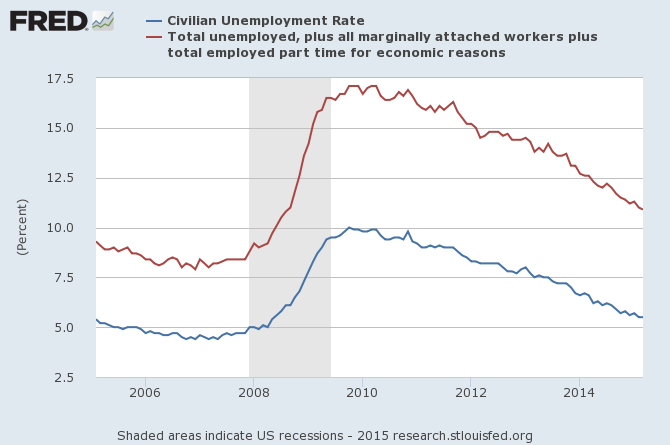
In fact, matters are worse than most people realize. Our unemployment rate has fallen back to a relatively normal 5.5%, as you can see in this graph (the blue line is unemployment, the red line is underemployment):

All_Unemployment

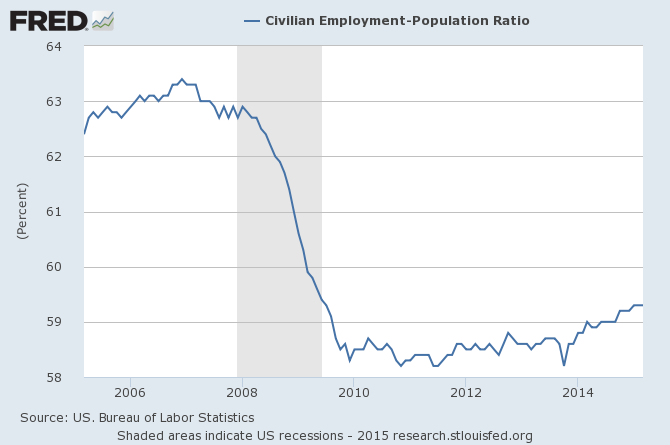
However, our employment rate never recovered from the Second Depression. As you can see in this graph, it fell from 63% to 58%, and has now only risen back to 59%:

Employment

How can unemployment fall without employment rising? The key is understanding how unemployment is calculated: It only counts people in the labor force. If people leave the labor force entirely, by retiring, going back to school, or simply giving up on finding work, they will no longer be counted as unemployed. The unemployment rate only counts people who want work but don’t have it, so as far as I’m concerned that figure should always be nearly zero. (Not quite zero since it takes some time to find a good fit; but maybe 1% at most. Any more than that and there is something wrong with our economic system.)

The optimal employment rate is not as obvious; it certainly isn’t 100%, as some people are too young, too old, or too disabled to be spending their time working. As automation improves, the number of workers necessary to produce any given product decreases, and eventually we may decide as a society that we are making enough products and most of us should be spending more of our time on other things, like spending time with family, creating works of art, or simply having fun. Maybe only a handful of people, the most driven or the most brilliant, will actually decide to work—and they will do because they want to, not because they have to. Indeed, the truly optimal employment rate might well be zero; think of The Culture, where there is no such concept as a “job”; there are things you do because you want to do them, or because they seem worthwhile, but there is none of this “working for pay” nonsense. We are not yet at the level of automation where this would be possible, but we are much closer than I think most people realize. Think about all of the various administrative and bureaucratic tasks that most people do the majority of the time, all the reports, all the meetings; why do they do that? Is it actually because the work is necessary, that the many levels of bureaucracy actually increase efficiency through specialization? Or is it simply because we’ve become so accustomed to the idea that people have to be working all the time in order to justify their existence? Is David Graeber (I reviewed one of his books previously) right that most jobs are actually (and this is a technical term), “bullshit jobs”? Once again, the problem doesn’t seem to be too few work incentives, but if anything too many.

Indeed, there is a basic fact about unemployment that has been hidden from most people. I’d normally say that this is accidental, that it’s too technical or obscure for most people to understand, but no, I think it has been actively concealed, or, since I guess the information has been publicly available, at least discussion of it has been actively avoided. It’s really not at all difficult to understand, yet it will fundamentally change the way you think about our unemployment problem. Here goes:

Since at least 2000 and probably since 1980 there have been more people looking for jobs than there have been jobs available.

The entire narrative of “people are lazy and don’t want to work” or “we need more work incentives” is just totally, totally wrong; people are desperate to find work, and there hasn’t been enough work for them to find since longer than I’ve been alive.

You can see this on the following graph, which is of what’s called the “Beveridge curve”; the horizontal axis is the unemployment rate, while the vertical axis is the rate of job vacancies. The red line across the diagonal is the point at which the two are even, and there are as many people looking for jobs as there are jobs to fill. Notice how the graph is always below the line. There have always been more unemployed people than jobs for them to fill, and at the worst of the Second Depression the ratio was 5 to 1.

Beveridge_curve_2

Personally I believe that we should be substantially above the line, and in a truly thriving economy there should be employers desperately trying to find employees and willing to pay them whatever it takes. You shouldn’t have to send out 20 job applications to get hired; 20 companies should have to send offers to you. For the economy does not exist to serve corporations; it exists to serve people.

I can see two basic ways to solve this problem: You can either create more jobs, or you can get people to stop looking for work. That may be sort of obvious, but I think people usually forget the second option.

We definitely do talk a lot about “job creation”, though usually in a totally nonsensical way—somehow “Job Creator” has come to be a euphemism for “rich person”. In fact the best way to create jobs is to put money into the hands of people who will spend it. The more people spend their money, the more it flows through the economy and the more wealth we end up with overall. High rates of spending—high marginal propensity to consumecan multiply the value of a dollar many times over.

But there’s also something to be said for getting people to stop looking for work—the key is do it in the right way. They shouldn’t stop looking because they give up; they should stop looking because they don’t need to work. People should have their basic needs met even if they aren’t working for an employer; human beings have rights and dignity beyond their productivity in the market. Employers should have to make you a better offer than “you’ll be homeless if you don’t do this”.

Both of these goals can be accomplished simultaneously by one simple policy: Basic income.

It’s really amazing how many problems can be solved by a basic income; it’s more or less the amazing wonder policy that solves all the world’s economic problems simultaneously. Poverty? Gone. Unemployment? Decimated. Inequality? Contained. (The pilot studies of basic income in India have been successful beyond all but the wildest dreams; they eliminate poverty, improve health, increase entrepreneurial activity, even reduce gender inequality.) The one major problem basic income doesn’t solve is government debt (indeed it likely increases it, at least in the short run), but as I’ve already talked about, that problem is not nearly as bad as most people fear.

And once again I think I should head off accusations that advocating a basic income makes me some sort of far-left Communist radical; Friedrich Hayek supported a basic income.

Basic income would help with unemployment in a third way as well; one of the major reasons unemployment is so harmful is that people who are unemployed can’t provide for themselves or their families. So a basic income would reduce the number of people looking for jobs, increase the number of jobs available, and also make being unemployed less painful, all in one fell swoop. I doubt it would solve the problem of unemployment entirely, but I think it would make an enormous difference.

Why the Republican candidates like flat income tax—and we really, really don’t

JDN 2456160 EDT 13:55.

The Republican Party is scrambling to find viable Presidential candidates for next year’s election. The Democrats only have two major contenders: Hillary Clinton looks like the front-runner (and will obviously have the most funding), but Bernie Sanders is doing surprisingly well, and is particularly refreshing because he is running purely on his principles and ideas. He has no significant connections, no family dynasty (unlike Jeb Bush and, again, Hillary Clinton) and not a huge amount of wealth (Bernie’s net wealth is about $500,000, making him comfortably upper-middle class; compare to Hillary’s $21.5 million and her husband’s $80 million); but he has ideas that resonate with people. Bernie Sanders is what politics is supposed to be. Clinton’s campaign will certainly raise more than his; but he has already raised over $4 million, and if he makes it to about $10 million studies suggest that additional spending above that point is largely negligible. He actually has a decent chance of winning, and if he did it would be a very good sign for the future of America.

But the Republican field is a good deal more contentious, and the 19 candidates currently running have been scrambling to prove that they are the most right-wing in order to impress far-right primary voters. (When the general election comes around, whoever wins will of course pivot back toward the center, changing from, say, outright fascism to something more like reactionism or neo-feudalism. If you were hoping they’d pivot so far back as to actually be sensible center-right capitalists, think again; Hillary Clinton is the only one who will take that role, and they’ll go out of their way to disagree with her in every way they possibly can, much as they’ve done with Obama.) One of the ways that Republicans are hoping to prove their right-wing credentials is by proposing a flat income tax and eliminating the IRS.

Unlike most of their proposals, I can see why many people think this actually sounds like a good idea. It would certainly dramatically reduce bureaucracy, and that’s obviously worthwhile since excess bureaucracy is pure deadweight loss. (A surprising number of economists seem to forget that government does other things besides create excess bureaucracy, but I must admit it does in fact create excess bureaucracy.)

Though if they actually made the flat tax rate 20% or even—I can’t believe this is seriously being proposed—10%, there is no way the federal government would have enough revenue. The only options would be (1) massive increases in national debt (2) total collapse of government services—including their beloved military, mind you, or (3) directly linking the Federal Reserve quantitative easing program to fiscal policy and funding the deficit with printed money. Of these, 3 might not actually be that bad (it would probably trigger some inflation, but actually we could use that right now), but it’s extremely unlikely to happen, particularly under Republicans. In reality, after getting a taste of 2, we’d clearly end up with 1. And then they’d be complaining about the debt and clamor for more spending cuts, more spending cuts, ever more spending cuts, but there would simply be no way to run a functioning government on 10% of GDP in anything like our current system. Maybe you could do it on 20%—maybe—but we currently spend more like 35%, and that’s already a very low amount of spending for a First World country. The UK is more typical at 47%, while Germany is a bit low at 44%; Sweden spends 52% and France spends a whopping 57%. Anyone who suggests we cut government spending from 35% to 20% needs to explain which 3/7 of government services are going to immediately disappear—not to mention which 3/7 of government employees are going to be immediately laid off.

And then they want to add investment deductions; in general investment deductions are a good thing, as long as you tie them to actual investments in genuinely useful things like factories and computer servers. (Or better yet, schools, research labs, or maglev lines, but private companies almost never invest in that sort of thing, so the deduction wouldn’t apply.) The kernel of truth in the otherwise ridiculous argument that we should never tax capital is that taxing real investment would definitely be harmful in the long run. As I discussed with Miles Kimball (a cognitive economist at Michigan and fellow econ-blogger I hope to work with at some point), we could minimize the distortionary effects of corporate taxes by establishing a strong deduction for real investment, and this would allow us to redistribute some of this enormous wealth inequality without dramatically harming economic growth.

But if you deduct things that aren’t actually investments—like stock speculation and derivatives arbitrage—then you reduce your revenue dramatically and don’t actually incentivize genuinely useful investments. This is the problem with our current system, in which GE can pay no corporate income tax on $108 billion in annual profit—and you know they weren’t using all that for genuinely productive investment activities. But then, if you create a strong enforcement system for ensuring it is real investment, you need bureaucracy—which is exactly what the flat tax was claimed to remove. At the very least, the idea of eliminating the IRS remains ridiculous if you have any significant deductions.

Thus, the benefits of a flat income tax are minimal if not outright illusory; and the costs, oh, the costs are horrible. In order to have remotely reasonable amounts of revenue, you’d need to dramatically raise taxes on the majority of people, while significantly lowering them on the rich. You would create a direct transfer of wealth from the poor to the rich, increasing our already enormous income inequality and driving millions of people into poverty.

Thus, it would be difficult to more clearly demonstrate that you care only about the interests of the top 1% than to propose a flat income tax. I guess Mitt Romney’s 47% rant actually takes the cake on that one though (Yes, all those freeloading… soldiers… and children… and old people?).

Many Republicans are insisting that a flat tax would create a surge of economic growth, but that’s simply not how macroeconomics works. If you steeply raise taxes on the majority of people while cutting them on the rich, you’ll see consumer spending plummet and the entire economy will be driven into recession. Rich people simply don’t spend their money in the same way as the rest of us, and the functioning of the economy depends upon a continuous flow of spending. There is a standard neoclassical economic argument about how reducing spending and increasing saving would lead to increased investment and greater prosperity—but that model basically assumes that we have a fixed amount of stuff we’re either using up or making more stuff with, which is simply not how money works; as James Kroeger cogently explains on his blog “Nontrivial Pursuits”, money is created as it is needed; investment isn’t determined by people saving what they don’t spend. Indeed, increased consumption generally leads to increased investment, because our economy is currently limited by demand, not supply. We could build a lot more stuff, if only people could afford to buy it.

And that’s not even considering the labor incentives; as I already talked about in my previous post on progressive taxation, there are two incentives involved when you increase someone’s hourly wage. On the one hand, they get paid more for each hour, which is a reason to work; that’s the substitution effect. But on the other hand, they have more money in general, which is a reason they don’t need to work; that’s the income effect. Broadly speaking, the substitution effect dominates at low incomes (about $20,000 or less), the income effect dominates at high incomes (about $100,000 or more), and the two effects cancel out at moderate incomes. Since a tax on your income hits you in much the same way as a reduction in your wage, this means that raising taxes on the poor makes them work less, while raising taxes on the rich makes them work more. But if you go from our currently slightly-progressive system to a flat system, you raise taxes on the poor and cut them on the rich, which would mean that the poor would work less, and the rich would also work less! This would reduce economic output even further. If you want to maximize the incentive to work, you want progressive taxes, not flat taxes.

Flat taxes sound appealing because they are so simple; even the basic formula for our current tax rates is complicated, and we combine it with hundreds of pages of deductions and credits—not to mention tens of thousands of pages of case law!—making it a huge morass of bureaucracy that barely anyone really understands and corporate lawyers can easily exploit. I’m all in favor of getting rid of that; but you don’t need a flat tax to do that. You can fit the formula for a progressive tax on a single page—indeed, on a single line: r = 1 – I^-p

That’s it. It’s simple enough to be plugged into any calculator that is capable of exponents, not to mention efficiently implemented in Microsoft Excel (more efficiently than our current system in fact).

Combined with that simple formula, you could list all of the sensible deductions on a couple of additional pages (business investments and educational expenses, mostly—poverty should be addressed by a basic income, not by tax deductions on things like heating and housing, which are actually indirect corporate subsidies), along with a land tax (one line: $3000 per hectare), a basic income (one more line: $8,000 per adult and $4,000 per child), and some additional excise taxes on goods with negative externalities (like alcohol, tobacco, oil, coal, and lead), with a line for each; then you can provide a supplementary manual of maybe 50 pages explaining the detailed rules for applying each of those deductions in unusual cases. The entire tax code should be readable by an ordinary person in a single sitting no longer than a few hours. That means no more than 100 pages and no more than a 7th-grade reading level.

Why do I say this? Isn’t that a ridiculous standard? No, it is a Constitutional imperative. It is a fundamental violation of your liberty to tax you according to rules you cannot reasonably understand—indeed, bordering on Kafkaesque. While this isn’t taxation without representation—we do vote for representatives, after all—it is something very much like it; what good is the ability to change rules if you don’t even understand the rules in the first place? Nor would it be all that difficult: You first deduct these things from your income, then plug the result into this formula.

So yes, I absolutely agree with the basic principle of tax reform. The tax code should be scrapped and recreated from scratch, and the final product should be a primary form of only a few pages combined with a supplementary manual of no more than 100 pages. But you don’t need a flat tax to do that, and indeed for many other reasons a flat tax is a terrible idea, particularly if the suggested rate is 10% or 15%, less than half what we actually spend. The real question is why so many Republican candidates think that this will appeal to their voter base—and why they could actually be right about that.

Part of it is the entirely justified outrage at the complexity of our current tax system, and the appealing simplicity of a flat tax. Part of it is the long history of American hatred of taxes; we were founded upon resisting taxes, and we’ve been resisting taxes ever since. In some ways this is healthy; taxes per se are not a good thing, they are a bad thing, a necessary evil.

But those two things alone cannot explain why anyone would advocate raising taxes on the poorest half of the population while dramatically cutting them on the top 1%. If you are opposed to taxes in general, you’d cut them on everyone; and if you recognize the necessity of taxation, you’d be trying to find ways to minimize the harm while ensuring sufficient tax revenue, which in general means progressive taxation.

To understand why they would be pushing so hard for flat taxes, I think we need to say that many Republicans, particularly those in positions of power, honestly do think that rich people are better than poor people and we should always give more to the rich and less to the poor. (Maybe it’s partly halo effect, in which good begets good and bad begets bad? Or maybe just world theory, the ingrained belief that the world is as it ought to be?)

Romney’s 47% rant wasn’t an exception; it was what he honestly believes, what he says when he doesn’t know he’s on camera. He thinks that he earned every penny of his $250 million net wealth; yes, even the part he got from marrying his wife and the part he got from abusing tax laws, arbitraging assets and liquidating companies. He thinks that people who live on $4,000 or even $400 a year are simply lazy freeloaders, who could easily work harder, perhaps do some arbitrage and liquidation of their own (check out these alleged “rags to riches” stories including the line “tried his hand at mortgage brokering”), but choose not to, and as a result deserve what they get. (It’s important to realize just how bizarre this moral attitude truly is; even if I thought you were the laziest person on Earth, I wouldn’t let you starve to death.) He thinks that the social welfare programs which have reduced poverty but never managed to eliminate it are too generous—if he even thinks they should exist at all. And in thinking these things, he is not some bizarre aberration; he is representing an entire class of people, nearly all of whom vote Republican.

The good news is, these people are still in the minority. They hold significant sway over the Republican primary, but will not have nearly as much impact in the general election. And right now, the Republican candidates are so numerous and so awful that I have trouble seeing how the Democrats could possibly lose. (But please, don’t take that as a challenge, you guys.)

What you need to know about tax incidence

JDN 2457152 EDT 14:54.

I said in my previous post that I consider tax incidence to be one of the top ten things you should know about economics. If I actually try to make a top ten list, I think it goes something like this:

  1. Supply and demand
  2. Monopoly and oligopoly
  3. Externalities
  4. Tax incidence
  5. Utility, especially marginal utility of wealth
  6. Pareto-efficiency
  7. Risk and loss aversion
  8. Biases and heuristics, including sunk-cost fallacy, scope neglect, herd behavior, anchoring and representative heuristic
  9. Asymmetric information
  10. Winner-takes-all effect

So really tax incidence is in my top five things you should know about economics, and yet I still haven’t talked about it very much. Well, today I will. The basic principles of supply and demand I’m basically assuming you know, but I really should spend some more time on monopoly and externalities at some point.

Why is tax incidence so important? Because of one central fact: The person who pays the tax is not the person who writes the check.

It doesn’t matter whether a tax is paid by the buyer or the seller; it matters what the buyer and seller can do to avoid the tax. If you can change your behavior in order to avoid paying the tax—buy less stuff, or buy somewhere else, or deduct something—you will not bear the tax as much as someone else who can’t do anything to avoid the tax, even if you are the one who writes the check. If you can avoid it and they can’t, other parties in the transaction will adjust their prices in order to eat the tax on your behalf.

Thus, if you have a good that you absolutely must buy no matter what—like, say, table saltand then we make everyone who sells that good pay an extra $5 per kilogram, I can guarantee you that you will pay an extra $5 per kilogram, and the suppliers will make just as much money as they did before. (A salt tax would be an excellent way to redistribute wealth from ordinary people to corporations, if you’re into that sort of thing. Not that we have any trouble doing that in America.)

On the other hand, if you have a good that you’ll only buy at a very specific price—like, say, fast food—then we can make you write the check for a tax of an extra $5 per kilogram you use, and in real terms you’ll pay hardly any tax at all, because the sellers will either eat the cost themselves by lowering the prices or stop selling the product entirely. (A fast food tax might actually be a good idea as a public health measure, because it would reduce production and consumption of fast food—remember, heart disease is one of the leading causes of death in the United States, making cheeseburgers a good deal more dangerous than terrorists—but it’s a bad idea as a revenue measure, because rather than pay it, people are just going to buy and sell less.)

In the limit in which supply and demand are both completely fixed (perfectly inelastic), you can tax however you want and it’s just free redistribution of wealth however you like. In the limit in which supply and demand are both locked into a single price (perfectly elastic), you literally cannot tax that good—you’ll just eliminate production entirely. There aren’t a lot of perfectly elastic goods in the real world, but the closest I can think of is cash. If you instituted a 2% tax on all cash withdrawn, most people would stop using cash basically overnight. If you want a simple way to make all transactions digital, find a way to enforce a cash tax. When you have a perfect substitute available, taxation eliminates production entirely.

To really make sense out of tax incidence, I’m going to need a lot of a neoclassical economists’ favorite thing: Supply and demand curves. These things pop up everywhere in economics; and they’re quite useful. I’m not so sure about their application to things like aggregate demand and the business cycle, for example, but today I’m going to use them for the sort of microeconomic small-market stuff that they were originally designed for; and what I say here is going to be basically completely orthodox, right out of what you’d find in an ECON 301 textbook.

Let’s assume that things are linear, just to make the math easier. You’d get basically the same answers with nonlinear demand and supply functions, but it would be a lot more work. Likewise, I’m going to assume a unit tax on goods—like $2890 per hectare—as opposed to a proportional tax on sales—like 6% property tax—again, for mathematical simplicity.

The next concept I’m going to have to talk about is elasticitywhich is the proportional amount that quantity sold changes relative to price. If price increases 2% and you buy 4% less, you have a demand elasticity of -2. If price increases 2% and you buy 1% less, you have a demand elasticity of -1/2. If price increases 3% and you sell 6% more, you have a supply elasticity of 2. If price decreases 5% and you sell 1% less, you have a supply elasticity of 1/5.

Elasticity doesn’t have any units of measurement, it’s just a number—which is part of why we like to use it. It also has some very nice mathematical properties involving logarithms, but we won’t be needing those today.

The price that renters are willing and able to pay, the demand price PD will start at their maximum price, the reserve price PR, and then it will decrease linearly according to the quantity of land rented Q, according to a linear function (simply because we assumed that) which will vary according to a parameter e that represents the elasticity of demand (it isn’t strictly equal to it, but it’s sort of a linearization).

We’re interested in what is called the consumer surplus; it is equal to the total amount of value that buyers get from their purchases, converted into dollars, minus the amount they had to pay for those purchases. This we add to the producer surplus, which is the amount paid for those purchases minus the cost of producing themwhich is basically just the same thing as profit. Togerther the consumer surplus and producer surplus make the total economic surplus, which economists generally try to maximize. Because different people have different marginal utility of wealth, this is actually a really terrible idea for deep and fundamental reasons—taking a house from Mitt Romney and giving it to a homeless person would most definitely reduce economic surplus, even though it would obviously make the world a better place. Indeed, I think that many of the problems in the world, particularly those related to inequality, can be traced to the fact that markets maximize economic surplus rather than actual utility. But for now I’m going to ignore all that, and pretend that maximizing economic surplus is what we want to do.

You can read off the economic surplus straight from the supply and demand curves; it’s the area between the lines. (Mathematically, it’s an integral; but that’s equivalent to the area under a curve, and with straight lines they’re just triangles.) I’m going to call the consumer surplus just “surplus”, and producer surplus I’ll call “profit”.

Below the demand curve and above the price is the surplus, and below the price and above the supply curve is the profit:

elastic_supply_competitive_labeled

I’m going to be bold here and actually use equations! Hopefully this won’t turn off too many readers. I will give each equation in both a simple text format and in proper LaTeX. Remember, you can render LaTeX here.

PD = PR – 1/e * Q

P_D = P_R – \frac{1}{e} Q \\

The marginal cost that landlords have to pay, the supply price PS, is a bit weirder, as I’ll talk about more in a moment. For now let’s say that it is a linear function, starting at zero cost for some quantity Q0 and then increases linearly according to a parameter n that similarly represents the elasticity of supply.

PS = 1/n * (Q – Q0)

P_S = \frac{1}{n} \left( Q – Q_0 \right) \\

Now, if you introduce a tax, there will be a difference between the price that renters pay and the price that landlords receive—namely, the tax, which we’ll call T. I’m going to assume that, on paper, the landlord pays the whole tax. As I said above, this literally does not matter. I could assume that on paper the renter pays the whole tax, and the real effect on the distribution of wealth would be identical. All we’d have to do is set PD = P and PS = P – T; the consumer and producer surplus would end up exactly the same. Or we could do something in between, with P’D = P + rT and P’S = P – (1 – r) T.

Then, if the market is competitive, we just set the prices equal, taking the tax into account:

P = PD – T = PR – 1/e * Q – T = PS = 1/n * (Q – Q0)

P= P_D – T = P_R – \frac{1}{e} Q – T= P_S = \frac{1}{n} \left(Q – Q_0 \right) \\

P_R – 1/e * Q – T = 1/n * (Q – Q0)

P_R – \frac{1}{e} Q – T = \frac{1}{n} \left(Q – Q_0 \right) \\

Notice the equivalency here; if we set P’D = P + rT and P’S = P – (1 – r) T, so that the consumer now pays a fraction of the tax r.

P = P’D – rT = P_r – 1/e*Q = P’S + (1 – r) T + 1/n * (Q – Q0) + (1 – r) T

P^\prime_D – r T = P = P_R – \frac{1}{e} Q = P^\prime_S = \frac{1}{n} \left(Q – Q_0 \right) + (1 – r) T\\

The result is exactly the same:

P_R – 1/e * Q – T = 1/n * (Q – Q0)

P_R – \frac{1}{e} Q – T = \frac{1}{n} \left(Q – Q_0 \right) \\

I’ll spare you the algebra, but this comes out to:

Q = (PR – T)/(1/n + 1/e) + (Q0)/(1 + n/e)

Q = \frac{P_R – T}{\frac{1}{n} + \frac{1}{e}} + \frac{Q_0}{1 + \frac{n}{e}}

P = (PR – T)/(1+ n/e) – (Q0)/(e + n)

P = \frac{P_R – T}}{1 + \frac{n}{e}} – \frac{Q_0}{e+n} \\

That’s if the market is competitive.

If the market is a monopoly, instead of setting the prices equal, we set the price the landlord receives equal to the marginal revenue—which takes into account the fact that increasing the amount they sell forces them to reduce the price they charge everyone else. Thus, the marginal revenue drops faster than the price as the quantity sold increases.

After a bunch of algebra (and just a dash of calculus), that comes out to these very similar, but not quite identical, equations:

Q = (PR – T)/(1/n + 2/e) + (Q0)/(1+ 2n/e)

Q = \frac{P_R – T}{\frac{1}{n} + \frac{2}{e}} + \frac{Q_0}{1 + \frac{2n}{e}} \\

P = (PR – T)*((1/n + 1/e)/(1/n + 2/e) – (Q0)/(e + 2n)

P = \left( P_R – T\right)\frac{\frac{1}{n} + \frac{1}{e}}{\frac{1}{n} + \frac{2}{e}} – \frac{Q_0}{e+2n} \\

Yes, it changes some 1s into 2s. That by itself accounts for the full effect of monopoly. That’s why I think it’s worthwhile to use the equations; they are deeply elegant and express in a compact form all of the different cases. They look really intimidating right now, but for most of the cases we’ll consider these general equations simplify quite dramatically.

There are several cases to consider.

Land has an extremely high cost to create—for practical purposes, we can consider its supply fixed, that is, perfectly inelastic. If the market is competitive, so that landlords have no market power, then they will simply rent out all the land they have at whatever price the market will bear:

Inelastic_supply_competitive_labeled

This is like setting n = 0 and T = 0 in the above equations, the competitive ones.

Q = Q0

Q = Q_0 \\

P = PR – Q0/e

P = P_R – \frac{Q_0}{e} \\

If we now introduce a tax, it will fall completely on the landlords, because they have little choice but to rent out all the land they have, and they can only rent it at a price—including tax—that the market will bear.

inelastic_supply_competitive_tax_labeled

Now we still have n = 0 but not T = 0.

Q = Q0

Q = Q_0 \\

P = PR – T – Q0/e

P = P_R – T – \frac{Q_0}{e} \\

The consumer surplus will be:

½ (Q)(PR – P – T) = 1/(2e)* Q02

\frac{1}{2}Q(P_R – P – T) = \frac{1}{2e}Q_0^2 \\

Notice how T isn’t in the result. The consumer surplus is unaffected by the tax.

The producer surplus, on the other hand, will be reduced by the tax:

(Q)(P) = (PR – T – Q0/e) Q0 = PR Q0 – 1/e Q02 – TQ0

(Q)(P) = (P_R – T – \frac{Q_0}{e})Q_0 = P_R Q_0 – \frac{1}{e} Q_0^2 – T Q_0 \\

T appears linearly as TQ0, which is the same as the tax revenue. All the money goes directly from the landlord to the government, as we want if our goal is to redistribute wealth without raising rent.

But now suppose that the market is not competitive, and by tacit collusion or regulatory capture the landlords can exert some market power; this is quite likely the case in reality. Actually in reality we’re probably somewhere in between monopoly and competition, either oligopoly or monopolistic competitionwhich I will talk about a good deal more in a later post, I promise.

It could be that demand is still sufficiently high that even with their market power, landlords have an incentive to rent out all their available land, in which case the result will be the same as in the competitive market.

inelastic_supply_monopolistic_labeled

A tax will then fall completely on the landlords as before:

inelastic_supply_monopolistic_tax_labeled

Indeed, in this case it doesn’t really matter that the market is monopolistic; everything is the same as it would be under a competitive market. Notice how if you set n = 0, the monopolistic equations and the competitive equations come out exactly the same. The good news is, this is quite likely our actual situation! So even in the presence of significant market power the land tax can redistribute wealth in just the way we want.

But there are a few other possibilities. One is that demand is not sufficiently high, so that the landlords’ market power causes them to actually hold back some land in order to raise the price:

zerobound_supply_monopolistic_labeled

This will create some of what we call deadweight loss, in which some economic value is wasted. By restricting the land they rent out, the landlords make more profit, but the harm they cause to tenant is created than the profit they gain, so there is value wasted.

Now instead of setting n = 0, we actually set n = infinity. Why? Because the reason that the landlords restrict the land they sell is that their marginal revenue is actually negative beyond that point—they would actually get less money in total if they sold more land. Instead of being bounded by their cost of production (because they have none, the land is there whether they sell it or not), they are bounded by zero. (Once again we’ve hit upon a fundamental concept in economics, particularly macroeconomics, that I don’t have time to talk about today: the zero lower bound.) Thus, they can change quantity all they want (within a certain range) without changing the price, which is equivalent to a supply elasticity of infinity.

Introducing a tax will then exacerbate this deadweight loss (adding DWL2 to the original DWL1), because it provides even more incentive for the landlords to restrict the supply of land:

zerobound_supply_monopolistic_tax_labeled

Q = e/2*(PR – T)

Q = \frac{e}{2} \left(P_R – T\right)\\

P = 1/2*(PR – T)

P = \frac{1}{2} \left(P_R – T\right) \\

The quantity Q0 completely drops out, because it doesn’t matter how much land is available (as long as it’s enough); it only matters how much land it is profitable to rent out.

We can then find the consumer and producer surplus, and see that they are both reduced by the tax. The consumer surplus is as follows:

½ (Q)(PR – 1/2(PR – T)) = e/4*(PR2 – T2)

\frac{1}{2}Q \left( P_R – \frac{1}{2}left( P – T \right) \right) = \frac{e}{4}\left( P_R^2 – T^2 \right) \\

This time, the tax does have an effect on reducing the consumer surplus.

The producer surplus, on the other hand, will be:

(Q)(P) = 1/2*(PR – T)*e/2*(PR – T) = e/4*(PR – T)2

(Q)(P) = \frac{1}{2}\left(P_R – T \right) \frac{e}{2} \left(P_R – T\right) = \frac{e}{4} \left(P_R – T)^2 \\

Notice how it is also reduced by the tax—and no longer in a simple linear way.

The tax revenue is now a function of the demand:

TQ = e/2*T(PR – T)

T Q = \frac{e}{2} T (P_R – T) \\

If you add all these up, you’ll find that the sum is this:

e/2 * (PR^2 – T^2)

\frac{e}{2} \left(P_R^2 – T^2 \right) \\

The sum is actually reduced by an amount equal to e/2*T^2, which is the deadweight loss.

Finally there is an even worse scenario, in which the tax is so large that it actually creates an incentive to restrict land where none previously existed:

zerobound_supply_monopolistic_hugetax_labeled

Notice, however, that because the supply of land is inelastic the deadweight loss is still relatively small compared to the huge amount of tax revenue.

But actually this isn’t the whole story, because a land tax provides an incentive to get rid of land that you’re not profiting from. If this incentive is strong enough, the monopolistic power of landlords will disappear, as the unused land gets sold to more landholders or to the government. This is a way of avoiding the tax, but it’s one that actually benefits society, so we don’t mind incentivizing it.

Now, let’s compare this to our current system of property taxes, which include the value of buildings. Buildings are expensive to create, but we build them all the time; the supply of buildings is strongly dependent upon the price at which those buildings will sell. This makes for a supply curve that is somewhat elastic.

If the market were competitive and we had no taxes, it would be optimally efficient:

elastic_supply_competitive_labeled

Property taxes create an incentive to produce fewer buildings, and this creates deadweight loss. Notice that this happens even if the market is perfectly competitive:

elastic_supply_competitive_tax_labeled

Since both n and e are finite and nonzero, we’d need to use the whole equations: Since the algebra is such a mess, I don’t see any reason to subject you to it; but suffice it to say, the T does not drop out. Tenants do see their consumer surplus reduced, and the larger the tax the more this is so.

Now, suppose that the market for buildings is monopolistic, as it most likely is. This would create deadweight loss even in the absence of a tax:

elastic_supply_monopolistic_labeled

But a tax will add even more deadweight loss:

elastic_supply_monopolistic_tax_labeled

Once again, we’d need the full equations, and once again it’s a mess; but the result is, as before, that the tax gets passed on to the tenants in the form of more restricted sales and therefore higher rents.

Because of the finite supply elasticity, there’s no way that the tax can avoid raising the rent. As long as landlords have to pay more taxes when they build more or better buildings, they are going to raise the rent in those buildings accordingly—whether the market is competitive or not.

If the market is indeed monopolistic, there may be ways to bring the rent down: suppose we know what the competitive market price of rent should be, and we can establish rent control to that effect. If we are truly correct about the price to set, this rent control can not only reduce rent, it can actually reduce the deadweight loss:

effective_rent_control_tax_labeled

But if we set the rent control too low, or don’t properly account for the varying cost of different buildings, we can instead introduce a new kind of deadweight loss, by making it too expensive to make new buildings.

ineffective_rent_control_tax_labeled

In fact, what actually seems to happen is more complicated than that—because otherwise the number of buildings is obviously far too small, rent control is usually set to affect some buildings and not others. So what seems to happen is that the rent market fragments into two markets: One, which is too small, but very good for those few who get the chance to use it; and the other, which is unaffected by the rent control but is more monopolistic and therefore raises prices even further. This is why almost all economists are opposed to rent control (PDF); it doesn’t solve the problem of high rent and simply causes a whole new set of problems.

A land tax with a basic income, on the other hand, would help poor people at least as much as rent control presently does—probably a good deal more—without discouraging the production and maintenance of new apartment buildings.

But now we come to a key point: The land tax must be uniform per hectare.

If it is instead based on the value of the land, then this acts like a finite elasticity of supply; it provides an incentive to reduce the value of your own land in order to avoid the tax. As I showed above, this is particularly pernicious if the market is monopolistic, but even if it is competitive the effect is still there.

One exception I can see is if there are different tiers based on broad classes of land that it’s difficult to switch between, such as “land in Manhattan” versus “land in Brooklyn” or “desert land” versus “forest land”. But even this policy would have to be done very carefully, because any opportunity to substitute can create an opportunity to pass on the tax to someone else—for instance if land taxes are lower in Brooklyn developers are going to move to Brooklyn. Maybe we want that, in which case that is a good policy; but we should be aware of these sorts of additional consequences. The simplest way to avoid all these problems is to simply make the land tax uniform. And given the quantities we’re talking about—less than $3000 per hectare per year—it should be affordable for anyone except the very large landholders we’re trying to distribute wealth from in the first place.

The good news is, most economists would probably be on board with this proposal. After all, the neoclassical models themselves say it would be more efficient than our current system of rent control and property taxes—and the idea is at least as old as Adam Smith. Perhaps we can finally change the fact that the rent is too damn high.

What if you couldn’t own land?

JDN 2457145 EDT 20:49.

Today’s post we’re on the socialism scale somewhere near the The Guess Who, but not quite all the way to John Lennon. I’d like to questions one of the fundamental tenets of modern capitalism, but not the basic concept of private ownership itself:

What if you couldn’t own land?

Many things that you can own were more-or-less straightforwardly created by someone. A car, a computer, a television, a pair of shoes; for today let’s even take for granted intellectual property like books, movies, and songs; at least those things (“things”) were actually made by someone.

But land? We’re talking about chunks of the Earth here. They were here billions of years before us, and in all probability will be here billions of years after we’re gone. There’s no need to incentivize its creation; the vast majority of land was already here and did not need to be created. (I do have to say “the vast majority”, because in places like Japan, Hong Kong, and the Netherlands real estate has become so scarce that people do literally build land out into the sea. But this is something like 0.0001% of the world’s land.)

What we want to incentivize is land development; we want it to be profitable to build buildings and irrigate deserts, and yes, even cut down forests sometimes (though then there should be a carbon tax with credits for forested land to ensure that there isn’t too much incentive). Yet our current property tax system doesn’t do this very well; if you build bigger buildings, you end up paying more property taxes. Yes, you may also make some profit on the buildings—but it’s risky, and you may not get enough benefit to justify the added property taxes.

Moreover, we want to allocate land—we want some way of deciding who is allowed to use what land where and when (and perhaps why). Allowing land to be bought and sold is one way to do that, but it is not the only way.

Indeed, land ownership suffers from a couple of truly glaring flaws as an allocation system:

      1. It creates self-perpetuating inequality. Because land grows in value over time (due to population growth and urbanization, among other things), those who currently own land end up getting an ever-growing quantity of wealth while those who do not own land do not, and very likely end up having to pay ever-growing rents to the landlords. (I like calling them “landlords”; it really drives home the fact that our landholding system is still basically the same as it was under feudalism.) In fact, the recent rise in the share of income that goes to owners of capital rather than workers is almost entirely attributable to the rise in the price of real estate. As that post rightly recognizes, this does nothing to undermine Piketty’s central message of rising inequality due to capital income (pace The Washington Post); it merely tells us to focus on real estate instead of other forms of capital.
      2. It has no non-arbitrary allocation. If we want to decide who owns a car, we can ask questions like, “Who built it? Did someone buy it from them? Did they pay a fair price?”; if we want to decide who owns a book, we can ask questions like, “Who wrote it? Did they sell it to a publisher? What was the royalty rate?” That is, there is a clear original owner, and there is a sense of whether the transfer of ownership can be considered fair. But if we want to decide who owns a chunk of land, basically all we can ask is, “What does the deed say?” The owner is the owner because they are the owner; there’s no sense in which that ownership is fair. We certainly can’t go back to the original creation of the land, because that was due to natural forces gigayears ago. If we keep tracing the ownership backward, we will eventually end up with some guy (almost certainly a man, a White man in fact) with a gun who pointed that gun at other people and said, “This is mine.” This is true of basically all the land in the world (aside from those little bits of Japan and such); it was already there, and the only reason someone got to own it was because they said so and had a bigger gun. And a flag, perhaps: “Do you have a flag?” I suppose, in theory at least, there are a few ways of allocating land which seem less arbitrary: One would be to give everyone an equal amount. But this is practically very difficult: What do you do when the population changes? If you have 2% annual population growth, do you carve off 2% of everybody’s lot each year? Another would be to let people squat land, and automatically own the land that they live on—but again practical difficulties quickly become enormous. In any case, these two methods bear about as much resemblance to our actual allocation of land as a squirrel does to a Tyrannosaurus.

So, what else might we use? The system that makes the most sense to me is that we would own all land as a society. In practical terms this would mean that all land is Federal land, and if you want to use it for something, you need to pay rent to the government. There are many different ways the government could set the rent, but the most sensible might be to charge a flat rate per hectare regardless of where the land is or what it’s being used for, because that would maximize the incentive to develop the land. It would also make the rent fall entirely on the landowner, because the rent would be perfectly inelasticmeaning that you can’t change the quantity you make based on the price, because you aren’t making it; it’s just already sitting there.

Of course, this idea is obviously politically impossible in our current environment—or indeed any foreseeable political environment. I’m just fantasizing here, right?

Well, not quite. There is one thing we could do that would be economically quite similar to government-only land ownership; it’s called a land tax. The idea is incredibly simple: you just collect a flat tax per hectare of land. Economists have known that a land tax is efficient at providing revenue and reducing inequality since at least Adam Smith. So maybe ownership of land isn’t actually foundational to capitalism, after all; maybe we’ve just never fully gotten over feudalism. (I basically agree with Adam Smith, and for doing so I am often called a socialist.) The beautiful thing about a land tax is that it has a tax incidence in which the owners of the land end up bearing the full brunt of the tax.

Tax incidence is something it’s very important to understand; it would be on my list of the top ten economic principles that people should learn. We often have fierce political debates over who will actually write the check: Should employers pay the health insurance premium, or should employees? Will buyers pay sales tax, or sellers? Should we tax corporate profits or personal capital gains?

Please understand that I am not exaggerating when I say that these sorts of questions are totally irrelevant. It simply does not matter who actually writes the check; what matters is who bears the cost. Making the employer pay the health insurance premium doesn’t make the slightest difference if all they’re going to do is cut wages by the exact same amount. You can see the irrelevance of the fact that sellers pay sales tax every time you walk into a store—you always end up paying the price plus the tax, don’t you? (I found that the base price of most items was the same between Long Beach and Ann Arbor, but my total expenditure was always 3% more because of the 9% sales tax versus the 6%.) How do we determine who actually pays the tax? It depends on the elasticity—how easily can you change your behavior in order to avoid the tax? Can you find a different job because the health insurance premiums are too high? No? Then you’re probably paying that premium, even if your employer writes the check. If you can find a new job whenever you want, your employer might have to pay it for you even if you write the check.

The incidence of corporate taxes and taxes on capital gains are even more complicated, because it could affect the behavior of corporations in many different ways; indeed, many economists argue that the corporate tax simply results in higher unemployment or lower wages for workers. I don’t think that’s actually true, but I honestly can’t rule it out completely, precisely because corporate taxes are so complicated. You need to know all sorts of things about the structure of stock markets, and the freedom of trade, and the mobility of immigration… it’s a complete and total mess.

It’s because of tax incidence that a land tax makes so much sense; there’s no way for the landowner to escape it, other than giving up the land entirely. In particular, they can’t charge more for rent without being out-competed (unless landowners are really good at colluding—which might be true for large developers, but not individual landlords). Their elasticity is so low that they’re forced to bear the full cost of the tax.

If the land tax were high enough, it could eliminate the automatic growth in wealth that comes from holding land, and thereby reducing long-run inequality dramatically. The revenue could be used for my other favorite fiscal policy, the basic income—and real estate is a big enough part of our nation’s wealth that it’s actually entirely realistic to fund an $8,000 per person per year basic income entirely on land tax revenue. The total value of US land is about $14 trillion, and an $8,000 basic income for 320 million people would cost about $2.6 trillion; that’s only 19%. You’d actually want to make it a flat tax per hectare, so how much would that be? Well, 60% of US land is privately owned at present (no sense taxing the land the government already owns), and total US land area is about 9 million square kilometers, so to raise $2.5 trillion you’d need a tax of $289,000 per square kilometer, or $2,890 per hectare. If you own a hectare—which is bigger than most single-family lots—you’d only pay $2,890 per year in land tax, well within what most middle-class families could handle. But if you own 290,000 acres like Jeff Bezos, (that’s 117,000 hectares) you’re paying $338 million per year. Since Jeff Bezos has about $38 billion in net wealth, he can actually afford to pay that ($338 million per year is about one-tenth of what Jeff Bezos makes automatically on dividends), though he might consider selling off some of the land to avoid the taxes, which is exactly the sort of incentive we wanted to create.

Indeed, when I contemplate this policy I’m struck by the fact that it has basically no downside—usually in public policy you’re forced to make hard compromises and tradeoffs, but a land tax plus basic income is a system that carries almost no downsides at all. It won’t disincentivize investment, it won’t disincentivize working, it will dramatically reduce inequality, it will save the government a great deal of money on social welfare spending, and best of all it will eliminate poverty immediately and forever. The only people it would hurt at all are extremely rich, and they wouldn’t even be hurt very much, while it would benefit millions of people including some of the most needy.

Why aren’t we doing this already!?

Why did we ever privatize prisons?

JDN 2457103 EDT 10:24.

Since the Reagan administration (it’s always Reagan), the United States has undergone a spree of privatization of public services, in which services that are ordinarily performed by government agencies are instead contracted out to private companies. Enormous damage to our society has been done by this sort of privatization, from healthcare to parking meters.

This process can vary in magnitude.

The weakest form, which is relatively benign, is for the government to buy specific services like food service or equipment manufacturing from companies that already provide them to consumers. There’s no particular reason for the government to make their own toothpaste or wrenches rather than buy them from corporations like Proctor & Gamble and Sears. Toothpaste is toothpaste and wrenches are wrenches.

The moderate form is for the government to contract services to specific companies that may involve government-specific features like security clearances or powerful military weapons. This is already raising a lot of problems: When Northrop-Grumman makes our stealth bombers, and Boeing builds our nuclear ICBMs, these are publicly-traded, for-profit corporations manufacturing some of the deadliest weapons ever created—weapons that could literally destroy human civilization in a matter of minutes. Markets don’t work well in the presence of externalities, and weapons by definition are almost nothing but externalities; their entire function is to cause harm—typically, death—to people without their consent. While this violence may sometimes be justified, it must never be taken lightly; and we are right to be uncomfortable with the military-industrial complex whose shareholders profit from death and destruction. (Eisenhower tried to warn us!) Still, there are some good arguments to be made for this sort of privatization, since many of these corporations already have high-tech factories and skilled engineers that they can easily repurpose, and competitive bids between different corporations can keep the price down. (Of course, with no-bid contracts that no longer applies; and it certainly hasn’t stopped us from spending nearly as much on the military as the rest of the world combined.)

What I’d really like to focus on today is the strongest form of privatization, in which basic government services are contracted out to private companies. This is what happens when you attempt to privatize soldiers, SWAT teams, and prisons—all of which the United States has done since Reagan.

I say “attempt” to privatize because in a very real sense the privatization of these services is incoherent—they are functions so basic to government that simply to do them makes you, de facto, part of the government. (Or, if done without government orders, it would be organized crime.) All you’ve really done by “privatizing” these services is reduced their transparency and accountability, as well as siphoning off a portion of the taxpayer money in the form of profits for shareholders.

The benefits of privatization, when they exist, are due to competition and consumer freedom. The foundation of a capitalist economy is the ability to say “I’ll take my business elsewhere.” (This is why the notion that a bank can sell your loan to someone else is the opposite of a free market; forcing you to write a check to someone you never made a contract with is antithetical to everything the free market stands for.) Actually the closest thing to a successful example of privatized government services is the United States Postal Service, which collects absolutely no tax income. They do borrow from the government and receive subsidies for some of their services—but so does General Motors. Frankly I think the Postal Service has a better claim to privatization than GM, which you may recall only exists today because of a massive government bailout with a net cost to the US government of $11 billion. All the Postal Service does differently is act as a tightly-regulated monopoly that provides high-quality service to everyone at low prices and pays good wages and pensions, all without siphoning profits to shareholders. (They really screwed up my mail forwarding lately, but they are still one of the best postal systems in the world.) It is in many ways the best of both worlds, the efficiency of capitalism with the humanity of socialism.

The Corrections Corporation of America, on the other hand, is the exact opposite, the worst of both worlds, the inefficiency of socialism with the inhumanity of capitalism. It is not simply corrupt but frankly inherently corrupt—there is simply no way you can have a for-profit prison system that isn’t corrupt. Maybe it can be made less corrupt or more corrupt, but the mere fact that shareholders are earning profits from incarcerating prisoners is fundamentally antithetical to a free and just society.

I really can’t stress this enough: Privatizing soldiers and prisons makes no sense at all. It doesn’t even make sense in a world of infinite identical psychopaths; nothing in neoclassical economic theory in any way supports these privatizations. Neoclassical theory is based upon the presumption of a stable government that enforces property rights, a government that provides as much service as necessary exactly at cost and is not attempting to maximize any notion of its own “profit”.

That’s ridiculous, of course—much like the neoclassical rational agent—and more recent work has been done in public choice theory about the various interest groups that act against each other in government, including lobbyists for private corporations—but public choice theory is above all a theory of government failure. It is a theory of why governments don’t work as well as we would like them to—the main question is how we can suppress the influence of special interest groups to advance the public good. Privatization of prisons means creating special interest groups where none existed, making the government less directed at the public good.

Privatizing government services is often described as “reducing the size of government”, usually interpreted in the most narrow sense to mean the tax burden. But Big Government doesn’t mean you pay 22% of GDP instead of 18% of GDP; Big Government means you can be arrested and imprisoned without trial. Even using the Heritage Foundation’s metrics, the correlation between tax burden and overall freedom is positive. Tyrannical societies don’t bother with taxes; they own the oil refineries directly (Venezuela), or print money whenever they want (Zimbabwe), or build the whole society around doing what they want (North Korea).

The incarceration rate is a much better measure of a society’s freedom than the tax rate will ever be—and the US isn’t doing so well in that regard; indeed we have by some measures the highest incarceration rate in the world. Fortunately we do considerably better when it comes to things like free speech and freedom of religion—indeed we are still above average in overall freedom. Though we do imprison more of our people than China, I’m not suggesting that China has a freer society. But why do we imprison so many people?

Well, it seems to have something to do with privatization of prisons. Indeed, there is a strong correlation between the privatization of US prisons and the enormous explosion of incarceration in the United States. In fact privatized prisons don’t even reduce the tax burden, because privatization does not decrease demand and “privatized” prisons must still be funded by taxes. Prisons do not have customers who choose between different competing companies and shop for the highest quality and lowest price—prisoners go to the prison they are assigned to and they can’t leave (which is really the whole point). Even competition at the purchase end doesn’t make much sense, since the government can’t easily transfer all the prisoners to a new company. Maybe they could transfer ownership of the prison to a different company, but even then the transition costs would be substantial, and besides, there are only a handful of prison corporations that corner most of the (so-called) market.

There is simply no economic basis for privatization of prisons. Nothing in either neoclassical theory or more modern cognitive science in any way supports the idea. So the real question is: Why did we ever privatize prisons?

Basically there is only one reason: Ideology. The post-Reagan privatization spree was not actually based on economics—it was based on economic ideology. Either because they actually believed it, or by the Upton Sinclair Principle, a large number of economists adopted a radical far-right ideology that government basically should not exist—that the more we give more power to corporations and less power to elected officials the better off we will be.

They defended this ideology on vaguely neoclassical grounds, mumbling something about markets being more efficient; but this isn’t even like cutting off the wings of the airplane because we’re assuming frictionless vacuum—it’s like cutting off the engines of the airplane because we simply hate engines and are looking for any excuse to get rid of them. There is absolutely nothing in neoclassical economic theory that says it would be efficient or really beneficial in any way to privatize prisons. It was all about taking power away from the elected government and handing it over to for-profit corporations.

This is a bit of consciousness-raising I’m trying to do: Any time you hear someone say that something should be apolitical, I want you to substitute the word undemocratic. When they say that judges shouldn’t be elected so that they can be apolitical—they mean undemocratic. When they say that the Federal Reserve should be independent of politics—they mean independent of voting. They want to take decision power away from the public at large and concentrate it more in the hands of an elite. People who say this sort of thing literally do not believe in democracy.

To be fair, there may actually be good reasons to not believe in democracy, or at least to believe that democracy should be constrained by a constitution and a system of representation. Certain rights are inalienable, regardless of what the voting public may say, which is why we need a constitution that protects those rights above all else. (In theory… there’s always the PATRIOT ACT, speaking of imprisoning people without trial.) Moreover, most people are simply not interested enough—or informed enough—to vote on every single important decision the government makes. It makes sense for us to place this daily decision-making power in the hands of an elite—but it must be an elite we choose.

And yes, people often vote irrationally. One of the central problems in the United States today is that almost half the population consistently votes against rational government and their own self-interest on the basis of a misguided obsession with banning abortion, combined with a totally nonsensical folk theory of economics in which poor people are poor because they are lazy, the government inherently destroys whatever wealth it touches, and private-sector “job creators” simply hand out jobs to other people because they have extra money lying around. Then of course there’s—let’s face it—deep-seated bigotry toward women, racial minorities, and LGBT people. (The extreme hatred toward Obama and suspicion that he isn’t really born in the US really can’t be explained any other way.) In such circumstances it may be tempting to say that we should give up on democracy and let expert technocrats take charge; but in the absence of democratic safeguards, technocracy is little more than another name for oligarchy. Maybe it’s enough that the President appoints the Federal Reserve chair and the Supreme Court? I’m not so sure. Ben Bernanke definitely handled the Second Depression better than Congress did, I’ll admit; but I’m not sure Alan Greenspan would have in his place, and given his babbling lately about returning to Bretton Woods I’m pretty sure Paul Volcker wouldn’t have. (If you don’t see what’s wrong with going back to Bretton Woods, which was basically a variant of the gold standard, you should read what Krugman has to say about the gold standard.) So basically we got lucky and our monetary quasi-tyrant was relatively benevolent and wise. (Or maybe Bernanke was better because Obama appointed him, while Reagan appointed Greenspan. Carter appointed Volcker, oddly enough; but Reagan reappointed him. It’s always Reagan.) And if you could indeed ensure that tyrants would always be benevolent and wise, tyranny would be a great system—but you can’t.

Democracy doesn’t always lead to the best outcomes, but that’s really not what it’s for. Rather, democracy is for preventing the worst outcomes—no large-scale famine has ever occurred under a mature democracy, nor has any full-scale genocide. Democracies do sometimes forcibly “relocate” populations (particularly indigenous populations, as the US did under Andrew Jackson), and we should not sugar-coat that; people are forced out of their homes and many die. It could even be considered something close to genocide. But no direct and explicit mass murder of millions has ever occurred under a democratic government—no, the Nazis were not democratically elected—and that by itself is a fully sufficient argument for democracy. It could be true that democracies are economically inefficient (they are economically efficient), unbearably corrupt (they are less corrupt), and full of ignorant idiotic hicks (they have higher average educational attainment), and democracy would still be better simply because it prevents famine and genocide. As Churchill said, “Democracy is the worst system, except for all the others.”

Indeed, I think the central reason why American democracy isn’t working well right now is that it’s not very democratic; a two-party system with a plurality “first-past-the-post” vote is literally the worst possible voting system that can still technically be considered democracy. Any worse than that and you only have one party. If we had a range voting system (which is mathematically optimal) and say a dozen parties (they have about a dozen parties in France), people would be able to express their opinions more clearly and in more detail, with less incentive for strategic voting. We probably wouldn’t have such awful turnout at that point, and after realizing that they actually had such a strong voice, maybe people would even start educating themselves about politics in order to make better decisions.

Privatizing prisons and soldiers takes us in exactly the opposite direction: It makes our government deeply less democratic, fundamentally less accountable to voters. It hands off the power of life and death to institutions whose sole purpose for existence is their own monetary gain. We should never have done it—and we must undo it as soon as we possibly can.

Beware the false balance

JDN 2457046 PST 13:47.

I am now back in Long Beach, hence the return to Pacific Time. Today’s post is a little less economic than most, though it’s certainly still within the purview of social science and public policy. It concerns a question that many academic researchers and in general reasonable, thoughtful people have to deal with: How do we remain unbiased and nonpartisan?

This would not be so difficult if the world were as the most devoted “centrists” would have you believe, and it were actually the case that both sides have their good points and bad points, and both sides have their scandals, and both sides make mistakes or even lie, so you should never take the side of the Democrats or the Republicans but always present both views equally.

Sadly, this is not at all the world in which we live. While Democrats are far from perfect—they are human beings after all, not to mention politicians—Republicans have become completely detached from reality. As Stephen Colbert has said, “Reality has a liberal bias.” You know it’s bad when our detractors call us the reality-based community. Treating both sides as equal isn’t being unbiased—it’s committing a balance fallacy.

Don’t believe me? Here is a list of objective, scientific facts that the Republican Party (and particularly its craziest subset, the Tea Party) has officially taken political stances against:

  1. Global warming is a real problem, and largely caused by human activity. (The Republican majority in the Senate voted down a resolution acknowledging this.)
  2. Human beings share a common ancestor with chimpanzees. (48% of Republicans think that we were created in our present form.)
  3. Animals evolve over time due to natural selection. (Only 43% of Republicans believe this.)
  4. The Earth is approximately 4.5 billion years old. (Marco Rubio said he thinks maybe the Earth was made in seven days a few thousand years ago.)
  5. Hydraulic fracturing can trigger earthquakes.(Republican in Congress are trying to nullify local regulations on fracking because they insist it is so safe we don’t even need to keep track.)
  6. Income inequality in the United States is the worst it has been in decades and continues to rise. (Mitt Romney said that the concern about income inequality is just “envy”.)
  7. Progressive taxation reduces inequality without adversely affecting economic growth. (Here’s a Republican former New York Senator saying that the President “should be ashamed” for raising taxes on—you guessed it—”job creators”.)
  8. Moderate increases in the minimum wage do not yield significant losses in employment. (Republicans consistently vote against even small increases in the minimum wage, and Democrats consistently vote in favor.)
  9. The United States government has no reason to ever default on its debt. (John Boehner, now Speaker of the House, once said that “America is broke” and if we don’t stop spending we’ll never be able to pay the national debt.)
  10. Human embryos are not in any way sentient, and fetuses are not sentient until at least 17 weeks of gestation, probably more like 30 weeks. (Yet if I am to read it in a way that would make moral sense, “Life begins at conception”—which several Republicans explicitly endorsed at the National Right to Life Convention—would have to imply that even zygotes are sentient beings. If you really just meant “alive”, then that would equally well apply to plants or even bacteria. Sentience is the morally relevant category.)

And that’s not even counting the Republican Party’s association with Christianity and all of the objectively wrong scientific claims that necessarily entails—like the existence of an afterlife and the intervention of supernatural forces. Most Democrats also self-identify as Christian, though rarely with quite the same fervor (the last major Democrat I can think of who was a devout Christian was Jimmy Carter), probably because most Americans self-identify as Christian and are hesitant to elect an atheist President (despite the fact that 93% of the National Academy of Sciences is comprised of atheists and the higher your IQ the more likely you are to be an atheist; we wouldn’t want to elect someone who agrees with smart people, now would we?).

It’s true, there are some other crazy ideas out there with a left-wing slant, like the anti-vaccination movement that has wrought epidemic measles upon us, the anti-GMO crowd that rejects basic scientific facts about genetics, and the 9/11 “truth” movement that refuses to believe that Al Qaeda actually caused the attacks. There are in fact far-left Marxists out there who want to tear down the whole capitalist system by glorious revolution and replace it with… er… something (they’re never quite clear on that last point). But none of these things are the official positions of standing members of Congress.

The craziest belief by a standing Democrat I can think of is Dennis Kucinich’s belief that he saw an alien spacecraft. And to be perfectly honest, alien spacecraft are about a thousand times more plausible than Christianity in general, let alone Creationism. There almost certainly are alien spacecraft somewhere in the universe—just most likely so far away we’ll need FTL to encounter them. Moreover, this is not Kucinich’s official position as a member of Congress and it’s not something he has ever made policy based upon.

Indeed, if you’re willing to include the craziest individuals with no real political power who identify with a particular side of the political spectrum, then we should include on the right-wing side people like the Bundy militia in Nevada, neo-Nazis in Detroit, and the dozens of KKK chapters across the US. Not to mention this pastor who wants to murder all gay people in the world (because he truly believes what Leviticus 20:13 actually and clearly says).

If you get to include Marxists on the left, then we get to include Nazis on the right. Or, we could be reasonable and say that only the official positions of elected officials or mainstream pundits actually count, in which case Democrats have views that are basically accurate and reasonable while the majority of Republicans have views that are still completely objectively wrong.

There’s no balance here. For every Democrat who is wrong, there is a Republicans who is totally delusional. For every Democrat who distorts the truth, there is a Republican who blatantly lies about basic facts. Not to mention that for every Democrat who has had an ill-advised illicit affair there is a Republican who has committed war crimes.

Actually war crimes are something a fair number of Democrats have done as well, but the difference still stands out in high relief: Barack Obama has ordered double-tap drone strikes that are in violation of the Geneva Convention, but George W. Bush orchestrated a worldwide mass torture campaign and launched pointless wars that slaughtered hundreds of thousands of people. Bill Clinton ordered some questionable CIA operations, but George H.W. Bush was the director of the CIA.

I wish we had two parties that were equally reasonable. I wish there were two—or three, or four—proposals on the table in each discussion, all of which had merits and flaws worth considering. Maybe if we somehow manage to get the Green Party a significant seat in power, or the Social Democrat party, we can actually achieve that goal. But that is not where we are right now. Right now, we have the Democrats, who have some good ideas and some bad ideas; and then we have the Republicans, who are completely out of their minds.

There is an important concept in political science called the Overton window; it is the range of political ideas that are considered “reasonable” or “mainstream” within a society. Things near the middle of the Overton window are considered sensible, even “nonpartisan” ideas, while things near the edges are “partisan” or “political”, and things near but outside the window are seen as “extreme” and “radical”. Things far outside the window are seen as “absurd” or even “unthinkable”.

Right now, our Overton window is in the wrong place. Things like Paul Ryan’s plan to privatize Social Security and Medicare are seen as reasonable when they should be considered extreme. Progressive income taxes of the kind we had in the 1960s are seen as extreme when they should be considered reasonable. Cutting WIC and SNAP with nothing to replace them and letting people literally starve to death are considered at most partisan, when they should be outright unthinkable. Opposition to basic scientific facts like climate change and evolution is considered a mainstream political position—when in terms of empirical evidence Creationism should be more intellectually embarrassing than being a 9/11 truther or thinking you saw an alien spacecraft. And perhaps worst of all, military tactics like double-tap strikes that are literally war crimes are considered “liberal”, while the “conservative” position involves torture, worldwide surveillance and carpet bombing—if not outright full-scale nuclear devastation.

I want to restore reasonable conversation to our political system, I really do. But that really isn’t possible when half the politicians are totally delusional. We have but one choice: We must vote them out.

I say this particularly to people who say “Why bother? Both parties are the same.” No, they are not the same. They are deeply, deeply different, for all the reasons I just outlined above. And if you can’t bring yourself to vote for a Democrat, at least vote for someone! A Green, or a Social Democrat, or even a Libertarian or a Socialist if you must. It is only by the apathy of reasonable people that this insanity can propagate in the first place.